
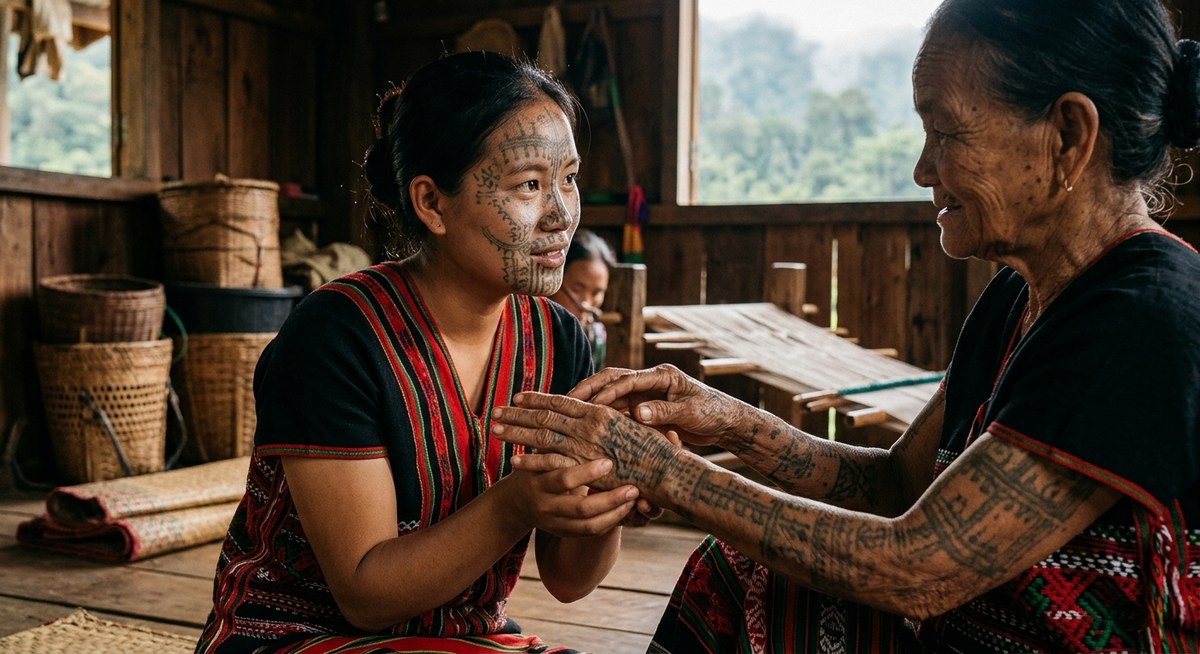
In the hills of Chin State, elderly women still wear intricate webs of ink across their faces. In the lowland villages of the Bamar majority, older men show off faded geometric patterns on their thighs and torsos. These are not just decorations. They are living records of history, spiritual belief, and ethnic identity.
For anyone curious about Myanmar traditional tattoos, the practice reveals a layer of the country that guidebooks rarely touch. It connects you to a time before mass tourism, before modern clinics with sterilized needles. It tells stories of protection against evil spirits, rites of passage into adulthood, and markers of belonging to a specific clan or village. Understanding these tattoos gives you a window into the resilience of Myanmar’s ethnic communities and the deep meaning behind the ink.
Myanmar traditional tattoos are spiritual armor, ethnic ID cards, and historical archives rolled into one. For groups like the Chin, Kachin, Bamar, and Shan, ink holds power against evil, marks courage, and preserves identity under threat. This guide explains the cultural logic behind the designs, the rituals involved, and how to approach them with respect in 2026.
The Ancient Origins of Tattooing in Myanmar
Tattooing in Myanmar is not a modern import. Archaeologists and historians trace the practice back to at least the Pyu period, between the 2nd century BCE and the 9th century CE. Early Burmese chronicles mention tattooed warriors who believed the ink made them invulnerable to blades and bullets.
The Bamar majority traditionally tattooed young men from the waist down to the knees in a style called “htoe kwin.” This involved dense geometric patterns filled with sacred verses, animals, and mythical creatures. The process was agonizing. It could take days or even weeks, and it served as a test of endurance as much as a decorative act.
But the practice goes far beyond the Bamar. Each ethnic group developed its own traditions, pigments, and spiritual beliefs around tattooing.
What Tattoos Mean Across Myanmar’s Ethnic Groups
Chin Facial Tattoos: Beauty, Identity, and a Vanishing Practice
The most famous form of Myanmar traditional tattoos are the facial tattoos of Chin women. In the remote mountains of Chin State, girls once received their first facial ink around the age of 14 or 15. The design varied by village. Some patterns covered the entire face with a web of lines. Others left the center of the face clear while darkening the forehead, cheeks, and chin.
These tattoos served multiple purposes. They made women less attractive to slave raiders from neighboring kingdoms. They also marked a girl’s transition into adulthood and signaled her clan membership. In a society without written records, the pattern on a woman’s face told anyone who met her exactly where she came from.
Today, the practice has almost stopped. The last generation of tattooed Chin women are elderly. Younger Chin women generally do not receive facial tattoos, partly due to influence from Christian missionaries and partly because of changing beauty standards. But the remaining women with these tattoos are living cultural treasures, and their faces hold stories that are disappearing.
Kachin Tattoos: Status and Spiritual Protection
Among the Kachin people of northern Myanmar, tattoos were primarily for men. Warriors wore designs on their arms, chests, and backs. The patterns included animal motifs like tigers and birds, as well as geometric shapes. Each tattoo had a specific protective function. A tiger on the arm gave the wearer the strength and courage of the animal. A certain pattern on the chest deflected enemy arrows.
Kachin tattooing also indicated social rank. A man who had taken a head in battle could wear a specific design. Village leaders and shamans had their own distinct markings. The ink itself came from natural sources, often soot mixed with animal fat or plant extracts.
Bamar Htoe Kwin: The Ordeal Below the Waist
For Bamar men, the “htoe kwin” was a rite of passage that tested pain tolerance and devotion to Buddhist teachings. The tattooer used a long brass needle or a sharpened bamboo stick to puncture the skin, sometimes using a hammer to drive the ink in. The process took multiple sessions over weeks. Men would sit on a low stool, legs stretched out, while the artist worked.
The designs were not random. They included sacred Pali verses, images of mythical beasts like the “galon” (a bird-like creature), and repeating geometric patterns. The belief was that these tattoos provided magical protection. A man with the right combination of verses and images could supposedly survive snake bites, sword cuts, and attacks by wild animals.
However, British colonial administrators banned Bamar men from wearing their traditional tattoos in the late 19th century. They viewed the practice as barbaric. The ban, combined with urbanization and the spread of Western clothing, caused thigh tattoos to fade from Bamar culture. Today, you see them mostly on older men in rural areas.
Shan and Kayah Traditions
In Shan State, men and sometimes women received small protective tattoos on the wrist, chest, or back. These were often Buddhist symbols or astrological signs meant to bring good luck and ward off misfortune. The Shan used a lighter hand than the Bamar, and the designs were less extensive.
Among the Kayah (Karenni) people, tattooing was common for both men and women. Men wore patterns on the arms and chest to signify bravery. Women had simpler designs on the arms and hands. Kayah tattoos often featured dots and lines that represented the wearer’s family lineage.
How a Traditional Tattoo Session Worked in the Past
Understanding the process helps you appreciate why these tattoos meant so much. Here is how a traditional session typically unfolded, step by step.
-
Preparation and purification. The tattooer would pray and make offerings to spirits or Buddha statues. The client might also fast or bathe in holy water. This cleansing prepared both the body and the spirit for the ink.
-
Design marking. The artist sketched the pattern on the skin using soot or charcoal. In some groups, they used a stencil made from thin paper or leather. The client had to remain still and silent through this phase.
-
Ink application. The artist dipped a long needle or a bamboo stick into a mixture of carbon black and water or animal fat. They punctured the skin repeatedly, driving the ink deep. For large areas, they used a small hammer to tap the needle in. The pain was intense. Many men fainted or needed to take breaks.
-
Aftercare. The tattooed area was left uncovered to dry. The client applied herbal pastes made from turmeric or crushed leaves to reduce swelling and prevent infection. They avoided washing the area for several days. Healing could take weeks, and the patterns would fade slightly as the skin recovered.
-
Spiritual blessing. Once the tattoo healed, a ceremony often took place. The tattooer recited prayers or chanted sacred words to activate the tattoo’s protective power. In some traditions, the client had to make offerings to the spirits annually to maintain the tattoo’s potency.
Ingredients and Tools: The Natural Palette
Myanmar traditional tattoos used only natural materials. The key ingredients and tools varied by region but shared common principles.
| Element | Traditional Source | Purpose |
|---|---|---|
| Black pigment | Soot from sesame oil lamps or charred rice husks | Creates dark, permanent ink |
| Binding agent | Animal fat or plant sap | Helps the pigment stay suspended and absorb into skin |
| Needle | Brass rod, sharpened bamboo, or thorn | Punctures the skin to deposit ink |
| Hammer | Small wooden mallet | Taps the needle into deep layers of the dermis |
| Aftercare paste | Turmeric, crushed neem leaves, or honey | Reduces swelling, prevents infection, promotes healing |
The simplicity of these materials is remarkable. Yet the results lasted a lifetime, and the spiritual power of the tattoos was taken very seriously.
The Spiritual Dimension: More Than Decoration
To understand Myanmar traditional tattoos, you must understand the belief systems that animate them. The Bamar and many other groups practice a blend of Buddhism and indigenous spirit worship known as “nat” belief. Tattoos fit into both frameworks.
Buddhist verses known as “gatha” were believed to carry protective energy when inscribed on the body. The letters themselves were sacred. A tattoo of a certain gatha could deflect harm, attract luck, or even render the wearer invisible to enemies.
The nat spirits also played a role. Some tattoo designs depicted specific spirits known for their power. A man with a tattoo of the spirit “U Min Gyaw” on his chest was thought to be invulnerable to bullets. Women in Chin State wore patterns that pleased the nature spirits of their village, ensuring good harvests and healthy children.
“The tattoo is not just on the skin. It enters the bones and stays in the spirit. A man without tattoos is like a house without a fence. The spirits can enter from any side.” — U Aung Kyaw, a retired tattoo artist from Mandalay, interviewed in 2024.
This quote captures the protective role of tattoos in traditional Myanmar society. They were not optional accessories. They were essential gear for navigating a world filled with visible and invisible dangers.
The Revival and Modern Shift
In the past decade, a new generation of tattoo artists in Yangon and Mandalay has started reviving traditional designs. But the context has changed. Young people get these tattoos for cultural pride, fashion, or connection to heritage. They often use modern machines and sterilized needles. The designs are adapted for arms, shoulders, and backs rather than thighs and faces.
This revival has sparked debate. Some elders feel the spiritual meaning is lost when a tattoo is done in a parlor without proper rituals. Others welcome the renewed interest as a way to keep traditional art alive. The Chin facial tattoo, however, remains culturally sensitive. Most Chin people today oppose the practice on young women, viewing it as harmful.
If you are a traveler or journalist wanting to document or even get a Myanmar traditional tattoo in 2026, here are a few guidelines to follow.
- Research the artist. Some studios in Yangon, like Yar Pyae Tattoo and True Art Tattoo, offer traditional-inspired designs. Ask about the artist’s background and whether they understand the cultural meanings.
- Choose designs respectfully. Avoid sacred Buddhist verses or spirit depictions unless you fully understand their significance. A tourist wearing a protective gatha without belief can be seen as cheapening the tradition.
- Do not request Chin facial tattoos. Getting a facial tattoo as a foreigner mimics a tradition that is deeply tied to ethnic identity and is now rare. It can offend Chin communities.
- Consider the location. A traditional htoe kwin on the thigh is a very large commitment. Many modern artists can scale down the pattern for a forearm or calf.
Connecting Tattoos to Myanmar’s Broader Culture
These tattoos are part of a larger tapestry of traditional arts and beliefs. To understand how tattooing fits into modern Myanmar, you might also read about the living tradition of Burmese nat worship and how spirit beliefs shape daily life. Tattooing also relates to Myanmar’s endangered crafts, where master artisans fight to preserve ancient techniques.
If you are planning a trip to learn more in person, what you really need to know before traveling to Myanmar in 2026 will help you prepare. And for respectful engagement with local communities, essential tips for authentic cultural experiences in Myanmar offers practical advice.
What Modern Tattoo Enthusiasts Can Learn
If you are a tattoo artist or collector interested in Myanmar traditional tattoos, focus on the stories behind the lines. The geometry of htoe kwin is not random; it follows a logic of sacred repetition. The spacing and angles often match the proportions of Buddhist stupas. The number of dots in a pattern might correspond to auspicious numbers.
Study the regional differences. Chin facial lines are usually vertical and symmetrical, flowing from the hairline down. Kachin arm bands often show stylized animal forms. Bamar thigh tattoos use dense blocks of pattern with occasional open spaces for verses.
Respect the pain. The traditional process was intentionally brutal because it proved the wearer’s worth. While you do not need to suffer, understanding the ordeal helps you appreciate the meaning.
Preserving an Endangered Art Form
Today, the number of master tattoo artists who know the full traditional methods is very small. Most are elderly. Some have passed their knowledge to younger students, but many techniques are at risk of being lost.
Organizations in Myanmar are working to document and preserve these practices. The Open Myanmar Initiative supports projects that record oral histories and create archives of traditional designs. If you want to help, consider donating to groups that work on cultural preservation. You can also contribute by sharing accurate information and avoiding cultural appropriation.
For those interested in broader transparency and accountability in Myanmar, see how international watchdogs are monitoring Myanmar’s governance reforms in 2026. Cultural preservation is linked to political stability and the protection of ethnic rights.
Why These Tattoos Matter Now More Than Ever
Myanmar traditional tattoos are not frozen in time. They are alive in the memories of elders, in the studios of revival artists, and in the pride of ethnic communities. For a culturally curious visitor, they offer a tangible connection to values that transcend digital life.
The next time you see a photo of a tattooed Chin elder or a faded Bamar thigh pattern, you will know more than just the visual style. You will know about rites of passage, spiritual armor, and identity under pressure. You will see a practice that survived colonization, war, and modernization.
That is why Myanmar traditional tattoos are more than body art. They are a skin-deep map of the soul of a nation.