
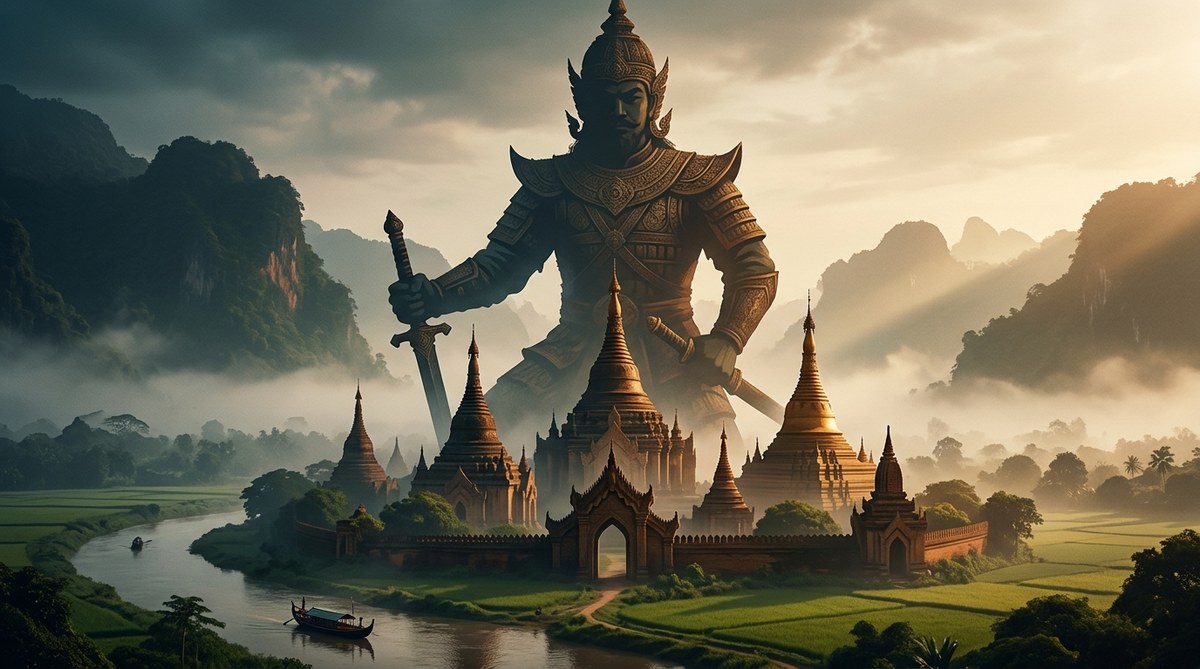
The Taungoo Empire controlled the largest territory ever assembled in mainland Southeast Asia, yet most people have never even heard of it. While students can name the Mongols, the Ottomans, or the Mughals, this Burmese dynasty that once stretched from the borders of India to the gates of Cambodia sits in near anonymity. The empire rose from a small city state to dominate the region for over two centuries, leaving behind a legacy that shaped modern Myanmar in ways that still echo today.
The Taungoo Empire was a major Southeast Asian power that unified Myanmar, expanded its borders further than any previous kingdom, and introduced military reforms that changed regional warfare. Despite its significance, it remains overshadowed by better known empires like Bagan and Konbaung. Understanding the Taungoo Empire provides crucial context for Myanmar’s modern identity, ethnic relations, and geopolitical challenges.
The Rise of a Giant
The story of the Taungoo Empire begins in the 15th century, when the Ava Kingdom was collapsing. Small states fought for control, and one of those states was Taungoo, a modest walled town in central Myanmar. The founder, King Mingyi Nyo, declared independence in 1510 and began a slow but steady expansion. But the real transformation came under his grandson, King Tabinshwehti.
Tabinshwehti was only 15 when he inherited the throne. He was young, ambitious, and hungry for conquest. By 1539, he had captured the Mon stronghold of Bago (then called Pegu) and moved his capital there. He then pushed south, taking the Irrawaddy Delta and opening trade routes to the Indian Ocean. His reign set the stage for the empire’s golden age.
His successor, Bayinnaung, is often called the “Napoleon of Burma.” He took the empire to its peak. Between 1550 and 1581, Bayinnaung conquered vast territories: Manipur, Shan states, Lan Na (modern northern Thailand), Lan Xang (Laos), and Ayutthaya (Siam). At its height, the Taungoo Empire controlled an area larger than present day Myanmar, Thailand, Laos, and parts of China and India combined.
Why Is the Taungoo Empire So Overlooked?
Several reasons explain the empire’s relative obscurity. Here are the main ones:
- The shadow of Bagan. The Pagan (Bagan) Empire, with its thousands of temples, dominates Myanmar’s historical imagination. Tourists flock to Bagan, and its legacy overshadows later dynasties.
- Lack of grand monuments. Unlike Bagan’s temples or Konbaung’s Mandalay Palace, the Taungoo capitals (first Pegu, later Ava) left fewer surviving structures. Many wooden buildings rotted away; stone inscriptions are rare.
- No Hollywood treatment. Western popular history focuses on China, Japan, India, and the Angkor Wat civilization. Southeast Asian empires outside of Vietnam and Thailand get almost no screen time.
- Colonial historiography. British colonial historians often dismissed Burmese empires as brutal and chaotic, preferring to highlight the “civilizing” influence of colonial rule. The Taungoo Empire was portrayed as a footnote.
- Modern political sensitivities. Some aspects of the empire involved ethnic conquests and forced resettlements. Contemporary ethnic tensions in Myanmar make this history uncomfortable to teach.
Despite these factors, the Taungoo Empire’s influence on Myanmar’s culture, religion, and politics is undeniable. It was during this period that Theravada Buddhism became deeply entrenched across the region, and the Burmese language spread to areas that previously spoke Mon, Shan, or Thai.
Military Might and Elephant Warfare
The Taungoo army was a formidable machine. At its core were war elephants, each carrying three or four archers and a mahout. Cavalry and infantry supported the elephants. Bayinnaung raised armies of 100,000 to 300,000 men by conscripting peasants from conquered territories.
One key innovation was the use of firearms. The Portuguese had arrived in Southeast Asia in the early 1500s, and Taungoo kings hired Portuguese mercenaries to train their troops in musket and cannon tactics. This gave them a decisive edge over enemies who still relied mostly on traditional weapons.
A typical Taungoo campaign looked like this:
- Step 1: Secure the home base. Before marching, the king would ensure that key cities like Bago and Prome were fortified and loyal.
- Step 2: Gather intelligence. Spies would report on the enemy’s numbers, fortifications, and supply routes.
- Step 3: Move during the dry season. November to February was the fighting season. Rains made roads impassable.
- Step 4: Use siege warfare. Cannons and muskets could breach wooden walls; elephant charges broke gates.
- Step 5: Resettle defeated populations. Captured people were moved to the heartland to boost agriculture and labor.
This last point was controversial. Bayinnaung resettled tens of thousands of people from Ayutthaya and Lan Na into the Irrawaddy Valley. It strengthened the empire’s economy but also sowed resentments that later led to rebellion.
Administration and Culture
The Taungoo Empire was not just about war. It also developed an administrative system that later dynasties copied. The empire was divided into provinces ruled by royal princes. A system of tribute bound conquered kingdoms to the center. The king was seen as a “Cakkavatti” (universal monarch) in Buddhist tradition, which legitimized his rule.
The empire also fostered a rich cultural life. The Burmese chronicle “Hmannan Yazawin” (the Glass Palace Chronicle) was compiled centuries later, but its roots lie in Taungoo period records. Literature, dance, and music flourished. The tradition of Burmese marionette puppetry (yoke the) likely developed during this time.
Buddhism was a unifying force. Kings built pagodas, sponsored monasteries, and supported the Sangha (monastic community). The Shwedagon Pagoda in modern Yangon was expanded and gilded during the Taungoo period. Religious harmony was not perfect, though. The empire’s conquest of Mon and Shan regions sometimes involved destruction of local Buddhist sites, a fact that still causes friction in Myanmar’s ethnic memory.
The Fall: Overextension and Revolt
After Bayinnaung’s death in 1581, the empire began to crack. His successor, Nanda Bayin, lacked his father’s military genius. Rebellions broke out across the conquered territories. Siam declared independence in 1584 after defeating a Taungoo invasion. Lan Na broke away. The Shan states reasserted control.
By 1599, the empire had fractured. Pegu was sacked by the combined forces of Arakan and rebel Mon armies. The capital moved back to Ava, but the era of dominance was over. A period of fragmentation followed until the Konbaung Dynasty (a later Burmese empire) reunited Myanmar in the 18th century.
What lessons can modern readers draw from this collapse? The table below compares the Taungoo Empire’s strengths and weaknesses.
| Strength | Weakness | Impact |
|---|---|---|
| Superior firearms and military tactics | Overreliance on conquered manpower | Rebellions drained resources |
| Well organized tribute system | Local governors often disloyal | Provinces broke away easily |
| Buddhist legitimacy | Ethnic and religious tensions | Conquered peoples resented rule |
| Strong trade connections | Capital moved too often | Administrative instability |
The empire’s rapid expansion made it unsustainable. It conquered faster than it could integrate. Sound familiar? Students of the Roman or Mongol empires will recognize the pattern.
Why It Matters Today
Understanding the Taungoo Empire helps explain modern Myanmar. The ethnic groups that the empire conquered (Shan, Mon, Karen, etc.) still assert their distinct identities. The memory of forced resettlements and cultural suppression lingers. At the same time, the empire’s legacy of Theravada Buddhism and Burmese language dominance shapes national unity.
For travelers, visiting sites from the Taungoo period offers a quieter, more contemplative experience than the crowds of Bagan. Places like the ancient city of Bago, with its Kanbawzathadi Palace ruins, or the Inwa (Ava) archaeological zone, let you walk through history without the tourist buses.
“The Taungoo Empire is the missing link in Myanmar’s story. If you only study Bagan and Konbaung, you miss the century when Burma truly acted as a regional superpower. Learning about Taungoo gives you the full picture.” (Dr. Maung Htin, historian at the University of Yangon, personal interview, January 2026)
If you are planning a trip to Myanmar in 2026, consider adding a day in Bago to your itinerary. You can visit the Shwemawdaw Pagoda (taller than Shwedagon) and the remnants of the Taungoo palace. It is a powerful way to connect with a chapter of history that most tourists overlook.
For those interested in deeper context, articles like the fall of Bagan and how the Konbaung Dynasty’s military innovations changed Warfare provide additional layers. Understanding the full sweep of Myanmar’s empires helps explain both past and present.
Rediscovering a Lost Empire
The Taungoo Empire deserves a better place in our mental map of world history. It was not a minor kingdom or a footnote. For a century, it was the dominant power in mainland Southeast Asia, with an army that could march from the Bay of Bengal to the Mekong River. Its kings spoke multiple languages, employed European gunners, and built a state that combined Buddhist ideals with brutal pragmatism.
If you are a history enthusiast, a student, or a traveler curious about the places you visit, take time to learn about Taungoo. Visit Bago. Read about Bayinnaung. You will come away with a richer understanding of Myanmar, and a deeper appreciation for the empires that did not make it into the textbooks. The past is full of giants that we have forgotten. The Taungoo Empire is one of them. And now you know where to start.