
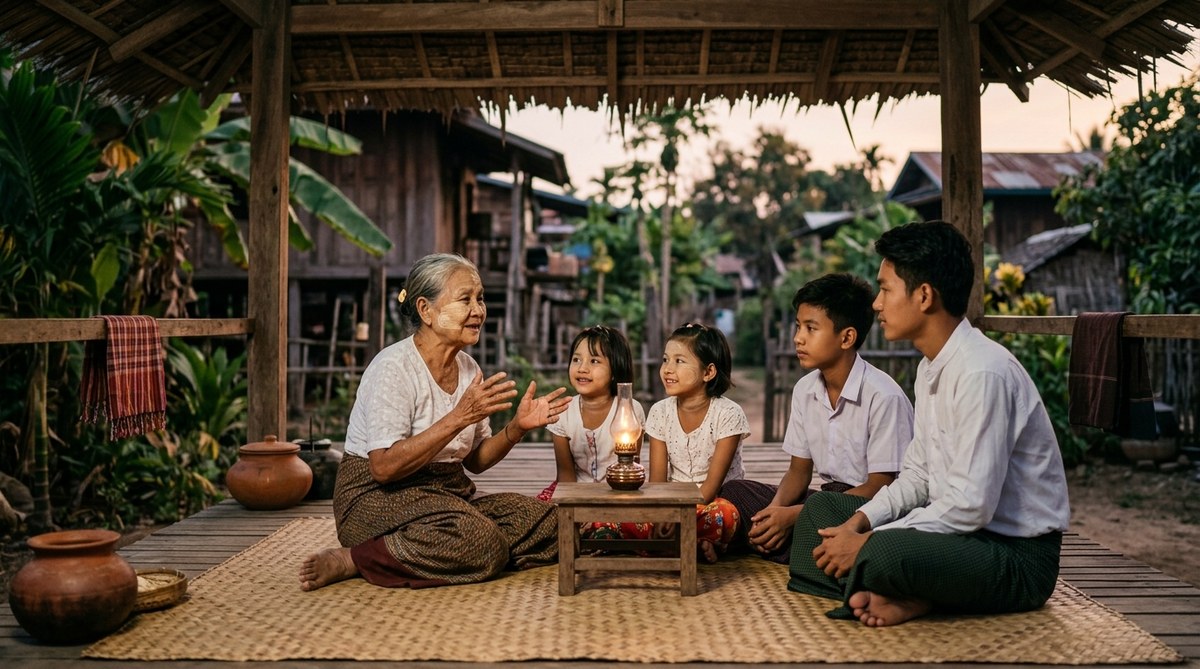
Imagine sitting cross-legged on a woven bamboo mat as the tropical dusk settles over the Irrawaddy Valley. The air smells of jasmine and thanaka paste. An elder clears her throat, and the rustling of the room stops. For the next hour, she carries everyone away on a tide of ancient words. She uses her voice to paint kingdoms, whisper moral lessons, and summon spirits. This is not just entertainment. In Myanmar, oral storytelling is the living thread that connects the present to a deep and complex past.
In Myanmar, oral storytelling is far more than folklore; it is a primary vehicle for preserving cultural identity across turbulent centuries. From monastic retellings of Buddhist Jataka tales to village elders reciting family genealogies and spirit invocations, spoken narratives transmit language, ethics, and historical memory. These shared stories anchor communities, reinforce social values, and ensure that Myanmar’s diverse ethnic voices survive and thrive for generations to come.
The Roots of Oral Tradition in Myanmar
Before digital archives and printed books, the human voice was the only library that mattered. Across the territories of modern day Myanmar, oral tradition served as the primary method for recording history, law, and spirituality. The ancient Pyu, Mon, and Bagan kingdoms all developed rich bardic cultures. Traveling storytellers and court poets memorized epic cycles that could take days to recite.
The arrival of Theravada Buddhism deepened this tradition. Monks memorized vast portions of the Tipitaka, the Buddhist canon, and used storytelling to make complex teachings accessible to laypeople. The Jataka tales, which recount the previous lives of the Buddha, became a cornerstone of Burmese moral education. Children learned about generosity, honesty, and compassion through these spoken parables long before they could read them on a page.
This oral foundation created a society that valued listening as a high form of respect. To listen to an elder was to receive wisdom. To remember a story was to honor your ancestors.
More Than Just Stories: What Oral Tradition Preserves
When you listen to a Myanmar oral storyteller, you are hearing many layers at once. The surface level is entertainment. The deeper layers carry the weight of cultural survival.
- Language preservation and regional dialects: In a country with over 135 recognized ethnic groups, spoken stories keep minority languages alive. An elder speaking in Mon, Shan, or Kayin helps maintain linguistic diversity that written texts alone cannot sustain.
- Buddhist moral frameworks: Every story offers a lesson. The clever rabbit outwits the greedy tiger. The generous king earns a better rebirth. These narratives reinforce the ethical code of the community.
- Historical memory: Village chronicles, family genealogies, and stories of migration are passed down orally. They tell people where they came from and who they belong to.
- Cultural values: Hospitality, respect for elders, and harmony with nature are woven into plots. A child who hears these stories absorbs social etiquette naturally.
- Spiritual practices: Spirit invocations and Nat worship rely heavily on spoken performance. The words themselves are believed to carry power.
The Art of Transmission: How Stories Are Passed Down
Oral storytelling is not random. It follows a structured process of transmission that ensures accuracy while allowing for natural creativity.
-
The elder as a living archive. In every community, certain individuals are recognized as the keepers of memory. They are often grandmothers, village heads, or retired monks. Younger family members sit with them during quiet evenings and special festivals. The elder tells the same stories at the same times each year, creating a rhythm of cultural learning.
-
Community festivals and pwe. The Burmese word “pwe” refers to a festival or theatrical performance. During these events, storytellers and performers act out famous tales. The audience already knows the plot. They come to experience the shared emotion and to witness the skill of the performer. This public reinforcement keeps stories fresh in the collective mind.
-
Monastic education. For centuries, the monastery was the main school in Myanmar. Young boys (and sometimes girls) learned to read Pali and Burmese by chanting texts. The act of reciting out loud was central to memory. Many monks became master storytellers themselves, able to weave sermons that captivated entire villages.
-
Apprenticeship with master artisans. Traditional puppet masters and classical dancers learn their craft through years of apprenticeship. They memorize entire performance cycles by watching and repeating. The body, not just the voice, becomes a tool for preserving the narrative.
“When an elder passes away, it is as if a library has burned down,” explains Dr. Khin Mya Zin, a cultural historian based in Yangon. “Their stories hold the memory of our people. Recording and respecting oral tradition is not about freezing the past. It is about giving the future a foundation.”
Key Techniques in Myanmar Oral Storytelling
Myanmar storytellers use specific methods to make their words memorable and emotionally powerful. These techniques are not accidents. They are refined practices passed down across generations.
| Technique | Purpose in Storytelling | Cultural Example |
|---|---|---|
| Rhythmic recitation | Aids memorization and adds emotional gravity. | Monks chanting paritta verses; a zawgyi telling a Jataka tale with a steady beat. |
| Call and response | Builds community engagement and shared experience. | Audience participation during anyein pwe comedic skits or festival chants. |
| Melodic intonation | Separates different story parts and expresses mood. | Saung gauk (Burmese harp) accompaniment during historical ballads or love stories. |
| Repetition of motifs | Reinforces key moral lessons and symbolic meaning. | Recurring phrases in folktales about clever rabbits or foolish kings. |
| Direct address | Makes the listener feel personally involved. | The storyteller pauses and asks, “What would you have done?” directly to the audience. |
These techniques transform a simple story into an event. The listener does not just hear the tale. They feel it, respond to it, and remember it.
Modern Challenges and the Fight to Preserve Oral Traditions
The world has changed. Smartphones and social media now fill the evening hours that were once reserved for storytelling. Younger generations migrate to cities or abroad, leaving villages with fewer elders to share their knowledge. The convenience of digital entertainment threatens to silence the voices of tradition.
Yet, oral storytelling in Myanmar is proving to be surprisingly resilient. Communities are finding ways to adapt. Local NGOs and cultural groups have started recording elders on video and audio. These recordings are archived in community centers and shared through messaging apps. Diaspora communities are using these digital tools to teach their American born children the stories of their homeland.
Political change and conflict have also given oral storytelling a new urgency. When official histories are contested, the stories told by ordinary people become powerful acts of testimony. They preserve perspectives that might otherwise be erased. In this sense, oral tradition is not just a relic of the past. It is a vital tool for civic resilience.
Listening to the Voice of Myanmar
Myanmar’s oral storytelling is a practice of endurance. It has survived colonization, economic isolation, and rapid modernization. For the cultural enthusiast or researcher, engaging with these traditions offers a direct line to the soul of the nation.
To learn about Myanmar is to listen to its stories. In 2026, those stories are still being told. They are spoken in village homes, in monastery halls, and across digital channels reaching global audiences. They wait for listeners who understand their value. The next time you have the chance to hear a Myanmar elder speak, lean in. You are not just hearing a tale. You are witnessing a living thread of identity being passed from one hand to the next.