
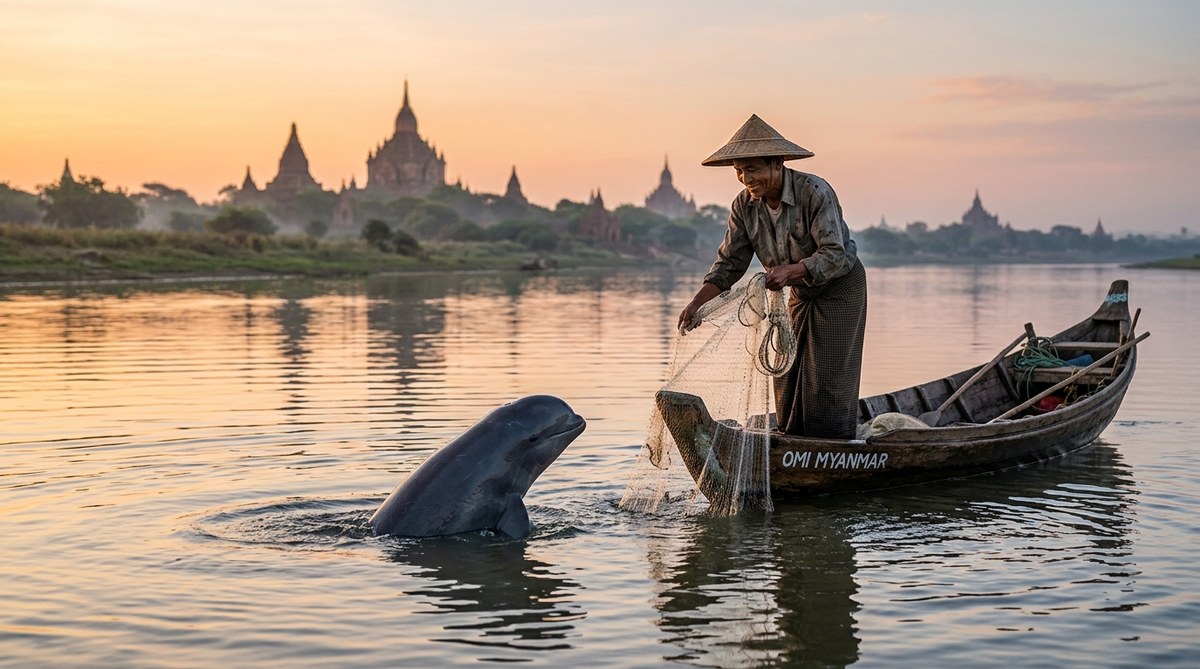
On the muddy brown surface of the Ayeyarwady River, a rounded gray head breaks the water. The Irrawaddy dolphin surfaces with a soft exhale, and the fishermen sitting in their narrow wooden boats do not cast their nets. They wait. They have always waited. This moment, repeated for generations, is not about fishing. It is about a pact between humans and animals that has shaped conservation in Myanmar for centuries. The relationship between Myanmar’s people and the Irrawaddy dolphin runs deeper than biology. It runs through folklore, daily livelihood, and spiritual belief. And right now, it offers one of the most powerful models for cultural conservation in Southeast Asia.
Myanmar’s Irrawaddy dolphins are not just a threatened species. They are cultural anchors that sustain indigenous knowledge, cooperative fishing traditions, and community-led river stewardship. Conservation efforts rooted in local beliefs have proven more resilient than top-down policies. Understanding this cultural dimension is vital for researchers, travelers, and advocates working at the intersection of wildlife protection and heritage preservation in Myanmar.
The Irrawaddy Dolphin: A Living Bridge Between Nature and Culture
The Irrawaddy dolphin (Orcaella brevirostris) is not a true river dolphin, though it spends much of its life in freshwater. It inhabits three major rivers in Asia, but the strongest remaining population lives in the Ayeyarwady River of Myanmar. These dolphins are recognizable by their rounded foreheads, short beaks, and a calm, almost knowing expression.
But local communities do not see them as mere animals. They see them as partners.
For the fishermen of Mandalay Region and the upper Ayeyarwady, the Irrawaddy dolphin is known as the “fisherman’s dolphin.” It helps them. When dolphins herd fish toward the shore or into shallow water, fishermen cast their nets. The dolphins then feed on the fish that escape. It is a cooperative system called “catch and share.” No one trained the dolphins to do this. No one trained the fishermen to wait. The practice emerged naturally over centuries and has been passed down through oral tradition.
This relationship is the heart of Myanmar Irrawaddy dolphins cultural conservation. It is not a program designed by an international NGO. It is a living tradition.
How Ancient Beliefs Shaped Dolphin Protection
Myanmar’s spiritual landscape is layered. The majority of the population practices Theravada Buddhism, but older animist beliefs remain strong, especially in rural and ethnic minority communities. The Irrawaddy dolphin sits at the intersection of these traditions.
In many river communities, dolphins are considered nat messengers. The nat are spirits that inhabit natural features like rivers, mountains, and trees. People believe that harming a dolphin brings bad luck, illness, or the anger of the river spirit. This belief alone has done more to protect dolphins than any formal regulation could.
Local elders tell stories of dolphins guiding lost boats to shore or rescuing drowning children. These stories are not treated as myths. They are treated as family history. When a child hears that their grandfather was saved by a dolphin, they grow up with a sense of obligation toward the species.
This cultural foundation created a safety net for the dolphins long before the species was listed as endangered by the IUCN. It also explains why community-led conservation in this region looks different from other parts of the world.
The Role of Fishermen in Conservation
The most effective conservation work happening in the Ayeyarwady today is led by the people who share the river with the dolphins. Fishermen have developed their own rules for coexistence. These rules are not written down. They are enforced by social pressure and mutual respect.
Here is how the cooperative fishing process works in practice:
- A group of fishermen spots a pod of Irrawaddy dolphins. They do not chase them or circle them. They approach slowly.
- The dolphins begin to herd fish toward the riverbank. The fishermen watch the movement of the dolphins, not the fish.
- When the dolphins surface in a specific pattern, the fishermen cast their nets in a coordinated way. They leave an opening for the dolphins to catch fish on the other side.
- Once the fishing is done, the fishermen share a portion of their catch with the dolphins. This is not a myth. They intentionally leave fish behind for the dolphins to eat.
- If a dolphin becomes entangled in a net, the fishermen stop everything to free it. In some villages, there are designated people trained in dolphin rescue.
This system works because it is based on trust, not enforcement. Fishermen who break the unwritten rules face shaming from their community. There is no need for a government patrol boat.
Key Cultural Practices That Protect Dolphins
To understand how cultural conservation functions in Myanmar, it helps to compare traditional practices with modern approaches. The table below shows what works and what does not.
| Practice | Cultural Approach | Common Mistake |
|---|---|---|
| Fishing boundaries | Fishermen avoid certain areas during dolphin calving season out of respect for the river spirit | Outsiders impose no-fishing zones without consulting locals, leading to resentment |
| Dolphin rescue | Villagers train their own rescue teams using traditional boat skills | NGOs bring in external trainers who do not understand local river conditions |
| Reporting violations | Community elders mediate disputes and enforce fines in the form of food offerings to the monastery | Hotlines and reporting apps fail because people do not trust anonymous systems |
| Education about dolphins | Grandparents tell stories during village gatherings that teach children to protect dolphins | School programs use foreign materials that feel disconnected from daily life |
| Tourism management | Villagers set their own rules for how close boats can get to dolphins | Tour companies run unregulated dolphin-watching trips that stress the animals |
The pattern is clear. When conservation respects local culture, it sticks. When it ignores culture, it fails. This is the central lesson of Myanmar Irrawaddy dolphins cultural conservation.
What Modern Conservation Can Learn from Myanmar’s Traditions
Conservation scientists often look for scalable solutions. They want models that can be replicated across borders. But the Irrawaddy dolphin example suggests something different. The most durable conservation is hyper-local.
“We tried to impose Western conservation models on Ayeyarwady communities for years. They didn’t work because they treated the river as a resource to be managed, not a relative to be respected. When we finally listened to the fishermen, they told us that the dolphins have always been part of their family. That changed everything.” — Dr. Myint Zaw, Myanmar conservation biologist and former UNESCO consultant
This quote captures the shift that needs to happen across the conservation world. The fishermen did not need to be taught why dolphins matter. They already knew. What they needed was support for their own systems.
In 2026, several grassroots initiatives are building on this insight. Local organizations are helping fishermen document their traditional knowledge. They are creating community-managed dolphin sanctuaries that align with existing fishing patterns. They are also training young people in eco-tourism so that dolphin protection becomes an economic asset rather than a burden.
For environmental researchers and cultural heritage enthusiasts, this case study offers a blueprint. When you lead with culture, conservation follows.
Practical Ways to Support Irrawaddy Dolphin Conservation
If you are an eco-traveler planning a trip to Myanmar, or a diaspora member looking to support conservation from abroad, there are real actions you can take. These go beyond donations.
- Choose community-based tourism operators. Look for tour companies that employ local fishermen as guides and donate a portion of fees to village-led patrols. Avoid operators that chase dolphins or allow guests to touch them.
- Share the stories, not just the facts. When you post about Irrawaddy dolphins on social media, include details about the cultural relationship. This helps outsiders understand why conservation in Myanmar is different.
- Support organizations that fund local leadership. Many international NGOs still control the budgets. Look for groups that give decision-making power to village councils and fishermen’s cooperatives.
- Learn the local etiquette around dolphins. Never throw food to them. Do not approach a pod with a motor running. Respect the space that local communities have designated as protected.
- If you are a researcher, partner with local universities. Myanmar has talented biologists and anthropologists who understand the cultural context. Collaborative research is more trusted and more accurate.
For more context on how local communities are shaping Myanmar’s future, read about 5 grassroots transparency initiatives reshaping local governance in Myanmar. These efforts share the same DNA of community leadership.
The Future of Irrawaddy Dolphin Conservation in Myanmar
The threats facing Irrawaddy dolphins are real. Bycatch in gillnets, habitat degradation from gold mining, and boat traffic have reduced the population to around 60 individuals in the core Ayeyarwady zone. But the cultural will to protect them remains strong.
In 2025 and 2026, new community-led monitoring programs have begun documenting dolphin sightings using mobile phones and shared messaging groups. Fishermen are the primary data collectors. They know the river better than anyone, and they care about the results because the dolphins are part of their identity.
The Myanmar government has also designated a protected area for the dolphins, but enforcement is weak. What makes the protection real is the daily commitment of the people who live on the river. They do not need a law to tell them to save the dolphins. They have been doing it for centuries.
For travelers interested in experiencing this relationship firsthand, the best time to visit the dolphin areas is between November and April, when the river is calm and the dolphins are more visible. Always go with a local guide who can explain the cultural significance. Do not treat the experience as a wildlife safari. Treat it as a visit to a community where humans and dolphins have learned to live together.
How the Irrawaddy Dolphin Story Connects to Broader Myanmar Culture
The same cultural values that protect dolphins also shape other aspects of Myanmar life. The emphasis on community, respect for elders, and spiritual connection to nature runs through everything from festivals to food.
If you want to understand this deeper cultural fabric, consider exploring related traditions. The living tradition of Burmese nat worship in modern Myanmar provides context for the spiritual beliefs that protect the dolphins. Similarly, Myanmar’s endangered crafts: master artisans fighting to preserve ancient techniques shows how the same communities are protecting other forms of heritage.
The dolphin story is not an isolated case. It is a window into how Myanmar’s people approach the world. They conserve what they love. They love what they know. And they know what has been part of their lives for generations.
A Path Forward for Cultural Conservation
The Irrawaddy dolphin will not survive on scientific reports and international funding alone. It will survive because a fisherman in a small wooden boat decides to wait before casting his net. It will survive because a grandmother tells her grandson that the dolphin saved her uncle during a storm. It will survive because the people of the Ayeyarwady River see the dolphin as family.
For environmental researchers, the lesson is to listen before prescribing. For cultural heritage enthusiasts, the lesson is to recognize that conservation is itself a cultural practice. For eco-travelers, the lesson is to visit with humility and respect.
If you are planning a trip to Myanmar in 2026, consider making the Irrawaddy dolphin part of your journey. Read what you really need to know before traveling to Myanmar in 2026 for practical advice. And remember that the best way to support conservation is to learn from the people who have been doing it all along.
The dolphins surface. The fishermen wait. The river flows. And a tradition older than any law continues to protect one of Myanmar’s most precious living treasures.