
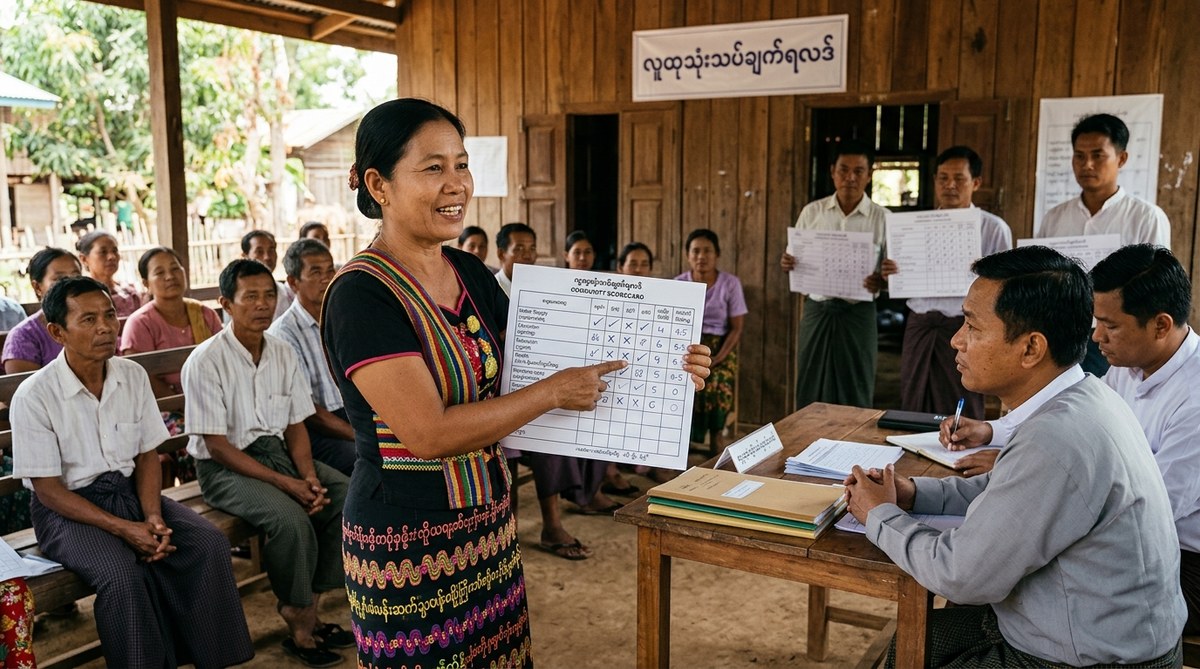
In a small township on the edge of the Ayeyarwady Delta, a group of farmers sat under a tin roof one humid afternoon. They held handmade sheets of paper covered in Burmese script. On those sheets, they had given their local township officer a score of 58 out of 100. They marked him down for slow responses to flood damage reports. They noted he had not visited their village in over six months. They also gave him credit for approving a new bridge repair fund. That piece of paper, a community scorecard, became the center of a public meeting. The officer sat across from them and listened. He promised to improve. And, remarkably, he did.
Community scorecards are one of the most effective non-state tools for holding local officials accountable in Myanmar. They work because they combine citizen-generated data with direct dialogue. In restrictive political environments, these scorecards bypass broken complaint systems and create a public record of performance. They empower communities to measure what matters to them, from road repairs to healthcare access, and give officials a clear incentive to respond.
How a Simple Scorecard Becomes a Tool for Power
Community scorecards are not complicated. That is their secret. A group of residents agrees on a set of indicators for a local service. They might score a health clinic on wait times, medicine availability, and staff politeness. They might score a township administrator on response speed, transparency in budgeting, and fairness in dispute resolution.
The process is deeply participatory. It does not rely on government data. It relies on lived experience. That is what makes it so hard for officials to dismiss. When a hundred families all say the same thing about a broken water pump, the data becomes undeniable.
Here is how a typical cycle works in Myanmar today:
- Community planning session — Residents gather to decide which public services matter most to them. They choose indicators that are specific and measurable.
- Data collection — Trained volunteers interview households using a standardized form. They collect scores and written comments.
- Scorecard compilation — Results are tallied and turned into a simple report. Visual charts help non-literate community members understand the findings.
- Interface meeting — Residents and officials sit together. A facilitator presents the scores. Officials respond. Promises are recorded.
- Follow up and re-scoring — After three to six months, the community scores again. Progress is tracked publicly.
The beauty of this method is its flexibility. In Myanmar’s current political climate, where formal oversight mechanisms have weakened, community scorecards fill a vacuum. They are not a protest. They are a structured conversation. And that structure protects both sides.
What Makes Myanmar a Unique Test Case for Scorecards
Myanmar presents a distinctive challenge for social accountability tools. The country has a long history of top-down governance. Local officials often see themselves as administrators of policy, not servants of the public. Trust between communities and authorities is fragile.
Yet Myanmar also has a strong tradition of community self-help. Villages routinely organize their own infrastructure projects, school repairs, and health funds. This culture of mutual aid provides a natural foundation for scorecards. People are already used to assessing their own needs. The scorecard simply gives them a formal way to communicate those assessments upward.
A 2025 pilot program in three townships showed measurable results. In one township, the average score for road maintenance rose from 42 to 67 over nine months. In another, complaints about medicine shortages at rural health centers dropped by half after the scorecard process identified specific procurement delays.
These numbers matter. But the real impact is harder to measure. It shows up in the way a village leader now greets the township officer as an equal. It shows up in the officer’s willingness to share budget documents without being asked.
Common Mistakes That Undermine Scorecard Efforts
Not every scorecard initiative succeeds. Some fail because of poor design. Others fail because of political backlash. The table below outlines the most common pitfalls and how to avoid them.
| Mistake | Why It Happens | How to Fix It |
|---|---|---|
| Indicators are too vague | Communities pick broad topics like “good governance” | Break each indicator into concrete actions, e.g., “Did the officer respond within 7 days?” |
| Data is not verified | Volunteers collect scores without cross-checking | Use a random sample of households and compare results across interviewers |
| Officials feel attacked | Scorecards are presented as accusations | Frame the meeting as a joint problem solving session, not a trial |
| No follow up mechanism | Communities score once and stop | Schedule a second scoring round before the first meeting ends |
| Language barriers | Scorecards are written in Burmese only | Translate into local ethnic languages and use visual icons for non-literate participants |
Avoiding these mistakes is critical. A failed scorecard process can damage trust even further. Communities that feel ignored after putting in the work may become more cynical than before.
The Role of Technology in a Low-Trust Environment
Myanmar’s internet landscape is uneven. Some areas have reliable mobile connectivity. Others rely on offline methods. Smart facilitators adapt to the context.
In 2026, several civic tech groups are experimenting with hybrid approaches. They use simple SMS surveys for initial data collection. Then they compile results using offline spreadsheet tools. The final report is printed and distributed physically.
“The most important piece of technology is not the app. It is the social contract between the community and the official. If that contract is broken, no amount of digital tools will fix it.” — Ma Khin, a community facilitator in Mandalay Region.
Digital tools can help with transparency. For example, a public dashboard showing scorecard trends over time makes it harder for officials to claim improvement when none exists. But the core of the method remains human. A face to face meeting where an official looks a farmer in the eye and says “I will fix this” carries more weight than any online petition.
For researchers and governance specialists, this is a key lesson. Technology should support the process, not replace it. If you are designing a scorecard program in a restrictive environment, start with the social dynamics. Add tech later.
How to Adapt Scorecards for Different Sectors
Community scorecards are not limited to local government offices. They work across multiple sectors. Here are a few examples from recent Myanmar initiatives:
- Healthcare: Patients and health workers co-designed a scorecard for maternal health services. They measured waiting times, availability of prenatal vitamins, and the cleanliness of delivery rooms. The results led to a reorganization of clinic hours.
- Education: Parents scored primary schools on teacher attendance, textbook availability, and the condition of latrines. One school used the feedback to start a parent teacher association for the first time.
- Infrastructure: Villagers scored the quality of road repairs funded by a township development fund. Their data showed that one contractor consistently used substandard materials. The contract was not renewed.
- Social welfare: Beneficiaries of a cash transfer program scored the distribution process. They identified that elderly recipients were being asked to travel too far to collect payments. The distribution point was moved closer.
Each sector requires a different set of indicators. But the core method stays the same. Ask the people who use the service. Let them define what good looks like. Then hold the provider accountable to that standard.
Why This Approach Matters for Accountability Research
For a researcher or governance specialist, Myanmar offers a living laboratory. The country’s political restrictions mean that traditional accountability mechanisms like elections and independent media are limited. Non-state tools like community scorecards become the primary way citizens can influence public services.
This has implications beyond Myanmar. The lessons learned here can apply to other restrictive environments. Whether you study governance in Southeast Asia, the Middle East, or Central Asia, the same principles hold. Citizens need credible, structured ways to communicate their needs to officials. Scorecards provide that structure.
The evidence from Myanmar shows that even in difficult conditions, accountability can be built from the ground up. It does not require a perfect legal framework. It requires persistence, clear communication, and a willingness to sit across a table and talk.
Building a Network of Citizen Monitors
One of the most promising developments in 2026 is the emergence of regional scorecard networks. Groups from different townships share their results and compare patterns. This creates a broader picture of governance quality across districts.
For example, when three neighboring townships all showed low scores for agricultural extension services, the combined data gave civil society organizations a stronger case to present to regional authorities. The result was a joint training program for extension officers.
These networks also provide peer support for facilitators. Running a scorecard process is emotionally demanding. Facilitators face pressure from both communities and officials. Having a network to share strategies and vent frustrations makes the work sustainable.
If you are a journalist or researcher looking for data on local governance in Myanmar, these networks are a goldmine. They produce raw, citizen generated data that is often more honest than official statistics.
What to Watch for in Future Scorecard Programs
The next few years will test the resilience of community scorecards in Myanmar. As the political situation evolves, so will the risks and opportunities. Here are three trends to follow:
- Integration with open data platforms: Some groups are experimenting with publishing scorecard results on public websites. This increases transparency but also increases risk. Officials who feel publicly shamed may retaliate.
- Expansion to ethnic armed group controlled areas: Scorecards are beginning to be used in areas outside central government control. This requires adapting the method to different governance structures and cultural norms.
- Donor pressure for scale: International funders want to see large numbers. But scaling too fast can dilute quality. The most effective programs grow slowly, training new facilitators carefully before expanding.
For anyone working in this space, the advice is simple. Prioritize quality over quantity. A single well run scorecard process in one village can create a model that others copy. A rushed rollout across twenty townships can produce meaningless data that nobody trusts.
The Quiet Revolution of Everyday Accountability
Community scorecards will not topple governments. They will not make national headlines. But they change something fundamental. They change the relationship between a citizen and the person who is supposed to serve them.
In a village in Sagaing Region, an elderly woman told a facilitator after her first scorecard meeting: “I never thought I could tell the officer that he was late. I thought that was disrespectful. Now I know. He works for me.”
That shift in perception is the real achievement. It is slow, quiet, and hard to measure. But it is real. And it is spreading.
If you are a researcher, journalist, or governance specialist, the best way to understand this tool is to see it in action. Visit a community scorecard meeting if you can. Talk to the facilitators. Read the raw data. You will find a story that official reports cannot tell.
For more on how citizens are reshaping governance from the bottom up, read our piece on 5 Grassroots Transparency Initiatives Reshaping Local Governance in Myanmar. And if you are working on a similar project, we would love to hear how community scorecards are evolving in your context. The method is simple. The impact is profound. The work continues.