
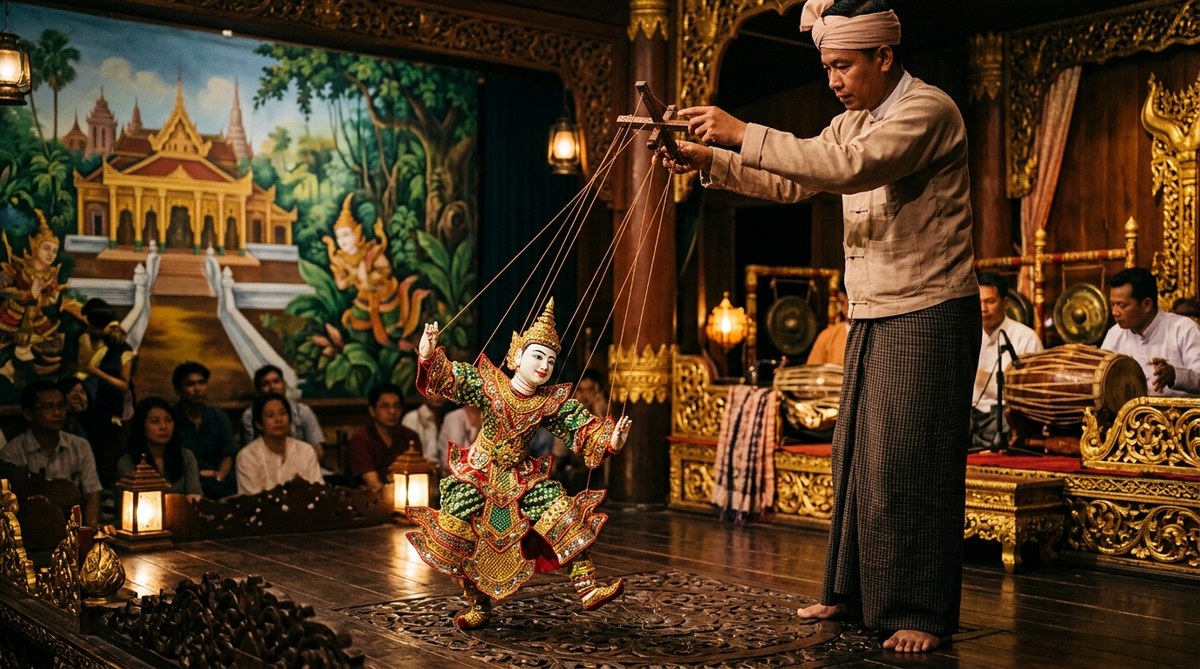
Picture a stage draped in deep red velvet. Oil lamps flicker. A small orchestra strikes up a lively tune. Then, from the shadows, a wooden figure glides into view. It moves with such grace that you almost forget it is not alive. That is the magic of yoke thay, the traditional marionette theater of Myanmar.
Myanmar marionette puppetry, known as yoke thay, is a centuries old art form that brings ancient Buddhist legends, royal chronicles, and folk tales to life through intricate string puppets. This guide covers its royal origins, the painstaking craft of carving and stringing puppets, the key characters, the unique performance techniques, and how to experience this living tradition today. Understanding yoke thay offers a window into Myanmar’s cultural soul.
A Royal Art Born in the Court
Yoke thay (literally “small figures” in Burmese) did not start in village squares. It began in the royal courts of the Konbaung dynasty. The earliest records point to the late 18th century, when puppetry became a favorite entertainment for kings and nobles. By the 19th century, it had grown into a sophisticated art form with strict conventions.
Puppet troupes received royal patronage. They performed at festivals, coronations, and religious ceremonies. The art was so highly regarded that master puppeteers held a social rank comparable to court musicians and dancers.
When the British annexed Upper Burma in 1885, the royal court disappeared. But the puppeteers did not vanish. They took their craft to the towns and villages. Yoke thay adapted. It became a popular entertainment for ordinary people. It also preserved many of the stories and movements that would otherwise have been lost.
What Makes a Burmese Marionette Different
If you have seen European marionettes, you will notice the difference immediately. A typical Burmese puppet has far more strings. A major character can have up to 18 or 20 strings, allowing for incredibly subtle movements. The strings control not just limbs but also fingers, eyebrows, lips, and even the eyelids. This level of detail creates a realism that is startling.
| Feature | Burmese Marionette (Yoke Thay) | Typical Western Marionette |
|---|---|---|
| String count | 10 to 20 strings | 8 to 10 strings |
| Material | Jackfruit wood, often with lacquer and gold leaf | Pine, balsa, or resin |
| Joints | Full body articulation including fingers, eyelids, jaw | Usually limbs and neck only |
| Movement style | Fluid, dance based, with precise hand gestures | Broad, mechanical, walk cycle driven |
| Character roles | Fixed: prince, princess, minister, ogre, nat, etc. | Customizable, no fixed archetypes |
The puppets themselves are carved from light, durable wood. Jackfruit wood is the traditional choice. Carvers work with small knives and chisels to shape the head, torso, arms, and legs separately. Then they assemble the pieces with joints. Finally, they paint and lacquer the figure. Gold leaf is often added for royal characters.
The Characters That Tell the Stories
Yoke thay has a fixed set of character types. Each has a distinct appearance, movement style, and voice. The audience recognizes them instantly.
- Prince and Princess: The romantic leads. They wear elaborate costumes and move with slow, elegant gestures.
- Minister: The wise advisor. He walks with a dignified bounce and uses measured hand movements.
- Ogre or Demon: The villain. Big, red faced, and aggressive. His movements are jerky and threatening.
- Jester: The comic relief. He makes silly faces, stumbles, and interacts with the audience.
- Nat (spirit): A supernatural being. Often dances with spinning movements.
- Animals: Horses, elephants, monkeys, and mythical creatures like the chinthe (lion like guardian).
The stories draw from the Jataka tales (previous lives of the Buddha), episodes from the Ramayana (called Yama Zatdaw in Myanmar), and local folk tales. Many performances also include scenes from court life, love stories, and moral lessons.
How a Puppet Is Made: A Step by Step Process
Making a traditional Burmese marionette is not something you can do in an afternoon. It takes a master carver several weeks to complete a single figure. Here is the general process:
- Choose the wood. Jackfruit or thayaw (a type of mulberry) is ideal. The wood must be seasoned for months to prevent cracking.
- Carve the head. The face is the most important part. The carver hand paints the eyes, eyebrows, and lips. The expression must match the character.
- Shape the body and limbs. Each part is carved separately. The torso is hollowed out slightly to keep the puppet light.
- Assemble the joints. Small pegs or dowels connect the arms and legs to the body. The joints must move freely but not be loose.
- Apply lacquer and paint. Traditional lacquer comes from the Thitsi tree. Multiple coats give a glossy finish. Gold leaf is applied for royalty.
- Add the costume. Silk or cotton clothes are sewn to fit. Costumes are often miniature versions of court dress.
- Attach the strings. Strings are tied to small metal rings or hooks at each joint. The main control bar (called a yoke) holds the strings for the head and shoulders. A second bar controls the arms and legs.
The stringing is the most delicate step. The puppeteer must balance the tension so that the puppet stands upright naturally but can also bend and gesture on command.
The Performance: Where Strings Meet Soul
A yoke thay performance is a full theatrical event. It starts with a musical overture played on a traditional Burmese orchestra, the saing waing. Instruments include drums, gongs, bamboo clappers, and the hne (a double reed oboe). The music sets the mood and signals the entrance of each character.
The main puppeteer, called the yoke thay sayar (master teacher), stands behind a low screen. He holds the control bars with both hands. He moves the strings with such precision that the puppet’s fingers can point, its eyebrows can raise, and its mouth can open and close in time with the dialogue.
“A good puppeteer does not make the puppet move. He makes the puppet forget it is made of wood.” — Master Kyaw Htoo, veteran member of the Htwe Oo Myanmar Puppet Troupe.
Puppeteers train for years. They learn the specific movements for each character type. A prince walks differently than a minister. An ogre does not dance like a nat. The gestures follow the same rules as classical Burmese dance, with each hand position holding a meaning.
Why Yoke Thay Almost Disappeared
By the late 20th century, yoke thay faced a crisis. Television, movies, and modern entertainment pulled audiences away. Many old masters passed away without training new generations. Puppet troupes struggled to earn enough to survive.
In the 1990s and 2000s, the number of active troupes dropped sharply. Only a handful remained in Yangon, Mandalay, and a few other cities. The art form was added to UNESCO’s list of Intangible Cultural Heritage in need of safeguarding in 2016, which brought renewed attention.
Today, preservation efforts are ongoing. Schools and workshops in Yangon and Mandalay train young puppeteers. Cultural organizations like the Open Myanmar Initiative support these efforts by documenting performances and providing resources. You can read about how international watchdogs are monitoring Myanmar’s governance reforms and how cultural preservation ties to broader transparency work.
Where to See Yoke Thay in 2026
If you want to experience yoke thay firsthand, you have options. Yangon is the easiest place to start. Several puppet theaters operate in the downtown area and near the famous Shwedagon Pagoda. Shows usually run in the evenings and last about an hour. They include a narrated introduction in English.
In Mandalay, the cultural capital, you can find longer performances that combine puppetry with live music and dance. Some troupes also offer workshops where you can try handling a puppet yourself.
For travelers who want a deeper experience, consider visiting a village festival. Many rural pagoda festivals still feature a yoke thay performance as the main evening entertainment. Check local event calendars. The climate and timing advice in our guide on what you really need to know before traveling to Myanmar in 2026 will help you plan.
For those who cannot travel, online videos are a good start. Look for recordings by the Htwe Oo Myanmar Puppet Troupe or the Mandalay Marionettes group. They have shared many full performances on YouTube.
The Future of an Ancient Storytelling Tradition
Yoke thay is not frozen in time. Young puppeteers are experimenting with new stories, including clips from contemporary life. They still use the traditional techniques, but they add humor and social commentary that resonates with today’s audiences.
Some troupes have collaborated with international artists. They have performed at festivals in Europe, Japan, and the United States. These exchanges bring fresh ideas while respecting the core traditions.
The challenge remains economic. Puppeteers earn modest incomes. Many supplement their art with other jobs. Supporting the craft means attending shows, buying puppets as souvenirs (many troupes sell hand carved puppets), and spreading the word.
Keeping the Strings Alive
Yoke thay is more than a quaint folk tradition. It is a living connection to Myanmar’s royal past, its religious stories, and its artistic genius. Every time a puppeteer lifts a control bar, he carries forward the skills of generations. The audience is not just watching a show. It is participating in an act of cultural preservation.
Next time you plan a trip to Myanmar, set aside one evening for a yoke thay performance. Arrive early to watch the puppeteers prepare. Chat with them afterward if they speak English. Ask about the characters. You will leave with a deeper appreciation for how wood and string can hold a nation’s soul.
To learn more about Myanmar’s rich cultural heritage, read our article on Myanmar’s endangered crafts: master artisans fighting to preserve ancient techniques. And if you are interested in how traditional arts intersect with modern governance, check out the role of civil society in promoting transparency and accountability in Myanmar.