
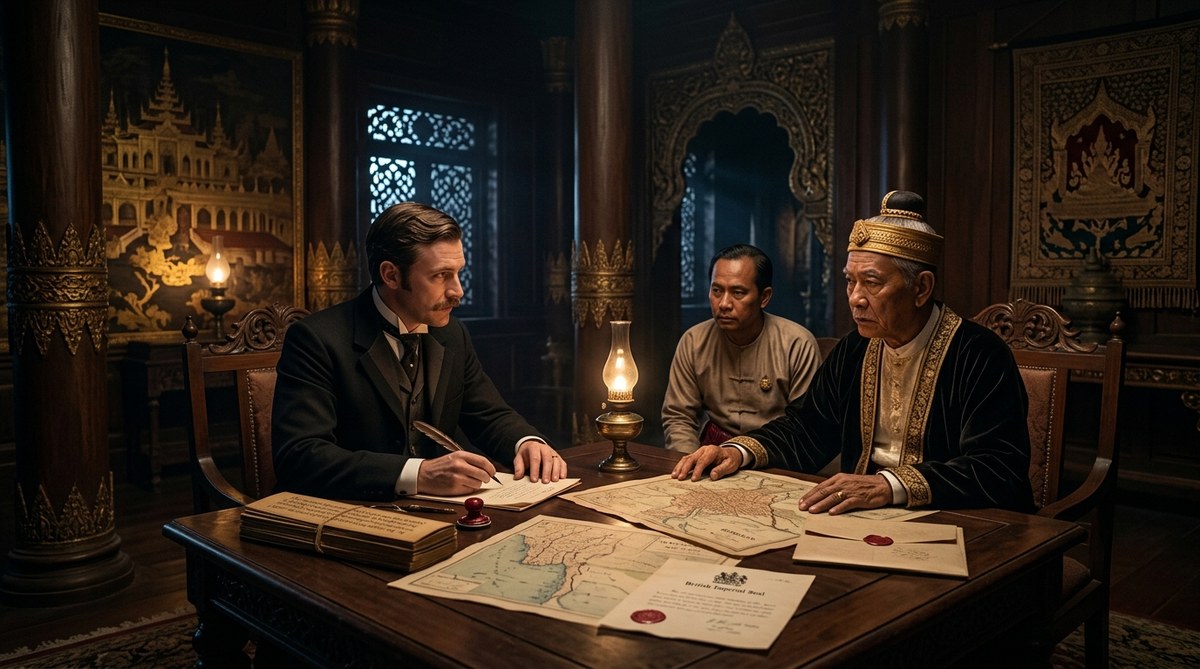
The British had been circling Burma for decades. By the time King Thibaw Min took the Peacock Throne in 1878, the colonial appetite for the region was insatiable. But what actually pushed the final domino? Most people assume the Third Anglo-Burmese War (1885) was a straightforward military conquest. It was not. The end of the monarchy was sealed by a shadowy game of letters, royal envoys, and diplomatic double-crosses that played out between Mandalay, Paris, and London. This is the story of how the last king of Burma lost his crown before a single shot was fired.
The last king of Burma, Thibaw Min, did not lose his throne solely on the battlefield. His downfall was orchestrated through secret diplomatic maneuvers with the French, which the British used as a pretext for invasion. Understanding this hidden history reveals why the end of the monarchy was a political tragedy, not just a military defeat.
The Fragile Crown of King Thibaw
King Thibaw was only 19 when he became the 11th and final monarch of the Konbaung dynasty. His reign started in blood. His powerful half-sister, the Supayalat, helped him consolidate power by eliminating dozens of royal rivals in a brutal palace purge. This violent beginning left Thibaw isolated. He trusted few people outside his inner circle. He also inherited a kingdom that was already bleeding territory.
The British had taken the southern coastal provinces of Tenasserim and Arakan after the First Anglo-Burmese War (1824-1826). They grabbed the entire southern half of the country, including Rangoon, after the Second Anglo-Burmese War (1852). By 1878, the once-mighty Konbaung empire had been reduced to Upper Burma, the central dry zone around Mandalay. The British sat on the doorstep, waiting for a reason to take the rest.
Thibaw knew he could not beat the British in a straight fight. His army was smaller, his weapons older, and his treasury thinner. So he looked for allies elsewhere.
The Secret Alliance That Scared London
The French were already active in Southeast Asia. They had colonized Vietnam and Cambodia, and they were pushing into Laos. For Thibaw, the French represented a potential counterweight to British power. He sent envoys to Paris in secret.
What the British feared most was a French railway. The French proposed building a line from their colony in Tonkin (northern Vietnam) all the way to Mandalay. This railway would have given France a direct economic and military corridor into the heart of Burma. More threatening to London, it would have linked French Indochina to the British sphere in India, bypassing British-controlled ports.
The secret diplomacy escalated. In 1883, Thibaw sent a formal diplomatic mission to Europe. The mission visited France, Italy, Germany, and even the United States. But the real business happened in Paris. The French government, under Prime Minister Jules Ferry, signed a commercial treaty with Burma in January 1885. The treaty gave French companies major trade concessions.
Then came the bombshell. The British discovered that a French gunboat had sailed up the Irrawaddy River to Mandalay. On board were French officials carrying documents that appeared to give France control of Burma’s postal system, its ruby mines, and its national bank. To the British Viceroy in India, Lord Dufferin, this was proof of a hostile alliance.
“The presence of a French gunboat at Mandalay is a direct menace to our Indian Empire. We cannot permit a rival power to establish itself on the upper waters of the Irrawaddy.”
Lord Dufferin, Viceroy of India, 1885
The British ultimatum arrived in Mandalay in October 1885. It demanded that Burma accept a British Resident with full diplomatic status, that the French treaty be renounced, and that British goods be given free passage. Thibaw tried to negotiate. He did not realize that the British had already decided on war. The secret diplomacy had sealed his fate.
How the British Engineered the Fall
The British plan was not to conquer Burma in a long campaign. They wanted a swift, decisive strike. They knew the Burmese court was divided. They also knew that the French would not send troops to defend Mandalay. Paris was too far away, and French public opinion was not ready for a war with Britain.
Here is how the British executed the takeover:
- Issued an impossible ultimatum. The terms were designed to be rejected. The British knew Thibaw could not abandon the French treaty without losing face and his only ally.
- Moved troops up the Irrawaddy. A force of 10,000 soldiers, mostly Indian sepoys, was assembled at the border town of Thayetmyo. They used steam-powered riverboats to move up the river during November, bypassing Burmese forts.
- Attacked the river forts. The Burmese defenders fought bravely at Minhla and other strongpoints, but they were outgunned. British artillery shredded the wooden stockades.
- Occupied Mandalay with minimal resistance. The main army reached Mandalay on November 28, 1885. There was no siege. The city gates were opened.
- Arrested the royal family. King Thibaw and Queen Supayalat surrendered without a fight. They were taken to a waiting British boat and exiled to India that same night.
The entire war lasted only 14 days. It was not a glorious conquest. It was a police action designed to remove a ruler who had made the wrong friends.
The Exile and the End of a Dynasty
King Thibaw spent the rest of his life in a small house on the coast of western India, in the port town of Ratnagiri. He was 26 years old when he arrived. He lived there for 30 years, a forgotten king in a foreign land. He died in 1916 and was buried in India. His body was only returned to Burma in 1954, long after the British had left.
The Konbaung dynasty did not just end. It was deliberately erased. The British abolished the monarchy immediately. They did not install a puppet king. They simply declared that Upper Burma was now part of British India. The royal palace in Mandalay was turned into a British club. The royal library was looted. The crown jewels were taken to London.
For the Burmese people, the loss of the monarchy was a deep cultural wound. The king was not just a political leader. He was the protector of Buddhism, the patron of the arts, and the symbol of national unity. Without him, the country lost its center.
Key Figures in the Fall of the Monarchy
| Figure | Role | Outcome |
|---|---|---|
| King Thibaw | Last monarch of Burma | Exiled to India, died in 1916 |
| Queen Supayalat | Chief queen and political partner | Exiled with Thibaw, died in 1925 |
| Lord Dufferin | British Viceroy of India | Ordered the invasion |
| Jules Ferry | French Prime Minister | Signed treaty with Burma, later resigned in scandal |
| Kinwun Mingyi U Kaung | Burmese chief minister | Tried to negotiate peace, blamed for the surrender |
The table above shows how the key players each contributed to the collapse. None of them acted alone. The end of the monarchy was a system failure, not just a personal failure.
What the End of the Monarchy Means for Myanmar Today
The shadow of that lost dynasty still falls across modern Myanmar. When you visit Mandalay today, you can see the reconstructed palace, but the original throne room is empty. The monarchy is gone, but the idea of a unified kingdom under a single ruler has never fully disappeared.
The fall of the Konbaung dynasty also set a pattern for how foreign powers have treated Myanmar. The British used a diplomatic pretext to justify a military takeover. That same pattern of external intervention, justified by local alliances, has repeated itself in different forms up to the present day.
For history enthusiasts, the lesson is clear. The last king of Burma did not lose his throne because his army was weak. He lost it because he played a game of international diplomacy that he could not win. He tried to balance two empires and got crushed between them.
If you want to understand the deeper forces that shaped modern Myanmar, start with this moment. The secret diplomacy that ended the monarchy was not a footnote. It was the blueprint for everything that followed. You can read more about how these historical patterns connect to current events in our article on how international watchdogs are monitoring Myanmar’s governance reforms in 2026.
Tracing the Royal Footsteps in Modern Myanmar
If you are planning a trip to Myanmar and want to connect with this history, there are a few places that bring the story to life.
- Mandalay Palace. The moat and walls are intact. The palace grounds are open to visitors. You can walk through the reception halls where Thibaw received the French envoys.
- Mandalay Hill. From the top, you can see the entire old city. This is where the British army set up their artillery to threaten the palace.
- The Royal Library. A small building inside the palace compound. Most of the manuscripts were taken, but the structure remains.
- Ratnagiri, India. The house where Thibaw lived in exile is now a small museum. It is a pilgrimage site for some Burmese visitors.
Visiting these sites gives you a tangible sense of what was lost. The walls are still standing. The ghosts of the court are still there.
For a deeper look at the cultural traditions that survived the fall of the monarchy, check out our guide to myanmar’s endangered crafts: master artisans fighting to preserve ancient techniques.
The Legacy of the Last King
The story of the last king of Burma is not just a tragedy. It is a warning. It shows what happens when a small nation gets caught in the crossfire of great power rivalries. It also shows the importance of understanding the hidden channels of diplomacy, the secret letters, the quiet promises, and the betrayals that happen far from the battlefield.
King Thibaw made mistakes. He trusted the French more than he should have. He failed to modernize his army. He did not unite his court behind a single strategy. But he was also a victim of forces far larger than himself. The British Empire was expanding, and it would not tolerate a rival on its border.
When you read about the end of the monarchy, remember that it was not inevitable. It was chosen. The British chose to invade. The French chose to abandon their ally. Thibaw chose to surrender. History is made of choices, and the choices made in 1885 still echo through Myanmar’s politics and identity today.
If this story has sparked your interest, you might also enjoy learning about how the konbaung dynasty’s military innovations changed southeast asian warfare forever. The same dynasty that fell in 1885 had once been a regional superpower. Understanding its rise makes its fall even more poignant.
The last king of Burma sits in a small house by the Indian Ocean, a ghost in a foreign land. His story is a reminder that empires are fragile, that alliances are temporary, and that the end of a monarchy is never just the end of a king. It is the end of a world.