
The train station at Hsipaw is a sleepy place. A few chickens peck at the dust. An old clock, frozen at a quarter past three, hangs above the ticket window. You buy a seat in the upper class carriage for a few dollars and settle onto a cracked vinyl bench. The engine gives a low, guttural whistle. Then, without fanfare, you begin to roll through a landscape that has changed little in a hundred years. This is the real Myanmar. Not a museum piece, but a living, breathing journey through time.
Myanmar’s railway network offers some of the most dramatic scenery in Southeast Asia, but it is not a luxury ride. These routes are slow, bumpy, and wonderfully authentic. They connect remote villages, cross towering viaducts, and let you see a side of the country that cars and planes simply miss. This guide covers the top scenic train routes for 2026 and how to ride them like a local.
The Gokteik Viaduct: A Journey Above the Clouds
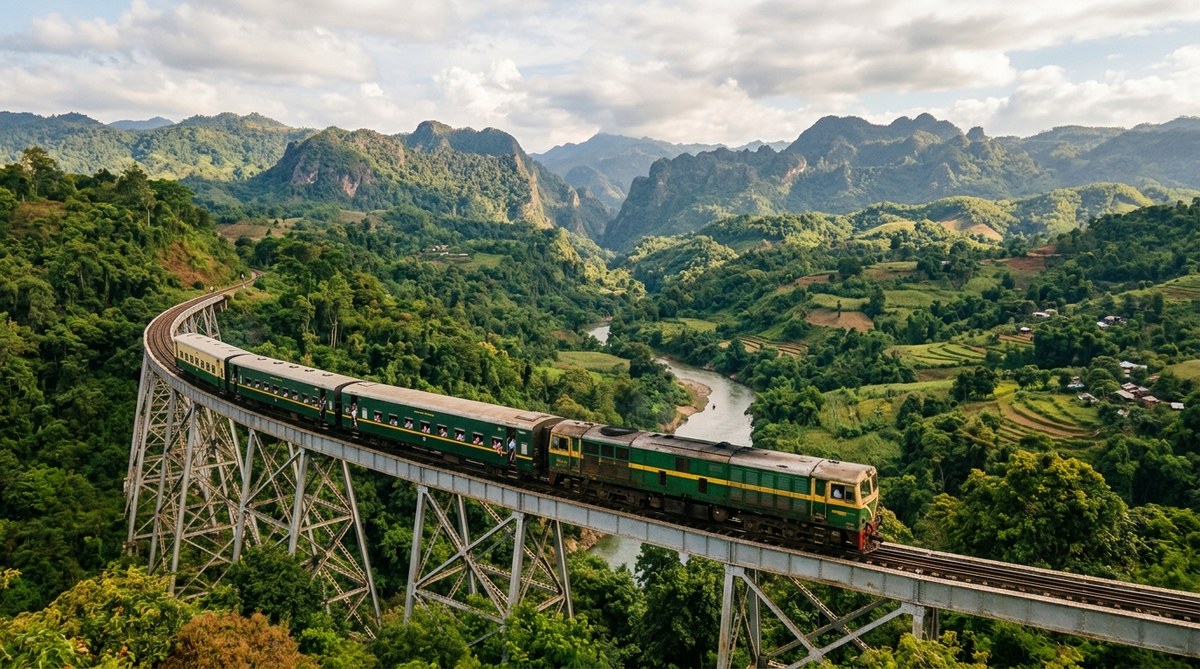
The Gokteik Viaduct is the crown jewel of Myanmar’s scenic train routes. Built by the British in 1900, this steel trestle bridge stretches 2,260 feet across a deep ravine. When your train crawls onto it, the world drops away. You look straight down through the iron grid floor and see the jungle floor hundreds of feet below. It is not for those who fear heights.
The train that crosses it runs from Mandalay to Lashio. But you do not need to go all the way to the Shan State border. Most travelers board the train in the town of Pyin Oo Lwin, a former British hill station known for its botanical gardens and colonial architecture. From there, the train climbs into the hills. The air turns cool. Eucalyptus trees line the track. About an hour into the ride, you reach the viaduct.
The train slows to a crawl as it crosses. Passengers lean out of open windows to snap photos. Vendors onboard sell fried snacks and sweet tea. The whole crossing takes about ten minutes, but it feels suspended in time. If you take only one train ride in Myanmar, make it this one.
The Slow Train to Hsipaw: A Window Into Village Life
If the Gokteik Viaduct is the highlight, the stretch from Pyin Oo Lwin to Hsipaw is the heart. This is Myanmar’s most famous train route for a reason. The train moves at a walking pace for much of the journey. That is not a bug. It is a feature.
You pass through dozens of small villages where children wave from the tracks. Farmers lead oxcarts across the rails. Women balance baskets of bananas on their heads. The train stops at tiny stations with no signs, just a wooden bench and a cluster of passengers waiting in the shade.
The ride takes about six hours to cover 100 miles. That averages out to roughly 16 miles per hour. Bring a book. Bring snacks. But mostly, just watch out the window. The scenery shifts from pine forests to terraced fields to rocky gorges. The train rattles over bridges that look like they were built for a model railroad set. It is slow, hot, and wonderfully real.
The Circular Railway: Yangon’s Moving Neighborhood
Not every great train ride needs to cross a mountain. Yangon’s Circular Railway is a 30-mile loop that circles the city. It takes about three hours to complete the full circuit. Locals use it as a commuter line. Travelers use it as a way to see Yangon without a guidebook.
The train departs from Yangon Central Station. Within minutes, the high rises give way to corrugated iron rooftops and dirt pathways. You pass by street markets, monasteries, and soccer fields. Monks in saffron robes sit across from factory workers. A vendor walks through the carriage selling fried tofu. The windows are always open, letting in the humid air and the sounds of the city.
This route is not on most tourist itineraries. It should be. It gives you a raw, unfiltered look at daily life in Myanmar’s largest city. For less than a dollar, you get a moving portrait of Yangon that no bus tour can match.
The Mandalay to Bagan Route: A Flat but Beautiful Ride
The train from Mandalay to Bagan is not as dramatic as the hill routes. The landscape is flat and dry. But it has its own kind of beauty. You roll through endless fields of sesame and peanut plants. Dusty villages appear every few miles. In the dry season, the heat shimmers off the ground.
The real draw here is the destination. Bagan is one of the most remarkable archaeological sites in Asia. Thousands of temples and pagodas spread across a plain beside the Irrawaddy River. Arriving by train feels right. You come into the station as the sun starts to set. The temples glow orange. It is a quiet, reverent arrival that matches the mood of the place.
The train itself is basic. Upper class means a padded seat and a working fan. The dining car serves simple Burmese curry and rice. The journey takes about six hours. It is not the most comfortable ride in Myanmar, but it is the most atmospheric.
Comparing the Routes: Which One Is Right for You?
Not every traveler has time for all four routes. Here is a breakdown to help you decide based on what matters most to you.
| Route | Duration | Scenery Level | Comfort | Best For |
|---|---|---|---|---|
| Mandalay to Lashio (Gokteik) | 6-8 hours | High (mountain, viaduct) | Low | Adventure seekers, photographers |
| Pyin Oo Lwin to Hsipaw | 6 hours | High (hills, villages) | Low | Cultural immersion, slow travel |
| Yangon Circular Railway | 3 hours | Moderate (urban, local life) | Medium | City explorers, budget travelers |
| Mandalay to Bagan | 6 hours | Moderate (plains, temples) | Medium | History lovers, sunset chasers |
How to Plan Your Train Trip in 2026
Myanmar’s railway system runs on its own schedule. Punctuality is not the norm. Delays of an hour or more are common. Do not plan a tight connection after your train arrives. Instead, treat the journey itself as the main event.
Here is a step-by-step process for booking and riding Myanmar’s scenic train routes:
- Choose your route based on season. The dry season from November to March offers the clearest skies and most comfortable temperatures. The rainy season from June to October can wash out tracks and cancel services.
- Buy your ticket at the station. Online booking is not reliable for most routes. Arrive at least an hour before departure. Bring cash in the local currency. Upper class seats sell out first on popular routes like Pyin Oo Lwin to Hsipaw.
- Pack for the conditions. Bring water, snacks, toilet paper, and a small cushion. The seats are hard. The windows are open. Dust and soot will get on your clothes. Wear something you do not mind getting dirty.
- Talk to your seatmates. Burmese travelers are friendly and curious. A simple smile goes a long way. You might be offered a share of someone’s lunch or an invitation to visit their village.
- Get off at a small station. On the Hsipaw route, consider getting off at a village like Kyaukme or Nawnghkio. Spend an hour walking around. Catch the next train a few hours later. This is how you find the real Myanmar.
What to Expect on Board
Let me be honest with you. These trains are not comfortable by Western standards. The seats are hard. The air conditioning is a fan that works some of the time. The bathrooms are basic. The food is simple but good. Fried rice, noodles, samosas, and sweet tea are standard.
But the discomfort is part of the experience. You are not insulated from the environment. You feel the heat. You hear the engine strain as it climbs a hill. You smell the wood smoke from village kitchens. That sensory connection is what makes these journeys unforgettable.
“The train is the only way to really see Myanmar. From the road, you see the surface. From the air, you see nothing. But from the train, you see the country as it lives. The farmers in the fields. The children walking to school. The monks reading under a tree. That is the real Myanmar.” — U Myo Win, retired railway conductor, Mandalay
Practical Tips for a Smooth Ride
Here are some things to keep in mind before you board.
- Start early. Most scenic routes depart in the morning. A 6:00 or 7:00 AM start means you travel in the cooler part of the day.
- Bring your own toilet paper. Public restrooms on trains and at stations rarely have any.
- Use the local currency. Vendors on the train do not accept credit cards or foreign currency. Small bills are best.
- Keep your valuables close. Theft is rare, but it happens. Keep your bag on your lap or between your feet.
- Learn a few words of Burmese. “Mingalaba” (hello) and “Cezu tin ba deh” (thank you) will earn you smiles.
For more detailed advice on getting around the country, read our guide on navigating Myanmar’s transportation network.
The Best Time to Ride
The dry season is the obvious answer, but there is more to consider. The landscape changes with the seasons.
- November to March: Cool, dry, and clear. The hills are green from the recent rains. This is peak tourist season, so trains are busier.
- April to May: Hot and dry. The plains are brown. The heat can be intense in lower elevations. But the higher routes like Pyin Oo Lwin to Hsipaw remain pleasant.
- June to October: Rainy season. The landscape is lush and dramatic. Waterfalls appear where there were none. But some routes may be disrupted by landslides or flooding.
If you want the best balance of good weather and few crowds, aim for November or February.
Why Train Travel Matters in Myanmar
Myanmar is at a crossroads. The country is changing. New roads are being built. Domestic flights are becoming cheaper. The old railway network, much of it built over a century ago, is slowly being upgraded. Some of these routes may not exist in their current form for much longer.
Riding these trains is not just about seeing scenery. It is about connecting with a way of life that is disappearing. The slow pace. The human interaction. The lack of digital distraction. On a Myanmar train, you are present. You have to be. There is nothing else to do but watch the world go by.
This kind of travel aligns with the values of responsible tourism. It supports local economies. It reduces your carbon footprint compared to flying. And it gives you a deeper understanding of the country than any guided tour can offer. For more on traveling with purpose, see our guide on how to be a responsible traveler in Myanmar.
A Final Word on Safety and Awareness
Travel in Myanmar requires a realistic understanding of the current situation. The country faces ongoing political challenges. Some regions are not safe for tourists. Always check your government’s travel advisories before planning a trip. Stick to well-established routes. Avoid traveling after dark. And be respectful of local customs and sensitivities.
That said, the routes described in this guide are among the safest and most traveled by foreigners. The train staff are professional. The local communities are welcoming. With common sense and preparation, a train journey through Myanmar can be one of the most rewarding travel experiences you will ever have.
Your Ticket to a Slower World
Myanmar’s scenic train routes are not for everyone. They are slow. They are dusty. They are unpredictable. But for the traveler who values experience over comfort, they offer something rare: a chance to step out of the modern world and into a landscape that still moves at the rhythm of the steam age. The train does not just carry you from one place to another. It carries you into the heart of the country. So buy your ticket. Find your seat. Let the whistle blow. And let Myanmar show you what travel used to be.