
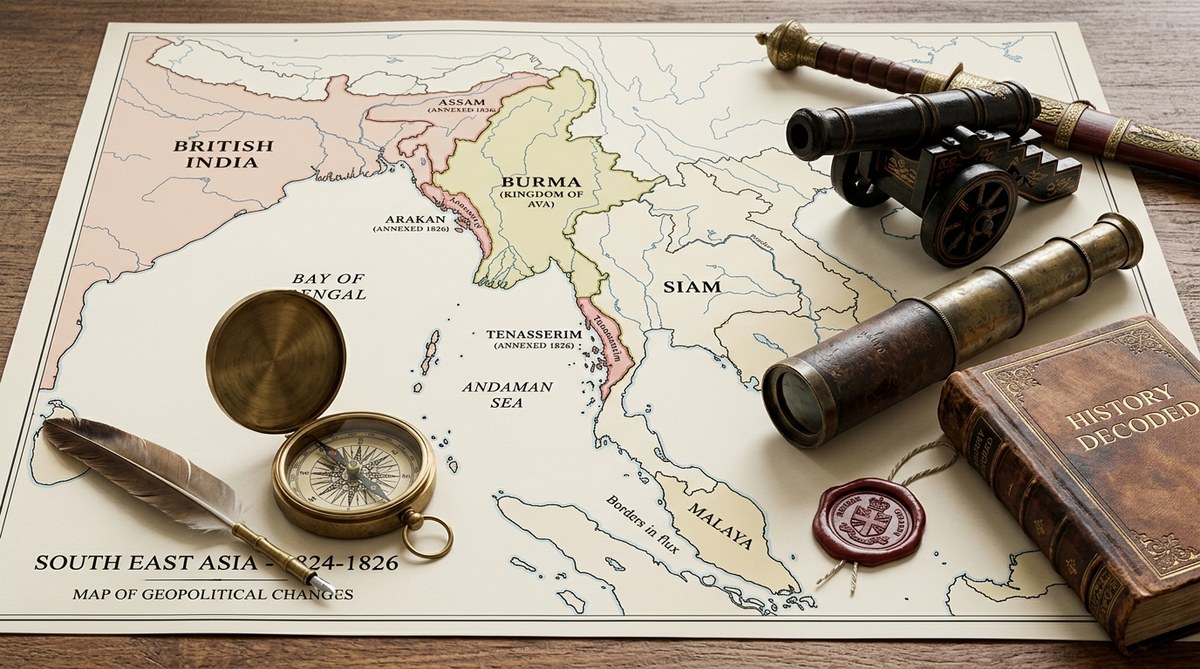
Picture this: It is 1824. The Konbaung Dynasty rules over an empire that stretches from the forests of Assam to the coast of Tenasserim. Burmese armies have clashed with the British East India Company along an ill-defined frontier for years. Tensions have been simmering over control of the northeastern states of India. Then, on March 5, 1824, the British officially declare war. What follows is a brutal two-year conflict that will redraw the map of Southeast Asia, bankrupt the Burmese kingdom, and set in motion a chain of events that ultimately leads to the complete colonization of Burma.
The First Anglo-Burmese War was not just another colonial skirmish. It was the most expensive war the British East India Company had ever fought up to that point. It cost tens of thousands of lives, mostly from disease rather than battle. And when it was over, the Treaty of Yandabo stripped Burma of its coastal territories, dismantled its military power, and left the kingdom isolated and vulnerable to future British aggression.
The First Anglo-Burmese War (1824-1826) ended the Konbaung Dynasty’s expansion and forced Burma into a humiliating peace under the Treaty of Yandabo. The war cost the British East India Company over 13 million pounds and led to massive territorial losses for Burma, including Assam, Manipur, Arakan, and Tenasserim. This defeat permanently weakened Burma and laid the foundation for British colonialism in Southeast Asia.
How the Konbaung Dynasty Pushed Too Far
To understand why this war happened, you need to look at the ambition of King Bagyidaw and his general, Maha Bandula. Under the Konbaung Dynasty, Burma had been on an expansionist march for decades. The Burmese had conquered the kingdom of Arakan in 1785. They pushed into Manipur and Assam in the early 1800s. By 1822, they were knocking on the door of British India itself.
The British East India Company watched this expansion with growing alarm. The company’s territories in Bengal shared a porous border with the Burmese sphere of influence. Burmese raids into British-administered areas became common. British officials in Calcutta demanded that the Burmese stop their incursions and recognize British authority over Assam and Manipur. The Burmese court refused.
Here is where things boiled over. In 1823, Burmese forces attacked a British outpost on Shahpuri Island near Chittagong. The British demanded reparations. The Burmese responded by massing troops along the border. Maha Bandula, perhaps the finest military commander the Konbaung Dynasty ever produced, was confident he could defeat the British. He was wrong.
The War That Cost a Fortune
The First Anglo-Burmese War was fought across a massive geographic area. The main theater was in Arakan, but fighting also occurred in Assam, Manipur, and along the coast of what is now Myanmar’s Rakhine State.
The British Game Plan
The British strategy relied on naval superiority and coordinated land campaigns. They could not match the Burmese in jungle warfare, but they controlled the sea. That gave them the ability to strike wherever they wanted.
- The British assembled a force of over 11,000 soldiers, mostly Indian sepoys, at Chittagong.
- They launched an amphibious assault on Rangoon (modern Yangon) in May 1824, catching the Burmese off guard.
- Maha Bandula raced south with his army to defend the capital, but he faced supply shortages and disease.
- The British held Rangoon through the rainy season, while cholera and dysentery ravaged both sides.
- In December 1824, the British pushed northward toward the Burmese heartland, defeating Bandula’s forces at the Battle of Danubyu in April 1825, where Bandula was killed.
A key lesson from the First Anglo-Burmese War is that logistics and disease often decide the outcome more than battlefield tactics.
| Factor | British Strength | Burmese Weakness |
|---|---|---|
| Naval power | Full control of coastal waters and river access | Almost no navy; could not defend coastal cities |
| Supply lines | Reinforced by sea from India | Overland supply routes stretched thin across jungles |
| Medical care | Basic field hospitals, but still terrible disease rates | Almost no organized medical support |
| Intelligence | Used local informants and survey maps | Poor understanding of British military capabilities |
| Leadership | Professional officers with colonial experience | Maha Bandula was brilliant, but his death crippled morale |
“The war was decided not by the bravery of soldiers on either side, but by the unchecked ravages of disease and the inability of the Burmese to defend their coastline.” – Dr. Thant Myint-U, historian and author of The River of Lost Footsteps
Both sides suffered horribly. Of the roughly 40,000 British and Indian troops deployed, around 15,000 died. Over 90 percent of those deaths came from disease, not combat. Burmese casualties were even higher, with estimates ranging from 15,000 to 20,000 military deaths and countless civilian losses.
The Treaty of Yandabo: A Humiliation That Echoed for Generations
The war ended with the Treaty of Yandabo, signed on February 24, 1826. The terms were devastating for Burma.
- Burma had to pay an enormous indemnity of one million pounds sterling, paid in installments.
- Burma ceded Assam, Manipur, Arakan (Rakhine), and the Tenasserim coast (modern Tanintharyi).
- Burma agreed to stop interfering in the affairs of the northeastern Indian states.
- A British resident was to be stationed at the Burmese court in Ava.
The indemnity alone was crippling. Burma’s economy was already shattered by the war. The royal treasury was empty. To raise the money, the king had to impose heavy taxes on farmers and monasteries. This caused widespread suffering and resentment against the monarchy.
The territorial losses were even more significant. Arakan had been a part of Burma for only 40 years, but its loss was a deep psychological blow. Tenasserim gave the British a strategic foothold on the Malay Peninsula, linking their interests in India with their growing trade in Southeast Asia.
For a deeper look at how these colonial structures later evolved, you can read our analysis of why the British chose Rangoon over Mandalay as colonial Burma’s capital.
How the War Reshaped Southeast Asia’s Geopolitics
The First Anglo-Burmese War did not just affect Burma and Britain. It changed the entire balance of power in Southeast Asia.
Weakening of the Konbaung Dynasty
Before the war, the Konbaung Dynasty was the dominant power in mainland Southeast Asia. It had defeated the Mon kingdoms, subdued the Shan states, and even threatened Siam (Thailand). After Yandabo, the dynasty was fatally weakened. The loss of territory, treasure, and prestige made it impossible for subsequent kings to resist British pressure. The Second Anglo-Burmese War in 1852 and the Third Anglo-Burmese War in 1885 followed in a predictable pattern of British aggression and Burmese collapse.
Rise of British Influence in the Region
The British now had a direct land border with Siam, and their control of the Tenasserim coast gave them a monopoly on trade routes across the Malay Peninsula. British merchants in Calcutta and London began eyeing the rest of Burma’s resources: teak, rice, rubies, and oil. The war also showed other Southeast Asian kingdoms, like Siam and Vietnam, that the British were a force to be reckoned with.
A Blueprint for Colonial Expansion
The First Anglo-Burmese War served as a testing ground for British military tactics that would later be used in India, Africa, and elsewhere. The use of amphibious landings, the reliance on Indian sepoys, and the strategy of attacking economic centers rather than fighting pitched battles all became hallmarks of British colonial warfare.
If you are interested in how these historical patterns of conflict relate to modern governance, take a look at our discussion of the Panglong Agreement and its broken promises to Myanmar’s ethnic groups.
The Human Cost and Cultural Trauma
It is easy to talk about wars in terms of treaties and territories. But the First Anglo-Burmese War had a profound human dimension that shaped Myanmar’s national psyche.
Thousands of Burmese soldiers and porters died in the jungles of Arakan and Assam. Entire villages were abandoned. Monastic libraries were destroyed. The war also unleashed a wave of refugees: Arakanese Muslims fled into British territory, while ethnic Rakhine Buddhists moved deeper into Burma. This population displacement planted seeds of communal tension that persist in Rakhine State to this day.
For the British, the war was a financial disaster despite being a military victory. The East India Company spent over 13 million pounds on the conflict, more than any other war it had fought. This led to a financial crisis in Calcutta and forced the company to take out loans. In a way, the cost of the war hastened the decline of the East India Company itself, leading to the British Crown taking direct control of India in 1858.
Why This War Still Matters in 2026
You might be wondering why a war that ended 200 years ago still matters today. The answer lies in the borders, identities, and grievances that the conflict created.
The modern borders of Myanmar are, in large part, a product of British colonialism that began with the Treaty of Yandabo. The ethnic tensions in Rakhine State, the disputes over citizenship, the resentment toward central authority, all of these have roots in the 19th century colonial encounter. The war also established a pattern of military defeat and foreign domination that influenced Myanmar’s later isolationist policies under Ne Win and the military junta.
Understanding the First Anglo-Burmese War helps you understand why Myanmar is the way it is today. It explains why the country distrusts foreign powers, why its military has such a dominant role in politics, and why ethnic minorities in the border regions feel alienated from the central government.
For a more complete picture of Myanmar’s complex history, you can also read about the five pivotal moments that shaped modern Myanmar’s independence movement and the fall of Bagan and what really caused the collapse of Myanmar’s greatest empire.
How the War Changed the Way Armies Fight
The First Anglo-Burmese War introduced several military innovations that would influence future conflicts.
- Use of steam-powered warships for river transport and bombardment, a first for the British in Asia.
- Deployment of Bengali sappers and miners to clear jungle paths and build fortifications, a tactic later used in the Opium Wars with China.
- The establishment of a dedicated military intelligence unit that mapped uncharted territories in Burma and Assam.
- Adoption of local laborers as porters and guides, which became standard practice in colonial campaigns.
The war also showed the limits of European power in tropical environments. The British learned that their traditional linear formations were useless in Burmese jungles. They had to adapt to smaller units, skirmish tactics, and fortified positions. These lessons were written up in military manuals and studied by officers across the British Empire.
The Legacy of Maha Bandula
No discussion of the First Anglo-Burmese War is complete without honoring Maha Bandula. He remains a national hero in Myanmar today. Statues of him stand in Yangon and Mandalay. His face appears on banknotes. He is remembered as a brilliant general who fought fearlessly against overwhelming odds.
Bandula’s death at the Battle of Danubyu was a turning point. After he was killed by a British mortar round, Burmese resistance collapsed. His troops lost heart. The king sued for peace soon after.
But Bandula’s legacy goes beyond military heroism. He symbolizes Myanmar’s resistance to foreign domination. In a country that has struggled with colonialism, military rule, and international isolation, Bandula represents the idea that Myanmar can stand up to powerful outsiders.
This sense of national pride and resilience is something you can see in Myanmar’s youth activism and civil society movements today, where a new generation is shaping the country’s future while drawing on its past.
What the First Anglo-Burmese War Teaches Us About Empire and Resistance
The First Anglo-Burmese War is a case study in how empires collide. Both the British and the Burmese were expansionist powers. Both believed they had a right to dominate their neighbors. Both underestimated the other.
For the British, the war was a wake-up call. They realized that conquering Burma would not be easy. It would take three wars spread over 60 years to finally subdue the kingdom. The jungle, the climate, and the fierce resistance of the Burmese people made it a costly endeavor.
For the Burmese, the war was a catastrophe. It exposed the weaknesses of the Konbaung Dynasty: its lack of a navy, its overreliance on a single general, its inability to adapt to modern warfare. But it also revealed the strength of Burmese national identity. Even after the defeat, the court at Ava continued to resist British influence, trying to modernize the kingdom while preserving its independence.
A Final Reflection on a War That Changed Everything
The First Anglo-Burmese War is not just a chapter in a history book. It is a living memory that shapes how Myanmar sees itself and the world. The war redrew the map of Southeast Asia, ended the Konbaung Dynasty’s dreams of empire, and set Burma on a path toward colonization.
But it also revealed something about the human spirit. The Burmese people endured a devastating defeat, crippling reparations, and the loss of their homeland. Yet they rebuilt. They adapted. They survived.
As you travel through Myanmar, or study its history, or do business with its people, keep the First Anglo-Burmese War in mind. It is a reminder that the past is never really past. The borders, the tensions, the pride, and the pain all have their roots in events that happened two centuries ago.
If you want to understand modern Myanmar, you have to start here. This war is the key that unlocks everything else.
For those planning a visit, we also have practical guides on what you really need to know before traveling to Myanmar in 2026 and how to get your Myanmar visa with a complete application guide.