
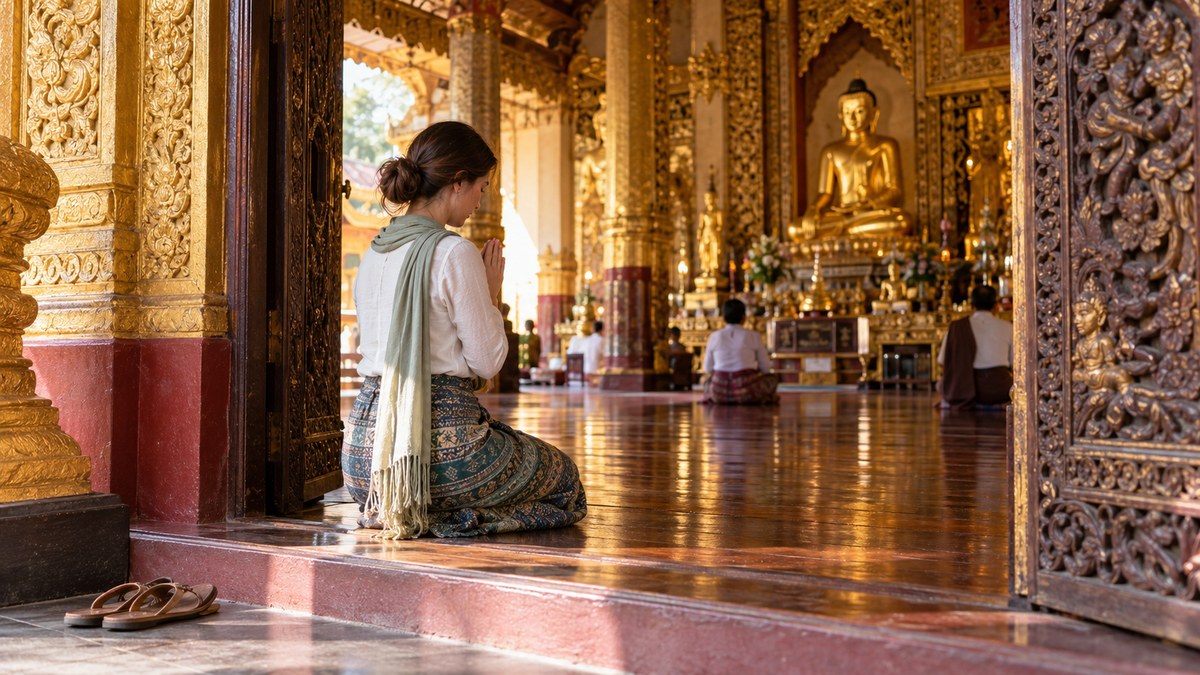
You step through the towering entrance of a golden pagoda in Yangon. The air smells of incense and jasmine. Monks in saffron robes glide past. The silence is broken only by the soft chime of bells in the breeze. You feel a deep sense of peace. Then you realize you are wearing shorts and your shoulders are bare. A local woman gently taps your arm and points to a sign you missed. You feel your face flush.
That moment is avoidable.
Myanmar is a country where faith is woven into daily life. Buddhist temples and pagodas are not just tourist attractions. They are living, breathing spaces of worship. Entering them without knowing the basic rules can cause real offense. The good news is that the rules are simple. Once you learn them, you will move through the country with confidence and grace.
Respecting Myanmar temple etiquette comes down to three things: remove your shoes and socks before entering any sacred space, cover your knees and shoulders, and never point your feet at a Buddha image or a monk. Follow these rules, stay quiet, and you will show genuine respect for a deeply spiritual culture. It is that straightforward.
Before You Go: What to Wear and What to Pack
The number one mistake travelers make is showing up in the wrong clothes. You cannot just walk into a pagoda wearing a tank top and flip-flops and expect to be welcomed. The dress code is strict, but it is also easy to follow.
For men: Wear long pants that cover your knees. A collared shirt or a t-shirt with sleeves is fine. Avoid sleeveless shirts.
For women: Long skirts or pants are best. Your shoulders must be covered. A lightweight scarf or shawl works perfectly. Avoid leggings or tight clothing.
For everyone: Bring a bag that can hold your shoes. You will be taking them off a lot.
Here is a checklist of items to keep in your daypack:
- A lightweight sarong or longyi (you can buy these everywhere for a few dollars)
- A scarf or shawl for shoulder coverage
- A small tote bag for your shoes
- Socks that are easy to slip on and off
- A water bottle (stay hydrated in the heat)
If you forget something, do not panic. Almost every major temple has a vendor outside selling longyis for a reasonable price. Just buy one and wrap it on. Locals will appreciate the effort.
The Golden Rule: Shoes Off, Always
This is the rule that catches most people off guard. In Myanmar, you remove your shoes and socks before entering any pagoda or temple. This includes the entire temple compound, not just the main building. The marble platforms around the Shwedagon Pagoda? Shoes off. The dusty pathways at Bagan? Shoes off. Even some smaller monastery buildings require it.
Local Wisdom: “In Myanmar, the feet are considered the lowest and dirtiest part of the body. Bringing shoes into a temple brings that dirt into a sacred space. It is a sign of humility to walk barefoot on holy ground.” – A monk from Mandalay
A few practical tips for the shoe rule:
- Wear slip-on shoes. Sandals or flip-flops are ideal. You will be taking them on and off constantly.
- Bring a plastic bag or a small cloth bag to carry your shoes. Do not leave them in a pile at the entrance if you can help it. They might get mixed up or taken.
- Expect hot ground. The marble at Shwedagon can be scorching at midday. Visit early in the morning or late in the afternoon to avoid burned feet. Some travelers wear thin socks for protection, though this is not traditional.
How to Behave Inside a Temple
Once you are inside, your behavior matters just as much as your clothing. The goal is to be quiet, calm, and aware.
Do not point your feet at Buddha. When you sit down to meditate or rest, tuck your feet behind you or sit cross-legged. Never stretch your legs out with your feet pointing toward a Buddha statue or an altar. This is seen as deeply disrespectful.
Do not touch the monks. If a monk is sitting in meditation, do not tap them on the shoulder or try to shake their hand. Women should never touch a monk at all. If you need to give something to a monk, place it on a cloth or a table in front of them.
Keep your voice down. Temples are not libraries, but they are spaces for contemplation. Loud conversations or laughter can disturb others who are praying. Speak softly.
Do not climb on the structures. This is a big one, especially at Bagan. The ancient temples are fragile. Climbing on them damages the brickwork and is considered disrespectful. It is also illegal now. Stay on the ground or use designated viewing platforms.
Here is a table that shows common mistakes and the correct behavior:
| Common Mistake | Why It Is Wrong | What to Do Instead |
|---|---|---|
| Pointing your feet at a Buddha image | Feet are considered low and unclean | Sit with feet tucked behind you |
| Touching a monk | Monks take vows of non-contact, especially with women | Speak to them from a distance or place items on a cloth |
| Taking photos during prayers | It interrupts a private moment of worship | Wait until the person has finished or ask permission |
| Speaking loudly | Disrupts the peaceful atmosphere | Use a soft voice or whisper |
| Turning your back to Buddha | Shows a lack of reverence | Walk around the altar clockwise, facing the image |
Navigating Offerings and Donations
You will see locals making offerings at almost every temple. They might place flowers, light candles, or stick small gold leaf squares onto a Buddha statue. This is a personal act of devotion.
You are welcome to participate, but do so with respect.
- Buy offerings from the stalls outside the temple. A simple bundle of flowers or a few incense sticks is perfect.
- When you place your offering, do it gently. Do not toss it onto the altar.
- If you want to donate money, use the donation boxes. Do not hand cash directly to a monk unless you are invited to do so.
- Avoid using your left hand to give anything. The left hand is considered unclean in Myanmar culture. Use your right hand or both hands together.
For a deeper look at how faith and daily life intertwine, read about the living tradition of Burmese nat worship in modern Myanmar. It helps explain the spiritual backdrop of the country.
Photography: When to Click and When to Stop
Myanmar’s temples are incredibly photogenic. The golden stupas, the intricate carvings, the soft light at sunset. It is tempting to photograph everything.
But remember that people are praying.
- Do not take photos of people while they are meditating or bowing before an altar. Wait until they have finished.
- Do not use flash inside dark temple chambers. It can disturb the atmosphere and damage ancient paintings.
- Ask before photographing monks. Some are happy to pose. Others find it intrusive. A smile and a nod can communicate your intent.
- Be extra careful at ceremonies. During festivals or important rituals, put your camera away and simply observe.
If you want to understand more about the sacred sites you will visit, check out our guide to beyond the Bagan temples: 12 lesser-known sacred sites that define Myanmar’s spiritual landscape. It will give you a richer experience.
A Step-by-Step Guide for Your First Temple Visit
Let us walk through what a respectful temple visit looks like from start to finish.
- Prepare your clothes at your hotel. Put on long pants or a long skirt. Cover your shoulders. Grab your shoe bag.
- Arrive at the temple entrance. Look for the shoe rack. Remove your shoes and socks. Place them in your bag or on the rack.
- Walk through the entrance quietly. Take a moment to observe the space. Notice where people are praying.
- Walk clockwise around the main stupa. This is the traditional direction. Keep the main shrine on your right side.
- Sit down to meditate or rest. Tuck your feet behind you. Do not point them at any Buddha image.
- Make an offering if you wish. Light a candle or place a flower gently on the altar. Use your right hand.
- Take photos sparingly. Capture the architecture, but avoid photographing people at prayer.
- Leave as quietly as you entered. Put your shoes back on outside the designated area.
That is it. You have shown respect. You have honored the culture. And you have avoided the awkward moment of being corrected by a local.
Understanding the Deeper Meaning
Temple etiquette is not just about following rules. It is about understanding the values behind them. Myanmar is a predominantly Theravada Buddhist country. The core teachings emphasize mindfulness, humility, and compassion.
When you remove your shoes, you practice humility. When you cover your body, you show modesty. When you speak softly, you respect the peace of others. These small acts align you with the spiritual rhythm of the country.
For travelers who want to go deeper, consider reading about what happens at a traditional Burmese shinbyu ceremony and why it matters. It is a beautiful coming-of-age ritual for boys that mirrors the values you will see in every temple.
What About Women Travelers?
Women do face a few extra considerations in Myanmar’s temples. It is not about restriction. It is about tradition.
- Do not touch a monk. If you need to hand something to a monk, place it on a cloth or a nearby table. He will pick it up.
- Do not sit directly next to a monk unless he invites you. Maintain a respectful distance.
- During your menstrual period, there is no formal restriction on entering temples in Myanmar. However, some very traditional women choose to avoid entering the most sacred inner chambers. Use your own judgment.
None of these rules should discourage you from visiting. Women travel solo through Myanmar all the time and have wonderful experiences. The key is awareness.
Special Considerations for Bagan
Bagan is the most famous temple destination in Myanmar. Thousands of pagodas and stupas dot the plain. It is breathtaking. But it also has specific rules.
- Do not climb the temples. This is the most important rule in Bagan. Climbing damages the ancient brickwork and is now illegal. You can be fined or even banned from the site. Use the designated viewing platforms for sunrise and sunset.
- Stay on the pathways. Some areas are restricted for conservation. Respect the barriers.
- Hire a local guide. A guide can show you the less crowded temples and explain the history. It also supports the local economy.
For a broader look at travel logistics in the country, read our guide on navigating Myanmar’s transportation network: trains, buses, and domestic flights explained. It will help you plan your route between temple sites.
How to Handle Mistakes Gracefully
You will probably make a small mistake at some point. Everyone does. The important thing is how you respond.
If a local corrects you, do not get defensive. Smile. Say “sorry” or “thank you.” Adjust your behavior. Most Burmese people are incredibly forgiving and will appreciate that you tried.
If you accidentally point your foot at a Buddha statue, simply move it. No one will scold you. If you forget to take off your shoes, someone will likely call out to you. Just apologize and remove them.
The worst thing you can do is argue or ignore the correction. That is what causes real offense.
Why This Matters Beyond the Temple
Learning temple etiquette is about more than avoiding embarrassment. It is about building bridges. When you show respect for a culture, you open doors. Locals will trust you more. They will share stories with you. They might invite you to a family ceremony or a festival.
This kind of cultural exchange is what makes travel meaningful. It is the difference between being a tourist and being a guest.
For travelers who want to be truly responsible, we have a full guide on how to be a responsible traveler in Myanmar. It covers everything from ethical photography to supporting local businesses.
Your Temple Visit, Done Right
You have the knowledge now. The next time you stand at the entrance of a golden pagoda, you will know exactly what to do. Slip off your sandals. Wrap your scarf around your shoulders. Walk quietly onto the cool marble floor. Take a deep breath. Let the bells and incense wash over you.
You are not just visiting a temple. You are participating in something ancient and beautiful. And you are doing it with respect.
That is the whole point.