
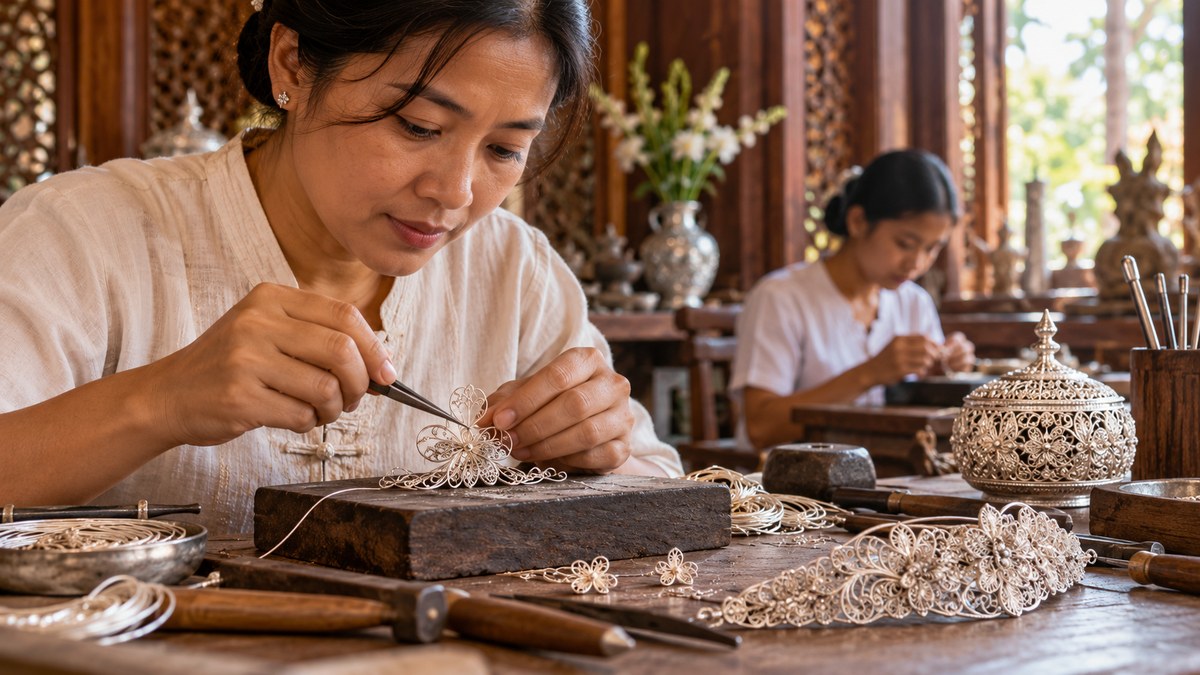
The scent of charcoal and metal fills a small workshop in Mandalay. A master artisan, U Thein, holds a thread of pure silver between his fingers. With a pair of tweezers and a steady breath, he curls it into a spiral so fine it looks like a strand of frozen moonlight. This is silver filigree, a craft that nearly disappeared from Myanmar. But in 2026, something has shifted. A new generation of makers, collectors, and cultural advocates is breathing life back into this delicate art form. The Myanmar silver filigree renaissance is real, and it is changing how the world sees this ancient tradition.
Myanmar’s silver filigree craft is not just surviving; it is thriving again. After decades of decline due to political isolation and shifting markets, a 2026 renaissance is being driven by young apprentices, social media exposure, and ethical tourism. This revival offers cultural heritage enthusiasts a rare chance to witness and support a living tradition that connects Myanmar’s royal past with its creative future.
The Silver Thread That Nearly Snapped
Silver filigree in Myanmar is not a simple decoration. It is a language. For centuries, artisans in Mandalay and Yangon used twisted silver wire to tell stories of Buddhist cosmology, royal courts, and natural beauty. The technique involves drawing pure silver into threads thinner than a human hair, then soldering them onto a base or weaving them into open, lace-like patterns. The result is jewelry, ceremonial boxes, and offering bowls that shimmer with an almost impossible lightness.
But the 20th century was hard on this craft. Decades of military rule cut off Myanmar from global markets. Cheap, machine-made imports flooded local bazaars. Young people stopped learning the family trade. By the early 2000s, only a handful of master silversmiths remained. The knowledge was passing away with them.
What Sparked the Renaissance in 2026
So what changed? Three forces came together to create the Myanmar silver filigree renaissance we see today.
Social media as a gallery. Artisans in Mandalay started posting short videos of their work on platforms like Instagram and TikTok. A video of U Thein shaping a silver lotus petal got over two million views. International buyers began reaching out directly. For the first time, a silversmith in a small workshop could sell a bracelet to someone in New York without leaving their bench.
A new wave of apprentices. Several non-profit organizations focused on cultural preservation launched training programs. Young women and men, many from rural areas, signed up for two-year apprenticeships. They receive a stipend, tools, and a path to earning a living. One program in the Sagaing region has already graduated 40 new filigree artists in 2026 alone.
Ethical tourism returning to Myanmar. As travel conditions stabilize, visitors are seeking authentic experiences. Instead of buying mass-produced souvenirs, they want to meet the maker. Workshops in Mandalay now offer half-day filigree classes. Tourists leave with a ring they helped shape, and a story they will tell for years. For more on traveling responsibly, check out our guide on how to be a responsible traveler in Myanmar.
How Silver Filigree Is Made: A Step-by-Step Process
If you visit a workshop, here is what you will see. The process is methodical and demands patience.
-
Preparing the silver. Pure silver, usually 925 or higher, is melted and drawn through a series of metal plates to create wire as thin as 0.3 millimeters. This can take hours.
-
Designing the pattern. The artisan sketches the design on paper or works from memory. Traditional motifs include lotus buds, peacock feathers, and the hintha bird. Some modern pieces incorporate geometric patterns.
-
Twisting and curling. Using fine-tipped pliers, the artisan twists the wire into curls, spirals, and leaves. This is the most delicate step. One wrong bend and the piece must be melted down and started over.
-
Soldering the frame. The individual elements are placed on a fireproof board. A small torch melts powdered solder to fuse the wires at their contact points. The heat must be precise. Too hot, and the silver warps.
-
Pickling and polishing. The piece is dipped in a mild acid solution to remove oxidation, then polished with a soft cloth and a fine abrasive powder. The result is a bright, matte finish that catches the light.
Common Mistakes Beginners Make (And How to Avoid Them)
Even experienced jewelers struggle when they first try filigree. Here is a table showing the most frequent errors and how master artisans fix them.
| Mistake | Why It Happens | How Master Artisans Avoid It |
|---|---|---|
| Wire breaks during twisting | Silver was drawn too thin or had impurities | Use certified 925 silver and test the wire by bending it gently before starting |
| Solder blobs ruin the pattern | Torch was too hot or held too close | Keep the torch at a 45-degree angle and use a lower flame setting |
| Design looks crooked | No guide marks were drawn on the board | Sketch a light outline with a pencil on the fireproof board before placing wire |
| Surface tarnishes too fast | Polishing was skipped or done poorly | Always finish with a lime juice and baking soda paste rinse |
| Pieces do not fit together | Elements were made separately without measuring | Build all parts on the same board and check fit before soldering |
A Word from a Master Artisan
I sat down with Ko Pyae, a 34-year-old silversmith whose family has worked with silver for four generations. He now teaches at a training center in Mandalay. Here is what he told me.
“When I was a boy, my father told me that silver filigree is like writing poetry with metal. Every curl has meaning. The lotus is not just a flower. It represents purity rising from mud. When we make these pieces, we are not just selling jewelry. We are passing on the stories of our ancestors. The renaissance is not about making more money. It is about making sure our grandchildren know these stories too.”
Ko Pyae’s students range from age 18 to 45. Some are university graduates who could not find work in their fields. Others are farmers looking for a skill that travels well. All of them share a desire to create something lasting.
Why This Renaissance Matters Beyond Myanmar
The revival of silver filigree is not just a local story. It matters for anyone who cares about cultural heritage, ethical trade, and the survival of traditional knowledge.
- It preserves a unique artistic language. Myanmar’s filigree is distinct from Indian or Thai styles. The motifs, the soldering technique, and the spiritual symbolism are unique to this region. When a craft dies, a way of seeing the world dies with it.
- It creates economic alternatives. In a country where stable jobs are scarce, a skilled silversmith can earn a reliable income. This reduces pressure on young people to leave their communities or turn to informal work. Read more about the rise of social enterprises in Myanmar.
- It builds cross-cultural understanding. When you wear a piece of Myanmar filigree, you carry a conversation starter. You can explain where it came from, who made it, and what the symbols mean. That human connection is more valuable than any factory-made product.
How to Support the Renaissance as a Visitor or Collector
You do not need to be a silversmith to be part of this revival. Here are practical ways to engage.
- Buy directly from workshops. Look for pieces that come with a certificate of authenticity and the artisan’s name. Avoid vendors who cannot tell you where the piece was made.
- Take a class. Even a two-hour introduction will give you a deep appreciation for the skill involved. Many workshops in Mandalay and Yangon welcome visitors. Plan your trip with our guide on what you really need to know before traveling to Myanmar in 2026.
- Share the stories. If you post about your purchase on social media, tag the artisan or the workshop. This helps them build an online presence and attract more customers.
- Support preservation organizations. Several local NGOs are training the next generation of filigree artists. A small donation can cover tools and materials for one apprentice for a full month.
The Future Holds More Than Silver
The Myanmar silver filigree renaissance of 2026 is still young. But the momentum is real. More young people are choosing this path. More international buyers are seeking out authentic pieces. And more travelers are making the trip to see the work in person.
This is not a story about saving a dying art. It is a story about a craft that refused to die. The silver threads are being spun again. The patterns are being taught again. And the world is starting to pay attention.
If you have ever wondered what it feels like to hold a piece of living history in your hands, now is the time to find out. Whether you buy a bracelet, take a class, or simply share this article, you become part of the renaissance. The artisans of Mandalay are waiting to welcome you.