
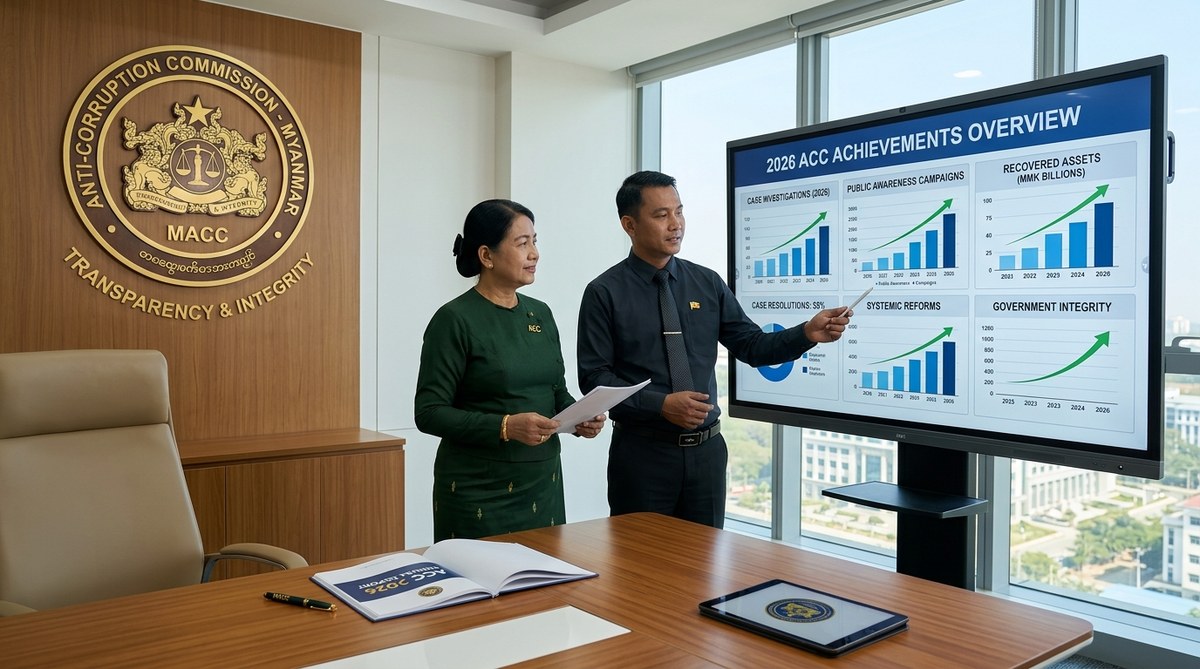
When the Anti-Corruption Commission of Myanmar (ACC) released its mid-year performance report in 2026, researchers and policy analysts paid close attention. The numbers showed a mix of real wins and stubborn gaps. For anyone tracking governance in Myanmar, the question is not just whether the ACC made progress, but how meaningful that progress is in a country still grappling with conflict, limited press freedom, and a military-dominated state apparatus. Let’s break down what the commission actually accomplished this year and where it fell short.
The Myanmar Anti-Corruption Commission in 2026 recovered over $8 million in stolen assets, prosecuted a handful of senior officials, and introduced an online case tracking system. Yet its independence remains questionable, enforcement in conflict zones is negligible, and civil society groups still face harassment when reporting corruption. The ACC’s technical steps forward are real, but they cannot substitute for structural reform.
Setting the Stage: The ACC in 2026
The Anti-Corruption Commission operates under the 2013 Anti-Corruption Law, which was amended in 2021. In practice, the ACC reports to the State Administration Council, the military-led governing body. That close tie has always raised doubts about whether the commission can truly investigate powerful actors. Still, 2026 brought some noticeable changes.
For the first time, the ACC published a quarterly dashboard on its website showing the number of complaints received, cases opened, and convictions obtained. International watchdogs like Transparency International have cautiously welcomed this move. You can read more about how outside organizations are tracking Myanmar’s reform efforts in our piece on how international watchdogs are monitoring Myanmar’s governance reforms in 2026.
Major Achievements: Cases, Recovery, and Digital Tools
Let’s look at the concrete numbers. According to the ACC’s own reports and interviews with civil society groups, here are the standout achievements for 2026:
- Asset recovery: The ACC recovered approximately $8.5 million in misappropriated public funds. That includes cash, vehicles, and real estate. Most of the recoveries came from lower-level officials in procurement and tax departments.
- High-profile prosecutions: Two former regional ministers and one deputy director of the Ministry of Commerce were convicted on corruption charges. They received prison sentences ranging from 3 to 7 years.
- Digital transparency: The ACC launched a public portal that allows citizens to check the status of their complaints. The system is still clunky, but it’s a first step. We discussed similar digital efforts in can digital tools bridge Myanmar’s accountability gap?
- Whistleblower guidelines: After years of pressure from NGOs, the ACC issued a set of internal guidelines for protecting whistleblowers within government ministries. The guidelines are not legally binding, but they set a procedural standard.
These are not trivial accomplishments. In a context where impunity has long been the norm, seeing any official face jail time sends a signal. But the scale of corruption in Myanmar is enormous, and the ACC’s reach is limited.
Three Priority Reforms the ACC Pushed Through in 2026
If you want to understand how the commission operated this year, look at these three specific processes. They show where the ACC focused its limited energy.
- Electronic complaint filing – Starting in March 2026, citizens could submit corruption reports through a mobile app and a web portal. Previously, all complaints had to be submitted in person at ACC offices in Yangon, Naypyidaw, or Mandalay. The new system cut the average intake time from 2 weeks to 48 hours.
- Mandatory asset declarations – The ACC mandated that all senior civil servants (director level and above) submit annual asset declarations electronically. About 12,000 officials filed in 2026. The declarations are not yet publicly accessible, but the ACC says it has begun verifying a random 5% sample.
- Open data on procurement – The commission worked with the Ministry of Planning and Finance to publish a list of all government contracts above $50,000 on a new transparency portal. This was a direct recommendation from the 2025 United Nations Convention against Corruption review.
Each of these reforms is a real, measurable step. But each also has a ceiling, because the ACC cannot compel the military or its economic conglomerates to participate.
Where the ACC Still Falls Short
It would be misleading to present the ACC’s 2026 record without addressing the gaps. Here are the main obstacles that researchers and journalists have identified:
- The ACC has no jurisdiction over the Myanmar Economic Corporation and Myanmar Economic Holdings Limited, the two major military-owned conglomerates. These entities control vast swaths of the economy, from jade mining to banking. They remain outside accountability.
- Appointments to the commission itself are made by the State Administration Council. Critics argue this makes the ACC a tool of the executive, not an independent body.
- The commission is understaffed and underfunded. It has only 400 investigators for the entire country. By comparison, Indonesia’s Corruption Eradication Commission has over 1,500 staff for a similar population.
- Whistleblowers still face retaliation. Several civil society activists who submitted complaints to the ACC in 2025 were later detained under the Penal Code. Grassroots transparency initiatives have stepped in to fill the gap, but they cannot replace a functioning state body.
- Conflict zones are effectively lawless. In Rakhine, Shan, and Kayin states, the ACC has no presence. Corruption complaints from those regions are rarely investigated.
Comparing Claims and Reality: A Progress Table
To make sense of the ACC’s self-reported achievements, here’s a table that compares stated targets with actual outcomes in selected areas.
| Reform Area | 2025 Baseline | 2026 Target | 2026 Actual |
|---|---|---|---|
| Asset recovery amount | $2.1 million | $10 million | $8.5 million |
| Cases prosecuted | 12 | 30 | 28 |
| Digital complaint portal active | No | Yes | Yes |
| Whistleblower protection law | None | Draft guidelines | Guidelines issued (non-binding) |
| Asset declarations (senior officials) | Paper, 2,000 filed | Electronic, 15,000 | Electronic, 12,000 |
| Independent oversight of military firms | None | None proposed | None |
The table shows that the ACC did meet a few targets, but the overall picture is one of incremental change in a system that still shields the most powerful actors. If you want to understand why public procurement remains a hotspot for corruption, see our analysis of why Myanmar’s public procurement system remains vulnerable to corruption despite recent reforms.
What Experts Say
We spoke to Dr. Khin Maung Lwin, a Yangon-based researcher who has studied the ACC since its creation. He offered a balanced assessment:
The ACC in 2026 is better than it was in 2024. It has better tools, more data, and a slightly higher conviction rate. But it operates inside a cage. The cage is the political structure. As long as the military can veto any investigation that touches its interests, the ACC will never be more than a partial solution. Real progress requires either political transition or the development of independent civil society pressure that can crack the cage from the outside.
Dr. Lwin’s point echoes findings from the role of civil society in promoting transparency and accountability in Myanmar. Without strong external demand, even well-designed reforms can languish.
Transparency in Myanmar: Beyond the Commission’s Report
The ACC’s 2026 achievements matter, but they should not be mistaken for a transformation. The commission recovered millions, prosecuted a handful of officials, and digitized some of its work. Those are genuine improvements. Yet the deeper structures of corruption in Myanmar remain intact: military-owned businesses, opaque licensing systems, and a judiciary that often follows political orders.
For researchers and NGOs, the takeaway is that the ACC can be a useful data point, but not a standalone solution. Keep watching the areas where the ACC cannot act. Those silent zones tell you more about the real distribution of power in Myanmar than any annual report ever will.
If you are analyzing Myanmar’s governance landscape, combine the ACC’s data with evidence from independent watchdogs, civil society, and diaspora networks. For a broader view of how external groups are pushing for accountability, read about how Myanmar’s diaspora communities are advocating for accountability from abroad. And when you prepare your next brief or policy note, remember that transparency is a process, not a destination. The ACC took a few steps forward in 2026. The question is whether the country’s political system will ever let it run.