
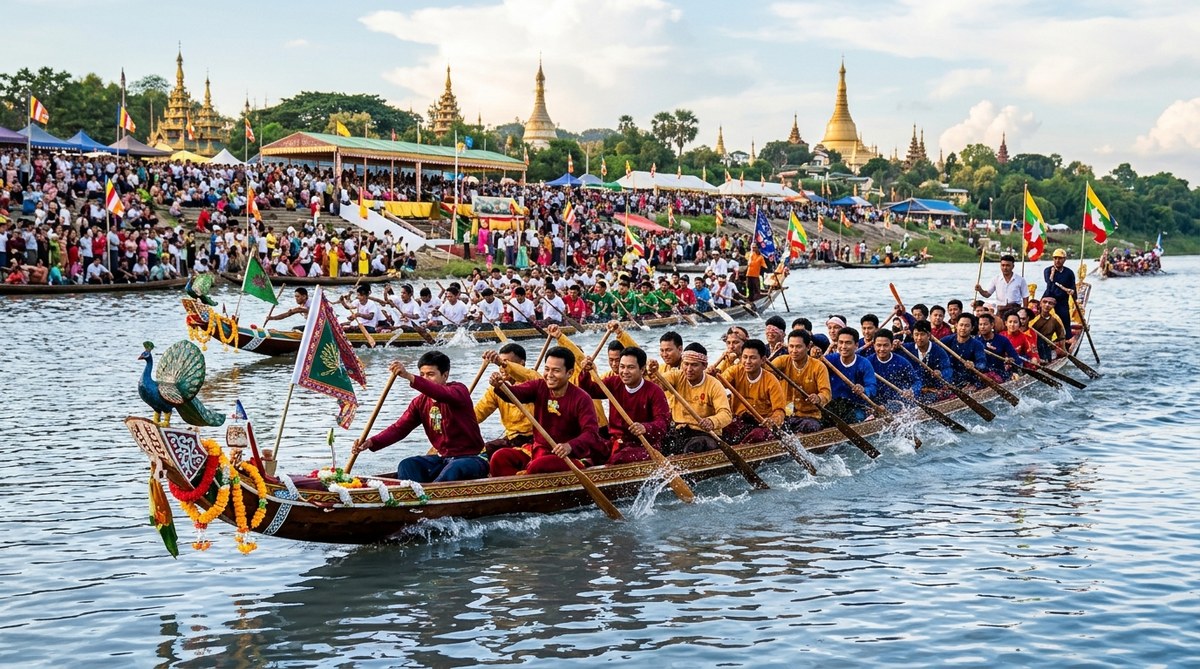
The first time I saw a longboat cut across the glassy surface of Inle Lake, I understood something important. The rowers did not just sit and pull oars. They stood on one leg, wrapped the other around the oar, and used their whole body to push the water. That image of leg rowing is the most famous symbol of the Myanmar traditional boat racing festival, but the festival itself is so much more. It is a gathering of towns, a celebration of the harvest, and a rare moment when the entire river community rows in the same direction.
The Myanmar traditional boat racing festival is not just a sport. It is a living tradition that strengthens social bonds between villages along the Ayeyarwady, Chindwin, and Inle Lake regions. Races happen during the post monsoon season, often tied to Buddhist holidays or harvest celebrations. Understanding the rituals, the unique leg rowing technique, and the community roles makes the experience richer for any visitor.
What Makes This Festival Different
You might have seen dragon boat festivals in other parts of Asia. The Myanmar version stands apart for one reason: the rowing style. In most of the world, rowers face backward and pull. In Myanmar, especially on Inle Lake, rowers stand at the stern on one leg. They wrap the other leg around the oar handle. This gives them more power and a better view of the water. It also looks like a dance.
The boats themselves are long and narrow. Some stretch over 50 feet. They are carved from a single tree trunk, usually teak or other hardwood. The front of the boat is decorated with elaborate carvings. You might see a mythical serpent or a lotus flower. These are not just decorations. They represent the village spirit.
The Seasonal Rhythm of the Races
The Myanmar traditional boat racing festival follows the monsoon cycle. Races happen after the rains end and the water levels drop. That usually means October through December. This timing is not accidental. The rivers are full, the rice has been harvested, and communities have time to celebrate.
Different regions hold their races at different times. Here are the major ones to know:
- Inle Lake (October/November): The most famous leg rowing regatta. Part of the Phaung Daw Oo Pagoda Festival.
- Ayeyarwady Delta (November): Larger boats, sometimes with 50 rowers. Tied to local pagoda festivals.
- Chindwin River (December): Smaller, more intimate village races. Fewer tourists, more local participation.
How Communities Prepare for Race Day
Preparing for a boat race is a village wide effort. It is not something a single team does alone. The entire community gets involved.
-
Boat selection and repair: Villages take their racing boat out of storage weeks before the event. They check for cracks, reapply waterproofing resin, and repaint the decorative carvings. This is often done by the elder fishermen who know the wood best.
-
Team tryouts: Young men and women from the village try out for the crew. Rowers are chosen for strength, endurance, and rhythm. The best rowers are not always the biggest. They are the ones who can keep a steady beat for the entire race.
-
Practice runs: Teams practice at dawn and dusk for two weeks before the main event. They row in silence at first, then add drumming. The drummer sets the pace. If the drummer is off, the whole boat loses.
-
Blessing ceremony: A Buddhist monk or village elder blesses the boat and the rowers. Offerings of flowers, rice, and coins are placed on the bow. This ensures safety and good luck.
-
Race day logistics: The village organizes food stalls, seating, and a judging platform. Families prepare packed meals for the rowers. It feels like a county fair on the water.
A Closer Look at the Racing Techniques
Not all boats row the same way. The technique depends on the region and the type of water. Here is a breakdown of the main styles.
| Technique | Region | Body Position | Best For |
|---|---|---|---|
| Leg rowing (Inle style) | Inle Lake | Standing on one leg, other leg wrapped around oar | Shallow, weed filled waters |
| Sitting row (Delta style) | Ayeyarwady Delta | Sitting on low bench, two hands on oar | Wide, open rivers with strong currents |
| Standing paddle (Chindwin style) | Chindwin River | Standing, using long single blade paddle | Narrow, winding tributaries |
| Knee row (Kachin style) | Northern rivers | Kneeling on boat floor, short oar | Fast, rocky streams |
Each style evolved for a reason. Inle Lake is shallow and covered with floating plants. Leg rowing lets the rower see the plants and avoid them. The Ayeyarwady Delta has strong tides. Sitting down gives more stability. The diversity of techniques is part of what makes the Myanmar traditional boat racing festival so fascinating.
“When you row in the Inle style, you are not just using your arms. You are using your spine, your legs, your breath. It is a full body prayer.”
U Thant Zin, former national rowing champion from Nampan Village
What Happens During the Festival
The race itself is only one part of the day. The festival includes ceremonies, food, music, and socializing. Here is what you can expect if you attend.
- Morning procession: Monks and villagers carry a Buddha image from the monastery to the water. They walk slowly, accompanied by drums and conch shells.
- Boat parade: All the competing boats line up and row past the crowd. Each boat flies a flag with the village name. The rowers wear matching longyi in bright colors.
- Opening ceremony: A senior monk or local official gives a short speech. They thank the spirits, the ancestors, and the water. Then they drop a flower into the river as an offering.
- The races: Heats run throughout the afternoon. Each heat has 4 to 6 boats. Distances vary from 500 meters to 2 kilometers. The crowd cheers by clapping and shouting the village names.
- Award ceremony: Winners receive cash prizes, new longyi, or a ceremonial trophy. The losing team often has to treat the winning team to tea or a meal.
- Evening entertainment: After the races, there is music, dancing, and sometimes a puppet show. Vendors sell grilled corn, fried snacks, and sweet tea.
Practical Advice for Visitors
If you want to see the Myanmar traditional boat racing festival, plan ahead. The dates shift each year because they follow the lunar calendar. Here are some tips to make your trip smoother.
- Check the local calendar: Contact a tour operator in Nyaungshwe (Inle Lake) or Pathein (Delta) about a month before you plan to travel. They will know the exact dates.
- Arrive early: Seating on the riverbank fills by 8 AM. Bring a small stool or a mat. The best views are from the water, so consider renting a small boat to watch from the lake.
- Dress respectfully: Shoulders and knees covered. This is a religious event. A simple longyi is ideal.
- Bring cash: Small vendors do not take cards. You will want to buy snacks, drinks, and maybe a souvenir.
- Respect the rowers: Do not block their path or get too close with a drone. The rowers need concentration. A drone buzzing overhead can break their rhythm.
For more general travel guidance, check out our practical guide to Myanmar customs and local etiquette for travelers in 2026. It covers dress codes, tipping, and greetings.
Common Mistakes to Avoid
Even well meaning visitors can make small errors that cause friction. Here are the most common ones.
- Taking photos during the blessing: The blessing ceremony is sacred. Wait until it is over. Then ask permission before photographing the monks or the boat.
- Touching the boat: The boat is considered a sacred object after the blessing. Do not lean on it or climb inside unless invited.
- Wearing shoes on the water: If you step onto a floating platform or a ceremonial raft, remove your shoes. This is standard practice at any religious site in Myanmar.
- Comparing races to Western sports: Do not say “This is like the Super Bowl.” That misses the point. The race is a religious and social ritual first, a competition second.
- Forgetting sunscreen: The sun reflects off the water. You will burn faster than you expect. Bring SPF 50 and a hat.
Why This Tradition Matters Today
Myanmar has gone through a lot of change in recent years. Political shifts, economic pressures, and the pandemic have all taken a toll. Yet the boat races endure. They are a thread that connects modern Myanmar to its past. They remind people that cooperation, not competition, is what keeps a village alive.
For cultural enthusiasts, the festival is a window into the Burmese worldview. The water is not just a resource. It is a living presence. The boat is not just a vehicle. It is a partner. The race is not just about winning. It is about honoring the ancestors who first carved these boats generations ago.
For travelers, watching a leg rowing race is one of those moments that stays with you. The balance, the grace, the silence between drumbeats. It is unlike anything else in Southeast Asia.
How to Learn More
If this article has sparked your curiosity, there are many ways to go deeper. You can read about the living tradition of Burmese nat worship in modern Myanmar to understand the spiritual context. Or explore how Myanmar’s ethnic minorities celebrate the new year differently to see the diversity within the country. For those interested in the broader festival landscape, our guide to discovering Myanmar’s unique festival traditions and their cultural significance is a great next step.
The Spirit of the River Lives On
The Myanmar traditional boat racing festival is not frozen in time. It adapts. Younger rowers now use lighter materials for the oars. Some villages livestream the races on Facebook so diaspora families can watch. But the core remains the same. A community gathers by the water. They remember who they are. They cheer for their neighbors. They row together.
If you get the chance to stand on the banks of Inle Lake in November, take it. Find a spot under a shade tree. Buy a cup of hot ginger tea. Watch the rowers balance on one leg, arms outstretched, faces calm. Listen to the drumbeat echo across the water. You will see something that no photograph can capture. You will see unity in motion.
And when the race ends and the winning team is carried off the boat on the shoulders of their friends, you will understand why this tradition has lasted for centuries. It is not about the trophy. It is about the moment when a whole village breathes as one.