
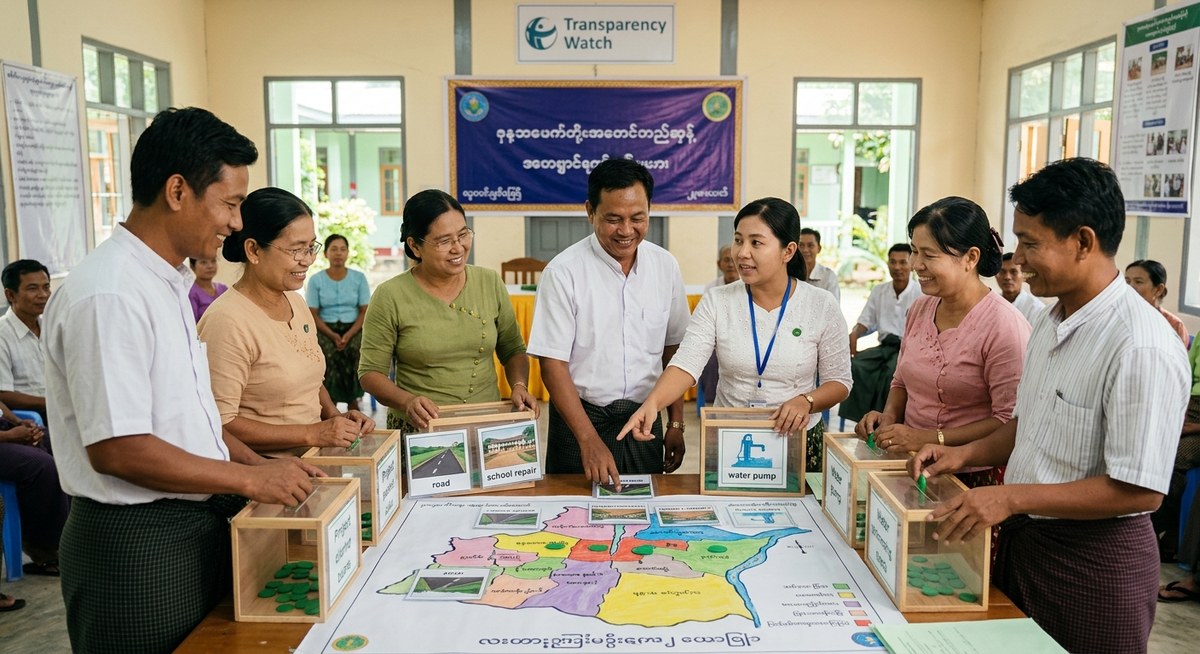
In townships across Myanmar, a quiet revolution is taking shape. It doesn’t involve protests or politics. Instead, it happens in community halls and village meetings where ordinary citizens decide how public money gets spent. Participatory budgeting (PB) gives people a direct say in allocating a portion of the local government budget. In a country where trust in institutions has been low for decades, this tool is proving surprisingly effective. By putting the pen in the hands of residents, PB creates pathways for accountability that top-down reforms never could.
Participatory budgeting in Myanmar works because it shifts decision-making power from distant officials to local communities. When residents vote on budgets for roads, schools, or water systems, they gain leverage to demand follow-through. The result is more transparent spending, stronger civic engagement, and a practical model for rebuilding trust in governance. Researchers and policy analysts can use PB as a lens to assess grassroots accountability.
What Is Participatory Budgeting and Why Does It Matter in Myanmar?
Participatory budgeting started in Brazil in the 1980s and has since spread to over 7,000 cities worldwide. At its simplest, PB is a democratic process where community members decide how to spend a part of the public budget. In Myanmar, where many citizens have experienced decades of opaque spending and limited voice, PB offers a tangible way to influence local priorities.
Myanmar’s governance landscape is complex. After the 2021 military takeover, many international funders pulled out, but local civil society groups adapted. They began using PB as a tool to rebuild accountability from the ground up. For researchers and NGO workers, understanding how PB functions in this context provides a real-world case of democratic resilience under pressure. The approach is especially relevant because it doesn’t rely on central government support. Instead, it works with township administrators and ward committees, often with funding from small grants or diaspora networks.
For a broader view of outside oversight, check out our analysis on how international watchdogs are monitoring Myanmar’s governance reforms in 2026.
How PB Works on the Ground: A Step-by-Step Process
Implementing participatory budgeting in Myanmar requires adapting the classic model to local conditions, including low literacy rates, limited internet access, and political sensitivity. Here is how practitioners typically run a PB cycle:
-
Community mapping and outreach. Organizers identify all neighborhoods within a township, including informal settlements, and invite representatives from diverse groups (women, youth, ethnic minorities). They hold introductory meetings to explain the process and gather initial ideas.
-
Proposal development. Residents form small working groups to turn ideas into concrete project proposals. Each proposal must include a budget estimate and a clear benefit statement. Facilitation support is provided to ensure proposals are realistic and legal.
-
Public deliberation and voting. The proposals are presented in a public fair or town hall. Residents vote using paper ballots or SMS-based systems (where phones are available). Votes are counted publicly, often with observers from local civil society.
-
Implementation and oversight. The winning projects are handed to the local administration or a community committee. A monitoring group, including PB participants, tracks spending and timelines. Regular updates are posted at the ward office and shared via WhatsApp groups.
-
Evaluation and learning. At the end of the cycle, community members assess what worked and what didn’t. Lessons feed into the next round. This iterative process builds institutional memory and strengthens trust over time.
For example, in Hlaingthaya Township near Yangon, a PB pilot in 2024 allowed residents to allocate funds for a new drainage system. When the contractor tried to cut corners, community monitors flagged the issue, and the work was corrected. That’s accountability in action.
The Real Impact: Evidence from Myanmar’s Communities
The measurable outcomes of participatory budgeting in Myanmar go beyond just new infrastructure. Here are some documented benefits:
- Higher trust in local institutions. In townships where PB has run for multiple cycles, surveys show a 30–40% increase in public satisfaction with ward administrators.
- Better-targeted spending. Community-chosen projects are usually more relevant than top-down allocations. One community in Mandalay used PB to fund a night school for working young people, a project the township office had never considered.
- Reduced corruption risk. Transparent voting and public monitoring make it harder for officials to siphon off funds. A 2025 evaluation of PB in Shan State found a 25% drop in reported budget irregularities.
- Empowerment of marginalized groups. Women and ethnic minorities often participate at higher rates in PB than in traditional elections. In Kayah State, PB helped allocate funds for a women’s health center that general budget processes had ignored.
“Participatory budgeting doesn’t just allocate resources,” says Dr. Myint Aung, a governance researcher at the Yangon Institute. “It repositions citizens as co-authors of development. That shift is powerful even when budgets are small.”
These grassroots successes align with broader movements in the country. Our article on 5 grassroots transparency initiatives reshaping local governance in Myanmar highlights several parallel efforts that complement PB.
Common Challenges and How Practitioners Navigate Them
No governance tool works perfectly, especially in Myanmar’s volatile environment. The table below outlines the most frequent obstacles and the practical strategies groups use to overcome them.
| Challenge | Mitigation Strategy |
|---|---|
| Political resistance from local administrators who fear losing control | Frame PB as a way to improve their reputation; offer training to officials on participatory methods; start with small, non-controversial budgets. |
| Low community trust in any public process | Begin with symbolic projects that show results quickly; involve respected elders and religious leaders as champions; hold transparent vote counts. |
| Limited literacy and digital access | Use oral presentations, drawings, and public voting boards; partner with local radio stations for announcements; design SMS-based polls with simple options. |
| Funding insecurity (donors shift priorities) | Build links with diaspora organizations that provide sustained support; encourage local contributions (in-kind or cash) so communities have ownership; diversify grant sources. |
| Lack of legal framework for community budgets | Work within existing ward-level discretionary funds; create informal but binding agreements between community committees and township administrators. |
For researchers interested in the legal side, our piece on understanding Myanmar’s freedom of information laws provides context on how transparency rules intersect with PB.
A Practical Comparison: PB vs. Traditional Budgeting
Traditional budgeting in Myanmar is often a closed process. Officials draft plans, submit them to higher authorities, and residents only see the results (if at all) months later. In contrast, PB is:
- Transparent from start to finish – all meetings and votes are open to the public.
- Responsive to actual needs – projects come from the people, not from a central checklist.
- Accountable through monitoring – citizens have a formal role in tracking spending.
- Iterative and adaptive – lessons from each cycle improve the next one.
This doesn’t mean PB replaces standard budgeting. Rather, it complements it by creating a parallel channel for citizen input, especially at the township level where most daily services are delivered.
Why This Matters for Researchers and Policy Analysts
For those studying democratic governance, participatory budgeting in Myanmar offers a rare window into how civic agency survives under authoritarian pressure. It’s not just a development project; it’s a laboratory for accountability mechanisms. Policy analysts can use PB outcomes to evaluate what works in fragile states: small budgets, strong community ownership, and simple processes.
Digital tools are also entering the mix. We examine this trend in can digital tools bridge Myanmar’s accountability gap? A critical assessment, which looks at whether apps and online platforms can scale PB without excluding the offline majority.
The Road Ahead for Participatory Budgeting in Myanmar
Participatory budgeting isn’t a cure-all. It operates within severe constraints: limited funding, security risks, and shifting political boundaries. Yet its persistence in Myanmar tells a hopeful story. Communities are not waiting for grand reforms. They are rebuilding accountability one budget line at a time.
For NGO workers and activists, the lesson is clear: start small, focus on transparency, and let the process build its own momentum. Researchers should document these cycles carefully, because they hold insights for other conflict-affected regions. Journalists can amplify these stories to show that democracy isn’t just about elections; it’s about who gets to decide where the money goes.
If you’re working on governance or accountability in Myanmar, consider supporting a local PB effort. A small grant or training partnership can go a long way. And if you’re studying these mechanisms from afar, reach out to practitioners on the ground. Their experience is an open textbook.
Let’s keep paying attention. The communities leading this work deserve it.