

The international community maintains an intricate web of oversight mechanisms focused on Myanmar’s governance situation, yet the actual impact of these monitoring efforts remains hotly debated among policy professionals. Multiple watchdog organizations deploy distinct methodologies to track everything from sanctions evasion to human rights violations, creating a complex landscape that requires careful navigation for anyone seeking reliable intelligence on the country’s political trajectory.
Myanmar governance monitoring 2024 involves coordinated efforts by UN bodies, regional organizations, human rights groups, and financial watchdogs tracking sanctions compliance, political prisoner numbers, internet restrictions, and economic indicators. These organizations employ satellite imagery, financial transaction analysis, testimony collection, and ground-level reporting networks to document governance failures and hold actors accountable despite severe access restrictions.
Major Organizations Conducting Oversight
Several key institutions form the backbone of international monitoring efforts in Myanmar throughout 2024.
The United Nations Special Rapporteur on Myanmar publishes quarterly reports documenting human rights violations and governance failures. These reports synthesize information from multiple sources including refugee testimony, satellite imagery analysis, and communications with underground networks inside the country.
Freedom House releases its annual Freedom in the World and Freedom on the Net assessments, providing numerical scores across political rights and civil liberties categories. Their 2024 Myanmar report highlights deteriorating internet freedom scores as the military government expanded digital surveillance infrastructure and restricted mobile data access in conflict zones.
Human Rights Watch maintains continuous monitoring operations, publishing targeted reports on specific governance issues ranging from arbitrary detention patterns to forced labor practices. Their January 2025 annual report documented how the junta severely restricted internet and phone services throughout 2024, impacting humanitarian operations and civilian communication networks.
The Bertelsmann Stiftung’s Transformation Index (BTI) provides comprehensive governance assessments every two years. Their 2024 Myanmar Country Report evaluates stateness, political participation, rule of law, and economic transformation indicators through a standardized methodology applied across 137 countries.
CIVICUS Monitor tracks civic space conditions, categorizing Myanmar as “closed” based on restrictions affecting freedom of expression, association, and peaceful assembly. Their February 2025 report documented continued persecution of political prisoners and new draconian cybersecurity legislation enacted during 2024.
How Watchdogs Collect Information Under Restrictions
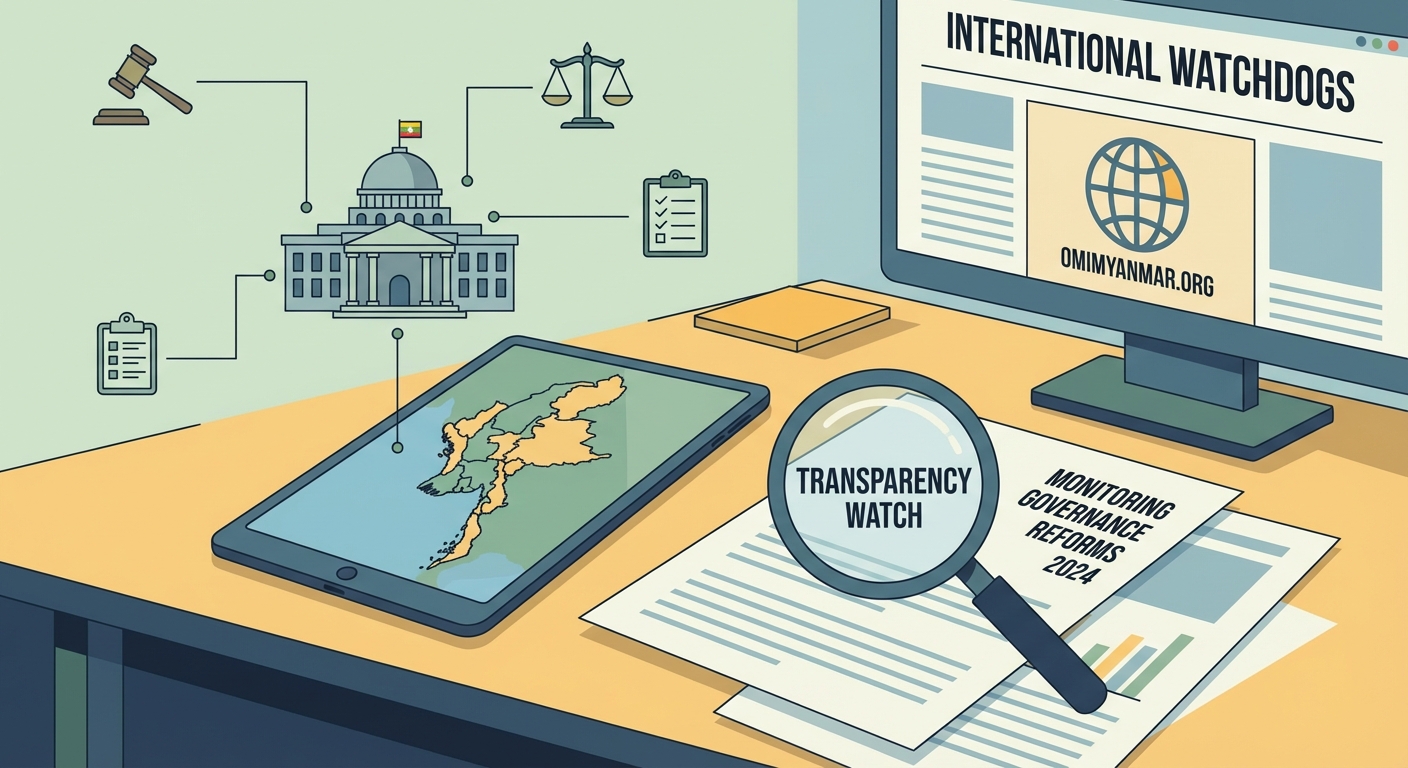
Monitoring Myanmar’s governance presents unique methodological challenges given severe access restrictions for international observers.
Most organizations rely on remote sensing technologies combined with human intelligence networks. Satellite imagery analysis reveals infrastructure developments, displacement patterns, and conflict-related destruction that ground-level reporting cannot safely document.
Financial transaction monitoring forms another critical pillar. Watchdog organizations track banking flows, trade data, and corporate ownership structures to identify sanctions evasion mechanisms. This work requires collaboration with financial intelligence units in jurisdictions where Myanmar-linked transactions occur.
Testimony collection happens primarily in border regions and refugee settlements. Trained researchers conduct structured interviews with recent arrivals from Myanmar, documenting their experiences with governance systems, security forces, and administrative processes.
Digital forensics teams analyze leaked documents, social media content, and government communications to verify claims and establish timelines. This work often involves collaboration with Myanmar civil society organizations operating in exile.
“The challenge isn’t gathering information about governance failures in Myanmar. The challenge is verifying that information through multiple independent sources when access is completely restricted and the risks to sources are extreme.” – Senior researcher at international human rights organization
Specific Governance Areas Under Surveillance
International watchdogs focus their monitoring efforts across several distinct governance dimensions.
Political prisoner documentation represents perhaps the most intensive monitoring area. The Assistance Association for Political Prisoners (Burma) maintains real-time databases tracking arrests, detentions, trials, and prison conditions. Their methodology involves family contact networks, legal observer reports, and prison informant systems.
Economic governance and sanctions compliance monitoring examines how Myanmar’s military-controlled economy operates under international restrictions. Organizations track jade exports, timber trade, financial transactions, and corporate ownership structures to identify sanctions violations and revenue streams funding military operations.
Internet freedom and digital rights monitoring intensified throughout 2024 as the military government expanded censorship infrastructure. Watchdogs document website blocking, social media restrictions, mobile data shutdowns, and surveillance technology deployment. Network measurement tools provide technical evidence of connectivity disruptions.
Judicial independence and rule of law assessments examine court proceedings, legal framework changes, and access to justice. Monitoring organizations track politically motivated prosecutions, legal amendments expanding military authority, and the functioning of parallel justice systems in resistance-controlled areas.
The complexity of why Myanmar’s public procurement system remains vulnerable to corruption despite recent reforms adds another layer to governance monitoring efforts, as watchdogs attempt to distinguish between systemic weaknesses and deliberate misappropriation.
Regional Organizations and Their Distinct Approaches
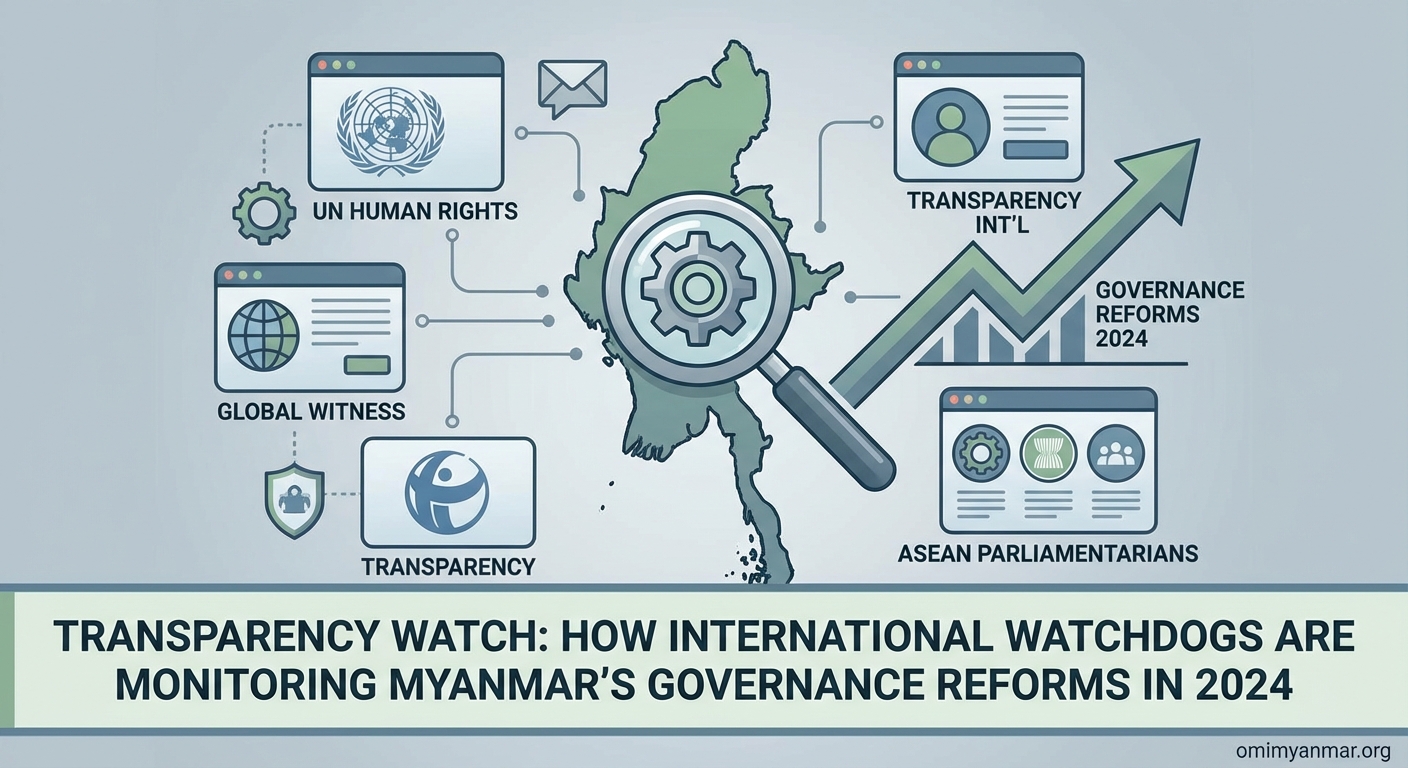
ASEAN’s role in Myanmar governance monitoring follows fundamentally different principles than Western-based watchdog organizations.
The Association of Southeast Asian Nations released its Five-Point Consensus in April 2021, establishing benchmarks for Myanmar’s political transition. However, implementation monitoring has proven ineffective. ASEAN’s 2024 summits under Laos’s chairmanship produced minimal progress on consensus implementation, highlighting the limitations of consensus-based regional approaches.
ASEAN’s monitoring methodology emphasizes diplomatic engagement and quiet diplomacy over public accountability mechanisms. Special envoys conduct periodic visits and shuttle diplomacy, though their access and effectiveness remain severely constrained.
This approach contrasts sharply with the public reporting and naming-and-shaming strategies employed by UN bodies and international NGOs. The different methodologies reflect underlying philosophical disagreements about how external actors should respond to governance failures in sovereign states.
Tracking Methods and Their Limitations
Understanding the specific techniques watchdogs employ helps contextualize the reliability and gaps in available governance data.
| Monitoring Method | Primary Applications | Key Limitations |
|---|---|---|
| Satellite imagery analysis | Infrastructure development, displacement tracking, conflict damage assessment | Cannot verify intent, limited temporal resolution, weather dependent |
| Financial transaction tracking | Sanctions evasion, revenue flows, corporate networks | Requires cooperation from financial institutions, incomplete coverage |
| Testimony collection | Human rights violations, administrative practices, lived experiences | Selection bias, memory limitations, verification challenges |
| Network measurement | Internet censorship, connectivity disruptions, surveillance infrastructure | Technical expertise required, limited geographic coverage |
| Legal document analysis | Legislative changes, court proceedings, regulatory frameworks | Translation requirements, incomplete access to documents |
| Open source intelligence | Social media monitoring, leaked documents, public statements | Authenticity verification needs, propaganda risks |
Each methodology produces valuable insights while containing inherent blind spots. Comprehensive monitoring requires triangulating multiple data sources to build reliable pictures of governance conditions.
Understanding the Monitoring Process Step by Step
For policy analysts and researchers seeking to utilize watchdog reports effectively, understanding how these organizations produce their assessments proves essential.
-
Information gathering phase typically spans several months, with researchers collecting data from diverse sources including remote sensing, testimony, document analysis, and digital forensics.
-
Verification and corroboration involves cross-checking claims against multiple independent sources, establishing timelines, and assessing source reliability through established protocols.
-
Analysis and contextualization places verified information within broader governance frameworks, identifying patterns, comparing against international standards, and assessing significance.
-
Report drafting and review subjects initial findings to internal peer review, legal vetting, and often external expert consultation before publication.
-
Publication and advocacy releases findings through multiple channels, often coordinated with media outreach, policy briefings, and advocacy campaigns targeting specific decision-makers.
-
Follow-up monitoring tracks responses to published reports, documents any retaliation against sources, and updates findings as new information emerges.
This systematic approach aims to balance timeliness with accuracy, though the tension between these goals constantly shapes monitoring work.
Key Indicators Watchdogs Track Continuously
Certain governance metrics receive sustained attention from monitoring organizations because they serve as bellwethers for broader conditions.
Political prisoner numbers fluctuate based on arrest waves, trial outcomes, and occasional releases. The count stood above 20,000 in early 2025 according to AAPP documentation, representing a key metric for assessing political repression intensity.
Internet shutdown frequency and duration provides quantifiable evidence of information control efforts. Organizations document both nationwide shutdowns and targeted disruptions in specific townships or regions.
Sanctions designation additions track which individuals and entities international bodies identify as complicit in governance failures. New designations signal evolving understanding of power networks and accountability efforts.
Civilian casualty figures from conflict zones indicate the humanitarian impact of governance breakdown. Multiple organizations maintain separate databases, with figures varying based on verification standards and information access.
Economic indicators including GDP contraction, currency depreciation, and foreign investment flows provide context for understanding how governance failures translate into material hardship.
Legislative changes expanding military authority or restricting civil liberties demonstrate the formal legal framework supporting authoritarian governance.
These indicators don’t tell complete stories individually, but collectively they paint pictures of governance trajectories that inform policy responses.
Challenges Specific to Myanmar’s Context
Myanmar presents monitoring challenges that exceed those in many other restricted environments.
The country’s ethnic and geographic diversity means governance conditions vary dramatically across regions. Military-controlled urban centers operate under different systems than ethnic armed organization-administered border areas or resistance-controlled rural zones. Monitoring organizations must account for this fragmentation when making national-level assessments.
The information environment includes sophisticated disinformation operations by multiple actors. Military-controlled media outlets, resistance groups, ethnic armed organizations, and external actors all produce competing narratives. Verification becomes exponentially more complex in this contested space.
Language barriers compound access challenges. Myanmar’s linguistic diversity means effective monitoring requires teams with Burmese fluency plus competency in numerous ethnic languages. Translation and interpretation introduce additional verification steps and potential error sources.
The security risks for local information sources remain extreme. Anyone providing information to international watchdogs faces arrest, torture, and lengthy imprisonment if discovered. This reality constrains what monitoring organizations can ethically request from ground-level sources.
Connecting to Myanmar through digital channels has become increasingly difficult as surveillance infrastructure expands, affecting both monitoring operations and the broader information ecosystem.
Coordination Mechanisms Among Watchdog Organizations
International monitoring efforts involve both competition and collaboration among organizations with overlapping mandates.
Informal information-sharing networks allow organizations to verify claims, avoid duplication, and coordinate publication timing for maximum impact. These networks operate through secure communication channels and periodic coordination meetings.
Some organizations maintain formal partnerships, particularly around specialized monitoring areas. Financial watchdogs collaborate with human rights groups to connect revenue flows with specific violations. Digital rights organizations share technical infrastructure for network measurement.
However, methodological differences and institutional priorities create tensions. Organizations using different verification standards may reach conflicting conclusions about the same events. Funding competition can discourage information sharing despite collaborative rhetoric.
The UN system provides some coordination infrastructure through the Special Rapporteur’s office and the Independent Investigative Mechanism for Myanmar, though these bodies face their own access and resource constraints.
How Monitoring Translates Into Accountability Mechanisms
The ultimate purpose of governance monitoring extends beyond documentation to enabling accountability.
Targeted sanctions rely heavily on watchdog research to identify individuals and entities meriting designation. Organizations provide detailed evidence packages supporting sanctions proposals to relevant governments.
International Criminal Court proceedings utilize monitoring organization reports as part of broader evidence gathering. While the ICC cannot prosecute crimes in Myanmar directly due to jurisdictional limitations, related cases involving Rohingya persecution in Bangladesh draw on this documentation.
Universal jurisdiction cases in third countries increasingly reference monitoring organization findings. Several European nations have initiated prosecutions against Myanmar military officials based partly on watchdog documentation.
Diplomatic pressure and policy formulation by governments and international organizations incorporates monitoring reports into decision-making processes. Regular briefings connect watchdog findings with policy responses.
Corporate accountability mechanisms use monitoring data to assess supply chain risks and human rights due diligence obligations. Companies operating in or sourcing from Myanmar face growing pressure to demonstrate governance risk awareness.
The accountability chain from monitoring to consequences remains incomplete and often frustratingly slow, yet the documentation work creates essential foundations for future justice processes.
Assessing Monitoring Effectiveness and Gaps
Critical evaluation of monitoring efforts reveals both successes and persistent shortcomings.
Watchdog organizations have successfully documented extensive evidence of governance failures, human rights violations, and accountability gaps. This documentation serves historical record functions and supports various accountability mechanisms.
However, monitoring has not prevented ongoing violations or fundamentally altered the military government’s behavior. The deterrent effect of international scrutiny appears minimal when actors calculate that they can operate with impunity despite documentation.
Coverage gaps persist in remote areas, among marginalized populations, and regarding certain violation types. Economic governance monitoring particularly struggles with opacity in military-controlled business networks.
Methodological limitations mean some claims remain unverifiable despite extensive investigation efforts. The standards of proof required for different accountability mechanisms vary, creating tensions around what can be conclusively stated.
Resource constraints affect all monitoring organizations, forcing difficult prioritization decisions about which governance areas receive sustained attention versus periodic review.
Emerging Monitoring Technologies and Approaches
Innovation in monitoring methodologies continues as organizations adapt to evolving challenges.
Artificial intelligence applications now assist with analyzing large volumes of social media content, identifying patterns in legal documents, and processing satellite imagery at scale. These tools augment rather than replace human analysis.
Blockchain-based evidence preservation systems aim to create tamper-proof records of documentation that can support future accountability processes. Several organizations experiment with distributed ledger technologies for sensitive materials.
Biometric and forensic technologies enable more sophisticated analysis of photo and video evidence, helping verify authenticity and establish chains of custody for digital materials.
Collaborative verification platforms allow multiple organizations to contribute to and validate shared databases, improving efficiency and reducing duplication while maintaining security.
Predictive analytics attempt to identify early warning indicators of escalating violations or governance deterioration, though these approaches remain experimental and controversial.
These technological advances create new capabilities while introducing fresh ethical considerations around data security, algorithmic bias, and the appropriate role of automation in human rights work.
What Policy Professionals Need From Monitoring Reports
Understanding how to effectively utilize watchdog organization outputs requires knowing what these reports can and cannot provide.
Monitoring reports excel at documenting what happened, when, where, and to whom. They provide factual foundations for understanding governance conditions and violation patterns.
Reports typically include contextual analysis explaining how documented events fit within broader political, economic, and social dynamics. This analysis helps non-specialists understand significance.
Most reports identify responsible actors to varying degrees of specificity, depending on available evidence and legal considerations. Attribution remains one of the most challenging and consequential aspects of monitoring work.
What reports generally cannot provide are definitive predictions about future trajectories or clear policy prescriptions. Monitoring organizations typically maintain analytical distance from specific policy advocacy, though some combine monitoring with explicit advocacy mandates.
The gap between what monitoring reveals and what policy responses emerge remains a persistent frustration for both watchdog organizations and the populations they document.
Staying Current With Monitoring Outputs
Policy analysts, researchers, and journalists tracking Myanmar governance need systematic approaches to monitoring the monitors.
- Subscribe to email alerts from major watchdog organizations to receive new reports immediately upon publication
- Follow UN Special Rapporteur social media accounts for real-time updates on emerging situations
- Monitor CIVICUS and Freedom House annual releases for comprehensive governance assessments
- Track specialized organizations like AAPP for political prisoner data updates
- Review financial watchdog publications for sanctions evasion and economic governance analysis
- Attend virtual briefings and webinars that monitoring organizations host for policy communities
- Establish relationships with researchers at key organizations for background discussions
- Cross-reference multiple sources when significant events occur to understand different analytical perspectives
The volume of monitoring outputs can overwhelm individual analysts. Developing efficient filtering and prioritization systems becomes essential for staying informed without drowning in information.
The Human Element Behind the Data
Numbers in monitoring reports represent individual human experiences of governance failure.
Behind political prisoner statistics are families separated, careers destroyed, and lives fundamentally altered by arbitrary detention. Each internet shutdown affects millions of people losing connection with loved ones, livelihoods, and information access.
Monitoring organizations walk difficult lines between necessary abstraction for analytical purposes and maintaining the human dignity of those whose suffering they document. The best reports balance quantitative rigor with qualitative testimony that preserves individual voices.
The silent struggle of Myanmar professionals who left successful careers behind illustrates the personal costs of governance breakdown that aggregate statistics cannot fully capture.
This human dimension matters not just for ethical reasons but for analytical ones. Understanding governance failures requires grasping how they manifest in individual lives and community experiences.
Building on Historical Monitoring Foundations
Current Myanmar governance monitoring builds on decades of documentation work.
Organizations have tracked conditions in Myanmar through multiple political transitions, from the 1988 uprising through the 2011-2021 opening period and the 2021 coup aftermath. This longitudinal perspective enables comparative analysis across different governance systems.
Historical documentation also establishes baselines against which current conditions can be measured. Understanding how today’s restrictions compare with past periods provides important context for assessing severity and trajectory.
Lessons learned from previous monitoring efforts inform current methodologies. Organizations refined verification protocols, source protection measures, and analytical frameworks through experience across multiple crisis periods.
When the Ava Kingdom fell silent centuries ago, the absence of systematic documentation left historical gaps that contemporary monitoring efforts aim to prevent for future generations seeking to understand this period.
Keeping Perspective on What Monitoring Achieves
International watchdog work on Myanmar governance monitoring 2024 continues despite limited immediate impact on ground conditions. The documentation serves multiple purposes beyond short-term behavior change.
Creating historical records ensures that governance failures and human rights violations cannot be denied or forgotten. This archival function supports truth-telling and eventual reconciliation processes.
Providing evidence for accountability mechanisms, even if those mechanisms activate slowly, maintains pressure and possibility for future justice. The International Criminal Court and various universal jurisdiction cases demonstrate how documentation from years past eventually supports legal proceedings.
Informing policy communities enables more evidence-based decision-making by governments, international organizations, and civil society actors engaged with Myanmar. While policy responses often disappoint, they would be even less informed without systematic monitoring.
Supporting affected communities by amplifying their experiences and maintaining international attention provides some solidarity, even when material support remains limited.
The gap between monitoring capacity and accountability outcomes reflects broader challenges in the international system’s ability to respond to governance failures in sovereign states. Myanmar’s situation tests the limits of existing mechanisms while potentially informing their evolution.
For policy analysts, human rights researchers, and journalists working on Myanmar issues, understanding the monitoring ecosystem proves essential for navigating available information, assessing its reliability, and recognizing both its value and limitations in driving meaningful change.
Making Sense of Competing Assessments
Different watchdog organizations sometimes reach varying conclusions about Myanmar’s governance situation based on methodological differences and analytical frameworks.
These variations don’t necessarily indicate that some organizations are wrong while others are right. Different verification standards, source networks, and analytical priorities produce legitimate differences in emphasis and interpretation.
Critical consumers of monitoring reports should examine methodologies, understand organizational mandates, and recognize that partial pictures from multiple perspectives often provide richer understanding than single authoritative assessments.
Triangulating across multiple monitoring sources, noting where they converge and diverge, and understanding the reasons for differences enables more sophisticated analysis than relying on any single organization’s outputs.
The monitoring ecosystem’s diversity ultimately strengthens overall understanding, even when it complicates efforts to identify simple answers to complex governance questions.