
“`
“`markdown
A university graduate in Yangon uses a smartphone app to track how her township’s education budget was spent. In Mandalay, a group of teenagers records road construction delays and posts them on a local Facebook group. Across Myanmar, young people are no longer waiting for institutional change to trickle down. They are building their own tools to demand transparency and hold local officials accountable. These youth-led transparency campaigns are reshaping how governance works at the village, township, and regional levels.
Myanmar’s youth are driving a quiet revolution in local governance by blending digital tools, community organizing, and media literacy. They expose corruption, track public spending, and demand accountability without waiting for top-down reforms. Their campaigns face serious risks from political repression and internet shutdowns, but their grassroots approach is building a more informed and active citizenry from the ground up. For researchers and policy analysts, these movements offer vital lessons in civic resilience.
The New Face of Accountability
Young people in Myanmar are uniquely positioned to challenge opaque governance. They grew up after the 2011 political reforms, when mobile internet exploded and social media became the primary source of news. Many speak English, have studied abroad, or have relatives in the diaspora who share global standards of transparency. They also face a state that is at best indifferent to corruption and at worst actively hostile to oversight. This combination of skills, connectivity, and frustration has created a fertile ground for grassroots accountability work.
What makes these campaigns different from older civil society efforts is their speed and informality. They do not wait for NGO funding or government permission. They start with a single phone, a Facebook page, and a determination to ask hard questions.
- They use low-cost digital tools: shared Google Sheets for budget tracking, Telegram groups for whistleblowing, and Facebook Live for town hall recordings.
- They are deeply local: campaigns focus on one school, one hospital, or one infrastructure project, not abstract policy.
- They are cross-ethnic: young activists from Bamar, Shan, Kayin, and other backgrounds collaborate through shared online spaces.
- They prioritize visual evidence: photos and videos of unfinished buildings, missing supplies, or inflated prices are more powerful than written reports.
A 2025 study by a Yangon-based research institute found that youth-led transparency initiatives had been launched in at least 48 townships across seven states and regions. The majority started after 2021, when the political crisis shattered trust in formal institutions and pushed young people to take matters into their own hands. For a broader look at how similar efforts are unfolding nationwide, see our overview of 5 grassroots transparency initiatives reshaping local governance in Myanmar.
How These Campaigns Actually Work
Most youth-led transparency campaigns follow a similar pattern, even though they operate independently. Understanding this process helps researchers and activists see where interventions can strengthen or scale them.
-
Identify a concrete information gap. A group picks a specific public project or budget line that is poorly documented. For example, “We want to know how many textbooks the township education office bought last year.” They request data from local officials or collect it themselves through surveys and site visits. When officials refuse, they build a case using indirect evidence like photos, receipts, and contractor names.
-
Amplify findings through social media. Once they have solid evidence, they package it into posts, short videos, or infographics designed for sharing. Facebook remains the dominant platform, but younger activists also use TikTok and Snapchat to reach peers. The content is often tagged with local community pages so that residents can verify the claims and add their own observations.
-
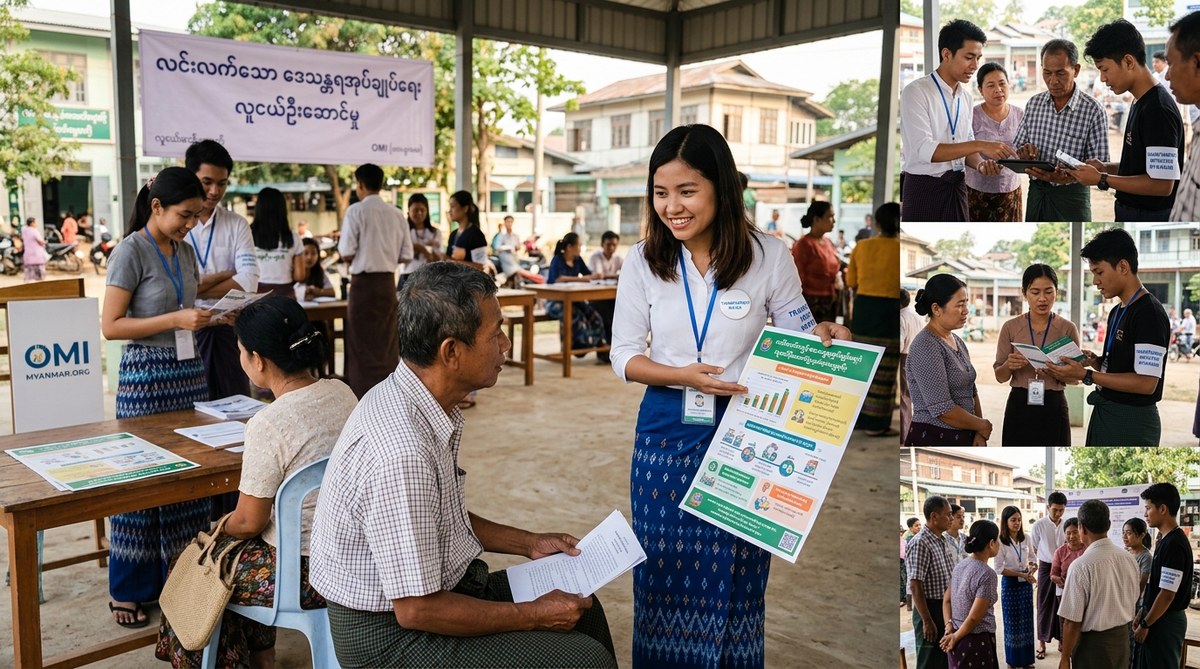
Organize public verification events. After the online buzz, groups hold in-person gatherings sometimes called “transparency circles.” Community members, local journalists, and sometimes low level administrators attend. Activists present their evidence publicly and invite questions. These events are recorded and shared online to create an unerasable record.
-
Follow up with targeted advocacy. Based on what they find, the youth group pressures the responsible authority through petitions, letters, or media stories. If the problem is corruption, they may work with a local lawyer to file a formal complaint. If it is mismanagement, they propose a clear fix and monitor its adoption.
These four steps are not theoretical. They have been used successfully in townships like Hpa-An, Lashio, and Pathein to expose everything from overpriced cement to missing medicine. To see how technology is accelerating this cycle, read our piece on how open data platforms are revolutionizing transparency in Myanmar’s local governments.
Techniques That Work and Common Pitfalls
Not every campaign succeeds. Some stall because of internal conflict, some because of government backlash, others because of poor strategy. The table below contrasts effective approaches with mistakes that often derail youth-led efforts.
| Effective Technique | Common Mistake | Real-World Example |
|---|---|---|
| Start with a narrow, winnable issue (e.g., 1 school’s supply budget) | Take on too many topics at once, spreading volunteers thin | A Yangon group focused only on school latrines and got them repaired in 3 months |
| Build relationships with local journalists before publishing findings | Go public without media allies, then get ignored or misrepresented | Activists in Mandalay who briefed a local reporter first saw their story picked up by national outlets |
| Use simple, visual reports (infographics, photo timelines) | Write long PDF reports that few people read | A Shan State group turned budget data into a 1-page comic and reached 50,000 shares |
| Establish clear decision-making rules to avoid internal disputes | Rely on a single charismatic leader who burns out | A collective in Bago built a rotating leadership system that kept the campaign running for 2 years |
| Plan for digital safety: encrypted backups, anonymous accounts | Post everything from personal phones without protection | After a 2024 crackdown, several activists lost devices because they hadn’t encrypted their messages |
Building digital resilience is not optional. Young activists who ignore their own security risk being silenced or worse. For a deeper look at the legal context, read our analysis of understanding Myanmar’s freedom of information laws.
“We learned the hard way that transparency is not just about revealing information. It is about protecting the people who do the revealing. Every youth campaign needs a security coordinator who thinks about data backups, safe communication channels, and exit strategies before the first post goes up.” — Senior trainer at a Myanmar civil society support organization
The Real Obstacles They Face
Youth-led transparency campaigns operate under constant threat. Political repression is the most obvious danger. Since the 2021 military takeover, authorities have arrested activists for posting budget comparisons, monitoring construction projects, or even sharing public tender documents. The 2023 Cybersecurity Law and the 2024 amendments to the Electronic Transactions Law give the state broad powers to prosecute anyone who “harms public order” online. Young people are especially vulnerable because they often lack legal support and cannot afford bail.
Internet shutdowns are another crippling barrier. When conflict flares up in a region, the military frequently cuts mobile data for days or weeks. Campaigns that rely entirely on Telegram and Facebook become paralyzed. Some groups now operate offline as well, printing posters and holding physical meetings in monasteries or tea shops. But this slows them down and increases exposure to surveillance.
Funding is also a persistent challenge. International donors are wary of supporting activities that might be seen as political interference. Local foundations have limited budgets. Many activists fund campaigns out of their own pockets or rely on small donations from the diaspora. This makes sustained work over months or years very difficult.
Digital literacy gaps within communities also limit impact. Even after a campaign publishes its findings, many villagers cannot read the budget charts or understand the technical language. Translating complex data into simple visuals that work without internet access requires extra effort. Our article on how technology is transforming civic engagement and transparency in Myanmar in 2026 explores how activists are adapting tools to work around these constraints.
What Researchers and Policy Analysts Can Learn
For those studying civil society in authoritarian or semi-authoritarian settings, Myanmar’s youth-led transparency campaigns offer fresh evidence about how accountability can emerge from below, not just from international pressure or legal frameworks. These movements are messy, informal, and often short-lived. But their cumulative effect is measurable.
- Trust shifts: In townships where campaigns have been active, residents report higher willingness to report corruption and lower tolerance for bribery.
- Service delivery improves: Schools, clinics, and roads that get public attention tend to see faster repairs and fewer missing supplies.
- New leaders emerge: Many young activists go on to run for local office or join formal watchdog bodies, bringing their transparency skills into institutions.
Policy analysts should watch how these movements interact with official anti-corruption bodies. The Myanmar Anti-Corruption Commission (ACC) has shown interest in civil society data, but coordination remains rare. A 2025 pilot in Naypyidaw allowed three youth groups to submit evidence directly to the ACC. Two cases led to formal investigations. Scaling this kind of partnership could bridge the gap between grassroots action and institutional enforcement. For more on the ACC’s progress, see what has Myanmar’s anti-corruption commission achieved in 2026.
Where Youth-Led Transparency Goes Next
Young activists are not waiting for permission to keep going. They are already experimenting with new methods such as participatory budgeting, where citizens decide how to spend a portion of local government funds. They are training younger peers in high schools to spot irregularities in their own school budgets. And they are building cross-border networks with diaspora communities who can amplify their findings internationally.
The biggest test ahead is whether these campaigns can survive a sustained crackdown. If the state blocks internet for long periods or jails multiple leaders, many efforts will wither. But the generation that started them is not giving up easily. They have seen what transparency can achieve: a repaired bridge, a recovered teacher salary, a corrupt contractor removed. Those small wins are addictive. They prove that young people in Myanmar can shape their own governance, one campaign at a time.
For researchers and activists watching from outside, the most useful support you can offer is not funding or publicity. It is protection. Advocate for digital rights, support safe communication tools, and amplify the stories of youth activists without putting them in the spotlight. That is how you help a movement that is already doing the hard work on the ground.
If you want to track these campaigns more closely, our guide on how international watchdogs are monitoring Myanmar’s governance reforms in 2026 lists the best sources for real-time updates. And if you are a young person living in Myanmar, start small. Pick one public project in your neighborhood. Ask a question. Record the answer. Share it with five friends. That is exactly how every successful transparency campaign begins.