
Planning a trip to Myanmar in 2026 feels like standing on the edge of something extraordinary. The golden pagodas, the quiet boat rides on the Irrawaddy, the kindness of strangers. But between you and that dream journey lie a handful of errors that can turn a magical experience into a stressful one. I have seen travelers arrive with empty wallets, wearing shorts they cannot wear into temples, and clutching outdated visa forms. The good news? Every single one of those mistakes is avoidable. Here is the honest, human guide to what not to do so you can focus on what really matters.
Myanmar is a country of deep traditions, cash-only economies, and unpredictable transport. The biggest mistakes travelers make revolve around three things: not preparing for the local currency reality, ignoring cultural dress codes at religious sites, and underestimating how long it takes to get from one city to another. Plan ahead, pack modesty, and bring crisp US dollars.
Mistake 1: Showing Up Without the Right Visa or Travel Permit
The visa rules for Myanmar have shifted several times in recent years. As of 2026, most nationalities need a visa obtained before arrival. The e-visa system is the most convenient option, but there are catches. Some entry points, like certain land borders, do not accept e-visas. And if you plan to visit restricted areas such as parts of Rakhine, Kachin, or Shan States, you need a special permit that takes weeks to arrange.
I once met a couple who flew into Yangon with a valid e-visa but had not checked that their planned border crossing into Thailand from Myawaddy was not covered. They spent two days sorting out paperwork instead of enjoying the journey.
The simplest rule is to check the official Myanmar Immigration website at least three weeks before your departure. For a step by step guide, read the guide on how to get your Myanmar visa complete application guide for every entry type. Do not rely on a third-party blog that may be outdated.
Mistake 2: Relying on Credit Cards and ATMs
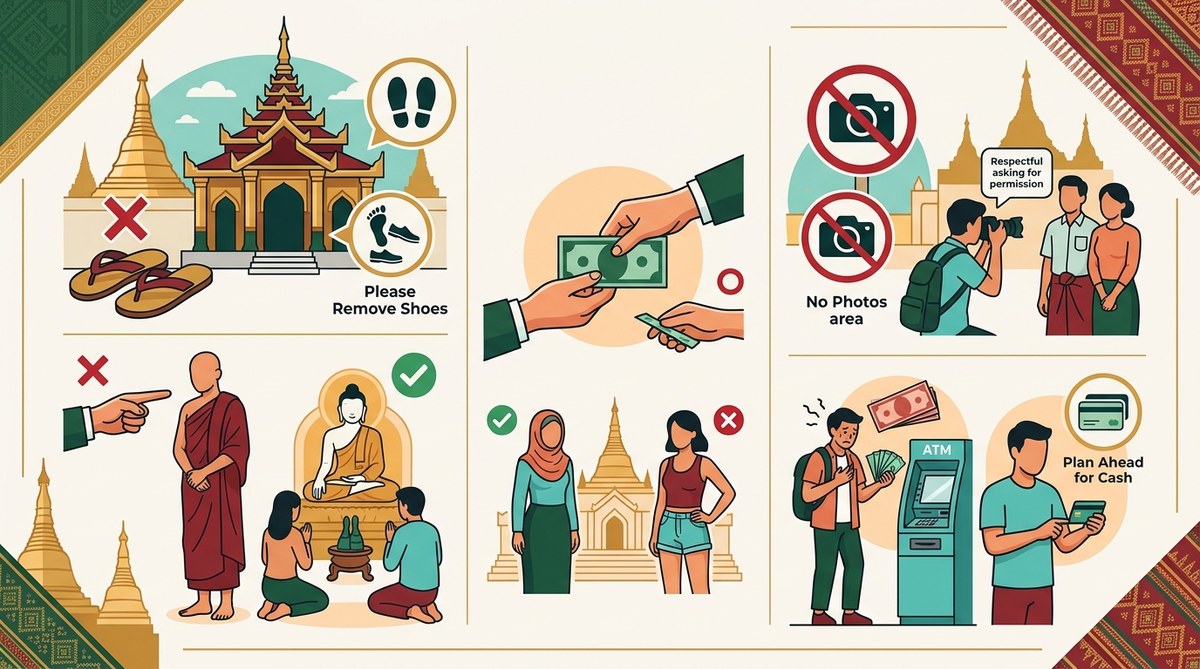
Myanmar is still a cash based economy. Outside of major hotels in Yangon and Mandalay, and a handful of upscale restaurants, plastic is not accepted. Even when a place displays a credit card logo, the machine often “does not work” that day. ATMs exist in cities, but they dispense Myanmar kyat at poor exchange rates and often charge high fees. Many ATMs run out of cash on weekends and public holidays.
Here is a practical process to keep you safe:
- Bring at least three hundred US dollars in crisp, new bills. Old, folded, or marked notes will be rejected by money changers.
- Split the cash between your wallet, your day bag, and a hidden money belt.
- Exchange money only at licensed counters or banks. Street changers may offer better rates, but they sometimes hand out counterfeit bills.
- Keep a stash of small denomination US dollars (1s, 5s, 10s) for taxis and small purchases.
For deep guidance on handling money day to day, see money matters in Myanmar currency ATMs and payment methods for travelers. Do not assume you can “just use your card.” You cannot.
Mistake 3: Packing Like You Are Going to Thailand
Myanmar shares a border with Thailand, but the weather and customs are different. Many tourists arrive with shorts, tank tops, and flip-flops, only to discover that every pagoda, temple, and monastery requires covered shoulders and knees. In Bagan, you cannot climb some of the smaller temples if you are not properly dressed. In Yangon, guards at the Shwedagon Pagoda will hand you a longyi (a traditional wrap) if you are underdressed, but it feels awkward and you will stand out.
What you actually need is lightweight, breathable clothing that covers your arms and legs. Linen pants, long skirts, and cotton shirts work well. Pack a scarf or shawl to cover your head when entering a pagoda. For footwear, sandals that you can slip on and off are essential because you will remove your shoes dozens of times a day. A full list is in the essential Myanmar packing list what to bring for every season and region.
Mistake 4: Underestimating Travel Times
Google Maps will tell you that a 200 kilometer drive in Myanmar takes three hours. Realistically, it takes five or six. Roads are often narrow, full of potholes, and shared with ox carts, bicycles, and chickens. Night buses are common, but they run on old highways and breakdowns happen. Trains are slow, charmingly slow. A trip from Yangon to Mandalay by train can take fifteen hours.
- Always add 30% to the estimated travel time from any booking site.
- Book domestic flights for long distances if your budget allows. They save days.
- Avoid travel during the rainy season (June to October) unless you want landslides.
- Leave buffer days between cities. A canceled bus can throw off a tight itinerary.
To understand the full network, check out navigating Myanmar transportation network trains buses and domestic flights explained. Do not pack seven cities into ten days. You will spend half your trip in transit.
Mistake 5: Not Learning Even Two Words of Burmese
English is not widely spoken outside tourist hubs. In smaller towns like Hpa-An, Kalaw, or Loikaw, shopkeepers and taxi drivers speak almost no English. A simple “Mingalabar” (hello) and “Cee-zu tin-ba-deh” (thank you) can melt a wall of silence. People genuinely appreciate the effort, and it often leads to better service, smiles, and sometimes an invitation to share a cup of tea.
- Learn “Jesu” (yes) and “Maho’bu” (no).
- Learn “Beh-lau lè?” (how much?).
- Learn “Nay kaung la?” (how are you?).
Even if your pronunciation is terrible, locals will light up. It shows respect. If you want a deeper understanding of the cultural signals behind language, read a practical guide to Myanmar customs and local etiquette for travelers in 2026.
Mistake 6: Disrespecting Sacred Spaces
Myanmar is deeply Buddhist. Monks are revered. Temples are not museums; they are living places of worship. Common mistakes include:
- Wearing shoes inside pagoda compounds.
- Pointing your feet at a Buddha image (sitting with soles facing the statue is offensive).
- Touching a monk or handing something directly to a woman. Women should place offerings on a cloth or table.
- Taking flash photography inside meditation halls.
- Speaking loudly or laughing loudly near prayer areas.
I once watched a traveler climb onto a ancient stupa in Bagan for a selfie. A guard shouted at him. The traveler argued that it was “just a ruin.” But it is not just a ruin. It is a sacred structure. The best advice is to observe how locals behave and follow their lead. If you want more detail on temple etiquette, see top cultural etiquette tips for respectful travel in Myanmar 2026.
Mistake 7: Staying Only in the Main Tourist Corridor
Many visitors fly into Yangon, see Shwedagon, take a bus to Bagan, then Mandalay, then fly to Inle Lake, and leave. This route is well trodden and does not show the real texture of the country. The remote villages of Chin State, the caves of Hpa-An, the beaches of Ngapali, and the trekking trails around Hsipaw offer experiences that feel less packaged.
However, some of these areas require travel permits or have security concerns. It is smart to read is Myanmar safe to visit a realistic assessment for travelers before veering off the beaten path. The answer is not a simple yes or no; it depends on where you go and the current situation. But if you stick only to the Golden Triangle loop, you miss the soul of the country.
Mistake 8: Ignoring Health and Sanitation Practices
Tap water is not safe to drink in Myanmar. Even brushing your teeth with tap water can cause stomach issues. Street food is delicious, but you need to be smart about it. Look for stalls with high turnover, where the food is cooked fresh in front of you. Avoid raw vegetables washed in tap water. Stick to peeled fruits.
Malaria and dengue are present in rural areas. Use mosquito repellent with DEET, sleep under a net, and consider taking malaria prophylaxis for trips to forested regions. Travel insurance that covers medical evacuation is essential. The healthcare system is limited outside Yangon. For a sobering look at the system, read understanding Myanmar healthcare system access challenges and community solutions. Better to be overprepared.
Mistake 9: Forgetting to Arrange Mobile Data Before You Go
Wi-Fi in Myanmar is slow and unreliable. Many hotels have internet that cuts out after 9 pm. The best way to stay connected is to buy a local SIM card at the airport or a mobile shop. MPT, Telenor, and Ooredoo offer tourist SIMs with data packages. You need to show your passport to register.
| Provider | Approx cost (USD) | Data allowance | Network coverage |
|---|---|---|---|
| MPT | $5 – $10 | 5 – 10 GB | Best in rural areas |
| Telenor | $4 – $8 | 3 – 8 GB | Good in cities, weak in hills |
| Ooredoo | $3 – $7 | 2 – 6 GB | Good in Yangon, patchy elsewhere |
Do not assume your US carrier’s international plan will work well. Many travelers spend days without reliable maps because they thought their plan covered Myanmar. For a full breakdown, see connecting to Myanmar SIM cards internet access and staying online while traveling.
Mistake 10: Bargaining Aggressively or Not Bargaining at All
Markets in Myanmar expect negotiation, but the rules are different from other Southeast Asian countries. You negotiate with a smile, not a hard face. If you start too low, the seller may simply refuse and walk away. A fair starting point is about 30% below the asking price. If the seller does not come down, it means the price is already fair. Do not argue.
The same goes for taxi fares. Agree on the price before you get in. Most taxis do not use meters. Ask your hotel what a fair fare is for a given destination. Overpaying by a dollar is not a disaster, but being taken advantage of leaves a bitter taste.
For a broader look at how to engage with local vendors and avoid common scams, read essential tips for authentic cultural experiences in Myanmar. Genuine connection beats a cheap price every time.
Traveling Smarter Means Traveling Deeper
Every mistake listed here comes from real stories. The couple who had to sleep at the bus station because they did not book ahead. The solo traveler who ran out of cash at midnight in Mandalay. The student who was refused entry to a temple for wearing shorts. These are not horror stories. They are learning moments. And now you know them before you go.
Myanmar is layered and complex, and that is why it stays with you long after you leave. The gentle ritual of offering alms to monks at dawn, the taste of mohinga by a lake, the sound of the big bell at Shwedagon. All of that is waiting for you. Just show up with the right visa, the right cash, the right clothes, and the right attitude. The rest will fall into place.