
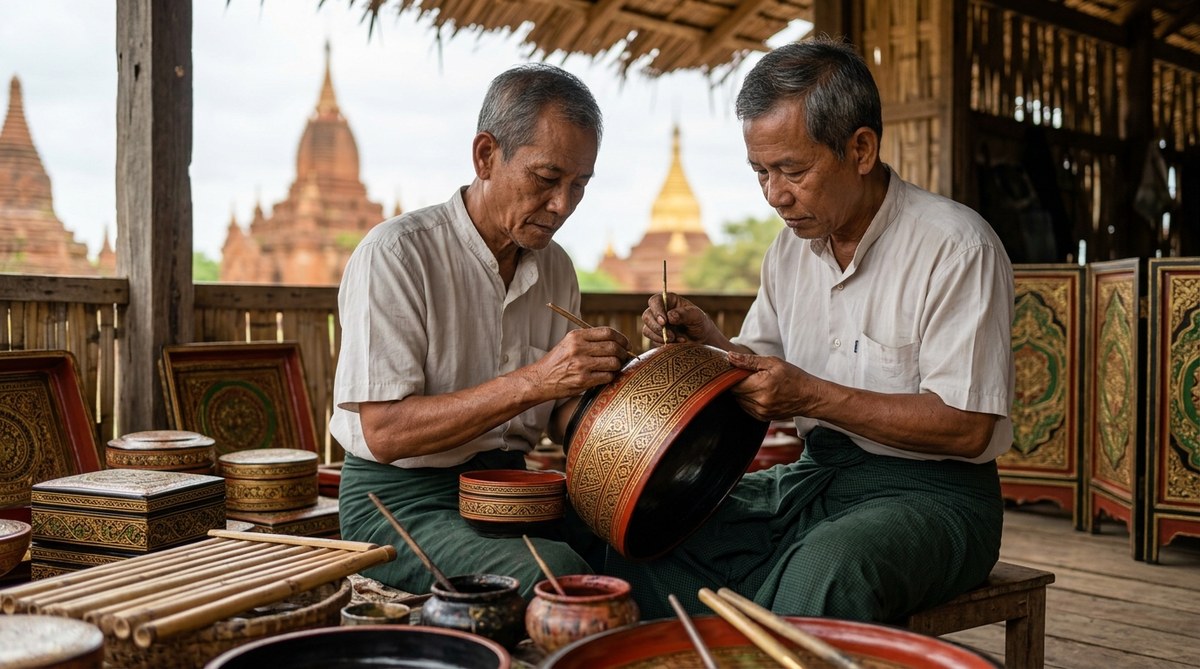
The sun hits the dusty streets of Bagan, and through the open door of a family workshop you catch the scent of lacquer, wood, and ash. Inside, an artisan sits cross-legged on the floor, her hands moving in a rhythm that has not changed in eight centuries. She is not painting. She is not carving. She is building layers. This is the Bagan lacquerware tradition, and it is one of the most demanding, beautiful, and misunderstood crafts on the planet.
Bagan lacquerware is not a painted souvenir. It is a layered sculpture made from bamboo strips, horsehair, and the sap of the Thitsi tree. Each piece requires months of patient work. Understanding the process transforms how you see these objects and how you choose one to bring home.
What Makes Bagan Lacquerware Different
Lacquerware exists across Asia. Japan has its urushi. China has its carved red lacquer. Thailand and Vietnam produce their own versions. But the Bagan lacquerware tradition stands apart for three reasons.
First, the base material is bamboo, not wood. Artisans split bamboo into thin strips and weave them into a core shape. This makes the final piece lighter and more durable than carved wood.
Second, the Thitsi tree sap used in Bagan is a specific species of lacquer that dries to a hard, glossy finish that can withstand heat and moisture. It is the same tree used for traditional Burmese tattoos and temple preservation.
Third, the decoration technique called yun thayo (carved lacquer) involves etching patterns through multiple colored layers. This creates a design that is part of the object, not painted on top of it. A genuine yun thayo bowl will never peel because the color runs through the entire depth of the lacquer.
How a Bowl Is Born: The 7 Step Process
Visitors to Bagan often walk into a shop, see a beautiful bowl, and assume it was turned on a lathe. It was not. Every piece is handmade from start to finish. Here is the cycle.
-
Weaving the core. Thin strips of bamboo are soaked and woven into a rough shape. For round objects, the artisan works the weave around a clay or wooden mold. This stage can take a full day for a medium sized bowl.
-
Applying the first layers. A paste made from Thitsi sap and ash is spread over the bamboo weave. This seals the gaps and creates a smooth surface. Each layer must dry in a cool, dark room for at least 24 hours.
-
Sanding and smoothing. The piece is sanded with river stone or modern sandpaper. Then more layers of pure Thitsi sap are applied. A quality bowl will have at least five layers of lacquer at this stage.
-
Coloring. Red and black are the traditional colors. Red comes from cinnabar or modern synthetic pigments. Black comes from iron oxide mixed with Thitsi sap. The piece gets two or three coats of the base color.
-
Incising the design. For yun thayo, the artisan uses a sharp stylus to scratch a design through the colored layers, revealing the colors underneath. The most skilled workers can create patterns with lines as thin as a hair.
-
Filling the lines. A contrasting color is rubbed into the incised lines. The excess is wiped away. This is what makes the pattern pop.
-
Final polish. The piece is polished with a soft cloth and sometimes rubbed with a fine stone until it shines. A final coat of clear lacquer seals everything.
The entire process takes between three and six months for a single bowl. That is why a genuine piece costs more than a factory copy.
Common Techniques and Common Mistakes
Not all lacquerware is created equal. The table below shows the main techniques you will find in Bagan and the pitfalls to watch for.
| Technique | Description | How to Spot It | Common Mistake |
|---|---|---|---|
| Yun thayo (carved) | Design is scratched through layers | Run your finger over the pattern. It should feel slightly recessed. | Buying painted copies where the design sits on top. |
| Htun (gilded) | Gold leaf applied over lacquer | Look for tiny seams where leaf pieces overlap. | Mistaking gold paint for real gold leaf. |
| Yun taya (relief) | Layers built up to create a raised design | The pattern stands above the surface. | Confusing this with molded plastic decoration. |
| Shwe chi hto (tapestry) | Lacquer painted onto a woven horsehair base | The object is flexible and very light. | Expecting it to be rigid like a wooden bowl. |
Expert advice from U Myint, a third generation artisan in Myinkaba village: “A real Bagan bowl should feel warm in your hand. It should have weight but not too much. If it smells like chemical paint, put it down. Real lacquer has a faint, earthy smell, like rain on dry soil.”
Where to See the Craft in Action
The best place to experience the Bagan lacquerware tradition is not a shop. It is a workshop. Most of the family run studios are in Myinkaba village, about 15 minutes south of the main temple area by bicycle or taxi.
When you visit a workshop, look for the following signs of authenticity:
- The family lives on site. You will see children doing homework near drying racks.
- They let you touch unfinished pieces. A real workshop has nothing to hide.
- They explain the process without rushing. A good artisan is proud of the work.
- You can see the drying room. It should be dark, cool, and smell of tree sap, not chemicals.
Avoid any place that offers to ship a bowl to your home before you pay. That is a common scam. Pay only for what you can hold in your hands.
How to Choose a Piece You Will Keep Forever
Buying lacquerware in Bagan can feel overwhelming. There are dozens of shops. Prices range from five dollars to five hundred. Here is a checklist to help you decide.
- Check the rim. Run your finger around the edge. It should be smooth and even. Rough spots mean poor sanding.
- Look at the base. The bottom of a bowl should be finished just as carefully as the top. If the maker cut corners there, they cut corners everywhere.
- Tap it gently. A good piece makes a clear, ringing sound. A dull thud suggests the bamboo core is loose inside.
- Ask about the Thitsi. A genuine artisan will tell you exactly where the sap came from. If they cannot answer, they are selling factory goods.
- Trust your hands. If the piece feels right, it probably is. Your instincts matter.
Why This Tradition Matters in 2026
The Bagan lacquerware tradition is not frozen in time. It is adapting. Younger artisans are experimenting with modern colors and shapes. Some are combining lacquer with recycled materials. A few are selling directly to international buyers through social media.
But the craft faces real pressure. Synthetic lacquers are cheaper and faster to use. The number of families who know the full traditional process is shrinking. When an elder artisan passes away, their knowledge often goes with them.
Supporting authentic lacquerware is one way to keep this heritage alive. When you buy a real piece, you are not just getting a souvenir. You are funding a family, a skill, and a tradition that predates most of the temples you came to see.
If you want to learn more about the broader landscape of Myanmar crafts, you can read about Myanmar’s endangered crafts and the master artisans fighting to preserve ancient techniques. For practical help planning your trip, check out what you really need to know before traveling to Myanmar in 2026.
A Tradition That Rewards Patience
Lacquerware from Bagan is not a thing you buy in five minutes and forget. It is a thing you live with. The bowl you bring home will change slightly over the years. The gloss will deepen. The colors will warm. You will notice details you missed on the first day.
That is the point. The Bagan lacquerware tradition was never about speed. It was about layering time, attention, and skill into an object that outlasts its maker. When you hold a piece in your hands, you are holding months of someone’s life. Treat it that way. Choose carefully. Buy from people who care. And when you get home, use the bowl. Lacquerware is meant to be handled, not hidden on a shelf.
Let it sit on your kitchen counter. Put fruit in it. Let your guests touch it. That is how you honor the craft. That is how the tradition continues.