
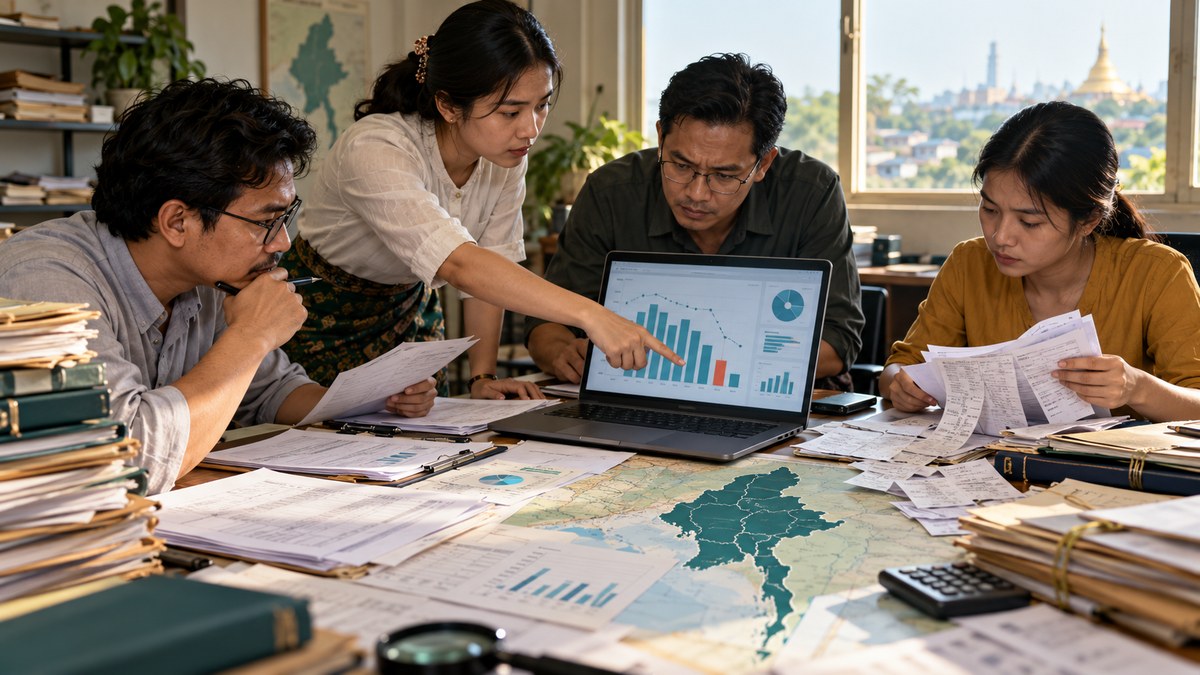
In 2026, a quiet revolution is happening across Myanmar. It does not involve soldiers or elections. It involves spreadsheets, leaked documents, and brave citizens asking one simple question: where did the money go? While the international community focuses on geopolitical chess moves, local watchdogs are doing the painstaking work of tracking Myanmar’s missing public funds. They are not waiting for permission. They are digging through procurement records, cross-referencing payrolls, and publishing their findings for the world to see.
Local watchdogs in Myanmar are using open-source intelligence, whistleblower networks, and grassroots auditing to track stolen public funds in 2026. Despite severe risks, they have exposed ghost workers, fake infrastructure projects, and diverted health budgets. Their work provides the most reliable picture of where Myanmar missing public funds 2026 have gone.
How the Money Goes Missing
The scale of the problem is staggering. Since the 2021 coup, Myanmar’s public finances have become a black box. Budgets that were once published online have disappeared. Procurement contracts are awarded without tender. And billions in state revenue from oil, gas, and jade simply vanish.
Local researchers have identified three main channels for Myanmar missing public funds in 2026:
- Ghost payrolls: Names of non-existent employees on government rosters, with salaries collected by supervisors.
- Inflated contracts: Infrastructure projects billed at triple the real cost, with the difference funneled to officials.
- Tax diversion: Local tax revenues that never reach central accounts, redirected to military-controlled enterprises.
Each channel requires a different method to detect. And each method puts the investigator at risk.
The Watchdog Toolkit: Methods That Work
These are not armchair analysts. The most effective local watchdogs operate like forensic accountants in a war zone. They use a mix of analog and digital techniques.
-
Leaked document verification: A source inside a township office provides a payroll list. The watchdog cross-checks names against voter rolls and school attendance records. Missing people? Ghost workers.
-
Satellite imagery analysis: A road construction project is announced. The watchdog checks satellite images from six months ago and today. No construction visible. The funds are gone.
-
Public procurement scraping: Despite censorship, some government portals remain accessible. Watchdogs scrape tenders and compare awarded prices to market rates. A hospital bed that costs $200 on the open market is listed at $2,000. That is a tenfold markup.
-
Community surveys: Volunteers interview villagers about services they actually received. A school renovation budget of $50,000 might have produced only a coat of paint. The rest is missing.
-
Whistleblower hotlines: Encrypted channels allow civil servants to report anomalies without revealing their identity. These tips often lead to the biggest breaks.
What They Have Found So Far
The findings are not abstract. They affect real people. In one township in Ayeyarwady Region, watchdogs discovered that 40 percent of the health budget had been diverted over two years. That meant no vaccines, no malaria medication, and no maternal health supplies for 15,000 residents.
In another case, a road project in Shan State was budgeted at 2.3 billion kyat. Local monitors found that only 600 million kyat worth of work had been done. The rest was gone. The road itself was barely passable after the first monsoon.
These are not isolated incidents. They are patterns. And they represent just a fraction of the total Myanmar missing public funds in 2026.
Techniques vs. Mistakes: A Field Guide
Even experienced watchdogs make errors. Here is a breakdown of what works and what does not.
| Technique | Common Mistake | Better Approach |
|---|---|---|
| Cross-referencing payroll with voter lists | Assuming voter lists are accurate | Use multiple sources: school records, clinic visits, phone directories |
| Analyzing satellite images | Relying on a single date | Compare images from before, during, and after the project period |
| Interviewing community members | Asking leading questions | Use neutral phrasing: “What services did you receive?” not “Did they steal the money?” |
| Leaked document verification | Trusting the leak without context | Confirm the document’s metadata and chain of custody |
| Price benchmarking | Using outdated market data | Check current prices from three independent suppliers |
Why This Work Is So Dangerous
Let us be direct. This work can get people killed. In 2025, at least three local transparency activists were detained. Others have fled the country. The military junta views any public audit as a threat to its control.
Watchdogs operate under constant surveillance. They use encrypted messaging apps, meet in person only after careful vetting, and often publish their findings through overseas partners. Some use pseudonyms. Some have stopped using their real names even among trusted colleagues.
“The risk is real, but the alternative is worse. If we stop tracking the money, they win completely. We are not heroes. We are just people who believe that a hospital should have medicine and a road should be paved.” A local watchdog based in Yangon, speaking on condition of anonymity.
How International Researchers Can Help
If you are a journalist, researcher, or policy analyst outside Myanmar, you have a role to play. You can amplify findings without exposing sources. You can provide legal support. You can also help with verification.
Here is a practical process for collaborating with local watchdogs:
- Establish trust through mutual contacts. Do not cold-message someone asking for documents.
- Use secure channels only. Signal or encrypted email. Never ask for real names.
- Offer to host data on international servers. This reduces the risk of seizure.
- Verify findings independently when possible. Use open-source tools.
- Credit the local team in any publication. Do not take sole authorship.
- Share any relevant data you find. Collaboration is a two-way street.
- Advocate for visa pathways. Some watchdogs may need to leave.
What the Data Reveals About 2026
The most comprehensive analysis of Myanmar missing public funds in 2026 comes from a coalition of local groups that have pooled their data. Their preliminary estimate suggests that between 25 and 35 percent of public spending at the township level is unaccounted for. That is not just corruption. That is systematic looting.
The sectors hit hardest are health, education, and infrastructure. These are exactly the areas where ordinary people feel the loss most acutely. When a school cannot afford textbooks because the budget was stolen, the impact lasts a generation.
There is also a geographic pattern. Conflict zones and ethnic states show higher rates of missing funds. In areas with active fighting, oversight is nearly impossible. The junta uses the chaos as cover.
Building a Culture of Accountability
The work of these watchdogs goes beyond exposing theft. It builds a habit of accountability. When villagers see that someone is watching, they become more willing to report problems. When civil servants know that leaks might happen, they think twice before taking a bribe.
This cultural shift is fragile but real. It is supported by a growing network of grassroots transparency initiatives. Groups that started with a single spreadsheet now train others. They share templates for budget tracking. They hold virtual workshops on data security.
For a closer look at how these networks operate, read about 5 grassroots transparency initiatives reshaping local governance in Myanmar. And if you want to understand the legal framework they are up against, our guide on understanding Myanmar’s freedom of information laws what changed and what remains offers essential context.
The Road Ahead for Transparency
Myanmar missing public funds in 2026 will not stop flowing just because we write about them. But every exposed case makes the next one harder to hide. Every verified report adds to the evidence base that future accountability mechanisms will rely on.
The international community can do more. Sanctions on specific individuals are useful, but they do not stop the flow of money. What would help is funding for local watchdog organizations. Not through government channels, which are easily compromised, but through trusted intermediaries.
Also important is the protection of whistleblowers. Current laws in Myanmar offer almost no safety. International pressure could help change that. For a deeper analysis of this issue, see why whistleblower protections in Myanmar still fall short despite new laws.
A Call to Pay Attention
The story of Myanmar missing public funds in 2026 is not a footnote. It is the story of how a military regime finances itself while a population suffers. It is the story of brave citizens who refuse to look away.
If you are reading this, you have a choice. You can treat it as background noise. Or you can use it. Share the data. Cite the local sources. Push your organization to fund transparency work. Ask the hard questions in policy meetings.
The watchdogs are doing their part. They are tracking the money, risking everything, and publishing the truth. The least the rest of us can do is pay attention and act on what we learn.