
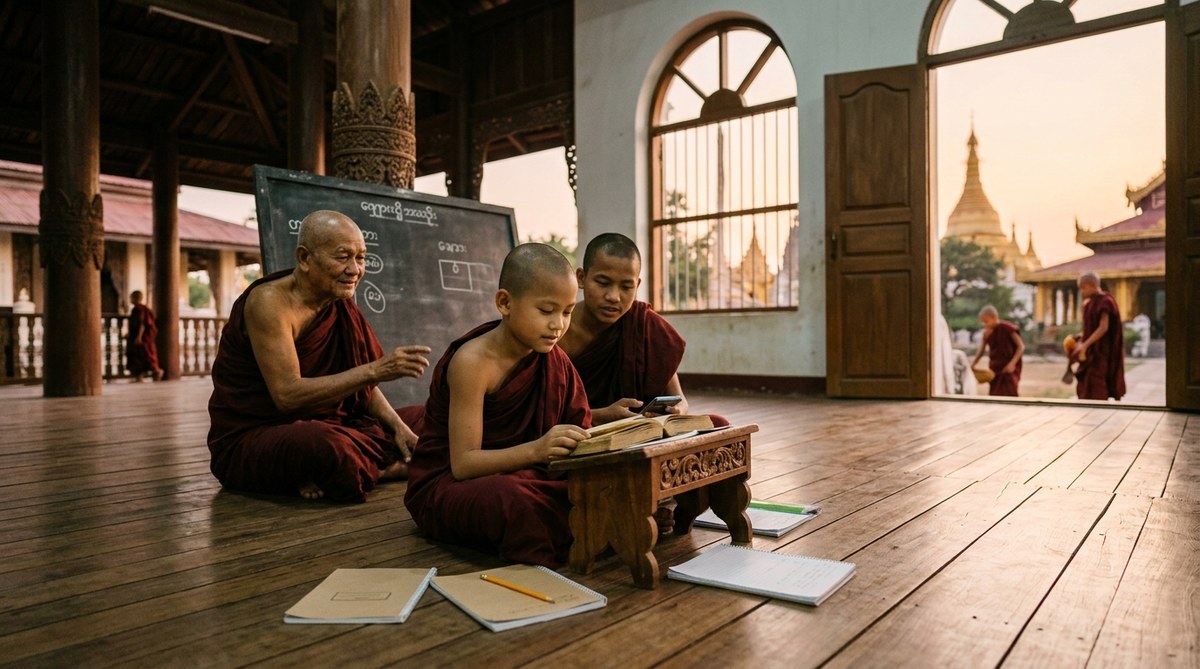
The sun rises over a dusty courtyard in Sagaing. Dozens of boys and girls, heads shaved, wrapped in maroon robes, sit cross-legged on wooden planks. They chant Pali verses in unison. Their voices carry across the compound, mixing with the sound of a diesel generator powering a single laptop inside the monastery library. This is a typical morning at a monastic school in Myanmar.
These schools are not relics of a forgotten past. They are thriving, adaptive institutions that educate hundreds of thousands of children across the country. For researchers, journalists, and educators trying to understand modern Myanmar, the monastic education system offers a window into how ancient Buddhist traditions coexist with 21st century realities. And in the wake of the 2021 coup and the ongoing civil conflict, these schools have become something more: lifelines for communities abandoned by the state.
Myanmar’s monastic education system is a parallel schooling network that educates over 300,000 children, many from poor and rural families. It combines Buddhist scripture, meditation, and ethics with standard academic subjects like math, science, and English. Since the 2021 coup, monastic schools have filled gaps left by the collapsing public education system, often operating under threat from military authorities while teaching values of compassion and civic responsibility.
The Roots of Monastic Learning in Myanmar
Buddhist monastic education in Myanmar is not a recent phenomenon. It predates the modern state by centuries. During the Pagan Empire (11th to 13th centuries), monasteries served as the primary centers of learning. Boys learned reading, writing, and arithmetic alongside the Tripitaka (Buddhist scriptures). Girls were typically educated at home.
This system persisted through the Konbaung dynasty and into the British colonial period. When the British introduced secular state schools in the 19th century, many families remained loyal to monastic education. They saw it as a way to preserve Burmese culture and Buddhist identity against Western influence.
After independence in 1948, the government under U Nu tried to integrate monastic schools into the national system. That effort stalled after the 1962 military coup. The junta viewed independent monastic institutions with suspicion. For decades, monastic schools operated in a gray zone, neither fully recognized nor suppressed.
Today, the monastic education system is a hybrid. It is neither entirely separate from the state nor fully integrated. This ambiguity has allowed it to survive, and in some ways thrive, through decades of political turmoil.
What a Monastic School Actually Teaches
A common misconception is that monastic schools only teach religion. That is not accurate. Most monastic schools in Myanmar follow a dual curriculum. The morning is reserved for Buddhist studies: chanting, meditation, memorization of suttas, and lessons in the Vinaya (monastic code). The afternoon covers secular subjects: mathematics, Burmese language, English, science, and geography.
Here is a breakdown of a typical daily schedule:
- 5:00 AM to 6:30 AM – Morning chanting and meditation. Students recite Pali verses from memory.
- 7:00 AM to 8:00 AM – Breakfast and chores. Older students help prepare food and clean the monastery grounds.
- 8:30 AM to 11:30 AM – Buddhist studies. Includes scripture analysis, ethics discussions, and memorization drills.
- 12:00 PM to 1:00 PM – Lunch and rest.
- 1:30 PM to 4:00 PM – Secular subjects. Math, English, science, and social studies. Textbooks are often donated by NGOs or borrowed from state schools.
- 4:30 PM to 6:00 PM – Tutoring and homework help. Older novices assist younger students.
- 7:00 PM to 8:00 PM – Evening chanting and meditation.
The balance between religious and secular instruction varies by school. Urban monasteries in Yangon and Mandalay tend to emphasize English and computer skills. Rural schools, especially in conflict-affected areas like Shan State or Chin State, focus more on basic literacy and numeracy.
Why Families Choose Monastic Schools
Families send their children to monastic schools for several reasons. For many, it is a matter of access. Public schools in rural areas are understaffed, underfunded, or simply nonexistent. A monastery might be the only educational option within walking distance.
Poverty is another driver. Monastic schools are almost always free. They provide meals, housing, and basic healthcare. For a family struggling to feed their children, a monastery offers survival.
“We do not turn anyone away,” says Sayadaw U Ottamasara, abbot of a monastic school in Mawlamyine. “If a child comes to us hungry, we feed them first. Then we teach them. The Buddha said that kindness is the foundation of all wisdom. We try to live that.”
There is also a cultural dimension. Many Buddhist parents believe that sending a son to the monastery for a few years earns merit. It is a tradition rooted in the concept of kutho (good karma). Even if the child does not become a monk, the time spent in monastic education is seen as spiritually valuable.
Since the 2021 coup, a new factor has emerged: safety. Monastic schools are often perceived as neutral ground in a country torn by armed conflict. Military forces and resistance groups both tread carefully around monasteries. For internally displaced families, a monastic school can be a rare zone of stability.
Adapting to Political Upheaval
The 2021 military takeover dealt a severe blow to Myanmar’s public education system. Teachers who joined the Civil Disobedience Movement were fired or arrested. Schools were closed for months. When they reopened, many were under military control, with curricula altered to promote nationalist narratives.
Monastic schools stepped into the breach. They absorbed students who had nowhere else to go. Some began offering classes in subjects that the state curriculum had dropped, such as critical thinking and ethnic minority languages.
This has not been without risk. Military authorities have accused monastic schools of harboring resistance sympathizers. In several instances, soldiers have raided monasteries, confiscated textbooks, and detained abbots. The relationship between the sangha (monastic community) and the junta is deeply strained.
Yet monastic schools continue to operate. They rely on a network of local donors, international NGOs, and diaspora organizations. The how-myanmar-s-diaspora-communities-are-advocating-for-accountability-from-abroad has been especially active in fundraising for monastic education since 2021.
A Practical Guide for Researchers and Visitors
If you are a researcher, journalist, or educator planning to visit a monastic school in Myanmar, preparation is key. These are not tourist attractions. They are working educational institutions, often in sensitive areas.
Follow these steps to ensure a respectful and productive visit:
- Secure proper permissions. Contact the central monastic education committee or a local NGO with existing relationships. Do not show up unannounced. In conflict-affected regions, you may also need permission from local authorities.
- Learn basic etiquette. Remove your shoes before entering any building. Do not touch a monk or novice on the head. Sit lower than the monks. Women should dress modestly, covering shoulders and knees.
- Arrange a translator. While some abbots speak English, many do not. A trusted translator who understands Buddhist terminology is invaluable.
- Bring something useful. Donations of school supplies, medicine, or solar lamps are always welcome. Cash donations should be made through a reputable intermediary.
- Respect photography rules. Many monastic schools allow photography of buildings and group activities but not of individual children without explicit consent. Always ask first.
Common Mistakes to Avoid
| Mistake | Why It Matters | Better Approach |
|---|---|---|
| Treating the school like a photo opportunity | Disrespects the community and can put the school at risk | Ask permission before taking any photos; focus on building relationships |
| Assuming all monastic schools are the same | Curriculum, resources, and political context vary widely | Research the specific school and region before visiting |
| Ignoring the security situation | A visit could endanger the school if military authorities are suspicious | Coordinate with local NGOs and monitor travel advisories |
| Giving money directly to children | Creates dependency and can cause conflict among students | Donate through the abbot or a registered organization |
| Expecting English fluency | Many teachers and students speak limited English | Bring a translator; learn a few basic Burmese phrases |
How Monastic Schools Are Reshaping Youth in 2026
The current generation of students in monastic schools is different from any that came before. They are digital natives, even in rural areas. Smartphones are common. Social media is a constant presence. Young novices discuss global news, climate change, and human rights concepts alongside the Jataka tales.
This creates tension. Traditional abbots worry that worldly distractions erode monastic discipline. Younger teachers argue that the sangha must engage with modern issues or become irrelevant. The result is a dynamic, sometimes contentious, internal debate.
Some monastic schools have embraced technology. They use tablets for Pali lessons. They teach basic coding. They connect with partner schools in Japan, South Korea, and the United States via video calls. These programs are often funded by international how-international-watchdogs-are-monitoring-myanmar-s-governance-reforms-in-2026 and human rights groups.
Other schools remain deliberately isolated. They ban phones. They limit contact with the outside world. Their goal is to preserve the traditional kyaung (monastery school) model, focused entirely on spiritual development.
Both approaches have merits. The key point is that the Myanmar monastic education system is not monolithic. It is a spectrum, from ultra-orthodox to surprisingly progressive.
The Role of Monastic Schools in Civic Engagement
Monastic schools teach more than literacy and scripture. They instill a set of values that have profound civic implications. The Buddhist concepts of metta (loving-kindness), karuna (compassion), and dana (generosity) translate into a sense of social responsibility.
Students are taught to care for the elderly, share resources with the poor, and resolve conflicts without violence. In a country where the military has taught generations to obey authority without question, monastic schools offer an alternative moral framework.
This has not gone unnoticed by the junta. Authorities have tried to monitor sermons and restrict what abbots can teach. But the sangha has deep roots in Burmese society. Cracking down too hard risks massive public backlash.
For researchers studying the-role-of-civil-society-in-promoting-transparency-and-accountability-in-myanmar, monastic schools represent a fascinating case study. They are traditional institutions performing a modern civic function. They are neither fully independent nor fully co-opted. They operate in the spaces between.
The Future of Monastic Education
The outlook for Myanmar’s monastic education system is uncertain. The ongoing civil war has displaced millions. Donor fatigue is a real concern. The economy is in shambles. Many monastic schools struggle to afford basic supplies.
Yet there are reasons for cautious optimism. The monastic education system has survived colonialism, military dictatorships, and economic collapse. It adapts. It endures.
International interest is also growing. Educators from Thailand, Sri Lanka, and Bhutan have studied Myanmar’s model as a potential template for their own countries. The idea of integrating moral education with academic instruction resonates far beyond Myanmar’s borders.
For those who want to support this system, the most effective approach is long-term partnership. Sponsor a teacher’s salary. Fund a school feeding program. Help build a library. Small, consistent contributions have more impact than one-time grants.
A Living Tradition That Refuses to Fade
Myanmar’s monastic schools are not a curiosity from a bygone era. They are a living, breathing response to the country’s deepest challenges: poverty, conflict, and a broken state. They teach children to read and count. They also teach them to be kind, to be patient, and to find meaning in service.
That combination is rare. It is worth understanding. It is worth protecting.
If you are a researcher, journalist, or educator, consider how your work can support these institutions without exploiting them. Listen to the abbots and the novices. Let them tell their own stories. The monastic education system of Myanmar has much to teach the world about resilience, faith, and the true purpose of learning.