
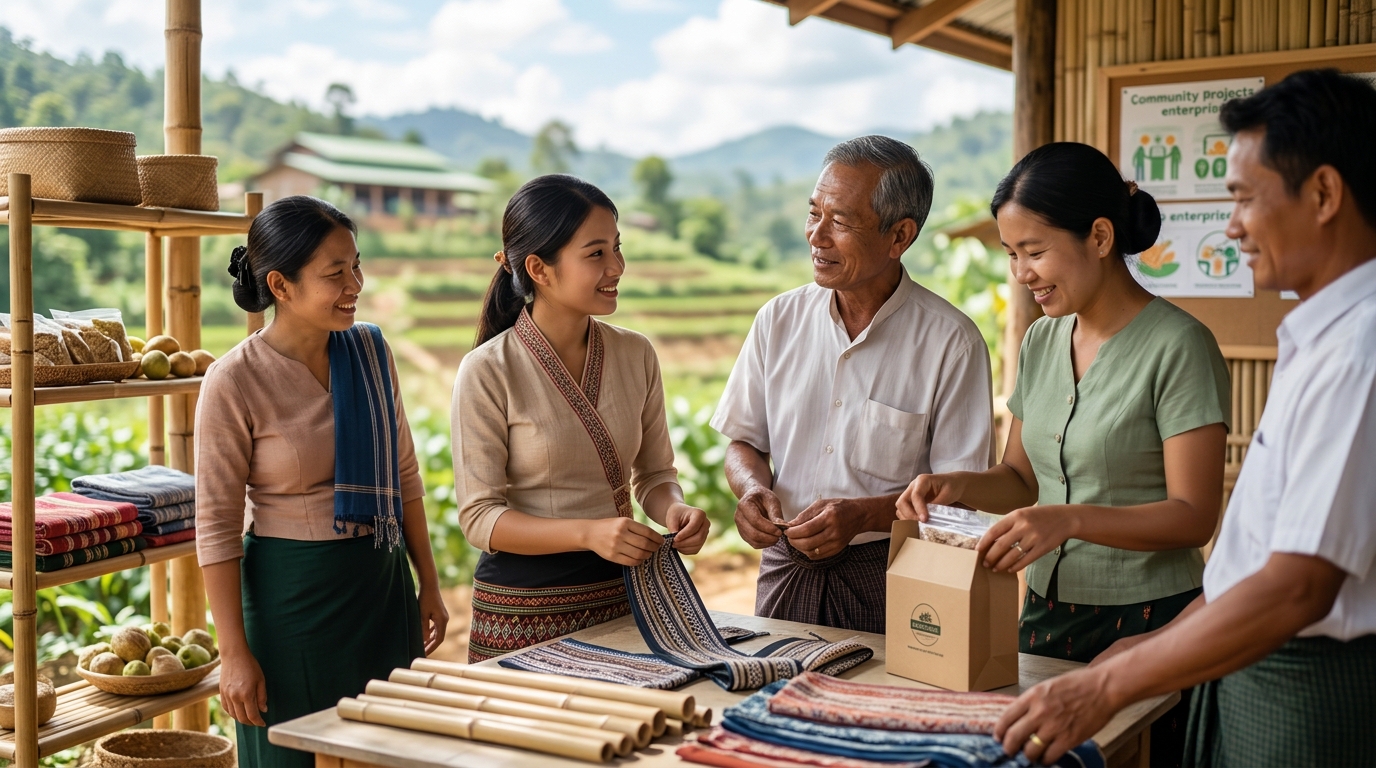
In rural Shan State, a women’s weaving collective generates income for 150 families while preserving traditional textile patterns. In Yangon, a coffee shop trains young people from disadvantaged backgrounds in hospitality skills. Across Myanmar, a new generation of social enterprises is proving that profit and purpose can coexist, creating sustainable solutions to some of the country’s most pressing challenges.
[Social enterprises](https://en.wikipedia.org/wiki/Social_enterprise) Myanmar blend commercial viability with social impact, addressing poverty, unemployment, and inequality through market-based solutions. These organizations generate sustainable income while empowering marginalized communities, preserving cultural heritage, and building economic resilience. Despite regulatory challenges and limited funding, they represent a growing force for positive change in Myanmar’s development landscape.
What Makes Social Enterprises Different in Myanmar
Social enterprises occupy a space between traditional nonprofits and purely commercial businesses. They generate revenue through selling products or services, but their primary mission centers on creating social or environmental impact rather than maximizing shareholder returns.
In Myanmar, this model resonates particularly well. Communities have long practiced mutual aid and collective problem-solving. Social enterprises formalize these traditions into sustainable business structures.
The defining characteristics include:
- Revenue generation through market activities rather than donations
- Reinvestment of profits into mission-driven activities
- Focus on serving marginalized or underserved populations
- Measurable social or environmental outcomes alongside financial metrics
- Commitment to transparency and stakeholder accountability
Unlike grant-dependent NGOs, social enterprises Myanmar build financial sustainability into their DNA. They create jobs, develop local supply chains, and generate tax revenue while addressing social challenges.
The Landscape of Social Impact Business Models
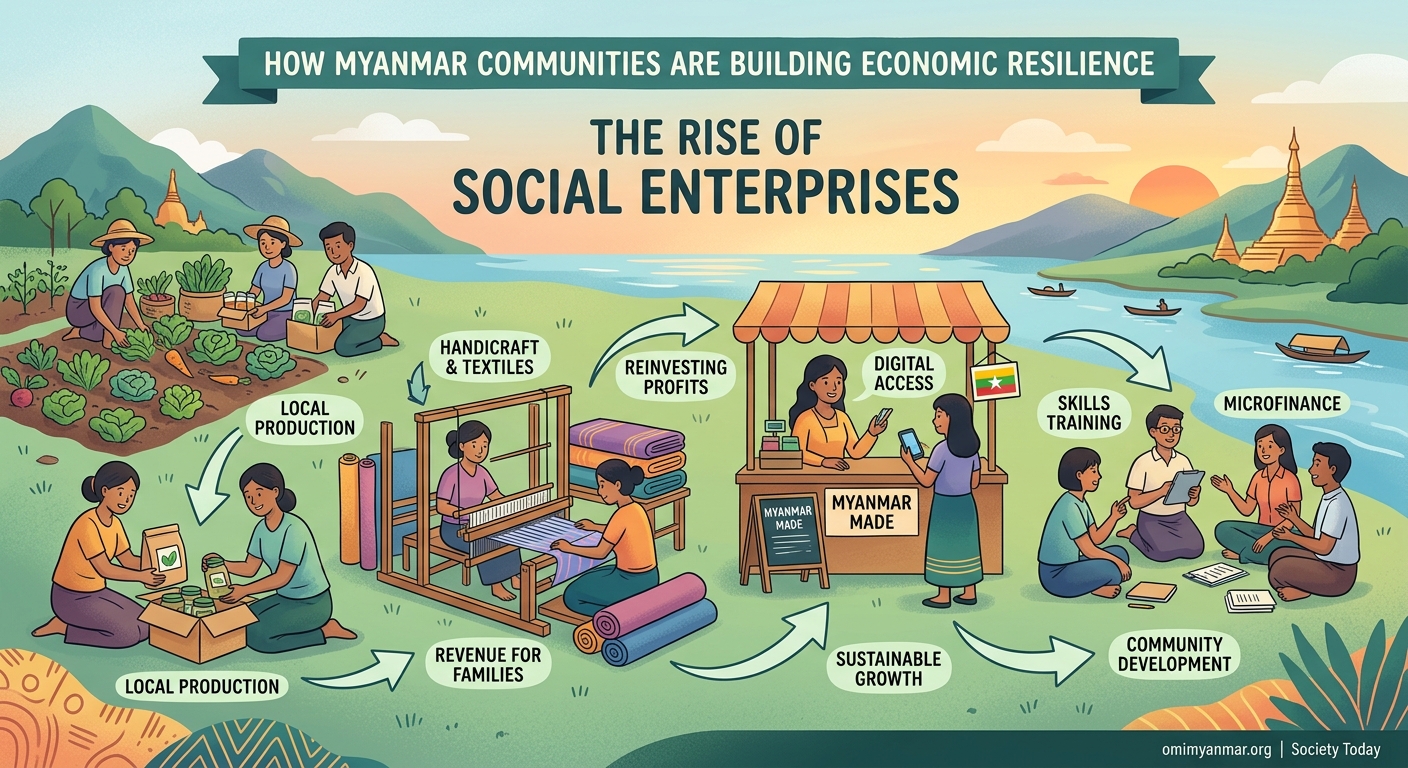
Myanmar’s social enterprise sector encompasses diverse approaches and industries. Some focus on agricultural value chains, connecting smallholder farmers to premium markets. Others provide essential services like healthcare, education, or clean energy to communities the formal sector overlooks.
The artisan sector has seen particularly strong growth. Organizations work with traditional craftspeople to modernize designs, improve quality standards, and access international markets. Myanmar’s endangered crafts benefit from these partnerships, which create economic incentives for preservation.
Common business models include:
- Employment-focused enterprises that hire and train marginalized populations, including people with disabilities, former street youth, or conflict-affected communities.
- Producer cooperatives that aggregate small farmers or artisans to achieve economies of scale and bargaining power.
- Service providers delivering affordable healthcare, education, or financial services to low-income communities.
- Environmental enterprises addressing waste management, renewable energy, or sustainable agriculture.
- Technology platforms connecting underserved populations to markets, information, or services.
Each model adapts to local contexts and community needs. A coffee processing enterprise in Pyin Oo Lwin operates differently from a recycling initiative in Mandalay, but both share the dual commitment to financial sustainability and social impact.
Building Blocks for Sustainable Social Ventures
Creating a viable social enterprise requires more than good intentions. Successful organizations master the fundamentals of business operations while maintaining their social mission.
The process typically unfolds in stages:
- Community needs assessment identifies genuine gaps in markets or services that affect specific populations.
- Business model development tests whether a commercially viable approach can address those needs sustainably.
- Pilot implementation proves the concept on a small scale before committing significant resources.
- Impact measurement systems track both financial performance and social outcomes from the start.
- Scaling strategies expand successful models while maintaining quality and mission integrity.
Financial planning presents unique challenges. Social enterprises often serve customers with limited purchasing power or operate in sectors with thin margins. They must balance affordability with sustainability.
“The hardest part is finding the sweet spot where your pricing allows you to be self-sustaining without excluding the people you’re trying to serve. It requires constant adjustment and creativity.” — Social enterprise founder, Yangon
Many organizations adopt hybrid revenue models. They might sell premium products to urban consumers while using those profits to subsidize services for rural communities. Others combine earned income with targeted grants for specific programs.
Navigating the Regulatory Environment
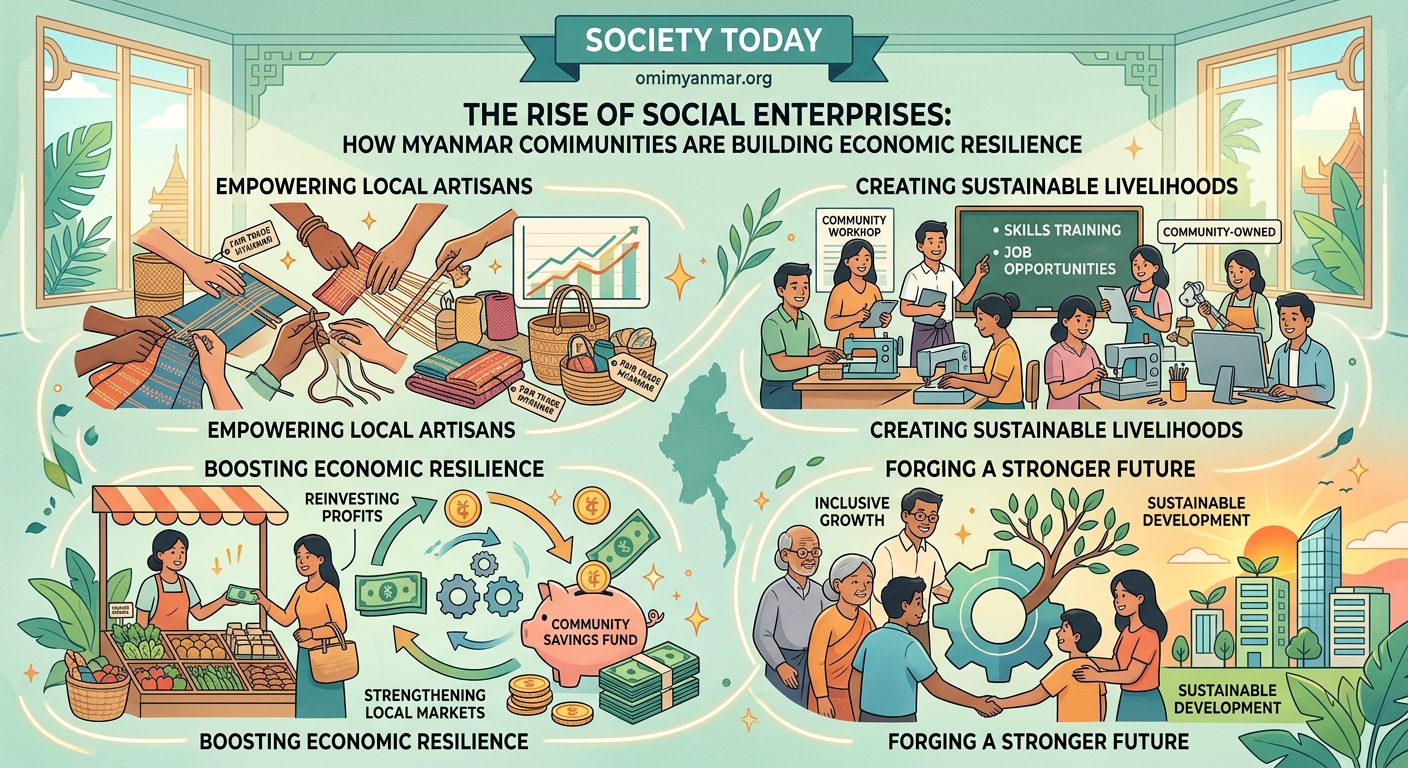
Myanmar’s legal framework for social enterprises remains evolving. No specific legal structure exists for organizations that blend commercial and social purposes. Most register as companies, cooperatives, or associations depending on their activities and ownership structure.
This regulatory ambiguity creates both challenges and opportunities. Organizations must carefully structure their operations to comply with multiple regulatory frameworks. What NGO workers need to know about navigating Myanmar’s regulatory environment applies equally to social entrepreneurs.
Key regulatory considerations include:
| Aspect | Challenge | Strategy |
|---|---|---|
| Legal structure | No dedicated social enterprise category | Choose entity type that best fits activities and ownership |
| Tax treatment | Unclear status between charity and business | Document social mission and impact for potential benefits |
| Foreign investment | Restrictions in certain sectors | Partner with local organizations or structure carefully |
| Reporting requirements | Multiple frameworks depending on structure | Implement robust systems from the start |
| Licensing | Sector-specific permits and approvals | Research requirements thoroughly before launching |
The regulatory landscape shifted significantly after 2021. Foreign investment regulations in Myanmar affected international partnerships and funding flows. Many social enterprises adapted by strengthening local ownership and domestic revenue streams.
Funding and Investment Challenges
Access to capital remains one of the biggest barriers for social enterprises Myanmar. Traditional banks view them as too risky, while many impact investors consider individual ventures too small for their fund structures.
Common funding sources include:
- Microfinance institutions providing small loans, though often at high interest rates
- Impact investors seeking both financial returns and measurable social outcomes
- Development finance institutions offering patient capital and technical assistance
- Crowdfunding platforms connecting ventures directly with individual supporters
- Accelerator programs providing seed funding alongside mentorship and capacity building
- Hybrid models combining grants for capacity building with loans for working capital
The funding gap hits hardest during the growth phase. Organizations prove their concept with small grants or personal savings, but struggle to access the larger capital needed to scale. Traditional venture capital expects growth rates and exit opportunities incompatible with social missions.
Some social enterprises bootstrap their growth, reinvesting all profits and growing slowly. Others sacrifice some mission purity to attract commercial investors. The right approach depends on the specific context and priorities.
Measuring Impact Beyond Profit
Social enterprises must track two bottom lines: financial performance and social impact. Both require rigorous measurement, but impact assessment presents unique challenges.
Effective measurement systems answer three questions:
- What changes are we creating for our target beneficiaries?
- How much of that change results directly from our activities?
- Are we achieving those outcomes efficiently and sustainably?
Common metrics include jobs created, incomes increased, people served, environmental impacts reduced, or traditional skills preserved. The specific indicators depend on each organization’s mission and theory of change.
Many organizations use frameworks like the Social Return on Investment (SROI) methodology or the Impact Management Project standards. These provide structured approaches to quantifying social value creation.
Challenges include:
- Attribution: separating your impact from other factors affecting beneficiaries
- Long-term outcomes: tracking changes that unfold over years
- Unintended consequences: identifying negative effects alongside positive ones
- Cost: balancing measurement rigor with limited resources
- Comparability: benchmarking against other organizations with different contexts
The best measurement systems integrate into operations rather than creating separate reporting burdens. When a weaving cooperative tracks production by individual artisan, that data simultaneously informs business decisions and impact reporting.
Workforce Development and Capacity Building
Human capital often determines whether social enterprises succeed or struggle. Organizations need staff who combine business acumen with genuine commitment to social mission. Finding that combination in Myanmar’s labor market presents challenges.
Understanding Myanmar’s labor market helps social enterprises develop realistic recruitment and training strategies. Many invest heavily in developing their own talent pipelines.
Training programs typically address:
- Business fundamentals including financial management, marketing, and operations
- Social impact methodology covering needs assessment, program design, and measurement
- Sector-specific skills depending on the industry and activities
- Leadership development preparing staff to take on greater responsibilities
- Cross-cultural competencies for organizations working across Myanmar’s diverse communities
Several accelerators and support organizations have emerged to strengthen the ecosystem. They provide mentorship, peer learning networks, and connections to resources. These intermediaries play a crucial role in building sector capacity.
Success Stories and Practical Models
Real examples illustrate how social enterprises Myanmar create change on the ground. A agricultural processing company in Ayeyarwady Region works with 800 smallholder farmers, providing training in organic methods and guaranteed purchase agreements. Farmers earn 30% more than conventional market prices while building soil health.
In Yangon, a restaurant chain employs young adults from disadvantaged backgrounds, providing six months of intensive hospitality training alongside paid work. Over 200 graduates have moved into permanent positions across the industry.
A renewable energy social enterprise installs solar home systems in off-grid villages, using a pay-as-you-go model that makes clean electricity affordable for low-income families. They’ve brought power to 15,000 households while reducing kerosene use and indoor air pollution.
These organizations share common success factors:
- Deep understanding of their target communities and markets
- Realistic business models tested and refined through experience
- Strong leadership combining business skills and social commitment
- Adaptive management that responds to changing conditions
- Transparent communication with stakeholders about both successes and challenges
They also face ongoing struggles. Funding remains tight. Regulatory uncertainty complicates planning. Market conditions shift unpredictably. Success requires resilience and creativity.
Partnerships and Ecosystem Development
No social enterprise operates in isolation. Successful organizations build networks of supporters, partners, and allies. These relationships provide resources, expertise, market access, and advocacy support.
Key partnership types include:
- Supply chain partners providing inputs or distribution channels
- Technical assistance providers offering specialized expertise
- Financial institutions providing capital and financial services
- Government agencies enabling regulatory compliance and accessing public programs
- Research institutions contributing evaluation and learning
- Media partners amplifying stories and building awareness
- International organizations connecting to global networks and resources
Grassroots transparency initiatives reshaping local governance in Myanmar create enabling conditions for social enterprises. When communities have stronger voice and accountability mechanisms, social ventures can operate more effectively.
Building these partnerships requires intentional effort. Organizations must clearly articulate their value proposition for potential partners. They need systems to manage relationships and deliver on commitments.
The strongest partnerships create mutual value. A craft social enterprise and an international retailer both benefit when they develop a fair-trade supply chain. The enterprise gains market access while the retailer secures unique products and a compelling story.
Adapting to Crisis and Uncertainty
Myanmar’s social enterprises have demonstrated remarkable resilience through multiple crises. Political upheaval, economic shocks, and global pandemic all tested these organizations’ ability to adapt while maintaining their missions.
Many pivoted their business models rapidly. A training organization shifted to online delivery when in-person programs became impossible. An agricultural enterprise developed new domestic markets when export channels closed. A handicraft cooperative modified designs to meet changing consumer preferences.
Crisis response strategies included:
- Diversifying revenue streams to reduce dependence on any single source
- Building cash reserves during good periods to weather downturns
- Maintaining strong relationships with beneficiaries and communities
- Staying flexible in operations while remaining committed to core mission
- Communicating transparently with stakeholders about challenges and adaptations
These experiences reinforced important lessons. Organizations with strong community roots weathered storms better than those with more transactional relationships. Diversified business models proved more resilient than those dependent on single products or markets. Transparent communication maintained trust even when organizations couldn’t deliver everything they hoped.
Looking Ahead for Social Enterprise in Myanmar
The social enterprise sector continues evolving. New organizations launch regularly, testing innovative approaches to persistent challenges. Existing ventures mature, developing more sophisticated operations and greater impact.
Several trends shape the landscape:
- Digital transformation as organizations adopt technology for operations, marketing, and service delivery
- Impact investing growth bringing new capital sources, though still limited compared to regional neighbors
- Sector specialization with clusters emerging around agriculture, renewable energy, and artisan goods
- Policy dialogue as practitioners advocate for more supportive regulatory frameworks
- Regional integration connecting Myanmar social enterprises to Southeast Asian networks and markets
Challenges remain substantial. Political and economic uncertainty affects all businesses, but social enterprises often serve the most vulnerable populations hit hardest by instability. Access to finance continues limiting growth. Capacity gaps persist, particularly in specialized skills like impact measurement or digital marketing.
Yet the fundamental value proposition grows stronger. As traditional aid budgets tighten and development approaches evolve, market-based solutions that achieve sustainability alongside impact attract increasing attention. Social enterprises Myanmar demonstrate that communities can drive their own development when provided appropriate support and enabling conditions.
Why This Movement Matters Now
Social enterprises represent more than just businesses or charities. They embody a different approach to development, one that recognizes community agency, values sustainability, and builds local capacity for long-term resilience.
For international development professionals and impact investors, understanding this landscape opens opportunities for partnership and support. The organizations profiled here need capital, technical assistance, market connections, and policy advocacy. They offer proven models for creating change and strong returns on investment, both financial and social.
For Myanmar communities, social enterprises provide pathways to economic participation and self-determination. They create jobs, preserve culture, protect the environment, and build skills. Most importantly, they demonstrate that solutions can emerge from within communities rather than being imposed from outside.
The rise of social enterprises Myanmar reflects broader shifts in how development happens. Top-down aid gives way to locally-led initiatives. Dependency transforms into sustainability. Beneficiaries become entrepreneurs, customers, and owners.
This transformation happens one organization at a time, one community at a time. Each weaving cooperative, each training program, each clean energy installation adds to a larger story of resilience and possibility. Together, they’re building an economy that works for more people and a society with greater equity and opportunity.