
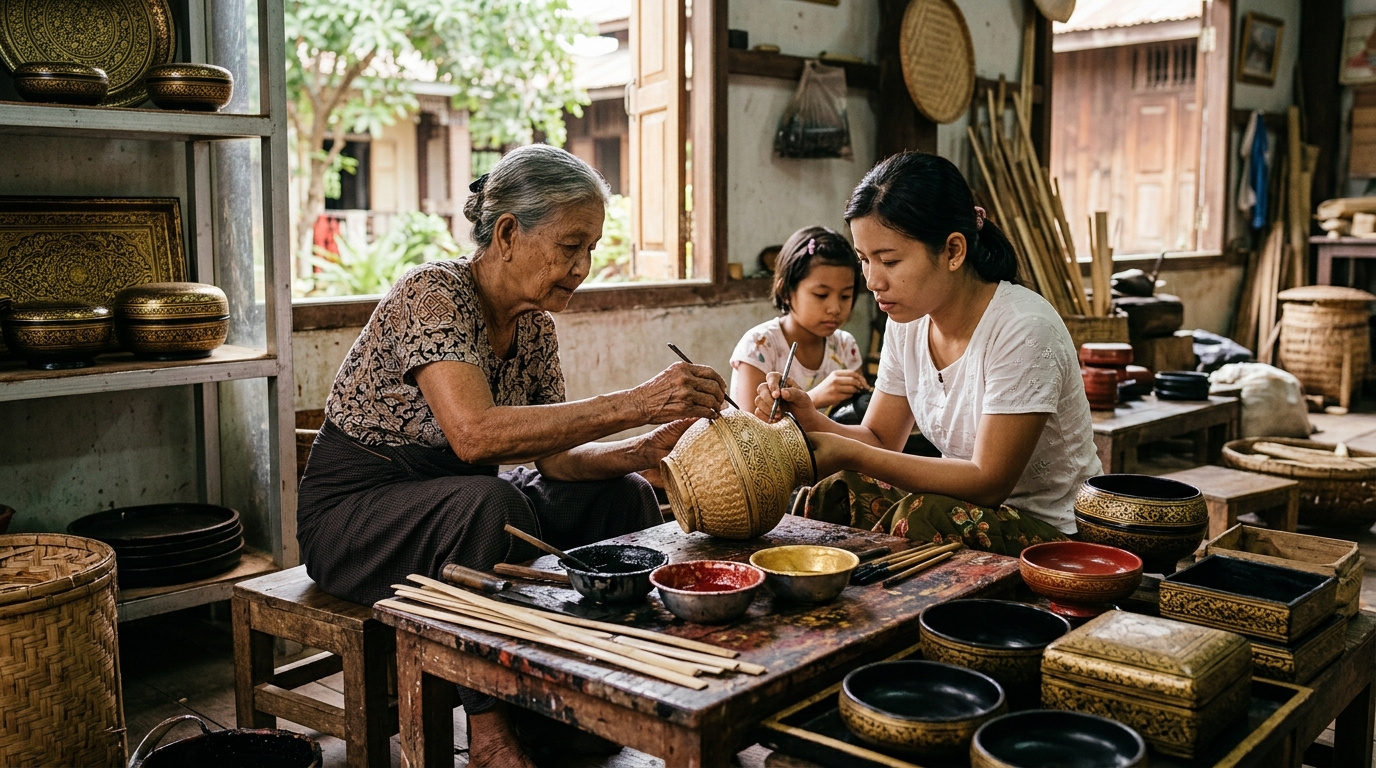
In a small workshop on the outskirts of Mandalay, 67-year-old U Tin Maung sits cross-legged on a woven mat, applying his 43rd layer of lacquer to a wooden bowl. His hands move with practiced precision, each stroke building on decades of knowledge passed down through seven generations. He is one of fewer than 200 master lacquerware artisans left in Myanmar, part of a vanishing community of craftspeople fighting to keep ancient techniques alive in a rapidly changing world.
Myanmar traditional crafts artisans preserve centuries-old techniques in lacquerware, gold leaf production, silk weaving, woodcarving, and metalwork. These master craftspeople face challenges from raw material shortages, declining apprenticeships, and economic pressures, yet continue creating authentic pieces that embody Myanmar’s cultural heritage. Visitors can support artisans directly through workshop visits in Mandalay, Bagan, Inle Lake, and Yangon.
The living traditions that define Myanmar’s craft heritage
Myanmar’s traditional crafts represent more than decorative objects. They embody spiritual practices, historical narratives, and community identity built over millennia.
The country’s artisan traditions center around the Pan Sè Myo, or Ten Flowers, a framework of classical arts established during the Bagan period (1044-1287 CE). These disciplines include blacksmithing, bronze casting, goldsmithing, lacquerware, masonry, painting, sculpture, stucco relief, and woodcarving.
Each craft requires years of apprenticeship. Most master artisans began learning between ages 8 and 12, spending their formative years observing, practicing, and absorbing techniques that cannot be fully captured in written instructions.
The knowledge transfer happens through demonstration and repetition. An apprentice might spend six months learning to hold a carving tool correctly before attempting their first independent cut.
How lacquerware artisans create layers of lasting beauty
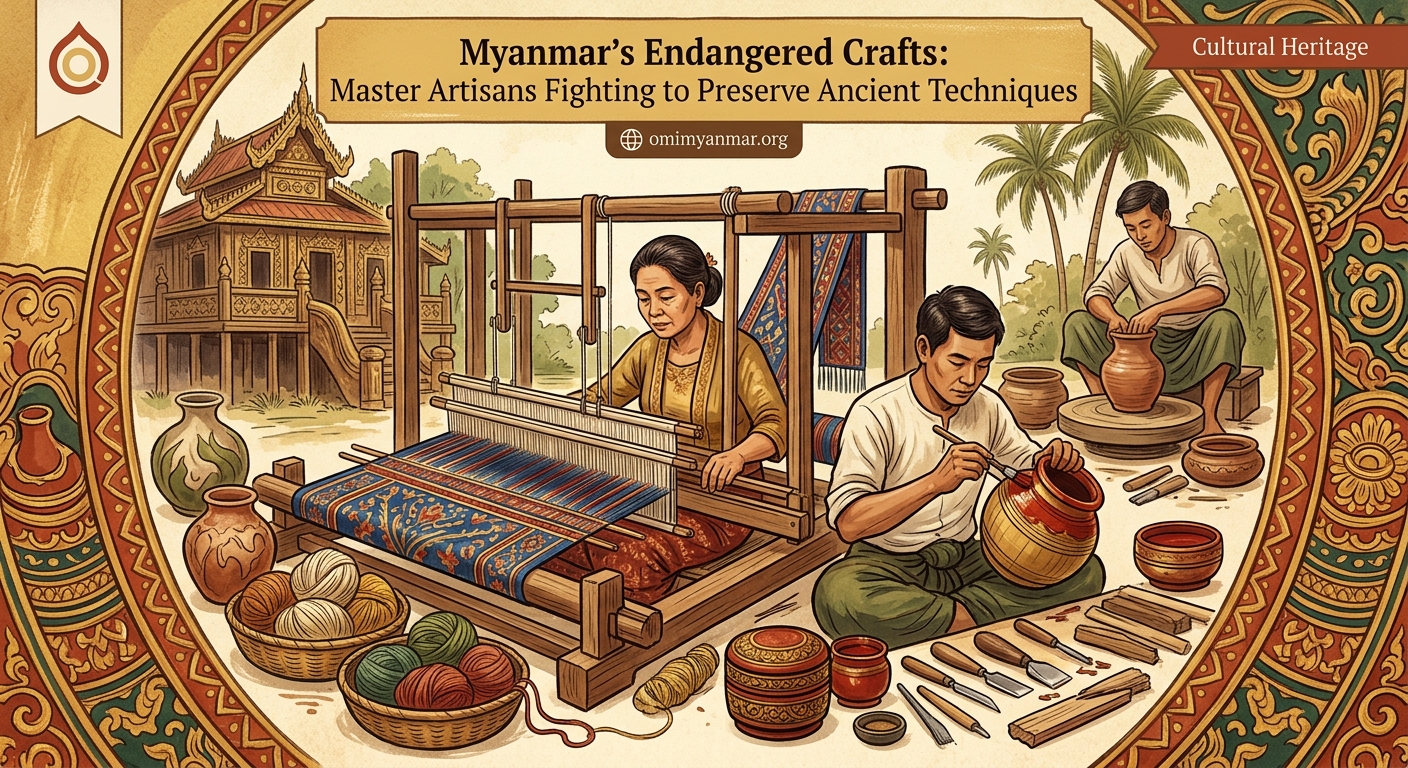
Lacquerware production in Myanmar centers in Bagan, where workshops have operated continuously for over 800 years. The process demands patience and precision that modern manufacturing cannot replicate.
Creating a single lacquerware piece follows these steps:
- Shaping the base form from bamboo strips or teak wood
- Applying the first coat of thitsi (lacquer tree sap mixed with ash)
- Drying the piece in a dark, humid chamber for 7-10 days
- Sanding the surface smooth with fine river sand
- Repeating steps 2-4 between 12 and 40 times depending on quality grade
- Engraving decorative patterns by hand
- Filling engravings with colored pigments or gold leaf
- Polishing the final surface with palm oil and tamarind seed powder
The entire process takes 3 to 6 months for standard pieces. Premium items requiring 40+ layers may take a full year to complete.
Master lacquerware artisan Daw Khin Saw Win explains the challenge: “Young people see the timeline and choose factory work instead. They earn money immediately. We wait months to sell one bowl.”
The lacquer itself comes from the Melanorrhoea usitata tree, which grows wild in Myanmar’s forests. Tappers collect sap using methods unchanged for centuries, but deforestation has reduced available trees by an estimated 60% since 1990.
Gold leaf beating requires strength and ancestral precision
Mandalay’s gold leaf workshops produce sheets so thin that 1,000 layers stacked together measure less than a postage stamp’s thickness. These delicate sheets cover pagodas, Buddha images, and ceremonial objects throughout Myanmar.
The beating process starts with small gold nuggets melted and rolled into ribbons. Artisans cut these ribbons into squares, sandwich them between layers of specially treated bamboo paper, and begin hammering.
A master beater strikes the packet approximately 10,000 times over 4-6 hours. The rhythm matters as much as the force. Too hard, and the gold tears. Too soft, and it won’t spread evenly.
The work requires exceptional physical stamina. Beaters typically work in pairs, alternating every 20 minutes to maintain consistent force. Most retire by age 50 due to repetitive strain injuries.
Temperature and humidity must stay within narrow ranges. Workshops operate in semi-underground rooms where thick walls maintain stable conditions year-round.
“My grandfather could tell if the humidity changed by 2% just by how the hammer felt in his hand. That sensitivity takes 20 years to develop. No machine can replace it.” – U Myint Swe, fourth-generation gold leaf artisan
Silk weaving communities preserve patterns with cultural memory
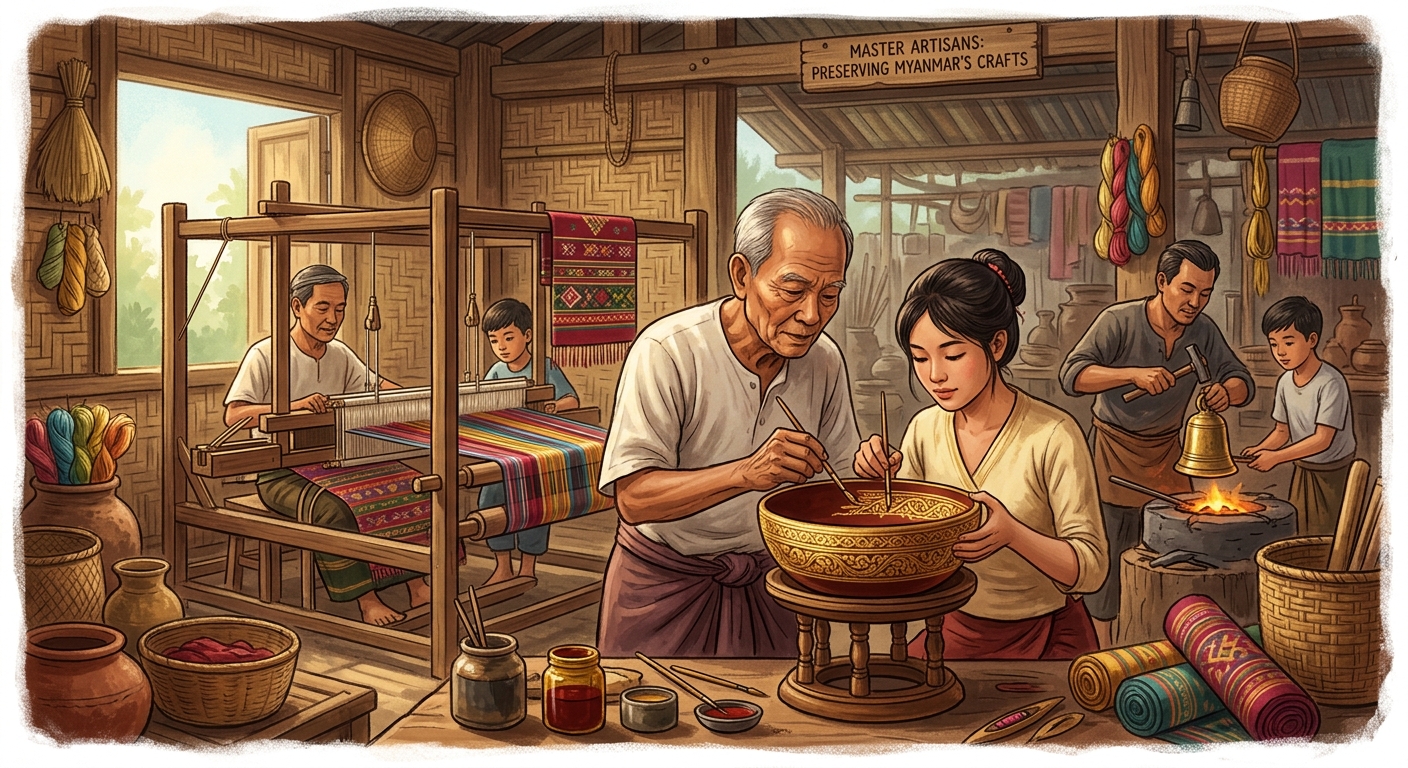
The Inle Lake region and Shan State host Myanmar’s most renowned silk weaving traditions. Artisans here create intricate patterns using techniques that predate written records.
Traditional looms stand over 6 feet tall and require weavers to coordinate hands and feet in complex sequences. Setting up a loom for a new pattern can take 2-3 weeks before the first thread gets woven.
The lotus fiber textile tradition represents Myanmar’s most distinctive weaving practice. Artisans extract fibers from lotus stems harvested from Inle Lake, spin them into thread, and weave fabric prized for its natural cooling properties and subtle sheen.
Producing enough lotus fiber for a single scarf requires approximately 4,000 lotus stems. Extraction must happen within 24 hours of cutting, or the fibers become brittle and unusable.
Contemporary challenges facing weavers include:
- Competition from factory-made imitations sold as authentic handwoven pieces
- Younger generation preference for less physically demanding work
- Rising costs of natural dyes and quality silk thread
- Difficulty accessing international markets without intermediaries
- Limited recognition and protection of traditional patterns
The Kachin and Chin communities maintain distinct weaving traditions featuring geometric patterns that encode family lineages and regional identities. Each pattern combination tells a story, identifying the weaver’s village, clan, and sometimes specific family history.
Woodcarving masters transform teak into architectural poetry
Myanmar’s woodcarving tradition reaches its pinnacle in the ornate monasteries and royal buildings that dot the landscape. The Shwenandaw Monastery in Mandalay, entirely constructed from carved teak, demonstrates the art form’s breathtaking complexity.
Carvers work primarily with teak, valued for its durability and fine grain. A single panel featuring intertwined floral and mythological motifs might require 400-600 hours of carving time.
The tools themselves represent generations of refinement. Master carvers often use chisels and gouges inherited from their teachers, the steel worn to perfect angles through decades of sharpening and use.
| Carving Technique | Traditional Application | Time Investment | Common Mistakes |
|---|---|---|---|
| Relief carving | Monastery panels, doors | 200-600 hours per panel | Cutting too deep initially, inconsistent depth |
| Openwork carving | Window screens, room dividers | 300-800 hours per piece | Breaking delicate connections, uneven thickness |
| Sculptural carving | Buddha images, mythical creatures | 100-400 hours per figure | Poor proportions, surface texture inconsistencies |
| Decorative inlay | Furniture, boxes | 50-200 hours per item | Gaps in joints, mismatched wood grain |
Modern economic pressures push carvers toward faster production. A piece that traditionally required three months might now be completed in three weeks, with noticeable quality compromises.
The shortage of quality teak poses another challenge. Government restrictions on logging, while necessary for forest conservation, limit legal access to the wood carvers have used for centuries. Many now work with imported teak or alternative hardwoods that lack the same working properties.
Where to meet Myanmar traditional crafts artisans in their workshops
Visiting artisan workshops provides direct support and authentic cultural experiences that benefit both travelers and craftspeople. Several regions offer accessible workshop visits.
Mandalay serves as Myanmar’s artisan capital. The traditional craft workshops cluster in specific neighborhoods where families have practiced their trades for generations. Gold leaf workshops operate primarily in the Shwe In Bin area. Marble carvers work near the base of Mandalay Hill. Tapestry weavers concentrate in the Amarapura township.
Most workshops welcome visitors between 8:00 AM and 5:00 PM. Mornings offer the best light for observing detailed work. Artisans appreciate genuine interest but may have limited English. Bringing a local guide or translator enhances the experience.
Bagan remains the center for lacquerware production. Over 300 workshops operate in and around the archaeological zone. Quality varies significantly. Look for workshops where you can observe the full production process rather than just retail showrooms.
The village of Myinkaba, just south of Old Bagan, hosts several multigenerational lacquerware families. These workshops typically offer more authentic experiences than tourist-oriented shops near major temples.
Inle Lake provides access to lotus weaving, silk production, and silversmithing traditions. Boat tours can include workshop stops, though these sometimes feel rushed. Consider staying in Nyaungshwe and arranging dedicated workshop visits through your accommodation.
The Inpawkhon village specializes in lotus fiber weaving. The Inn Paw Khone Weaving Village hosts multiple workshops where you can observe the entire process from fiber extraction through finished textiles.
Yangon offers craft experiences within an urban context. Bogyoke Aung San Market houses numerous craft vendors, though most sell rather than produce on-site. The Pun Hlaing Estate area includes some working studios.
For travelers planning visits, what you really need to know before traveling to Myanmar in 2024 covers essential preparation steps.
Supporting artisans through ethical purchasing decisions
Buying directly from artisans ensures they receive fair compensation for their work. The price difference between workshop purchases and market resales can exceed 300%.
When evaluating craft pieces, consider these authenticity indicators:
- Slight irregularities in pattern or finish (handmade items show natural variation)
- Visible tool marks consistent with traditional techniques
- Appropriate weight for materials (genuine lacquerware feels substantial)
- Natural material scent (chemical odors suggest synthetic components)
- Artisan willingness to explain production process in detail
Prices for authentic handmade pieces reflect the labor investment. A quality lacquerware bowl requiring 3 months of work might cost $80-150. Silk scarves woven from lotus fiber typically range from $200-400. These prices support sustainable livelihoods for artisans and their families.
Photography etiquette matters in workshop visits. Always ask permission before photographing artisans at work. Some craftspeople, particularly older masters, prefer not to be photographed. Respect these boundaries.
Small purchases carry significance beyond their monetary value. Buying a simple item demonstrates appreciation for the craft and encourages artisans that their skills retain value in the modern economy.
The apprenticeship crisis threatening craft continuity
Myanmar traditional crafts artisans face a generational challenge. Fewer young people choose to apprentice in traditional crafts when other career paths offer faster financial returns.
A typical apprenticeship spans 5-10 years before an individual can work independently. During early years, apprentices earn minimal income while learning fundamental techniques. This extended training period conflicts with contemporary economic pressures on young families.
Master carver U Kyaw Sein notes the mathematics: “I started learning at age 9. I sold my first independent piece at 18. Today, a young person can learn smartphone repair in 3 months and earn steady income. How do I compete with that reality?”
Some artisans have adapted by offering shorter, focused training programs. These condensed courses teach specific techniques rather than comprehensive mastery. While this approach attracts more students, it raises questions about depth of knowledge transfer.
Government and NGO initiatives have launched to support traditional crafts preservation. These programs provide stipends for apprentices, help artisans access broader markets, and document techniques through video and written records.
However, documentation cannot fully capture tacit knowledge, the intuitive understanding that develops through years of practice. An apprentice learns to read wood grain, judge lacquer consistency, or feel proper tension in loom threads through experience that resists codification.
The economic viability of traditional crafts depends partly on market access. Organizations working on grassroots transparency initiatives reshaping local governance in Myanmar sometimes intersect with artisan support networks, helping craftspeople navigate regulatory requirements for export and e-commerce.
How traditional techniques adapt without losing authenticity
Some Myanmar traditional crafts artisans integrate contemporary elements while maintaining core techniques. This balance allows crafts to remain relevant without abandoning ancestral methods.
Lacquerware artists now create modern forms like laptop cases and jewelry boxes alongside traditional betel boxes and offering vessels. The production method stays identical, but the shapes reflect current needs.
Weavers incorporate new color palettes while using traditional natural dyes and hand-weaving techniques. A silk scarf might feature contemporary color blocking, but every thread is still hand-dyed and woven on a traditional loom.
Woodcarvers accept commissions for furniture and architectural elements in modern buildings, applying traditional joinery and carving techniques to contemporary designs.
These adaptations generate controversy within artisan communities. Purists argue that changing forms dilutes cultural authenticity. Pragmatists counter that adaptation enables survival, allowing techniques to continue even as applications evolve.
The debate reflects broader questions about cultural preservation. Should traditional crafts remain frozen in historical forms, or can they evolve while maintaining technical integrity?
Most successful artisans find middle ground. They maintain production of classical pieces that embody full traditional practice while also creating adapted items that appeal to contemporary buyers and generate necessary income.
The cultural significance embedded in every handmade piece
Myanmar traditional crafts artisans create objects that carry meaning beyond their physical form. Each piece connects to spiritual practices, historical narratives, and community identity.
Lacquerware begging bowls used by monks link to Buddhist traditions of simplicity and detachment. The circular form represents the cycle of existence. The black and red colors reference earth and spiritual transformation.
Gold leaf applied to pagodas and Buddha images represents an act of merit-making. Devotees believe that gilding sacred objects generates positive karma. The thinness of the leaf symbolizes the refinement of spiritual practice.
Woven textiles encode social information. Specific patterns indicate ethnic group, region, and sometimes family lineage. A knowledgeable observer can identify a weaver’s background from pattern combinations and color choices.
Woodcarvings on monasteries and royal buildings depict jataka tales (stories of Buddha’s previous lives), mythological creatures, and floral motifs with symbolic meanings. These visual narratives served educational purposes in societies with limited literacy.
Understanding these cultural layers enriches appreciation for the crafts. An object becomes more than decoration when you recognize the spiritual intention, historical context, and community identity it embodies.
The connection between crafts and cultural identity explains why preservation matters beyond economic or artistic considerations. When traditional crafts disappear, communities lose tangible links to their heritage and ways of transmitting cultural knowledge across generations.
Similar cultural preservation challenges appear in other aspects of Myanmar society, including traditional practices like why thanaka paste remains Myanmar’s most beloved beauty secret after 2,000 years.
Hands that hold centuries
The future of Myanmar traditional crafts artisans depends on choices made today by consumers, policymakers, and communities. Every purchase of an authentic handmade piece supports an artisan’s livelihood and validates years of dedicated practice. Every visitor who spends time in a workshop learning about techniques reinforces the cultural value of these traditions.
The master artisans working today represent living libraries of knowledge that cannot be recovered once lost. Their hands hold techniques refined over centuries, passed person to person in an unbroken chain stretching back through generations. Supporting their work preserves not just beautiful objects, but entire systems of knowledge, cultural identity, and human connection to craft that our increasingly automated world desperately needs.
When you hold a piece of authentic Myanmar lacquerware or watch gold leaf being beaten to impossible thinness, you witness human capability at its most refined. These artisans remind us that some things cannot be rushed, replicated by machines, or reduced to efficiency metrics. They create beauty through patience, skill through dedication, and meaning through tradition. That legacy deserves our attention, respect, and support.