

Corruption in Myanmar’s business sector isn’t just a regulatory checkbox. It’s a daily reality that shapes market entry decisions, supplier relationships, and operational risks for international companies. Whether you’re conducting due diligence for a new investment or building compliance protocols for existing operations, understanding the current landscape of anti-corruption measures Myanmar has implemented is essential for protecting your business and making informed decisions.
Myanmar’s anti-corruption framework combines legislative reforms, institutional oversight bodies, and international partnerships, but enforcement remains inconsistent. Business professionals must navigate a complex environment where formal regulations exist alongside entrenched informal practices. Success requires understanding both the official compliance requirements and the practical realities of operating in sectors with varying corruption risks and limited rule of law protections.
The current state of corruption risks in Myanmar
Myanmar presents a challenging corruption environment that ranks among the most difficult in Southeast Asia. Transparency International’s Corruption Perceptions Index consistently places the country in the lower tier, reflecting systemic issues that affect every business sector.
The military’s continued influence creates unique complications. Military-linked enterprises and cronies maintain substantial economic power, often operating outside normal regulatory oversight. This creates an uneven playing field where connections matter as much as compliance.
Bribery remains common in public services. Businesses report regular demands for unofficial payments when dealing with customs, licensing authorities, and regulatory agencies. These practices are so normalized that many local businesses budget for them as operational expenses.
The judicial system offers limited recourse. Courts lack independence, and legal protections for businesses challenging corrupt practices are weak. This means prevention and careful partner selection matter more than legal remedies.
Regional variations add another layer of complexity. Border areas and ethnic minority regions operate under different governance structures, with disputed state authority creating additional corruption risks.
Legislative framework and formal regulations
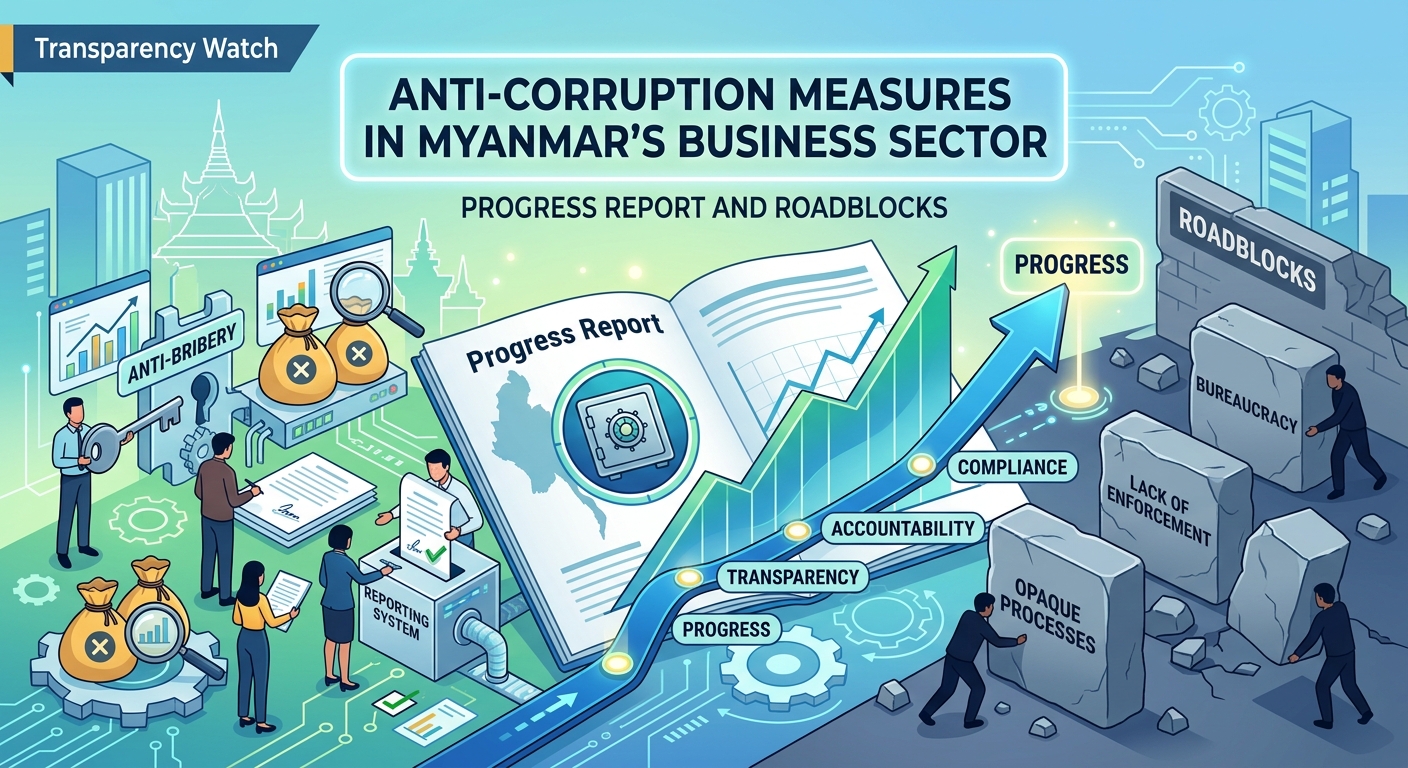
Myanmar has developed a legal framework addressing corruption, though implementation lags behind the written law. The Anti-Corruption Law, enacted in 2013, established the legal foundation for prosecuting corrupt practices and created institutional mechanisms for enforcement.
The law covers both public officials and private sector actors. It prohibits bribery, embezzlement, abuse of office, and illicit enrichment. Penalties include imprisonment and fines, with more severe punishments for cases involving large amounts.
Key provisions relevant to businesses include:
- Prohibition of offering bribes to public officials
- Requirements for transparent accounting and record-keeping
- Restrictions on gifts and hospitality beyond nominal values
- Obligations to report suspected corruption
- Protections for whistleblowers (though enforcement is weak)
The Anti-Corruption Commission serves as the primary enforcement body. Created by the 2013 law, it has authority to investigate cases, recommend prosecutions, and implement prevention programs. However, its effectiveness is limited by resource constraints and political interference.
Public procurement regulations aim to reduce corruption in government contracting. The procurement law requires competitive bidding for contracts above certain thresholds and mandates transparency in award decisions. Yet why Myanmar’s public procurement system remains vulnerable to corruption despite recent reforms highlights ongoing challenges in this area.
The Companies Act and Investment Law include anti-corruption provisions requiring businesses to maintain accurate financial records and prohibiting corrupt practices in obtaining licenses or permits.
Institutional oversight and enforcement mechanisms
Several government bodies share responsibility for anti-corruption enforcement, creating a fragmented system with overlapping jurisdictions and coordination challenges.
The Anti-Corruption Commission investigates cases involving government officials and recommends prosecutions to the Attorney General’s Office. It also conducts asset declarations for public officials and runs public education campaigns. However, its independence is questionable, and it has been criticized for selective enforcement.
The Auditor General’s Office examines government accounts and public enterprises for financial irregularities. Its reports sometimes reveal corruption-related issues, but follow-up action is inconsistent.
The Attorney General’s Office prosecutes corruption cases referred by the Anti-Corruption Commission. Political considerations often influence which cases proceed to trial.
Sector-specific regulators also have anti-corruption responsibilities. The Central Bank oversees financial institutions’ anti-money laundering compliance. The Directorate of Investment and Company Administration monitors business registration and compliance. The Myanmar Investment Commission reviews foreign investment proposals.
Civil society organizations play an important monitoring role despite facing restrictions. Groups focused on transparency and good governance document corruption cases, advocate for reforms, and provide business integrity training. However, what NGO workers need to know about navigating Myanmar’s regulatory environment reveals the challenges these organizations face.
Sector-specific corruption vulnerabilities
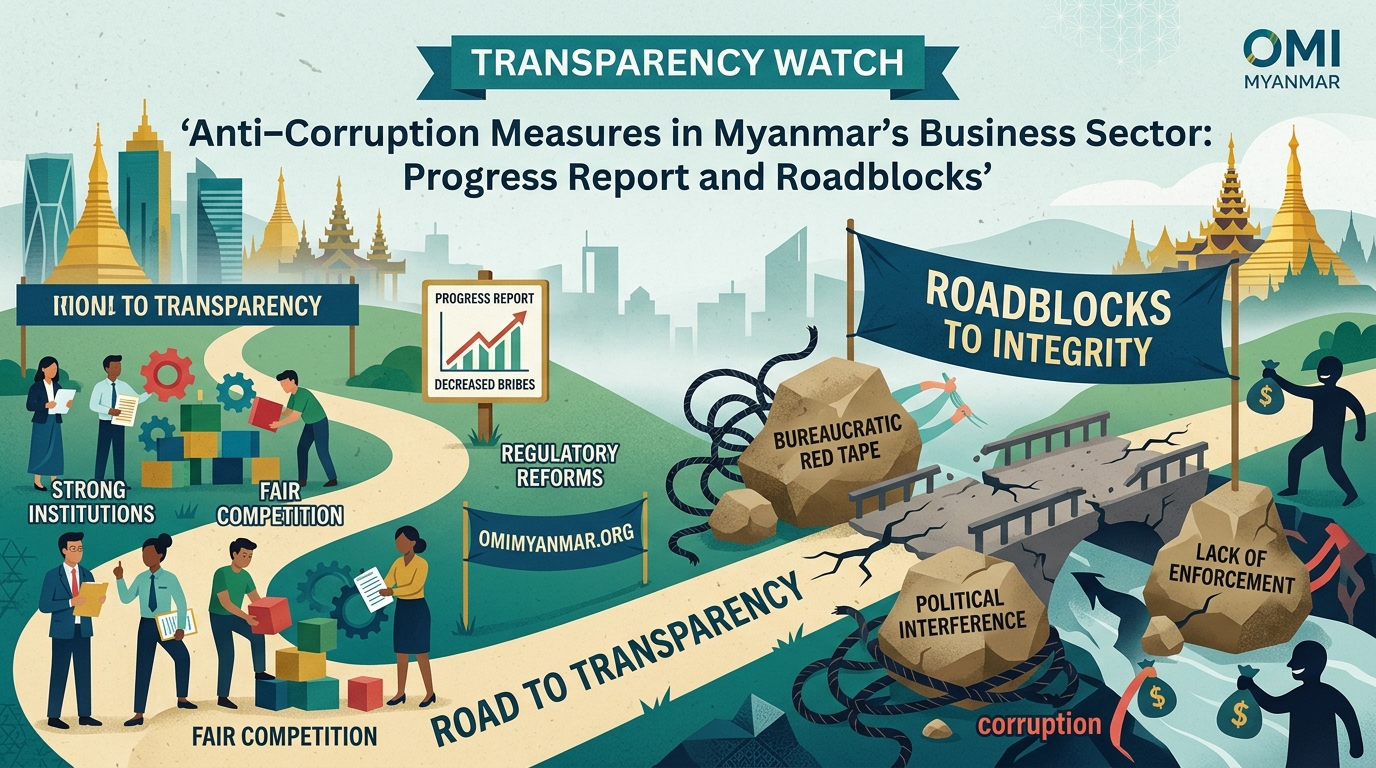
Different business sectors face varying levels of corruption risk in Myanmar. Understanding these patterns helps companies assess exposure and design appropriate controls.
Natural resources and extractives
Mining, oil and gas, and timber sectors face the highest corruption risks. These industries involve large capital investments, government concessions, and military interests. Opaque licensing processes and revenue management create opportunities for corruption at multiple points.
Companies operating in extractives must navigate complex relationships with military-linked enterprises, ethnic armed organizations controlling resource-rich areas, and government officials with discretion over permits and royalties.
Construction and infrastructure
Public infrastructure projects frequently involve corruption in contract awards, change orders, and quality inspections. Connections with decision-makers often matter more than technical qualifications or competitive pricing.
Real estate development faces risks related to land acquisition, zoning approvals, and utility connections. Unofficial payments to expedite permits are common.
Financial services
Banks and financial institutions face anti-money laundering compliance challenges. Weak enforcement and limited international cooperation make Myanmar attractive for money laundering related to corruption proceeds, drug trafficking, and other illicit activities.
Healthcare and pharmaceuticals
Drug registration, import licenses, and hospital supply contracts present corruption risks. Quality control is weak, creating opportunities for substandard products through corrupt approval processes.
Import and export
Customs procedures remain a major corruption flashpoint. Businesses report frequent demands for unofficial payments to clear goods, obtain accurate valuations, or avoid delays. Classification disputes and discretionary enforcement create leverage for corrupt officials.
Practical compliance steps for international businesses
Operating in Myanmar requires robust anti-corruption compliance programs tailored to local risks. Here’s a systematic approach:
-
Conduct thorough due diligence on potential partners, agents, and suppliers before establishing relationships. This includes background checks, beneficial ownership verification, and reputation assessments.
-
Implement clear policies prohibiting bribery and corruption, with specific guidance on gifts, hospitality, facilitation payments, and dealing with government officials. Make sure policies address Myanmar-specific scenarios.
-
Establish financial controls ensuring accurate recording of all transactions, with particular attention to payments to third parties, consultants, and agents who interact with government officials.
-
Provide regular training for employees and partners on anti-corruption policies, local corruption risks, and reporting procedures. Training should include realistic scenarios they’ll encounter.
-
Create confidential reporting channels allowing employees and partners to raise concerns about potential corruption without fear of retaliation.
-
Monitor high-risk activities including government interactions, licensing processes, customs clearance, and third-party relationships through regular audits and reviews.
-
Conduct periodic risk assessments evaluating changes in operations, regulatory environment, or business relationships that might create new corruption vulnerabilities.
“The biggest mistake international companies make is assuming their standard global compliance program will work in Myanmar. You need controls specifically designed for the local context, with particular attention to third-party relationships and government interactions that happen at operational levels, not just executive meetings.”
Common compliance mistakes and how to avoid them
Many businesses struggle with anti-corruption compliance in Myanmar. This table outlines frequent errors and practical solutions:
| Mistake | Why It Happens | Better Approach |
|---|---|---|
| Relying solely on contractual anti-corruption clauses with local partners | Assumes written agreements provide sufficient protection | Combine contracts with ongoing monitoring, training, and relationship management |
| Using local agents or consultants without proper due diligence | Need for local expertise and connections leads to hasty hiring | Conduct thorough background checks, verify track record, and implement clear oversight |
| Treating all facilitation payments as acceptable because they’re common | Misunderstanding of legal standards and local norms | Prohibit facilitation payments in policy, document any that occur under duress, and report internally |
| Failing to monitor third-party relationships after initial approval | Compliance seen as one-time checkbox rather than ongoing process | Implement periodic re-screening, audit payments, and review performance |
| Inadequate documentation of government interactions | Informal business culture and lack of processes | Require written records of meetings, decisions, and payments involving officials |
| Ignoring red flags in financial transactions | Pressure to complete deals or maintain relationships | Establish clear escalation procedures and empower compliance staff to pause transactions |
International frameworks and external pressure
International anti-corruption conventions and foreign laws create additional compliance obligations for businesses operating in Myanmar, particularly those with connections to countries with extraterritorial anti-corruption enforcement.
The U.S. Foreign Corrupt Practices Act applies to U.S. companies, foreign companies listed on U.S. exchanges, and any company using U.S. financial systems to facilitate corrupt payments. FCPA violations in Myanmar have resulted in significant penalties for several multinational corporations.
The UK Bribery Act covers UK companies and foreign companies doing business in the UK. It includes a corporate offense of failing to prevent bribery, placing responsibility on companies to implement adequate procedures.
International organizations provide frameworks and support. The United Nations Office on Drugs and Crime has worked with Myanmar on anti-corruption capacity building, helping develop institutional frameworks and training programs.
The World Bank and Asian Development Bank include anti-corruption provisions in project financing and have suspended funding for projects involving corruption. Their oversight creates incentives for better practices in infrastructure and development projects.
Business associations promote integrity standards. The Myanmar Centre for Responsible Business and similar organizations provide guidance, training, and platforms for companies to share compliance practices.
How international watchdogs are monitoring Myanmar’s governance reforms in 2024 offers additional context on external oversight mechanisms.
Digital tools and transparency initiatives
Technology is creating new opportunities for transparency and corruption prevention, though adoption remains limited.
Some government services have moved online, reducing face-to-face interactions where corruption often occurs. Electronic payment systems for taxes and fees create transaction records that are harder to manipulate than cash payments.
Civil society groups use digital platforms to report corruption and monitor government activities. Mobile apps allow citizens to document bribery demands and share experiences, though users face potential retaliation.
Blockchain and distributed ledger technologies are being explored for land registries and supply chain tracking in sectors like timber and gemstones, where corruption and illegal activity are endemic.
Can digital tools bridge Myanmar’s accountability gap? A critical assessment examines these technologies’ potential and limitations.
However, digital solutions face significant barriers. Limited internet access, low digital literacy, and government restrictions on online activity constrain effectiveness. Technology alone cannot substitute for political will and institutional capacity.
The role of transparency and information access
Access to information remains limited in Myanmar, hampering corruption prevention and detection efforts.
Freedom of information laws exist but provide weak protections and numerous exemptions. Government agencies routinely refuse disclosure requests, and appeals processes are ineffective. Understanding Myanmar’s freedom of information laws: what changed and what remains provides detailed analysis of these limitations.
Media freedom has deteriorated significantly. Journalists investigating corruption face harassment, arrest, and prosecution under vague laws criminalizing criticism of the government or military. This chills investigative reporting on corrupt practices.
Company ownership remains opaque. Beneficial ownership disclosure requirements are weak, allowing corrupt officials and their families to hide interests in businesses. This makes due diligence more difficult and enables conflicts of interest.
Government contracting lacks transparency. Contract awards, bid documents, and performance information are rarely published. This opacity facilitates corruption in procurement.
Some positive developments exist. 5 grassroots transparency initiatives reshaping local governance in Myanmar documents community-level efforts to increase accountability despite national-level challenges.
Building ethical business relationships
Success in Myanmar requires more than compliance programs. It demands careful relationship building based on shared integrity standards.
When selecting local partners, look beyond surface credentials. Ask detailed questions about their approach to government interactions, their experience with compliance requirements, and their willingness to operate transparently. References from other international companies are valuable.
Build relationships gradually. Start with smaller projects or limited arrangements that allow you to assess a partner’s integrity before making major commitments.
Invest in joint training and capacity building. Many local businesses lack exposure to international compliance standards. Providing training demonstrates your commitment and helps partners understand expectations.
Be prepared to walk away. Some opportunities aren’t worth the corruption risks. Companies that succeed long-term in challenging environments are those willing to decline deals that can’t be done cleanly.
Create alignment through incentives. Structure agreements so partners benefit from compliance rather than seeing it as a burden. Performance metrics and bonuses tied to ethical conduct reinforce desired behaviors.
What businesses should watch going forward
Myanmar’s anti-corruption landscape continues to change, creating both risks and opportunities for businesses.
Political instability affects corruption patterns and enforcement priorities. Changes in government or military influence shift which sectors face scrutiny and which corrupt networks hold power.
International pressure may increase. As Myanmar seeks foreign investment and international legitimacy, external actors can leverage access to markets and financing to demand better governance.
Regional integration creates new dynamics. As Myanmar participates in ASEAN economic initiatives, regional standards and peer pressure may drive improvements.
Technology adoption will accelerate. Younger generations comfortable with digital tools are entering business and government, potentially disrupting traditional corrupt practices.
Civil society resilience matters. Despite restrictions, grassroots transparency initiatives continue pushing for accountability.
Sanctions and trade restrictions create compliance complexity. Businesses must monitor evolving restrictions related to military-linked enterprises and human rights concerns.
Making informed decisions in a complex environment
Anti-corruption measures Myanmar has implemented create a framework for business integrity, but the gap between law and practice remains substantial. International companies face genuine challenges operating ethically in this environment.
Success requires realistic assessment of risks, robust compliance programs tailored to local conditions, and careful partner selection. It means understanding that formal regulations tell only part of the story, and that informal practices and power dynamics shape daily business reality.
The businesses that navigate Myanmar successfully are those that invest in understanding the context deeply, build relationships based on shared integrity standards, and maintain the discipline to walk away from opportunities that can’t be pursued cleanly. They recognize that corruption risks can’t be eliminated entirely but can be managed through thoughtful strategies and consistent application of ethical principles.
Your compliance program should evolve as you learn more about operating in Myanmar. Regular reassessment, honest conversations with local partners, and willingness to adjust approaches based on experience will serve you better than rigid application of generic policies designed for different markets.