
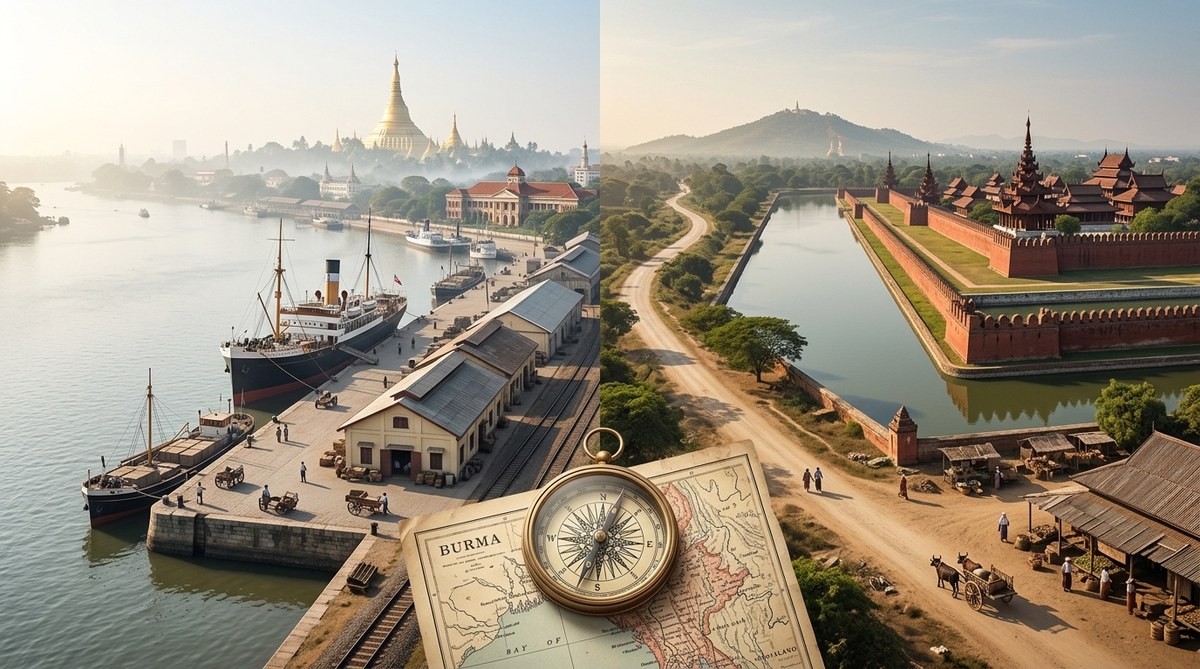
When the British annexed Upper Burma in 1885, they faced a crucial administrative decision. The ancient royal capital of Mandalay sat inland, rich with cultural heritage and symbolic power. Yet the colonial administration chose Rangoon, a coastal city already under British control since 1852, as the capital of unified Burma.
This choice wasn’t arbitrary. It reflected cold calculations about trade, defense, and control that would shape Myanmar’s development for the next century and beyond.
Rangoon became Burma’s colonial capital because of its strategic port location, established infrastructure, and proximity to British India. The city offered maritime access, commercial advantages, and easier administrative control compared to landlocked Mandalay. This decision prioritized economic extraction and imperial logistics over traditional Burmese political centers, fundamentally reshaping the country’s geographic and economic orientation toward the coast.
Geographic advantages that sealed Rangoon’s fate
Rangoon sits at the mouth of the Irrawaddy River delta, just 21 miles from the Andaman Sea. This position gave British administrators direct access to maritime trade routes connecting Burma to India, Singapore, and beyond.
Mandalay, by contrast, lies 400 miles inland in central Burma. Reaching it required river navigation or overland travel through difficult terrain. For an empire built on naval power and global commerce, this isolation posed serious logistical problems.
The delta region surrounding Rangoon also offered something Mandalay couldn’t match: vast expanses of fertile land perfect for rice cultivation. British planners saw immediate potential to transform these wetlands into export-oriented agricultural zones.
Water access meant everything in the 19th century. Steamships could dock directly in Rangoon’s harbor, load cargo, and depart for international markets. The same journey from Mandalay required transferring goods to smaller river vessels, then reloading onto ocean-going ships at the coast.
Economic infrastructure already in place
By 1885, Rangoon had served as the capital of British Lower Burma for 33 years. That time hadn’t been wasted.
The British had already constructed:
- Government administrative buildings
- Port facilities and customs houses
- Railway connections to the interior
- Telegraph lines linking the city to Calcutta
- Banking and commercial establishments
- European residential quarters
Building equivalent infrastructure in Mandalay would have required massive investment and years of construction. The British were practical colonizers. They saw no reason to duplicate what they’d already built.
Rangoon’s commercial networks connected directly to British India’s economy. Indian merchants, British trading houses, and Chinese business communities had established operations there. Moving the capital to Mandalay would have disrupted these profitable arrangements.
The rice trade that drove colonial priorities
Burma became the world’s largest rice exporter under British rule. This wasn’t accidental.
The Irrawaddy delta possessed ideal conditions for rice cultivation: flat terrain, abundant water, and rich alluvial soil. Rangoon served as the natural export hub for this agricultural bounty.
Consider the logistics:
- Farmers grew rice in delta regions surrounding Rangoon
- Merchants collected and milled the grain in the city
- Ships loaded rice directly at Rangoon’s port
- Exports reached markets in India, Ceylon, and beyond
This system generated enormous profits for British trading companies and tax revenue for the colonial administration. Mandalay offered no comparable economic advantage.
The numbers tell the story. Between 1855 and 1905, Burma’s rice exports increased from 162,000 tons to 2.4 million tons annually. Nearly all of this passed through Rangoon’s port facilities.
“Rangoon was not merely a capital but a commercial engine. Its position at the delta’s edge made it the mandatory gateway for Burma’s most valuable export commodity. No inland city could replicate this function.” — Colonial administrative records, 1890s
Military and administrative control considerations
The British learned hard lessons during the three Anglo-Burmese Wars. Controlling Burma required more than defeating royal armies. It demanded maintaining supply lines and projecting power across difficult terrain.
Rangoon’s coastal position provided critical advantages:
- Direct reinforcement from India by sea
- Naval gunboats could support ground operations
- Supplies arrived without dangerous inland transport
- Communication with London remained reliable via telegraph
Mandalay sat deep in potentially hostile territory. Garrisoning troops there meant long, vulnerable supply lines through regions where resistance continued for years after formal annexation.
The British also wanted to diminish Mandalay’s symbolic importance. Keeping the capital there would have acknowledged traditional Burmese political authority. Rangoon represented a clean break, a new order oriented toward British imperial interests rather than indigenous traditions.
Comparing the two cities in 1885
Understanding why Rangoon became the capital requires seeing how dramatically these cities differed:
| Factor | Rangoon | Mandalay |
|---|---|---|
| Port access | Deep-water harbor | None, 400 miles inland |
| British control period | Since 1852 (33 years) | Newly captured in 1885 |
| Infrastructure | Extensive colonial buildings | Traditional royal structures |
| Commercial networks | Established international trade | Limited to regional commerce |
| Rice export capacity | Direct shipping facilities | Required river transport |
| Telegraph connection | Direct line to Calcutta | Would need new construction |
| European population | Significant community | Minimal presence |
| Strategic vulnerability | Defendable from sea | Exposed to inland resistance |
The table makes the colonial calculus clear. Rangoon checked every box for efficient imperial administration.
Cultural and symbolic dimensions
The British deliberately chose to marginalize Mandalay’s cultural significance. The city represented centuries of Burmese royal authority, Buddhist kingship, and indigenous political traditions.
Making Rangoon the capital sent a message: Burma’s future lay in commerce, not tradition. The country would orient toward global markets, not inward-looking royal courts.
This decision had profound long-term consequences. Rangoon grew rapidly while Mandalay stagnated. Investment, infrastructure, and opportunity concentrated on the coast. The country’s economic and demographic center of gravity shifted permanently southward.
Many Burmese resented this transformation. They saw Rangoon as a foreign imposition, a city that served British interests rather than Burmese identity. This tension between traditional cultural centers and colonial commercial hubs persisted long after independence.
Infrastructure development under colonial rule
Once established as capital, Rangoon received massive infrastructure investment that Mandalay never matched.
The British constructed:
- The Sule Pagoda Road (now Sule Pagoda Road), a grand boulevard
- Rangoon General Hospital, the country’s premier medical facility
- Rangoon University, Burma’s first modern higher education institution
- An expanded port with modern cargo handling equipment
- Railway lines radiating to Mandalay, Prome, and Pegu
- The Secretariat building, an imposing red-brick administrative complex
These investments created path dependency. Each new building, railway line, or institution made Rangoon more entrenched as the capital. The gap between it and Mandalay widened with each passing decade.
By 1900, Rangoon had become a genuinely cosmopolitan city. Indians, Chinese, Europeans, and Burmese lived in distinct quarters. The population exceeded 250,000, making it one of Southeast Asia’s largest cities.
The role of Indian immigration
British policy encouraged massive Indian immigration to Burma, particularly to Rangoon. Indians worked as laborers, clerks, merchants, and moneylenders in the colonial economy.
By 1931, Indians comprised over half of Rangoon’s population. This demographic transformation wouldn’t have occurred as easily in Mandalay, where Burmese cultural identity remained stronger.
The Indian community integrated deeply into Rangoon’s commercial life. They staffed the colonial bureaucracy, ran trading houses, and provided capital for rice cultivation. This made the city even more valuable to British administrators.
Mandalay, by contrast, remained more ethnically Burmese. Moving the capital there would have meant operating in a less familiar cultural environment with fewer trusted intermediaries.
Transportation networks radiating from Rangoon
The British built Burma’s railway system with Rangoon as the hub. Lines connected the capital to:
- Prome (1877)
- Toungoo (1884)
- Mandalay (1889)
- Pegu (1877)
This network served two purposes: extracting resources and projecting control. Rice, teak, and other commodities flowed to Rangoon for export. Troops and administrators moved outward to maintain order.
Mandalay eventually got railway connections, but always as a spoke on a wheel centered at Rangoon. The city never became a transportation hub in its own right.
River transport followed similar patterns. Steamship services on the Irrawaddy connected Mandalay to Rangoon, but the coastal capital controlled access to international shipping.
Administrative efficiency and communication
Running an empire required fast, reliable communication. Rangoon’s telegraph connection to Calcutta, completed in 1871, gave administrators near-instantaneous contact with their superiors in India.
From Calcutta, messages could reach London via the Indo-European Telegraph. This global network made Rangoon feel closer to imperial decision-makers than Mandalay ever could.
The postal system worked similarly. Ships departing Rangoon carried mail directly to India and beyond. Letters from Mandalay had to travel overland or by river before reaching ocean transport.
These communication advantages mattered enormously for colonial governance. Administrators in Rangoon could request instructions, report developments, and coordinate with other colonies far more efficiently than counterparts in an inland capital.
Economic extraction and export orientation
British colonial policy in Burma focused relentlessly on resource extraction. The country served as a source of rice, teak, oil, and minerals for the broader empire.
Rangoon’s port facilities made this extraction efficient. Raw materials flowed out; manufactured goods from Britain and India flowed in. The city became a classic colonial entrepôt, enriching British merchants while transforming Burma’s economy.
This export orientation fundamentally reshaped Burmese society. Farmers shifted from subsistence cultivation to commercial rice production. Traditional craft industries declined as cheap imports arrived through Rangoon. The economy became dependent on global markets and vulnerable to price fluctuations.
None of this would have worked as well with Mandalay as capital. The logistics of moving bulk commodities through an inland city would have reduced profitability and complicated administration.
Lessons from other colonial capitals
The British made similar decisions throughout their empire. Calcutta, Bombay, Singapore, and Hong Kong all served as coastal capitals chosen for commercial and strategic reasons rather than cultural significance.
This pattern reflected imperial priorities: trade, naval power, and connection to global networks mattered more than accommodating indigenous political traditions.
In some cases, like India, the British eventually moved capitals inland (to New Delhi in 1911). But this happened only after railways and telegraphs reduced the disadvantages of interior locations. Burma never reached that point under colonial rule.
The choice of Rangoon over Mandalay fit a broader colonial logic that valued efficiency and profit over cultural continuity.
Long-term consequences for Myanmar
Rangoon’s selection as capital had effects that outlasted British rule. When Burma gained independence in 1948, the new government kept Rangoon as capital. The city’s infrastructure, institutions, and economic importance made alternatives impractical.
This decision perpetuated colonial-era patterns. Investment and opportunity remained concentrated on the coast. Urban migration trends continued drawing people from traditional centers like Mandalay to the commercial capital.
Only in 2006 did Myanmar’s government move the capital to Naypyidaw, a purpose-built city in the interior. Even then, Yangon (as Rangoon is now known) retained its position as the country’s commercial and cultural heart.
The British decision in 1885 thus shaped Myanmar’s geography of power for more than a century. It demonstrated how colonial choices, made for imperial convenience, can have profound and lasting effects on colonized societies.
Why this choice still matters today
Understanding why Rangoon became Burma’s capital helps explain Myanmar’s modern economic geography. The country’s orientation toward maritime trade, the dominance of Yangon in commercial life, and regional inequalities between coast and interior all trace back to colonial decisions.
For researchers studying colonial history, this case illustrates how imperial powers prioritized logistics and profit over indigenous political structures. The British didn’t choose Rangoon because it was better for Burma. They chose it because it was better for the British Empire.
For visitors to Myanmar today, recognizing this history adds depth to experiencing both cities. Yangon’s colonial architecture, grid streets, and port facilities tell one story. Mandalay’s palace, monasteries, and traditional arts tell another. Together, they reveal how colonialism reshaped not just governments but entire societies.
The question “why was Rangoon capital of Burma” thus opens windows into imperial strategy, economic history, and the long-term consequences of colonial rule. It reminds us that seemingly simple administrative decisions can echo across generations, shaping nations in ways their original architects never imagined.