
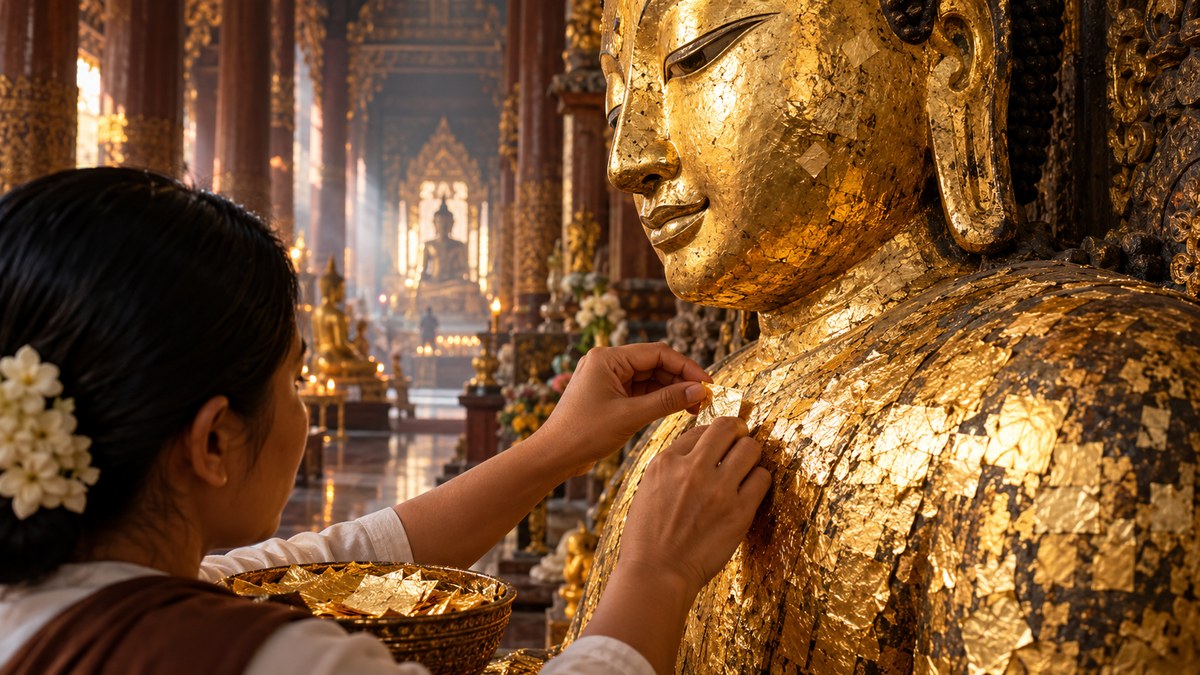
Walking into a dimly lit pagoda in Yangon, the first thing you notice is the glow. It is not a harsh light. It is a warm, almost breathing radiance that seems to come from the walls themselves. As your eyes adjust, you see the source: layers upon layers of gold leaf covering ancient Buddha statues and ornate spires. This is not decoration. This is an act of faith. In Myanmar, gold leaf gilding is a living tradition that transforms ordinary materials into sacred objects. It is a form of alchemy where the physical act of applying gold becomes a spiritual practice. For centuries, Burmese Buddhists have used this craft to generate merit, express devotion, and connect with the divine. Understanding the Myanmar gold leaf gilding spiritual meaning opens a window into the soul of the country itself.
Myanmar gold leaf gilding is far more than a decorative craft. It is a profound devotional practice rooted in Theravada Buddhism. Each hammer strike and careful application represents an offering of merit, a transformation of the mundane into the sacred, and a physical manifestation of spiritual aspiration. This ancient alchemy reveals how material beauty serves a higher purpose.
The Sacred Alchemy of Turning Metal into Light
Gold does not tarnish. It does not rust. It holds its luster through centuries. For Buddhists in Myanmar, these qualities make gold the perfect symbol for the deathless state of nirvana. When you see a gilded Buddha, you are looking at a representation of enlightenment made visible.
The process of creating gold leaf is itself a meditation. Artisans in Mandalay have passed down these techniques for generations. They take a single ounce of pure gold and hammer it into a sheet so thin that it covers an area the size of a living room. The gold becomes almost weightless. It becomes light.
This transformation matters. The gold leaf gilding spiritual meaning lies in the journey from raw metal to luminous surface. The gold starts as a dense, heavy lump. Through patient labor, it becomes something ethereal. This mirrors the Buddhist path. A person starts with heavy attachments and desires. Through practice and discipline, they become lighter. They move toward liberation.
What Gold Symbolizes in Burmese Buddhism
- Purity: Gold does not corrode. It represents an uncorrupted mind.
- Impermanence: Despite its beauty, gold leaf is fragile. A single breath can disturb it.
- Radiance: The light reflects wisdom and compassion.
- Value: Offering the most precious material shows total devotion.
- Merit: The act of funding or applying gold generates kammic credit for a better rebirth.
How Gold Leaf Is Made: A Step-by-Step Process
The craft of gold beating is concentrated in Mandalay, specifically in the 35th Street district. Walking through that neighborhood, you hear a constant rhythm. It sounds like distant drums. It is the sound of hammers hitting gold packets.
Here is how the process works:
- Melting and casting: Pure gold (usually 24 karat) is melted and poured into a mold to create a small bar.
- Rolling: The bar is passed through steel rollers to flatten it into a thin ribbon.
- Cutting: The ribbon is cut into small squares, each about the size of a fingernail.
- Stacking and wrapping: These squares are stacked between sheets of special bamboo paper. The stack is wrapped in a deerhide or plastic packet.
- Hammering: This is the core of the craft. A master beater swings a heavy hammer onto the packet. He hits it hundreds of times, rotating the packet carefully. The gold spreads inside the paper.
- Repacking: The partially flattened pieces are cut in half, restacked, and wrapped again. The hammering continues.
- Final thinning: After several rounds, the gold becomes paper thin. A single leaf can be as thin as 0.0001 millimeters.
- Cutting and packaging: The finished leaves are cut into standard sizes and placed between sheets of paper for sale.
The entire process takes weeks for a single batch. There is no room for impatience. A rushed hammer strike can tear the leaf and ruin hours of work.
Why Gold Leaf Gilding Is an Act of Devotion
The Myanmar gold leaf gilding spiritual meaning becomes clearest when you see who pays for the gold. It is rarely the government or a wealthy institution. It is ordinary people. A farmer might save for years to buy a single sheet of gold leaf. A shopkeeper might donate gold for the repair of a local pagoda.
This is the practice of dana, or generosity. In Theravada Buddhism, giving is one of the highest virtues. It weakens attachment to material things. It builds merit. When someone donates gold for a Buddha statue, they are not buying a decoration. They are planting a seed for their own spiritual future.
“When you offer gold to a Buddha image, you are not beautifying the Buddha. The Buddha needs nothing. You are purifying your own heart.” — U Zawana, a monk from the Shwedagon Pagoda in Yangon.
This quote captures the essence of the practice. The gold is a mirror. It reflects the intention of the giver. A donation made with a pure heart generates pure merit. A donation made for show generates little.
Common Misunderstandings About Gold Leaf Gilding
| What People Think | What It Actually Means |
|---|---|
| It is about showing wealth | It is about letting go of wealth |
| It is for decoration | It is for veneration |
| Only rich people do it | People of all means participate |
| It is a one-time event | It is a continuous practice |
| The gold is the point | The intention is the point |
The Ritual of Applying Gold Leaf
Watching someone apply gold leaf is a lesson in mindfulness. The process is slow. The tools are simple. A master gilder uses a flat brush made of squirrel hair to pick up a single leaf. Static electricity helps it stick to the brush. The gilder then places the leaf onto the prepared surface. A second brush is used to press it down gently.
There is no glue in the traditional method. The gold adheres through a combination of static and a special clay base called thayo.
The gilder works in silence or while chanting. Each placement is deliberate. If a leaf tears, the gilder starts over. There is no rushing. The work itself is a form of meditation.
What happens during a gilding ceremony
- Monks chant protective verses.
- Laypeople offer the gold leaves to the statue.
- The gilder applies the leaves in a specific order, starting from the top.
- Offerings of flowers and incense accompany the work.
- The ceremony ends with a dedication of merit to all beings.
The Spiritual Meaning Behind the Glow
When sunlight hits a freshly gilded pagoda, the effect is stunning. The structure seems to vibrate with light. For a Burmese Buddhist, this is not an accident. It is a reminder of the Buddha’s teachings.
The light represents panna, or wisdom. Wisdom cuts through ignorance just as light cuts through darkness. The gold represents karuna, or compassion. Compassion shines outward without discrimination.
This is why even small village pagodas are often gilded. A poor community will pool its resources to buy gold leaf for their local shrine. The result might be modest compared to the Shwedagon Pagoda, but the spiritual value is the same.
What the gilded statue communicates to devotees
- The Buddha is not made of flesh and bone. He is transcendent.
- The teachings are timeless and incorruptible.
- Enlightenment is attainable. The gold shows that transformation is possible.
- The community shares in the merit of the offering.
How to Experience This Tradition Respectfully
If you travel to Myanmar in 2026, you can see this tradition alive. The best places to observe gold leaf gilding are in Mandalay and Yangon. In Mandalay, the gold leaf quarter on 35th Street is open to visitors. You can watch artisans at work. They are usually happy to explain their craft.
At pagodas, you may see gilding in progress. Always ask permission before taking photographs. The work is sacred. Treat it with the same respect you would show in a church or temple.
If you want to participate, you can donate a gold leaf at most major pagodas. The cost is surprisingly low. A single leaf might cost a few dollars. The act of offering it yourself is a profound experience.
For a deeper understanding, read about the spiritual landscape of Myanmar beyond the Bagan temples. You will find that gold leaf gilding is just one thread in a rich tapestry of devotion.
The Deeper Meaning of Gold in Daily Life
The Myanmar gold leaf gilding spiritual meaning extends beyond temples. You see gold leaf on manuscripts, on lacquerware, and on the spires of monasteries. Each application carries the same intention.
Even the way gold leaf is handled says something. Artisans wash their hands before touching the gold. They do not breathe directly on it. They treat it as something sacred. This care is itself a teaching. It reminds us to handle all things with respect.
Gold leaf is also used in traditional medicine and in offerings to nats, the spirits that inhabit Burmese folk religion. This blending of Buddhism and animism shows how flexible the spiritual meaning can be. Gold is a universal symbol of the sacred. It works across traditions.
The Future of an Ancient Craft
In 2026, the craft faces challenges. Younger generations are moving to cities. The training takes years. The work is physically demanding. But there is hope. Organizations are working to preserve the techniques. Tourism, when done responsibly, provides income for artisans.
Some workshops now use electric hammers for the initial stages. But the final thinning is still done by hand. Master beaters say the machine cannot replicate the touch of a human hand. The gold would not feel the same.
If you value cultural preservation, consider supporting these artisans. Buying a small sheet of gold leaf as a souvenir is fine. But understand what you are holding. It is not just a product. It is the result of weeks of labor, generations of knowledge, and centuries of faith.
For those interested in other endangered crafts, read about master artisans fighting to preserve ancient techniques. The story of gold leaf gilding is part of a larger struggle to keep tradition alive.
What the Alchemy of Gold Leaf Teaches Us
Gold leaf gilding is alchemy in the truest sense. It takes a heavy, dull metal and transforms it into something that barely touches the ground. The gold becomes a metaphor for the human journey. We start heavy. We work. We become lighter. We begin to shine.
This is the heart of the Myanmar gold leaf gilding spiritual meaning. It is not about the gold. It is about what the gold represents. It is about the possibility of change. It is about the power of intention. It is about a community coming together to create something beautiful and sacred.
The next time you see a photograph of a gilded pagoda in Myanmar, look past the sparkle. See the hands that made it. See the faith that paid for it. See the hope that keeps it shining.
A Final Reflection on Light and Devotion
Standing before a gilded Buddha, you might feel small. The gold towers above you. The light seems to come from another world. But that is the point. The gilding is not meant to make you feel insignificant. It is meant to show you what is possible. The gold was once a nugget in the ground. Through human effort and devotion, it became light. So can you.
The tradition of gold leaf gilding in Myanmar invites you to consider your own life. What heavy things are you carrying? What could you transform through patience and practice? The answer is not in the gold. It is in the intention you bring to your own path.
If you visit Myanmar, take a moment to sit quietly in a gilded temple. Let the gold speak. It has a story to tell. It is a story of faith, of labor, and of the endless human desire to touch the divine.