
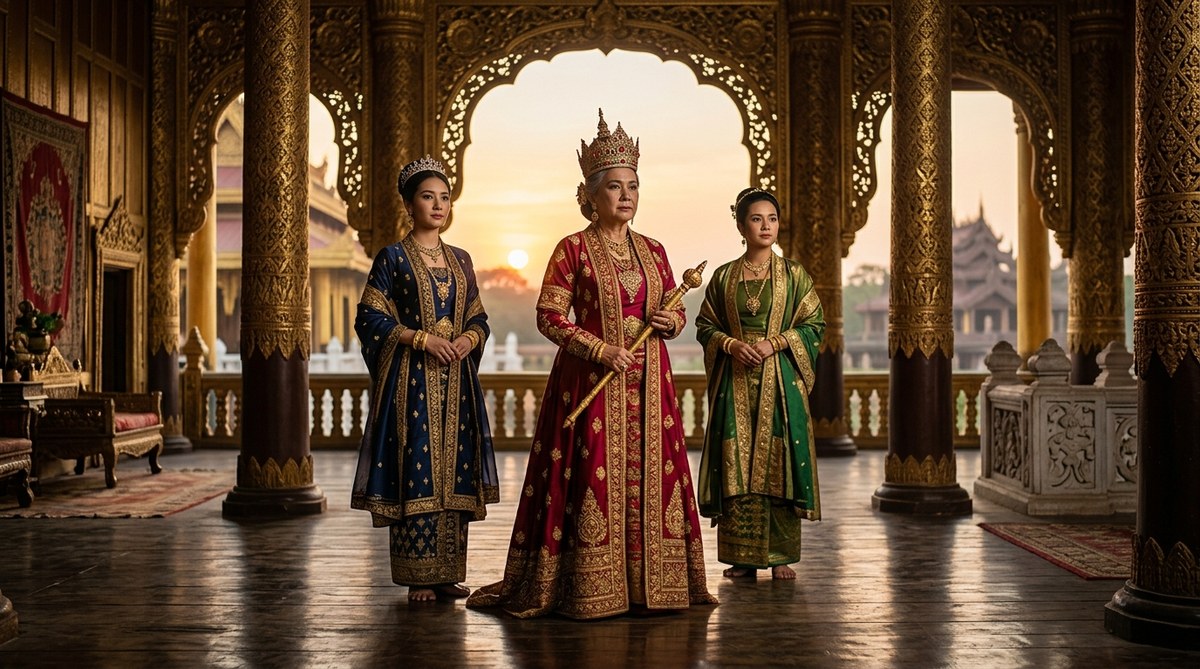
Picture a young queen standing on the wooden walls of Mandalay Palace in 1885. British troops march closer by the hour. Her husband, King Thibaw, hesitates. She does not. Queen Supayalat orders the gates closed and prepares to defend her kingdom. That moment of defiance is one of the last times a Burmese queen would hold visible power. Yet for centuries before, women in Myanmar’s royal courts were not just ornaments or mothers of heirs. They were generals, regents, kingmakers, and sometimes the actual brains behind the throne.
Myanmar’s forgotten queens held real political, military, and economic power for centuries. From Queen Shin Sawbu who ruled the Mon kingdom alone to Queen Supayalat who tried to stop British colonization, these women shaped history. Their stories were erased by colonial narratives and modern neglect. Rediscovering them changes how we understand Myanmar’s past.
Most history books about Myanmar focus on kings, generals, and colonial officers. The women who stood beside them or above them are often reduced to a footnote. But the truth is richer. The Konbaung Dynasty, the last ruling dynasty of Burma, had queens who managed treasury accounts, chose successors, and even led troops. Records from the Hmannan Yazawin, the Glass Palace Chronicle, describe queens as “nan-myaing” or palace insiders, a term that carried weight and respect.
Why were these women forgotten? The British colonial administrators who wrote modern Burmese history had Victorian biases. They could not imagine Asian women in positions of authority. They downplayed the role of queens, calling them “concubines” or “royal wives” even when those women held the royal seal. After independence, military historians continued that trend. They preferred stories of strong men. The queens slipped through the cracks.
Let us meet some of these remarkable women.
The Queen Who Ruled Alone: Shin Sawbu
In the 15th century, a woman ruled the Hanthawaddy Kingdom. Her name was Shin Sawbu, and she was the only female monarch in Burmese history to reign as a sovereign, not a regent. Born a princess, she was taken as a queen by the king of Ava. But she did not stay. She escaped, fled south, and eventually took the throne of the Mon kingdom.
Shin Sawbu ruled for over two decades. She lowered taxes, built monasteries, and maintained peace with neighboring kingdoms. She also made a choice that shaped Myanmar’s religious landscape. She invited Buddhist monks from Sri Lanka to purify the monastic order. That decision strengthened Theravada Buddhism across the region.
When she grew old, she did not cling to power. She stepped down and handed the throne to her son-in-law, Dhammazedi. Under him, the kingdom flourished. Her legacy was stability and wisdom. Yet outside of Myanmar, almost no one knows her name.
The Queen Who Picked the King: Queen Me Nu
Queen Me Nu lived in the early 19th century, during the Konbaung Dynasty. She was the chief queen of King Bagyidaw. But she was far more than a royal spouse. She managed vast land holdings, oversaw tax collection from her own estates, and controlled access to the king. When Bagyidaw fell into deep depression after the First Anglo-Burmese War, Me Nu essentially ran the government.
She appointed her brother as heir presumptive. She made key military decisions. She also angered powerful court factions who resented her influence. After Bagyidaw died, a coup removed Me Nu from power. Her brother was executed, and she was exiled. Her fall was dramatic. But during her peak, she was one of the most powerful people in the kingdom.
Scholars debate whether her rule was beneficial. Some say her favoritism caused instability. Others argue she was a capable administrator facing impossible circumstances. What is clear is that she was not a passive figure. She acted, she decided, and she shaped history.
The Warrior Queens of the Frontier
Myanmar is not a single culture. It is a patchwork of ethnic kingdoms. In many of those kingdoms, women held military power.
Consider the Shan queens. In the Shan principalities of the eastern hills, some saopha (chiefs) were women. They led armies, negotiated with the British, and defended their territories. One such figure was Sao Nang Hearn Kham, the princess of Hsenwi. She fought against British annexation in the late 19th century. Though the British eventually won, she never surrendered her claim to sovereignty.
In the Karenni states, female leaders managed diplomatic relations with both the Burmese court and the British empire. They understood the game of power very well. They used marriage alliances, trade agreements, and military threats to protect their people.
How Power Worked for Royal Women
To understand these queens, you need to understand the structure of the Burmese court. It was not like European monarchy. A Burmese king had many wives, but only a few held real status.
| Role | Real Power | Myth / Mistake |
|---|---|---|
| Chief Queen | Controlled palace finances, chose successors, led court ceremonies | Often dismissed as “just a wife” |
| Regional Queen | Managed her own territory, collected taxes, had personal armies | Confused with concubines by colonial writers |
| Queen Mother | Influential regent, often the true power behind a young king | Assumed to be passive or irrelevant |
| Princess of Royal Blood | Could inherit lands, lead provinces, marry strategically | Seen as marriage pawns, not political actors |
The chief queen was not chosen for love. She was chosen from high-ranking royal families to secure alliances. Once in position, she controlled the royal treasury, supervised the palace granaries, and had the right to speak in court councils. Some chief queens even held the “Hintha” seal, a personal seal that could authorize documents independent of the king.
Why Colonial Records Got It Wrong
The British wrote most of what we know about the Konbaung court. They had a language barrier and a cultural bias. Many British officers could not speak Burmese well. They relied on translators who were often lower-ranked courtiers with grudges. When a British officer described a queen as “a scheming concubine,” he was often repeating the gossip of a rival faction.
This is a key problem for anyone researching Myanmar’s forgotten queens today. The primary sources are unreliable. You have to read against the grain.
Here is a practical approach if you want to do your own research:
- Start with the Hmannan Yazawin, the Glass Palace Chronicle. It was compiled by Burmese scholars in 1829. It includes queens as active participants. Look for the sections on the Toungoo and Konbaung periods.
- Cross-reference with British accounts, but note the dates. Early British accounts (1820s-1850s) are more accurate because they still depended on Burmese informants. Later accounts, written after the 1885 annexation, are more dismissive of female power.
- Read Mon and Shan chronicles separately. These were written in different languages and often preserved details the Burmese court left out.
- Look for land grant inscriptions. Queens often funded pagodas and monasteries. The stone inscriptions at those sites record their titles and donations, which reveal their status.
One excellent source is the “Yazawin Thit,” the New Chronicle written by the scholar U Kala in the early 18th century. It describes queens managing trade deals and foreign relations. That kind of detail is hard to find in later histories.
The Last Queen: Supayalat
The most famous of Myanmar’s forgotten queens is also the most tragic. Queen Supayalat was the last queen of the Konbaung Dynasty. She married King Thibaw, who was her half-brother. That sounds strange to modern ears, but royal incest was common in Southeast Asian courts to keep power within the bloodline.
Supayalat is often painted as a villain. The British called her a “she-devil.” They said she ordered the massacre of 80 royal relatives to clear the path for Thibaw’s coronation. The truth is murkier. The massacre likely happened, but it was ordered by Thibaw’s mother, not Supayalat. Supayalat was a teenager at the time. She was used as a scapegoat.
When war with Britain came, Supayalat urged Thibaw to fight. She organized food supplies for the army. She rallied the palace staff. After the surrender, she was sent into exile in Ratnagiri, India, with her husband and daughters. She lived there in poverty for decades. She died in 1925, forgotten by the world that once feared her.
Her granddaughter, Princess Hteik Su Phaya Gyi, lived in a modest apartment in Yangon until her death in 2017. She was a living link to Myanmar’s royal past. She was also almost entirely ignored by her own country.
“The queens of Burma were not shadows. They were suns. But the colonial sun set on them, and we forgot how bright they once burned.” – Dr. Ni Ni Myint, Burmese historian
What We Lose When We Forget
Forgetting these queens is not just an academic loss. It distorts our understanding of Myanmar itself. If we believe that only men ran things, we miss how power actually worked. We miss the negotiations, the alliances, the checks and balances that queens provided.
For example, the Konbaung court had a formal system of checks between the king and the chief queen. The king could not sell royal lands without the queen’s seal. The queen could not go to war without the king’s approval. This was a constitutional balance of power, encoded in court tradition.
When the British dismantled the monarchy, they removed both king and queen. But they replaced that system with a colonial administration that had no space for women at all. That shift may have weakened women’s political status in Myanmar for generations.
Today, women in Myanmar still face barriers to political leadership. But their history offers a different model. It shows that Burmese women once held top positions. That is not a foreign idea. It is their own heritage. Women’s roles in modern Myanmar are shaped by this long legacy, even if most people do not recognize it.
Honoring the Forgotten Queens
If you are a traveler visiting Myanmar, you can still see traces of these queens. The Mandalay Palace has a museum room dedicated to Queen Supayalat. The Shwedagon Pagoda in Yangon was expanded with donations from Queen Shin Sawbu. The Mahamuni Buddha in Mandalay was regilded by royal women for centuries.
When you visit these places, you are standing where they stood. The gold on the pagoda was paid for by a queen’s treasury. The peace that allowed those temples to be built was negotiated by a queen’s diplomacy.
Learning their names is the first step. Telling their stories is the second. That is how we undo the colonial erasure. That is how Myanmar’s forgotten queens finally get their place in history.
The Stories Still Waiting to Be Told
The queens covered here are only the most visible. Many more remain buried in archives, written in palm-leaf manuscripts that have never been translated. There are queens of the Pagan period who funded entire temple complexes. There are princesses of the Ava period who ran spy networks. There are Mon queens who wrote poetry that is still recited.
The work of recovering these stories is ongoing. Researchers from Myanmar and abroad are slowly piecing together the fragments. The authority of influence these women held is becoming clearer with each new discovery.
You do not need to be a scholar to help. Simply reading about them, sharing their names, and correcting the record when someone says “Burmese history is all about kings” makes a difference. The next time you visit a pagoda in Bagan or a palace in Mandalay, pause and think about the queen who made it possible. Her name may not be on the sign, but her work is all around you.