
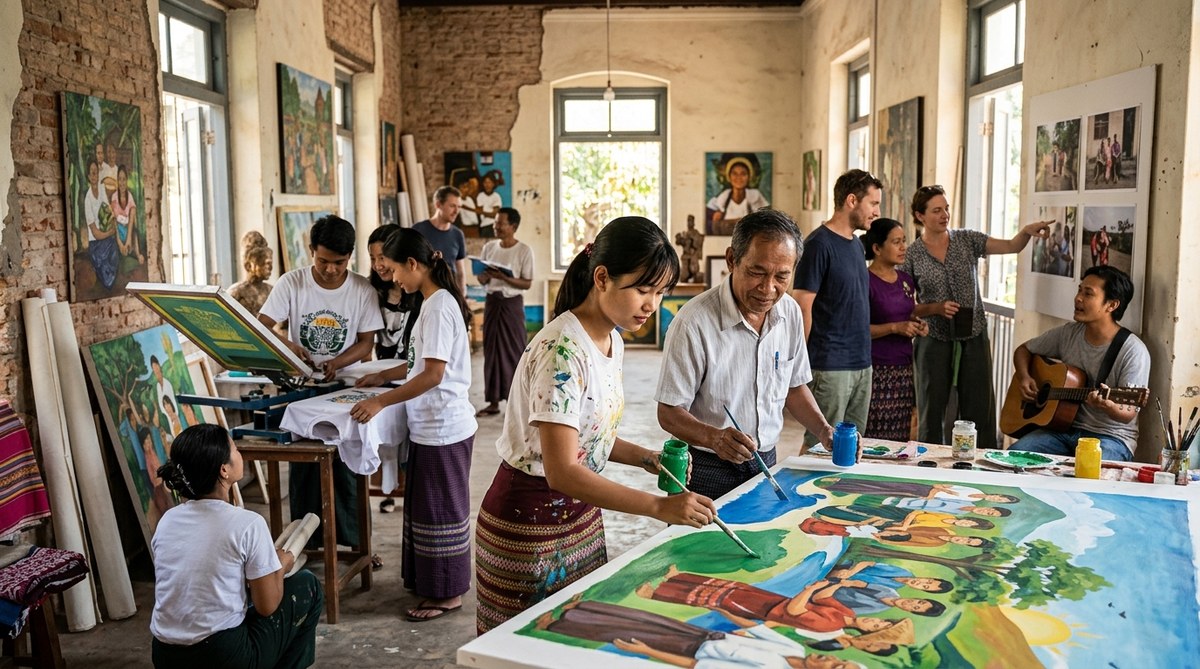
In a quiet neighborhood in Yangon, inside a former printing house with faded teal shutters, a group of teenagers is painting a mural about environmental justice. Across town, in a monastery courtyard in Mandalay, a theater troupe performs a play about ethnic reconciliation. In Mawlamyine, a photography collective teaches young people how to document the daily realities of their communities. These scenes are not isolated acts of creativity. They are part of a growing network of community art spaces that are quietly reshaping Myanmar’s social fabric. For researchers, activists, and journalists trying to understand grassroots cultural movements, these spaces offer a window into how ordinary citizens are using art for social change Myanmar in ways that are both subtle and profound.
Community art spaces in Myanmar serve as vital platforms for civic engagement, mental healing, and nonviolent resistance. They provide safe gathering places where citizens use painting, theater, and music to address social issues, preserve cultural heritage, and advocate for accountability. Understanding these spaces is essential for anyone tracking Myanmar’s civil society transformation.
The Rise of Community Art Spaces in Myanmar
Myanmar has a long artistic tradition. From the intricate murals of Bagan to the puppet theaters of Mandalay, creative expression has always been part of the country’s identity. But the modern community art space movement is something different. It emerged in the 2010s as political reforms created small openings for civic expression. After the 2021 military takeover, these spaces took on new urgency.
When traditional civil society organizations faced restrictions, art spaces became alternative forums for dialogue. They were less visible than political rallies. They were harder to shut down. And they offered something that protest alone could not: a way to process collective trauma and imagine a different future.
Today, community art spaces range from formal galleries in Yangon to makeshift studios in ethnic state capitals. Some operate with international funding. Others survive on donations of paint and paper. What unites them is a belief that creative expression can be a tool for social change.
As one artist in Myitkyina told me, “We cannot always speak directly. But we can paint. We can perform. We can show people what we feel. That is also resistance.”
These spaces are particularly important for young people. Myanmar has one of the youngest populations in Southeast Asia, with over half of citizens under 30. Many young people feel disconnected from traditional political structures. Art spaces give them a way to engage on their own terms. They learn to voice opinions, work collaboratively, and address issues like corruption, gender inequality, and environmental degradation. This aligns closely with the work of youth activists who are shaping Myanmar’s future through civic engagement.
How Art Drives Change
Community art spaces advance social change through several interconnected mechanisms. They do not replace traditional advocacy, but they complement it in ways that are often overlooked.
- Building safe spaces for difficult conversations. Art allows people to address sensitive topics without direct confrontation. A painting about disappeared activists can say what a speech cannot.
- Preserving cultural identity under threat. Ethnic minorities use traditional music, weaving, and dance to keep their heritage alive. This is especially important in regions affected by conflict.
- Promoting mental health and healing. Making art helps individuals process trauma. Many spaces now incorporate art therapy practices for displaced communities.
- Developing civic skills. Organizing an exhibition requires planning, budgeting, and collaboration. These are skills that translate directly to civic participation.
- Amplifying marginalized voices. Women, ethnic minorities, and LGBTQ+ individuals find platforms in community art spaces that mainstream society often denies them.
- Building networks across divides. Art festivals bring together people from different ethnic groups, religions, and political views, fostering dialogue that is rare in daily life.
These mechanisms make community art spaces a unique form of civil society infrastructure. They are not advocacy groups in the traditional sense. But they create the conditions for advocacy to happen. This mirrors the broader work of civil society organizations promoting transparency and accountability in Myanmar.
Techniques and Challenges at a Glance
Practitioners of art for social change Myanmar have developed distinct approaches over the past decade. Each technique comes with its own set of common pitfalls and better practices.
| Approach | Common Mistake | Better Practice |
|---|---|---|
| Mural projects | Using outsider themes without local input | Co-create with community members from the start |
| Theater performances | Ignoring sensitive political contexts | Read the room carefully and adapt content |
| Photography workshops | Assuming expensive equipment is needed | Use smartphones and focus on storytelling |
| Music and spoken word | Prioritizing performance over participation | Hold open mic nights to encourage everyone |
| Traditional craft revival | Treating traditions as static | Help artisans innovate while respecting roots |
| Digital art campaigns | Assuming universal internet access | Provide offline alternatives and printed materials |
The table above reflects lessons learned through trial and error. Many early initiatives failed because they imported models from other countries without adapting them to Myanmar’s context. Today, the most effective spaces are deeply rooted in local communities. They listen first, then act.
One notable example is the revival of traditional weaving in Rakhine State. Women weavers have turned their craft into both an economic livelihood and a way to document their stories. Patterns that were once purely decorative now carry messages about peace and resilience. This kind of work connects directly to the efforts of master artisans preserving ancient techniques across the country.
Three Steps to Support Community Art Spaces
For researchers, activists, and journalists who want to engage with these spaces, here is a practical framework.
-
Start with listening, not programming. Spend time in a space before offering support. Attend events. Talk to participants. Understand the local context. Each community has its own priorities. A theater group in Kayah State faces different challenges than a photography collective in Yangon. General solutions rarely work.
-
Provide resources without imposing agendas. Funding is critical, but it comes with risks. International donors sometimes push themes that do not resonate locally. The best support is flexible. Provide materials, training, or venue space, then let the artists decide what to create. Trust their judgment.
-
Document and share stories responsibly. Journalists and researchers can help by amplifying the work of these spaces. But they must do so carefully. Publicity can attract unwanted attention from authorities. Always ask permission before publishing names or images. Consider using pseudonyms or anonymizing locations if needed. Focus on the art and the process, not on individual personalities who might face retaliation.
These steps are not exhaustive. But they follow a principle that experienced practitioners emphasize: support the ecosystem, do not try to control it.
An Expert Perspective on Safety and Sustainability
I spoke with a veteran facilitator who has run community art programs in Myanmar for over a decade. She asked to remain anonymous due to security concerns. Here is what she shared.
“The biggest mistake outsiders make is thinking that art is apolitical. In Myanmar, everything is political. A children’s drawing class can be seen as a threat if it teaches kids to think critically. You have to be aware of that. You also have to accept that some spaces will not survive. That is okay. What matters is that the practice continues, even if the physical space closes. Artists take their skills with them. They start new groups. The movement is bigger than any single location.”
Her words capture a reality that many outsiders miss. Sustainability in Myanmar’s art movement is not about keeping one space open forever. It is about building capacity and relationships that persist even when conditions are difficult. This is why many successful initiatives focus on training trainers. They teach young artists how to teach others. The knowledge spreads horizontally.
This approach mirrors successful strategies in community-led development initiatives across Myanmar, where local ownership is the key to long-term impact.
What’s Next for Myanmar’s Art Movement
Looking ahead to 2026 and beyond, several trends are shaping the future of community art spaces in Myanmar.
Digital tools are creating new possibilities. Artists are using encrypted messaging apps to share work. Virtual exhibitions allow Myanmar’s diaspora to participate in cultural events. But the digital divide remains a barrier. Many rural communities lack reliable internet. The most effective spaces combine online outreach with offline activities.
There is also growing attention to economic sustainability. Art spaces are exploring social enterprise models. They sell prints, offer paid workshops, and rent studio space to cover costs. This reduces dependence on international funding. It also builds local ownership. The rise of social enterprises in Myanmar provides a template for how art spaces can become financially resilient while staying true to their mission.
Meanwhile, the international community is paying more attention. Foundations and human rights organizations increasingly recognize that cultural expression is part of civic space. They are funding art programs alongside legal aid and advocacy. This is a positive development, but it comes with risks. Too much attention can trigger crackdowns. Too many rules can stifle creativity. The balance is delicate.
A Space for Every Voice
Community art spaces in Myanmar are not a luxury. They are not a soft addition to the work of civil society. They are a vital part of how people process change, build solidarity, and imagine a just society. For researchers, activists, and journalists, they offer a way to understand Myanmar that goes beyond policy reports and news headlines. They show you the texture of daily life. They reveal what people care about when no one is telling them what to say.
If you are planning to visit Myanmar or study its cultural movements, start by finding a local art space. Sit in on a workshop. Watch a performance. Talk to the artists. You will learn more about the country’s hopes and struggles in one evening than in a dozen briefings. The paint is still wet. The stories are still being told. And the movement is still growing, one brushstroke at a time.