
Myanmar’s path to independence wasn’t a single moment of triumph. It was a decades-long struggle marked by assassinations, world wars, ethnic divisions, and fierce determination. Understanding this journey means grappling with complex colonial relationships, nationalist movements, and the leaders who risked everything for sovereignty.
Myanmar gained independence from Britain on January 4, 1948, after decades of resistance movements, wartime occupation, and political negotiation. The struggle involved key figures like [Aung San](https://en.wikipedia.org/wiki/Aung_San), student activists, and ethnic leaders who shaped the nation’s sovereignty movement. However, independence brought new challenges including ethnic conflicts, military coups, and ongoing struggles for democratic governance that continue to influence Myanmar today.
British Colonial Rule and Early Resistance
Britain conquered Myanmar through three separate wars between 1824 and 1885. Each conflict stripped away more territory until the entire kingdom fell under colonial control.
The British annexed Myanmar as a province of India. This administrative decision would shape resistance movements for generations.
Early opposition came from multiple sources. Buddhist monks organized protests against foreign rule. Ethnic leaders in frontier regions maintained armed resistance. Urban intellectuals began forming political organizations.
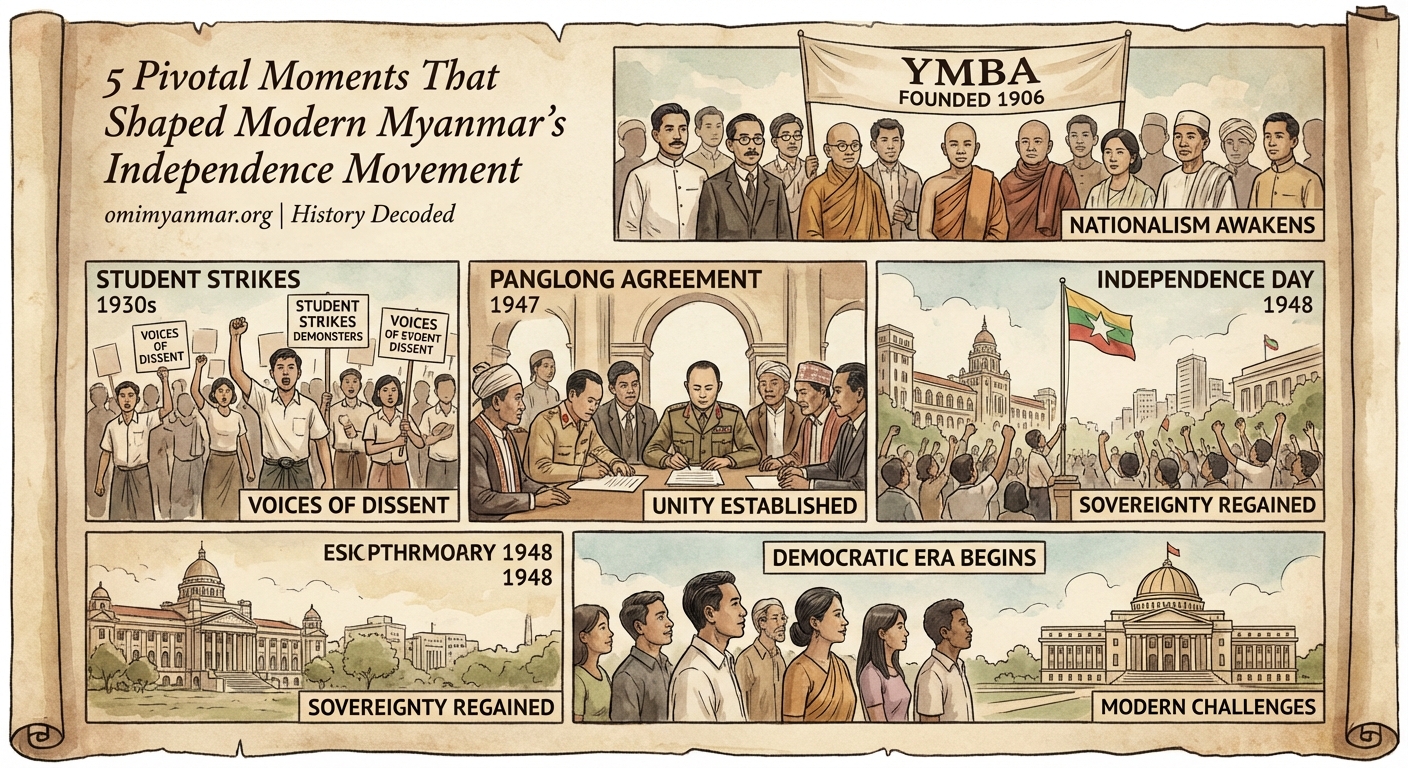
The Young Men’s Buddhist Association, founded in 1906, became an early platform for nationalist sentiment. Students at Rangoon University would later become crucial to the independence movement.
By the 1920s, organized political parties emerged. The General Council of Burmese Associations pushed for self-governance within the British system. More radical groups demanded complete independence.
The 1930s Student Movement and Thakin Party
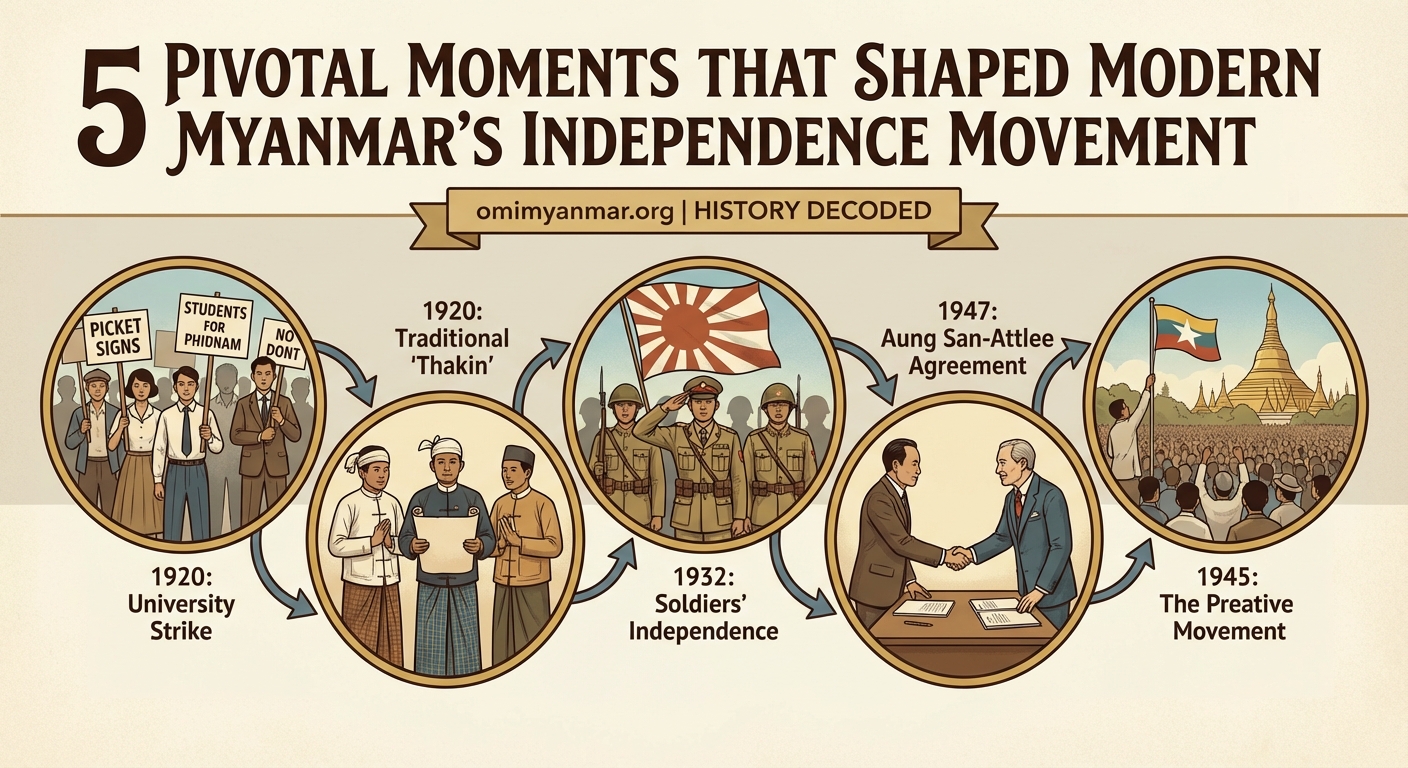
University students became the driving force of nationalist politics in the 1930s. The 1920 student strike at Rangoon University set a precedent for youth activism.
In 1930, a major uprising led by Saya San shook British confidence. Though ultimately suppressed, it demonstrated widespread discontent with colonial rule.
The Dobama Asiayone, or “We Burmans Association,” formed in 1930. Members adopted the title “Thakin,” meaning “master,” a term previously reserved for British colonials. This symbolic act challenged the racial hierarchy of colonial society.
Young leaders like Aung San, Nu, and Ne Win joined the Thakin movement. They studied Marxist theory, anti-colonial writings, and strategies from other independence movements.
The 1936 student strike brought national attention to these young activists. Aung San emerged as a charismatic leader capable of mobilizing mass support.
Britain granted Myanmar separation from India in 1937, creating a distinct colonial administration. This partial autonomy fell far short of independence demands.
World War II and the Burma Independence Army
When World War II reached Southeast Asia, Burmese nationalists saw opportunity. Aung San and twenty-nine other young activists, known as the “Thirty Comrades,” secretly traveled to Japan in 1940.
Japan trained these men and promised support for Burmese independence. The Burma Independence Army formed under Japanese sponsorship in 1941.
Japanese forces invaded in 1942. The Burma Independence Army fought alongside them against British troops. Many Burmese initially welcomed the Japanese as liberators.
Reality quickly shattered these hopes. Japanese occupation proved brutal and exploitative. The promised independence was a sham with no real sovereignty.
By 1944, Aung San and other leaders recognized their mistake. They began secret negotiations with British forces and resistance groups.
The Anti-Fascist People’s Freedom League formed in 1944, uniting various resistance factions. In March 1945, the Burma National Army switched sides and fought against Japanese forces.
This strategic reversal positioned Burmese nationalists as allies rather than enemies when Britain returned. The wartime experience also gave independence leaders military credentials and organizational strength.
Negotiations and the Path to Sovereignty
Post-war negotiations determined Myanmar’s future. Britain initially planned gradual steps toward self-governance over many years.
Aung San rejected this timeline. Mass demonstrations and strikes in 1946 showed popular support for immediate independence.
The Aung San-Attlee Agreement of January 1947 outlined the path to full sovereignty. Britain agreed to recognize Myanmar’s independence within one year.
A constitutional convention began work on governance structures. Ethnic minority leaders participated in discussions about the future state.
The Panglong Agreement of February 1947 became crucial to national unity. Aung San met with Shan, Kachin, and Chin leaders to negotiate their participation in the independent state.
These ethnic leaders agreed to join the Union of Burma with promises of autonomy and equal representation. The agreement’s terms would later become sources of conflict.
Elections for a constituent assembly took place in April 1947. Aung San’s Anti-Fascist People’s Freedom League won overwhelmingly.
The Assassination Crisis and Transfer of Power
July 19, 1947, changed everything. Political rivals assassinated Aung San and eight cabinet members during a council meeting.
The nation plunged into shock. Aung San was only 32 years old and had become the face of independence.
U Saw, a former prime minister, orchestrated the assassinations. He was quickly arrested, tried, and executed.
Nu, a close associate of Aung San, assumed leadership. The independence process continued despite the tragedy.
Britain transferred power on January 4, 1948. Myanmar became a sovereign nation outside the British Commonwealth.
The new constitution established a parliamentary democracy. It recognized ethnic states within a federal union structure.
Optimism filled the early days. Myanmar had rich natural resources, educated leadership, and international goodwill.
Common Mistakes When Studying Myanmar Independence History
| Mistake | Why It’s Wrong | Better Approach |
|---|---|---|
| Viewing independence as inevitable | Colonial powers rarely surrendered control willingly | Study the specific pressures and negotiations that forced Britain’s hand |
| Ignoring ethnic minority perspectives | The Panglong Agreement was crucial to state formation | Examine how different ethnic groups experienced and shaped independence |
| Separating WWII from independence | The war fundamentally changed power dynamics | Understand how Japanese occupation and resistance affected negotiations |
| Focusing only on Aung San | Many leaders and movements contributed | Research the broader coalition of activists, monks, students, and ethnic leaders |
| Assuming independence solved problems | Post-1948 conflicts emerged immediately | Study how independence created new challenges around governance and ethnic relations |
Key Figures Who Shaped the Independence Movement
Understanding Myanmar independence history requires knowing the people behind the movement.
Aung San remains the most recognized leader. His military background, political skills, and tragic death made him a national martyr. His legacy influences Myanmar politics to this day.
U Nu led the nation through its first decade of independence. A devout Buddhist and intellectual, he navigated complex ethnic and political challenges until the 1962 military coup.
Thakin Than Tun led the communist faction within the independence movement. His split with mainstream nationalists created lasting political divisions.
Saw Ba U Gyi founded the Karen National Union. His resistance to the central government began conflicts that continue today.
Sao Shwe Thaik became Myanmar’s first president. A Shan prince, he represented ethnic minority participation in the new state.
U Razak and other Muslim leaders advocated for their communities during constitutional negotiations. Their concerns about minority rights would prove prescient.
The evolution of press freedom in Myanmar shows how these early leaders’ visions for governance evolved over decades.
Understanding the Panglong Agreement’s Lasting Impact
The February 1947 Panglong Agreement deserves special attention. This accord between Aung San and ethnic minority leaders promised:
- Equal rights for all ethnic groups within the union
- Autonomy for ethnic states in managing local affairs
- Proportional representation in national government
- The right to secede after ten years if terms weren’t honored
These promises shaped expectations for the post-independence state. When successive governments failed to fully implement the agreement, ethnic armed groups formed.
Many current conflicts trace back to disagreements over Panglong’s interpretation and implementation. Ethnic leaders argue the agreement was violated. Central governments claim security concerns justified centralization.
“The Panglong Agreement represented the best hope for a truly federal, democratic Myanmar. Its incomplete implementation remains at the heart of our national struggles.” — Ethnic affairs scholar
Recent peace processes have invoked Panglong’s spirit, attempting to recreate the trust and compromise of 1947.
The First Years After Independence
Independence brought immediate challenges. Multiple insurgencies erupted in 1948.
Communist groups rejected the parliamentary system and launched armed struggle. Ethnic militias in Karen, Mon, and other regions began fighting for autonomy or independence.
By 1949, insurgent forces controlled significant territory. The central government nearly collapsed.
Nu’s government survived through a combination of military action and political maneuvering. British military advisors helped reorganize government forces.
Economic challenges compounded security problems. War damage, insurgencies, and inexperienced administration hampered development.
The government nationalized major industries and attempted socialist economic policies. Results were mixed at best.
Despite instability, Myanmar maintained democratic institutions through the 1950s. Multiple parties competed in elections. Press freedom existed. Courts operated independently.
This democratic period ended with General Ne Win’s 1962 coup. Military rule would dominate Myanmar for decades.
How to Research Myanmar Independence History Effectively
Students and researchers can follow these steps for thorough understanding:
-
Start with primary sources from the independence period, including newspaper archives, government documents, and leader speeches.
-
Read multiple perspectives on key events, comparing British colonial records, Burmese nationalist accounts, and ethnic minority narratives.
-
Study the international context, examining how World War II, decolonization movements, and Cold War politics influenced Myanmar’s path.
-
Investigate economic factors that shaped independence negotiations, including control of resources, trade relationships, and development priorities.
-
Examine how different regions and ethnic groups experienced independence differently, avoiding a Rangoon-centric narrative.
-
Connect independence-era decisions to current political situations, tracing how early choices created lasting consequences.
Essential Resources for Understanding the Independence Movement
Serious students need access to quality sources. University libraries often hold collections of colonial-era newspapers and documents.
The British Library’s India Office Records contain extensive materials on British Burma. These provide the colonial perspective on independence negotiations.
Myanmar’s National Archives preserve important documents, though access has been restricted at various times. Digital preservation efforts have made some materials available online.
Memoirs from independence-era leaders offer valuable firsthand accounts. Nu’s “Saturday’s Son” and other autobiographies provide insider perspectives.
Academic journals focusing on Southeast Asian history regularly publish new research. The Journal of Burma Studies and similar publications offer scholarly analysis.
Documentary films and oral history projects capture stories from people who lived through independence. These human perspectives complement written records.
The connection between historical governance structures and how international watchdogs are monitoring Myanmar’s governance reforms in 2024 shows ongoing relevance of independence-era decisions.
Why Ethnic Minority Experiences Matter
Myanmar’s independence story cannot be told without ethnic minority perspectives. The majority Bamar population dominated nationalist movements, but ethnic groups had their own relationships with colonial rule and independence.
Some ethnic groups enjoyed relative autonomy under British indirect rule. The Shan princes, Kachin chiefs, and Chin leaders governed their regions with limited British interference.
Independence threatened this autonomy. Ethnic leaders feared Bamar domination would replace British control.
The Karen people had complex relationships with both British and Bamar populations. Many Karen served in British colonial forces. This created tensions with Bamar nationalists.
The Rohingya and other Muslim communities faced questions about citizenship and belonging. These issues remain unresolved today.
Understanding these diverse experiences reveals why Myanmar struggled to build national unity after independence. The promises made at Panglong couldn’t overcome deep-seated fears and competing visions for the state.
Youth activism and civil society today often grapples with these same questions of inclusion and representation.
The Role of Women in the Independence Struggle
Women participated actively in Myanmar’s independence movement, though historical accounts often overlook their contributions.
Daw Khin Kyi, Aung San’s wife, worked in nationalist organizations and later in government. Her daughter, Aung San Suu Kyi, would become a democracy leader decades later.
Female students joined strikes and demonstrations. Women’s organizations mobilized communities and provided logistical support for political movements.
During World War II, women served in resistance networks, gathering intelligence and supporting armed groups.
The post-independence constitution granted women voting rights and legal equality. Myanmar was relatively progressive on women’s political participation compared to regional neighbors.
However, women held few leadership positions in government or military. Traditional gender roles limited their formal political power even as they contributed substantially to the movement.
Modern discussions about women’s roles in modern Myanmar connect to these independence-era precedents.
What Independence Meant for Different Social Classes
Independence affected Myanmar’s social classes differently. The colonial period had created new economic hierarchies.
British companies and Indian merchants dominated commerce. Chinese traders controlled significant sectors. Indigenous Burmese held less economic power.
Nationalization policies after independence aimed to reverse this. The government took control of major industries and restricted foreign business.
Landlords and rural elites faced land reform pressures. Peasant organizations demanded redistribution.
Urban intellectuals and professionals gained opportunities in the new government. Education in Burmese rather than English became possible.
Working-class movements grew stronger. Labor unions played significant roles in post-independence politics.
These economic tensions contributed to political instability. Different classes had competing visions for Myanmar’s development.
Lessons From Myanmar’s Independence for Modern Movements
Myanmar’s independence struggle offers insights for contemporary activists and researchers.
Coalition building proved essential. The Anti-Fascist People’s Freedom League united diverse groups with different ideologies and interests.
International context mattered enormously. World War II and Britain’s weakened position created opportunities that might not have existed otherwise.
Timing and strategy determined outcomes. Aung San’s decision to switch sides in 1945 positioned nationalists advantageously for post-war negotiations.
Incomplete solutions create lasting problems. The Panglong Agreement’s vague promises and unfulfilled terms generated decades of conflict.
Leadership transitions during crises test movements. Aung San’s assassination could have derailed independence, but institutional structures and committed successors maintained momentum.
Military experience shaped post-independence politics. Leaders with wartime backgrounds dominated governance, eventually leading to military rule.
These patterns appear in independence movements worldwide. Myanmar’s experience provides a case study in both successes and failures of decolonization.
The Independence Movement’s Cultural Legacy
January 4 remains Myanmar’s most important national holiday. Independence Day celebrations include ceremonies, parades, and cultural performances.
Aung San’s image appears on currency, monuments, and public buildings. His legacy influences political discourse across ideological divides.
Songs and literature from the independence era remain culturally significant. Nationalist poetry and revolutionary music still resonate.
The “Thirty Comrades” became legendary figures. Their story represents courage, sacrifice, and national service.
However, interpretations of independence history vary. Different political groups claim different legacies from the same events.
Military governments emphasized order and unity. Democracy activists highlighted the parliamentary system and civil liberties of early independence.
Ethnic groups often tell independence stories differently, focusing on broken promises rather than liberation.
These competing narratives show how history remains contested and politically relevant. Understanding Myanmar independence history means grappling with these multiple perspectives.
Where Myanmar’s Independence Story Continues
Myanmar’s independence didn’t end in 1948. The struggle for sovereignty, democracy, and ethnic rights continues.
Military coups in 1962 and 1988 reversed democratic progress. Decades of authoritarian rule followed.
The 2010s brought renewed hope with political reforms and elections. Aung San Suu Kyi’s National League for Democracy won power.
The 2021 military coup returned the country to direct military control. Protests, civil disobedience, and armed resistance emerged.
Today’s conflicts connect directly to unresolved issues from the independence era. Ethnic autonomy, federal governance, and civilian control of military remain contentious.
The Panglong spirit lives in ongoing peace negotiations. Ethnic armed groups and political parties still reference the 1947 agreement.
Understanding historical independence struggles helps make sense of current events. The same questions about power, identity, and governance persist.
For researchers, this continuity makes Myanmar independence history both fascinating and urgent. The past directly shapes present struggles.
Making Sense of a Complex Liberation
Myanmar independence history defies simple narratives. It wasn’t just heroic resistance against colonial oppression. It wasn’t merely elite political maneuvering. It combined mass movements, international pressures, ethnic negotiations, wartime opportunism, and tragic violence.
The leaders who achieved independence were young, idealistic, and sometimes naive. They made brilliant strategic decisions and serious miscalculations. They built coalitions and created divisions. They won sovereignty but couldn’t resolve fundamental questions about governance and identity.
Their legacy remains deeply relevant. Every political crisis in Myanmar connects somehow to independence-era decisions, promises, and failures. Understanding this history means understanding contemporary Myanmar.
For students and researchers, this complexity offers rich material for study. Primary sources reveal human struggles behind historical events. Comparing different accounts shows how perspective shapes historical interpretation. Tracing consequences demonstrates how early choices create lasting impacts.
The independence movement’s story reminds us that liberation is a process, not a moment. Formal sovereignty doesn’t automatically bring justice, prosperity, or peace. Those require ongoing work, negotiation, and commitment to principles that transcend any single generation’s achievements.