Blog

  • Why Myanmar’s Middle Class Is Growing Despite Economic Uncertainty

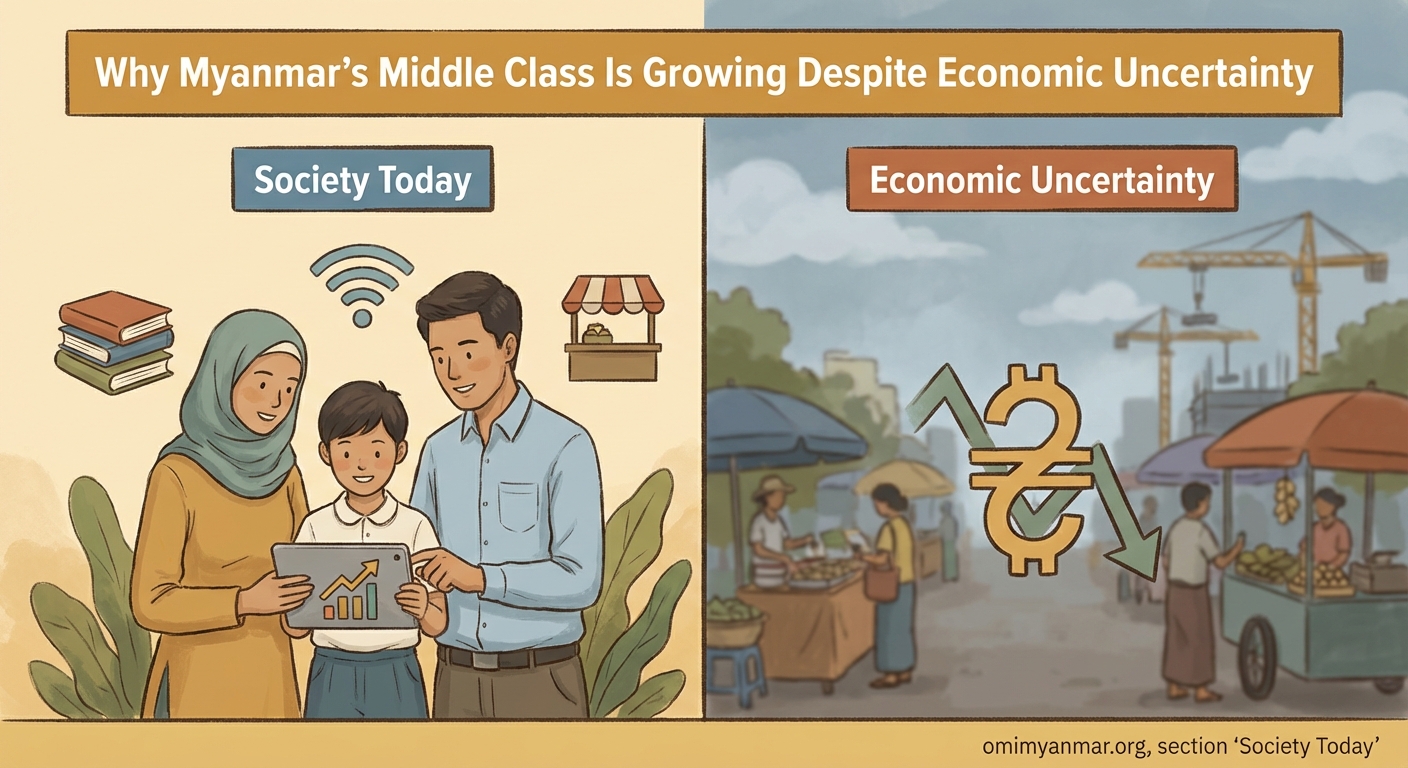
    Why Myanmar’s Middle Class Is Growing Despite Economic Uncertainty

    Myanmar’s economy presents one of the most puzzling contradictions in Southeast Asia today. While headlines focus on conflict and sanctions, a significant portion of the population continues climbing into middle class income brackets. This isn’t happening despite the chaos. In many ways, it’s happening because of how people have adapted to it.

    Key Takeaway

    Myanmar middle class growth persists through remittances, informal economy expansion, digital commerce, and strategic consumer behavior. Urban populations leverage mobile banking and cross-border trade networks while rural communities benefit from agricultural modernization. Understanding these resilience mechanisms reveals investment opportunities and market dynamics that traditional economic indicators miss entirely. Political instability paradoxically accelerates certain entrepreneurial adaptations that fuel household income growth.

    Understanding the numbers behind middle class expansion

    Defining middle class status in Myanmar requires looking beyond simple income thresholds. The Asian Development Bank typically uses $10 to $100 daily purchasing power parity as the range. By that measure, roughly 25 to 30 percent of Myanmar’s population now falls into this category, up from approximately 15 percent a decade ago.

    These figures seem impossible given recent economic contractions. GDP growth turned negative after 2021. Inflation spiked above 20 percent in several periods. Currency depreciation made imports expensive.

    Yet household consumption data tells a different story. Sales of motorcycles, smartphones, and home appliances have remained surprisingly stable in urban centers. Restaurant spending continues. Private school enrollment hasn’t collapsed.

    The explanation lies in how income actually flows through Myanmar’s economy. Official statistics capture only a fraction of economic activity. The informal sector accounts for an estimated 60 to 70 percent of employment. Cash transactions dominate. Many households maintain multiple income streams that never appear in government records.

    How remittances fuel household prosperity

    Why Myanmar's Middle Class Is Growing Despite Economic Uncertainty - Illustration 1

    Myanmar has one of the highest emigration rates in Southeast Asia. Millions work in Thailand, Malaysia, Singapore, and the Middle East. Their remittances form a crucial pillar of middle class stability.

    The World Bank estimates formal remittance flows at $2 to 3 billion annually. Informal channels likely double or triple that figure. Money transfer agents operate throughout the country, moving funds through networks that bypass traditional banking entirely.

    These remittances don’t just cover basic needs. They fund:

    • Down payments on urban apartments
    • Capital for small business ventures
    • Education expenses for younger siblings
    • Medical care at private clinics
    • Consumer electronics and household upgrades

    A construction worker in Bangkok earning $400 monthly can send home $200. That amount exceeds what many local jobs pay for full-time work. Multiply this across hundreds of thousands of workers and the impact becomes substantial.

    The political situation actually increased emigration in some demographics. Young professionals who might have stayed now seek opportunities abroad. Their higher earnings translate into larger remittances. Families back home experience income growth even as local job markets deteriorate.

    Digital commerce creates new economic pathways

    Mobile penetration in Myanmar exceeds 100 percent when accounting for multiple SIM cards. Smartphone ownership has become nearly universal in cities and increasingly common in rural areas. This connectivity opened entirely new income channels.

    Facebook Marketplace dominates e-commerce. Sellers operate without formal business registration, avoiding taxes and regulations. A teacher might sell cosmetics online after school. A retired government worker could run a clothing import business from home. A university student might manage social media for local shops.

    “The digital economy in Myanmar operates almost entirely outside official frameworks. This creates resilience because it doesn’t depend on institutional stability. When formal systems fail, informal digital networks adapt and continue functioning.” – Regional economist studying Southeast Asian informal markets

    Payment systems evolved to match this reality. Mobile money services process billions in transactions monthly. Peer-to-peer transfers happen instantly. Cross-border payments flow through cryptocurrency, money changers, and informal banking networks.

    This digital infrastructure supports middle class consumption in several ways:

    1. Income diversification becomes accessible to anyone with a smartphone
    2. Geographic barriers disappear for both buyers and sellers
    3. Capital requirements stay minimal for starting online businesses
    4. Operating costs remain low without physical storefronts
    5. Market reach extends nationally or even internationally

    A woman in Mandalay can source products from China, market them on Facebook, collect payments through mobile money, and ship via local delivery services. Her entire operation might generate $500 to $1,000 monthly profit with minimal startup investment. That income places her household firmly in middle class territory.

    Agricultural modernization benefits rural households
    Why Myanmar's Middle Class Is Growing Despite Economic Uncertainty - Illustration 2

    While cities grab attention, rural income growth contributes significantly to overall middle class expansion. Agricultural productivity improvements have raised farmer incomes in key regions.

    Rice yields increased through better seed varieties and fertilizer access. Export crops like pulses, sesame, and rubber generate hard currency. Contract farming arrangements with processors provide stable income and technical support.

    Mechanization reached even small landholders. Chinese-made tractors and harvesters became affordable. Equipment rental services spread the benefits to farmers who can’t purchase machinery outright. Labor productivity jumped accordingly.

    The following table illustrates how different agricultural improvements translate into household income gains:

    Improvement Type Investment Required Annual Income Increase Payback Period
    Hybrid rice seeds $50-100 per hectare $200-400 3-6 months
    Drip irrigation system $300-500 $400-600 12-18 months
    Small tractor purchase $3,000-5,000 $1,000-2,000 2-3 years
    Contract farming participation Minimal cash outlay $500-1,500 Immediate
    Solar water pump $400-700 $300-500 18-24 months

    These gains might seem modest in absolute terms. But for a household previously earning $2,000 annually, an extra $500 represents a 25 percent income increase. Combined with remittances from one family member working abroad, total household income can easily double.

    Rural electrification also matters enormously. Solar panels and mini-grids brought power to communities that never had reliable electricity. This enabled cold storage for agricultural products, reducing post-harvest losses. It powered irrigation pumps, extending growing seasons. It allowed households to operate small processing businesses, adding value before selling crops.

    Consumer behavior reveals adaptive strategies

    Middle class households in Myanmar don’t consume the same way their counterparts do in stable economies. They’ve developed sophisticated strategies for protecting purchasing power and managing uncertainty.

    Savings preferences shifted heavily toward physical assets. Gold purchases increased. Real estate investment continued despite price volatility. Foreign currency holdings became common, particularly US dollars and Thai baht.

    Shopping patterns emphasize bulk buying when prices dip. Households stock up on rice, cooking oil, and other staples during periods of currency strength. They switch between brands based on availability and price fluctuations rather than maintaining brand loyalty.

    Cross-border shopping trips to Thailand became routine for those living near the border. Groups organize van trips to Mae Sot or Chiang Mai, returning with electronics, clothing, and household goods at lower prices than domestic markets offer.

    These behaviors demonstrate economic sophistication. Households actively manage inflation risk, currency exposure, and supply chain disruptions. They function as informed economic actors rather than passive consumers.

    Why traditional metrics miss the full picture

    Standard economic indicators fail to capture Myanmar’s reality. GDP calculations rely on formal sector data. Inflation measures use official exchange rates. Employment statistics miss informal work entirely.

    The actual lived experience of middle class households operates largely outside these frameworks. A family might show no formal employment yet maintain comfortable consumption through remittances, online selling, and agricultural income. Official statistics would classify them as unemployed and poor. Reality tells a different story.

    Currency depreciation looks catastrophic in charts showing the kyat’s declining value. But many households hold assets in dollars or gold. They earn income in foreign currency through exports or remittances. The weak kyat actually benefits them when converting foreign earnings.

    Banking sector struggles appear severe when examining deposit outflows and credit contraction. Yet most middle class transactions never touched banks to begin with. Mobile money, cash, and informal lending networks handle the bulk of financial activity.

    This disconnect between official data and ground reality creates opportunities for those willing to look deeper. Consumer markets remain viable. Certain sectors show genuine growth. Investment returns can be substantial for those who understand the actual mechanisms driving economic activity.

    Sector-specific growth patterns

    Different industries contribute to middle class expansion in distinct ways. Understanding these patterns helps clarify where opportunity and risk lie.

    Construction continues in major cities despite broader economic challenges. Apartment buildings rise in Yangon and Mandalay. Infrastructure projects proceed, funded by Chinese investment or domestic capital. Construction workers, suppliers, and related service providers benefit from this activity.

    Education spending remains a priority for middle class families. Private schools, tutoring centers, and test preparation services thrive. Parents view education as the best investment for children’s futures, particularly given limited domestic opportunities. This spending sustains a substantial service sector ecosystem.

    Healthcare follows similar patterns. Private clinics and hospitals serve those who can afford to avoid public facilities. Medical tourism to Thailand increased for serious conditions. Pharmaceutical sales stay strong. Middle class households prioritize health spending even when cutting other expenses.

    Transportation and logistics adapted to new realities. Delivery services exploded alongside e-commerce growth. Motorcycle taxi apps function in major cities. Cross-border trucking networks expanded to handle increased trade with neighboring countries.

    Food and beverage businesses show resilience. Coffee shops proliferate in urban areas. Bakeries, bubble tea stands, and casual dining restaurants maintain customer bases. Food delivery services became routine for middle class consumers.

    Regional variations create different dynamics

    Myanmar’s middle class growth isn’t uniform across the country. Regional factors create distinct patterns worth understanding.

    Yangon remains the commercial center with the largest middle class population. Access to imports, diverse job opportunities, and established infrastructure support higher living standards. Competition for housing and services also drives costs higher.

    Mandalay functions as the northern commercial hub with strong connections to China. Cross-border trade generates substantial income for merchants, logistics operators, and service providers. Chinese investment in infrastructure and manufacturing creates employment.

    Border regions like Tachileik, Myawaddy, and Muse benefit enormously from trade flows. Informal commerce thrives. Currency exchange, transportation, warehousing, and retail sectors employ thousands at middle class wages.

    Coastal areas with fishing industries maintain stable incomes through seafood exports. Processing facilities, cold storage operations, and trading companies provide employment. These regions often have stronger foreign currency earnings than agricultural areas.

    Resource-rich states with jade, gems, or timber generate wealth that filters through local economies. While extraction industries themselves employ relatively few people, the income they generate supports broader service sectors.

    Investment implications for business professionals

    Understanding Myanmar middle class growth patterns reveals specific opportunities and risks for investors and business strategists.

    Consumer goods companies should focus on value-oriented products rather than premium positioning. Price sensitivity remains high. Brand switching happens readily. Distribution through informal channels often outperforms formal retail.

    Digital services face fewer barriers than physical infrastructure businesses. Mobile apps, online platforms, and digital payment systems can scale without navigating complex regulatory environments or physical logistics challenges.

    Cross-border business models leverage Myanmar’s integration with regional economies. Sourcing from China, selling to Thailand, or providing services to diaspora communities all represent viable strategies.

    Financial services innovation happens outside traditional banking. Mobile money, peer-to-peer lending, and alternative payment systems serve middle class needs better than conventional banks in current conditions.

    Education and healthcare businesses demonstrate consistent demand. Middle class families prioritize these categories regardless of broader economic conditions. Service quality matters more than price in these sectors.

    Looking ahead at sustainability questions

    The key question for investors and analysts isn’t whether Myanmar middle class growth exists. The evidence clearly shows it does. The real question is whether these patterns can sustain themselves or represent temporary adaptations to abnormal conditions.

    Several factors support continued growth. Regional economic integration will likely deepen regardless of domestic political situations. Labor migration patterns seem stable. Digital infrastructure continues improving. Agricultural productivity gains have room to run.

    Risk factors include potential escalation of internal conflict, additional international sanctions targeting broader economic sectors, or regional economic downturns affecting remittance flows. Banking sector instability could eventually impact even informal financial networks.

    The middle class itself shows remarkable adaptability. Households that survived the past several years of disruption have developed robust coping mechanisms. They’ve diversified income sources, built informal safety nets, and learned to navigate uncertainty.

    Making sense of the paradox

    Myanmar middle class growth amid economic chaos isn’t actually paradoxical once you understand the mechanisms involved. It reflects how economies actually function versus how economic models assume they should function.

    Formal institutions matter less than theory suggests. Informal networks prove remarkably effective at allocating resources, facilitating transactions, and enabling commerce. Human ingenuity finds paths around obstacles.

    For business professionals and investors, this reality demands different analytical approaches. Traditional due diligence methods miss crucial dynamics. On-the-ground understanding of how transactions actually happen, where income really comes from, and what consumers genuinely need becomes essential.

    The middle class consumers driving this growth aren’t waiting for political stability or institutional reform. They’re building businesses, educating children, improving homes, and planning futures right now. Understanding their strategies, motivations, and capabilities reveals opportunities that aggregate statistics obscure entirely.

  • Navigating Myanmar’s Tax System as a Foreign Business Owner

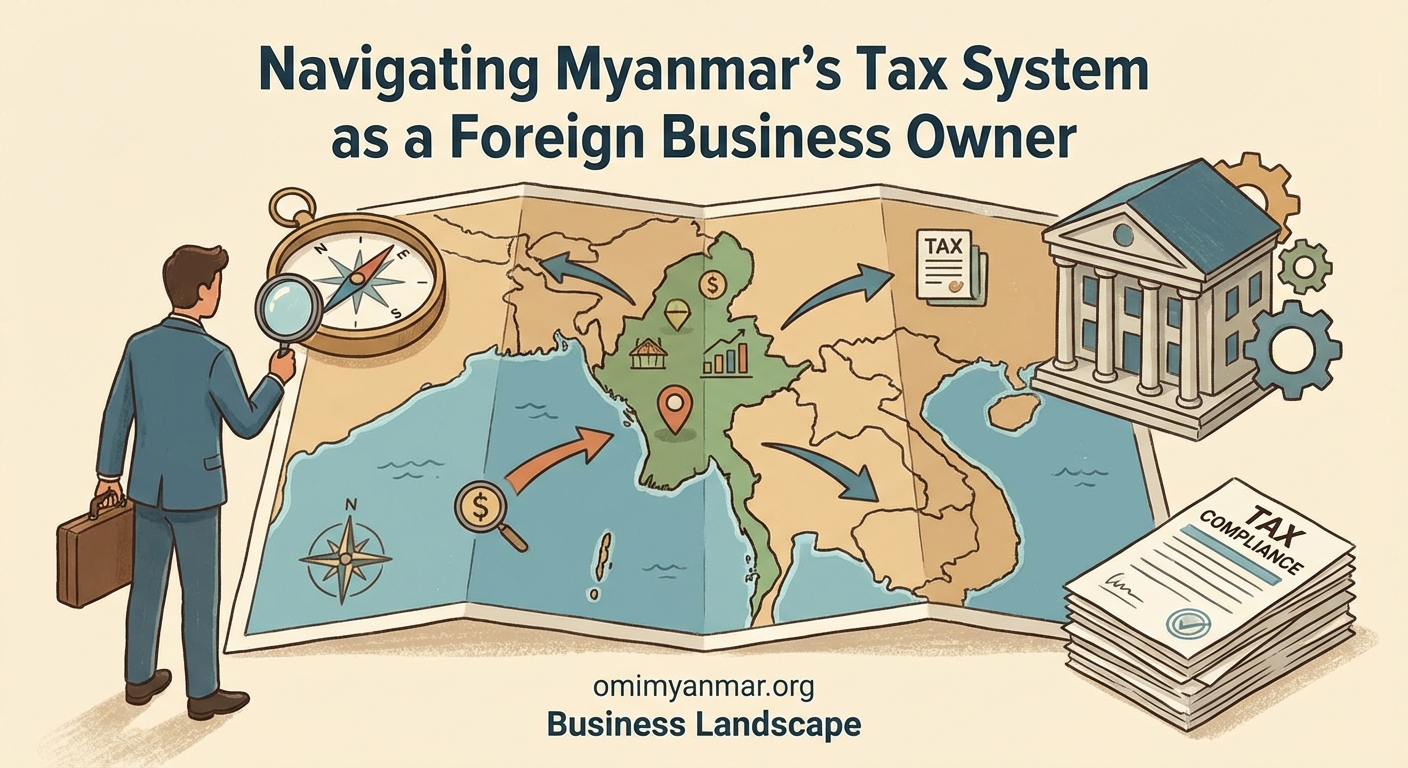
    Navigating Myanmar’s Tax System as a Foreign Business Owner

    Setting up a business in Myanmar means facing a tax landscape that can feel unfamiliar at first. The country’s tax system combines elements familiar to international entrepreneurs with local regulations shaped by decades of economic transition. Foreign business owners need to understand not just what taxes apply, but how to register, file, and stay compliant in a system that’s still evolving.

    Key Takeaway

    Myanmar’s tax system for foreign business owners includes corporate income tax at 25%, commercial tax on goods and services, and withholding tax on payments to non-residents. Foreign companies must register with the Internal Revenue Department, file monthly commercial tax returns, and submit annual income tax declarations. Compliance requires understanding tax treaties, transfer pricing rules, and documentation standards that differ from Western systems but follow recognizable international frameworks.

    Understanding corporate income tax obligations

    Foreign businesses operating in Myanmar face a standard corporate income tax rate of 25% on profits. This applies whether you’ve established a local subsidiary, registered a branch office, or operate through a representative office with taxable activities.

    The tax year in Myanmar runs from April 1 to March 31. Your company must file its annual income tax return within three months of the fiscal year end, meaning by June 30 each year. Many foreign business owners find this timeline tight, especially when coordinating with overseas parent companies that operate on different fiscal calendars.

    Myanmar uses a self-assessment system. You calculate your own tax liability, file your return, and pay what you owe. The Internal Revenue Department can audit your filing later, but they don’t pre-approve your calculations. This puts responsibility squarely on your shoulders to get it right the first time.

    Taxable income includes all revenue from business operations in Myanmar. You can deduct ordinary business expenses like salaries, rent, utilities, and professional fees. Capital expenditures follow depreciation schedules set by tax law, not accounting standards you might use elsewhere.

    “Foreign companies often struggle with the difference between accounting profit and taxable income in Myanmar. Just because your financial statements show a certain profit doesn’t mean your tax calculation will match. Understanding allowable deductions and required adjustments is critical.”

    Commercial tax on sales and services

    Navigating Myanmar's Tax System as a Foreign Business Owner - Illustration 1

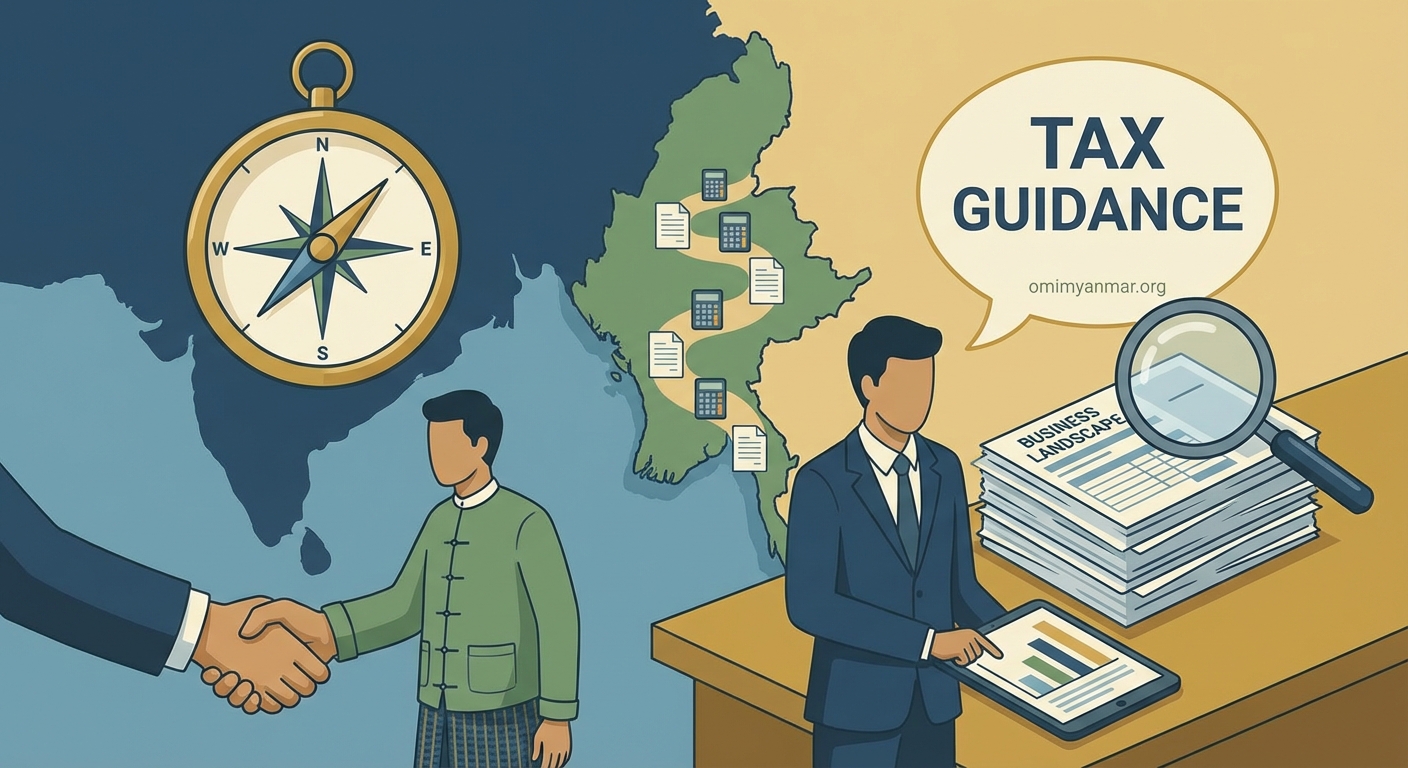
    Commercial tax functions similarly to value-added tax or sales tax in other countries. The standard rate is 5% on most goods and services, though some items carry higher rates or exemptions.

    Your business must register for commercial tax if annual turnover exceeds 50 million kyat, roughly $24,000 at recent exchange rates. Most foreign businesses cross this threshold easily. Registration happens at the township tax office where your business operates.

    Monthly filing is mandatory. You submit returns by the 10th of the following month, calculating tax on sales and claiming credits for tax paid on purchases. The net difference is what you pay or, occasionally, carry forward as a credit.

    Certain sectors face different rates. Luxury goods might carry 8%, 15%, or even 25% commercial tax. Exported goods typically qualify for zero-rating, meaning you charge no tax on the sale but can still claim credits on related purchases. Services to foreign clients outside Myanmar may also qualify for favorable treatment.

    Record keeping matters enormously. You need proper invoices showing commercial tax separately, organized by month, and available for inspection. Many foreign business owners underestimate how detailed Myanmar tax authorities expect documentation to be.

    Withholding tax on payments abroad

    When your Myanmar business pays foreign entities for services, royalties, interest, or dividends, you must withhold tax before sending money overseas. Standard withholding rates are:

    • Technical services: 15%
    • Royalties: 15%
    • Interest: 15%
    • Dividends: 0% (currently suspended)

    These rates can drop significantly if Myanmar has a tax treaty with the recipient’s country. Tax treaties exist with several nations including India, Singapore, Thailand, Vietnam, and the United Kingdom. Treaty rates often reduce withholding to 5% or 10%, sometimes eliminating it entirely for certain payment types.

    Claiming treaty benefits requires documentation. The foreign recipient must provide a tax residency certificate from their home country and complete forms specified by Myanmar tax authorities. Without proper paperwork, you’re stuck applying the standard 15% rate.

    You must remit withheld tax to the Internal Revenue Department by the 10th of the following month. A separate return details each payment, the recipient, the nature of the payment, and the tax withheld. Penalties for late filing or payment can reach 2% per month on outstanding amounts.

    Registration and compliance timeline

    Navigating Myanmar's Tax System as a Foreign Business Owner - Illustration 2

    Setting up tax compliance for your foreign business in Myanmar follows a specific sequence:

    1. Obtain your company registration certificate from the Directorate of Investment and Company Administration or the Myanmar Investment Commission, depending on your business structure and sector.

    2. Register with the Internal Revenue Department within 30 days of receiving your business license, submitting your company documents, shareholder information, and projected business activities.

    3. Apply for a commercial tax registration certificate at your township tax office, providing your company registration, office lease agreement, and business plan showing expected turnover.

    4. Open a Myanmar bank account in your company name, which you’ll need for tax payments and receiving the tax clearance certificates that prove you’re current on obligations.

    5. Register for withholding tax if you’ll make payments to foreign entities, submitting details about expected payment types and recipient countries.

    Each registration generates a tax identification number. Keep these numbers accessible because you’ll reference them on every filing, payment, and correspondence with tax authorities.

    Key compliance deadlines throughout the year

    Tax Type Filing Frequency Deadline Payment Due
    Commercial tax Monthly 10th of following month Same as filing
    Withholding tax Monthly 10th of following month Same as filing
    Income tax Annual June 30 Same as filing
    Advance income tax Quarterly 14th of month following quarter Same as filing
    Social security Monthly 15th of following month Same as filing

    Missing deadlines triggers penalties automatically. Late filing penalties typically equal 2% of tax due per month. Late payment adds another 2% monthly. These compound separately, so a return filed and paid three months late could face 12% in total penalties.

    Transfer pricing considerations

    Myanmar introduced transfer pricing regulations that require foreign businesses to price transactions with related parties at arm’s length. If your Myanmar subsidiary buys from, sells to, or pays fees to your parent company or sister entities, these rules apply.

    Documentation requirements kicked in for companies with annual revenue above 10 billion kyat, approximately $4.8 million. You must maintain a master file describing your global business, a local file detailing Myanmar operations and related party transactions, and contemporaneous documentation supporting your pricing decisions.

    The Internal Revenue Department can challenge your transfer pricing and adjust your taxable income upward if they believe you’ve shifted profits out of Myanmar through below-market sales or above-market purchases. Penalties for inadequate documentation or pricing adjustments can be severe.

    Many foreign business owners find Myanmar’s transfer pricing rules less developed than those in Singapore, Thailand, or Malaysia. Guidance is limited. Precedents are few. Working with advisors who understand both international transfer pricing principles and Myanmar’s specific requirements becomes essential.

    Common mistakes foreign businesses make

    New foreign business owners in Myanmar frequently stumble over the same issues. Understanding these pitfalls helps you avoid them:

    • Assuming accounting standards and tax rules align. Myanmar tax law specifies depreciation rates, expense deductibility, and income recognition that often differ from International Financial Reporting Standards.

    • Failing to maintain Myanmar-specific books. Tax authorities expect records in Myanmar, not just consolidated accounts from your home country.

    • Missing the advance income tax requirement. Companies must pay estimated tax quarterly based on the previous year’s liability, not just file annually.

    • Ignoring documentation standards for deductions. Receipts must show specific details, vendor tax registration numbers, and proper formatting to support expense claims.

    • Treating commercial tax like VAT in other countries. Subtle differences in crediting, exemptions, and filing can trip up experienced finance teams.

    • Overlooking tax clearance requirements for contract renewals, visa extensions, and business license renewals. Myanmar authorities often require proof of tax compliance before processing other business needs.

    Tax incentives and special economic zones

    Myanmar offers tax holidays and reduced rates for businesses in encouraged sectors or special economic zones. Manufacturing, agriculture, and technology businesses may qualify for three to seven year income tax exemptions, depending on location and investment size.

    The Thilawa, Dawei, and Kyaukphyu special economic zones provide additional benefits. Companies operating there might enjoy extended tax holidays, exempted commercial tax on imported machinery, and relief from customs duties.

    Claiming these incentives requires approval during your investment application process. You can’t apply retroactively. The Myanmar Investment Commission or relevant zone authority must explicitly grant tax benefits in your permit. Without that written approval, standard tax rates apply regardless of your sector or location.

    Benefits come with conditions. You must meet investment thresholds, create specified job numbers, or achieve export targets. Failing to meet conditions can trigger clawback provisions where you must repay tax savings plus penalties.

    Working with tax advisors and authorities

    Few foreign business owners handle Myanmar tax compliance entirely in-house, at least initially. The system’s quirks, language barriers, and evolving regulations make local expertise valuable.

    Hiring a Myanmar tax advisor costs less than you might expect. Monthly retainers for basic compliance services typically range from $500 to $2,000 depending on transaction volume and complexity. Annual income tax preparation might add another $1,000 to $5,000.

    Choose advisors carefully. Look for firms with experience serving foreign clients in your industry. Ask about their relationship with local tax offices. Request references from other foreign business owners. The cheapest option rarely proves most cost effective when penalties for errors can exceed the savings.

    Building a respectful relationship with your township tax office helps tremendously. Tax officers appreciate when foreign business owners make genuine efforts to comply, ask questions before problems arise, and submit clear, organized filings. Small gestures like visiting in person for registration rather than sending staff, or providing requested documents promptly, create goodwill that matters when issues surface.

    Recent changes and future directions

    Myanmar’s tax system continues evolving. Recent years brought transfer pricing rules, expanded withholding tax coverage, and increased digital filing requirements. The Internal Revenue Department has signaled intentions to modernize further.

    Electronic filing systems now handle most commercial tax and withholding tax returns in major cities. Income tax e-filing is expanding but not yet universal. Expect continued digitization that should eventually simplify compliance while creating a clearer audit trail.

    Tax administration capacity is growing. More officers receive international training. Audit techniques are becoming more sophisticated. The days when foreign businesses could file minimal documentation and face little scrutiny are ending.

    Exchange rate complications persist. Myanmar’s currency volatility creates challenges when converting foreign currency transactions to kyat for tax purposes. Regulations specify using the Central Bank of Myanmar’s official rate, but practical application during periods of extreme rate divergence remains contentious.

    Making tax compliance work for your business

    Understanding Myanmar’s tax system for foreign business means accepting that some aspects will feel inefficient or unclear compared to more developed markets. That’s the reality of operating in a country still building modern tax administration.

    Success comes from three practices. First, maintain meticulous records from day one. Don’t wait until filing deadlines to organize receipts and invoices. Second, ask questions early. Tax authorities and advisors can provide clarity before you make costly mistakes. Third, budget for compliance costs as a normal business expense, not an unexpected burden.

    Your tax obligations in Myanmar represent more than just a cost of doing business. They’re your contribution to a country working to build transparent institutions and sustainable development. Paying taxes properly, filing on time, and maintaining good records helps Myanmar while protecting your business from penalties and disruptions that derail operations.

    The learning curve feels steep at first, but most foreign business owners find Myanmar tax compliance becomes routine within a year or two. The key is treating it as a core business function deserving proper attention and resources, not an afterthought to handle at the last minute.

  • Connecting to Myanmar: SIM Cards, Internet Access, and Staying Online While Traveling

    Connecting to Myanmar: SIM Cards, Internet Access, and Staying Online While Traveling

    Landing in Myanmar without mobile data can feel isolating. You need maps to find your hotel. You want to message home that you arrived safely. You might need to call a taxi or check opening hours for a pagoda.

    Getting connected is simpler than you think. Within an hour of landing, you can have a working local SIM card with data, calls, and texts. No need to rely on spotty hotel WiFi or expensive roaming charges.

    Key Takeaway

    Buying a myanmar sim card for travelers takes 10 minutes at the airport or city shops. Three major providers offer affordable prepaid plans with decent coverage in tourist areas. Bring your passport, choose a provider based on where you’re traveling, and top up data as needed. Most hotels also have WiFi, but a local SIM gives you freedom to navigate and communicate anywhere.

    Where to buy your SIM card in Myanmar

    You have three main options for purchasing a local SIM card.

    Yangon International Airport is the easiest starting point. After clearing customs, you’ll see several mobile provider kiosks in the arrivals hall. They’re open for most international flights, even late arrivals. Staff speak English and can activate your SIM immediately.

    Mandalay International Airport also has provider kiosks, though fewer than Yangon. If you’re flying directly to Mandalay, you can still get set up before leaving the terminal.

    City shops and authorized dealers are everywhere in larger towns. Look for branded storefronts with provider logos. These shops can help with top-ups, plan changes, and troubleshooting. Some hotels also sell SIM cards at their front desk, though prices may be slightly higher.

    Street vendors sometimes offer SIM cards, but stick to official shops or airport kiosks. You need proper registration, and unofficial sellers may not complete that process correctly.

    The three major mobile providers

    Connecting to Myanmar: SIM Cards, Internet Access, and Staying Online While Traveling - Illustration 1

    Myanmar has three main networks. Each has strengths depending on where you plan to travel.

    MPT (Myanmar Posts and Telecommunications) is the oldest provider with the widest coverage. If you’re visiting remote areas, rural villages, or less touristy regions, MPT often has the best signal. Their network reaches more of the country than competitors.

    Ooredoo offers strong coverage in cities and major tourist destinations. Their data speeds are generally faster in urban areas. If you’re staying mostly in Yangon, Bagan, Mandalay, or Inle Lake, Ooredoo performs well.

    Telenor was a major player but exited Myanmar in 2022. You may still see references to Telenor in older guides, but the network no longer operates independently. Focus on MPT or Ooredoo.

    For most travelers, either MPT or Ooredoo works fine. MPT edges ahead for adventurous itineraries. Ooredoo suits city-focused trips.

    How to buy and activate your SIM

    The process is straightforward. Follow these steps:

    1. Bring your passport. Registration is mandatory for all SIM cards in Myanmar. The shop will photocopy your passport and record your details.
    2. Choose your provider and plan. Tell the staff how long you’re staying and how much data you think you’ll need. They’ll recommend a package.
    3. Provide your phone. The staff will insert the SIM, configure settings, and test the connection. This takes about five minutes.
    4. Pay in cash. Most airport kiosks and small shops don’t accept credit cards. Have kyat or US dollars ready.
    5. Save your provider’s USSD code. You’ll use this to check your balance and buy more data later.

    Your phone must be unlocked to use a local SIM. If you’re unsure, check with your home carrier before traveling. Most modern smartphones bought outright are unlocked by default.

    Cost breakdown for SIM cards and data

    Connecting to Myanmar: SIM Cards, Internet Access, and Staying Online While Traveling - Illustration 2

    Prices are affordable compared to international roaming.

    Item Cost (Kyat) Cost (USD) Notes
    SIM card 1,500 $1 One-time purchase
    2 GB data (7 days) 3,000 $2 Good for light use
    5 GB data (30 days) 7,000 $4.50 Popular tourist plan
    10 GB data (30 days) 12,000 $8 Heavy streaming
    Local calls (per minute) 25 $0.02 Rarely needed

    Most travelers buy 5 GB for a two-week trip. That covers daily map use, messaging apps, social media, and occasional photo uploads. If you plan to stream video or work remotely, get 10 GB or more.

    Top-ups are easy. You can buy more data at any provider shop, through mobile banking apps, or by purchasing scratch cards at convenience stores.

    Coverage across popular destinations

    Network quality varies by location. Here’s what to expect in key tourist areas.

    Yangon has excellent coverage from all providers. 4G is standard in most neighborhoods. You’ll have fast, reliable internet at pagodas, markets, and restaurants.

    Bagan has good coverage in the main temple zones. MPT and Ooredoo both work well. Signal can be weaker in remote temples or during sunrise/sunset when everyone is online.

    Mandalay offers strong urban coverage. The city center, U Bein Bridge, and Mandalay Hill all have solid connections.

    Inle Lake has decent coverage in Nyaungshwe town and popular lake areas. Signal weakens in more remote villages around the lake.

    Ngapali Beach has coverage near hotels and the main beach strip. Don’t expect fast speeds, but messaging and basic browsing work.

    Remote areas like Chin State, northern Shan State, or Kayah State have limited coverage. MPT is your best bet, but expect gaps. Download offline maps before heading to these regions.

    If you’re trekking or visiting very rural areas, tell your guesthouse staff your route. They can advise on coverage and safety. Many remote guesthouses have WiFi powered by satellite, which is slower but functional.

    Data plans and how to choose

    Providers offer daily, weekly, and monthly packages. Choose based on your trip length.

    Short trips (3 to 7 days) suit weekly packages. Buy 2 to 3 GB and top up if needed. You won’t waste unused data.

    Two-week trips work well with a 5 GB monthly plan. You’ll have plenty of data and won’t worry about running out.

    Long stays (one month or more) benefit from 10 GB or unlimited plans. Some providers offer unlimited social media packages that don’t count against your data cap.

    Business travelers who need video calls should get at least 10 GB. Hotel WiFi can be unreliable during peak hours.

    Data doesn’t roll over. If you buy a 30-day plan but leave after 20 days, the remaining data expires. Buy conservatively and top up as needed.

    WiFi availability in Myanmar

    Most hotels, guesthouses, and cafes offer free WiFi. Quality varies widely.

    Budget guesthouses often have slow, shared connections. Fine for messaging but frustrating for video calls or uploading photos.

    Mid-range hotels usually provide decent speeds in rooms and common areas. You can work or stream without major issues.

    High-end hotels have reliable, fast WiFi. Some offer fiber connections that rival home internet in other countries.

    Cafes in Yangon and Mandalay often have good WiFi. Popular chains and expat-friendly spots prioritize connectivity.

    Restaurants outside major cities may have WiFi but don’t count on it. Having your own mobile data removes this uncertainty.

    Practical tips for staying connected

    Here are common situations and how to handle them.

    Your data runs out mid-trip. Visit any provider shop or buy a scratch card at a convenience store. Activation is instant.

    You can’t get signal in your hotel room. Move closer to a window or go outside. Thick concrete walls block signals. Hotel WiFi is your backup.

    Your phone won’t connect after inserting the SIM. Check that mobile data is enabled in settings. Restart your phone. If problems persist, return to the shop where you bought the SIM.

    You need to make local calls. Most plans include some call minutes. Dial the number normally. International calls are expensive, so use WhatsApp or similar apps instead.

    You’re traveling with multiple devices. Most phones can create a WiFi hotspot. Share your SIM data with your tablet or laptop.

    You’re worried about security. Use a VPN when accessing sensitive information. Public WiFi at cafes and airports is less secure than your mobile data.

    What to do before you leave home

    Preparation makes the process smoother.

    Check that your phone is unlocked. Contact your carrier if unsure. Locked phones won’t accept foreign SIM cards.

    Download offline maps for Myanmar. Google Maps lets you save regions for offline use. Do this before your flight.

    Install messaging apps like WhatsApp, Telegram, or Signal. These work over data and WiFi without needing a local number for calls.

    Inform your bank that you’re traveling. Some banks block foreign transactions without notice.

    Write down important phone numbers. Keep them separate from your phone in case it’s lost or stolen.

    Consider buying a SIM card ejector tool or bringing a paperclip. Some phones have tricky SIM trays.

    Common mistakes travelers make

    Avoid these pitfalls.

    Relying only on hotel WiFi. You’ll miss spontaneous moments when you can’t check directions or opening hours on the go.

    Buying too little data. It’s frustrating to run out mid-trip. Data is cheap, so buy more than you think you need.

    Not registering properly. If your SIM isn’t registered with your passport, it may stop working after a few days. Insist on proper registration at purchase.

    Ignoring top-up options. Learn how to check your balance and buy more data through USSD codes or apps. Don’t wait until you’re out of data to figure this out.

    Choosing the wrong provider for your route. If you’re heading to remote areas, MPT is usually better. For city-only trips, Ooredoo is fine.

    eSIM options for tech-savvy travelers

    Some newer phones support eSIM technology. This lets you activate a plan digitally without a physical SIM card.

    A few international eSIM providers offer Myanmar coverage. You buy a plan online before your trip, scan a QR code, and activate the eSIM when you land.

    Advantages: No need to visit a shop. You keep your home SIM active in a dual-SIM setup. Convenient if you’re visiting multiple countries.

    Disadvantages: More expensive than local SIM cards. Coverage depends on which local network the eSIM provider partners with. Not all phones support eSIM.

    For most travelers, a local physical SIM is cheaper and simpler. But if you have an eSIM-compatible phone and value convenience, it’s worth considering.

    Using your SIM for specific needs

    Different travelers have different priorities.

    Photographers uploading to cloud storage should get 10 GB or more. Upload during downtime at your hotel to save mobile data.

    Digital nomads working remotely need reliable data. Consider getting two SIM cards from different providers for backup. Some coworking spaces in Yangon offer day passes with excellent WiFi.

    Families traveling together can share one SIM via hotspot, but each person having their own is safer. If someone gets separated, they can still communicate.

    Budget backpackers can get by with 2 GB if they use WiFi whenever possible. Download entertainment before leaving WiFi zones.

    Keeping your home number active

    You have a few options for managing your home SIM while traveling.

    Dual-SIM phones let you keep both SIMs active. You can receive calls and texts on your home number while using Myanmar data. Check your phone’s specs before traveling.

    Forward calls to a messaging app. Some carriers let you forward calls to WhatsApp or Google Voice. You’ll receive calls over data.

    Pause your home plan. Some carriers offer travel pauses where you pay a reduced rate to keep your number without full service.

    Accept that you’ll miss calls. If you’re only gone for a week or two, let important contacts know to reach you via messaging apps.

    Most travelers find that keeping their home SIM in their phone (if dual-SIM) or in their luggage works fine. Critical contacts can reach you through internet-based apps.

    Returning your SIM or keeping it for next time

    You don’t need to return your SIM card. It’s yours to keep.

    If you plan to return to Myanmar within a year, keep the SIM. You can reactivate it with a top-up on your next visit. This saves time at the airport.

    If you won’t return soon, throw it away or recycle it. The SIM has no residual value and your registration expires after a period of inactivity.

    Some travelers collect SIM cards as travel souvenirs. They’re small, lightweight, and remind you of the trip.

    Staying connected makes travel better

    Having mobile data transforms your Myanmar experience. You can navigate confidently, find hidden restaurants, translate signs, and share moments in real time.

    The process is simple. Land, buy a SIM at the airport, and you’re online within minutes. Spend a few dollars for the freedom to explore without constantly searching for WiFi.

    Choose your provider based on where you’re going. Top up when needed. Enjoy the peace of mind that comes with always being connected.

    Your myanmar sim card for travelers is more than a convenience. It’s your map, your translator, your camera backup, and your lifeline home. Get one as soon as you arrive.

  • Why Thanaka Paste Remains Myanmar’s Most Beloved Beauty Secret After 2,000 Years

    Why Thanaka Paste Remains Myanmar’s Most Beloved Beauty Secret After 2,000 Years

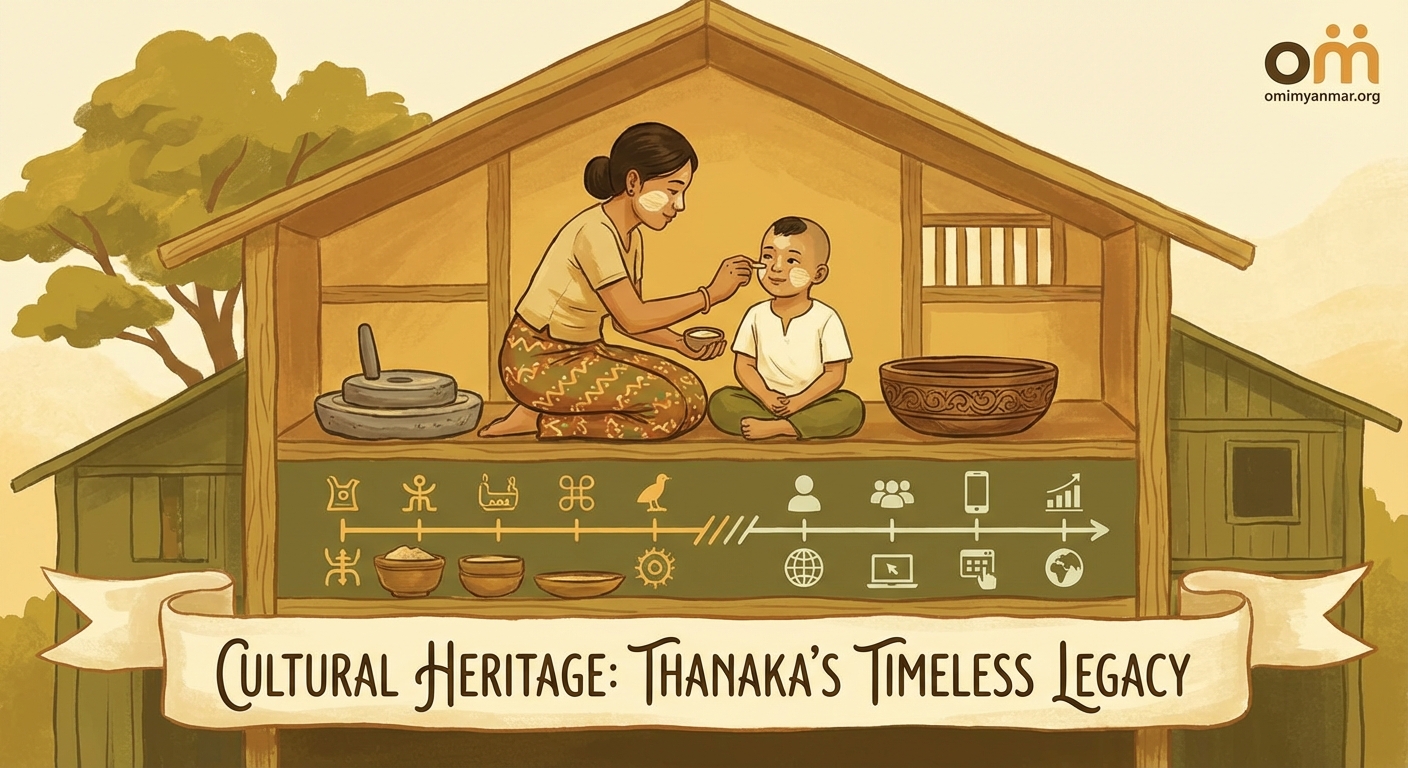
    Walk through any street in Yangon and you’ll see golden paste painted across faces in delicate patterns. Young women wear it. Elderly grandmothers apply it every morning. Even monks use it. This isn’t makeup. This is thanaka, a beauty ritual older than most civilizations, and it’s still going strong.

    Key Takeaway

    Thanaka is Myanmar’s 2,000-year-old beauty secret made from ground tree bark. It offers natural sun protection, fights acne, reduces oiliness, and cools the skin. Locals apply it daily by grinding bark on a stone slab with water, creating a paste they paint onto their faces in traditional patterns that signal identity and occasion.

    What makes thanaka different from modern skincare

    Most beauty products promise results in six weeks. Thanaka has been delivering for two millennia.

    The paste comes from the bark of thanaka trees, which grow only in central Myanmar’s dry zones. These trees take at least 35 years to mature before harvest. The older the tree, the better the paste.

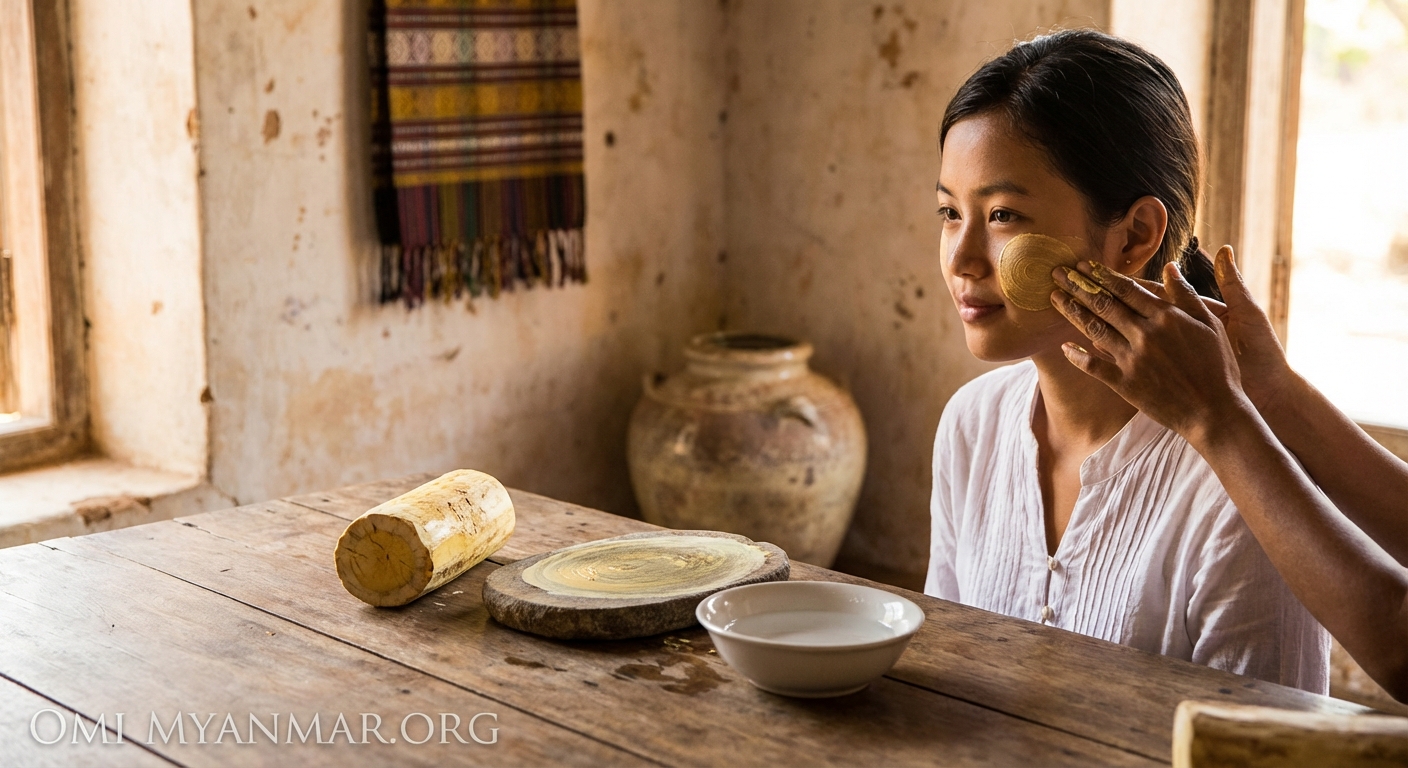
    You won’t find thanaka in fancy bottles. Instead, people buy bark logs called kyauk pyin from markets. They grind these logs on circular stone slabs with a few drops of water, creating a smooth, fragrant paste.

    The scent is woody and slightly sweet. The texture is creamy but light. The color ranges from pale yellow to deep gold depending on the tree’s age.

    Unlike commercial sunscreens that sit on top of your skin, thanaka absorbs while leaving a visible layer. That layer does triple duty: sun protection, oil control, and a cooling effect that feels like natural air conditioning for your face.

    How thanaka protects and heals skin

    Why Thanaka Paste Remains Myanmar's Most Beloved Beauty Secret After 2,000 Years - Illustration 1

    Scientists have studied thanaka’s chemical makeup. The bark contains several active compounds that explain why it works.

    Marmesin acts as a natural sunscreen. Studies show it blocks UV rays more effectively than many synthetic ingredients. People who wear thanaka daily report less sun damage over time.

    The paste also contains hesperidin, which reduces inflammation. This explains why thanaka helps with acne, rashes, and irritation.

    For oily skin, thanaka is a game changer. It absorbs excess sebum without stripping moisture. Your face stays matte for hours without feeling tight or dry.

    The cooling sensation isn’t just psychological. Thanaka actually lowers skin temperature by a few degrees. During Myanmar’s brutal hot season, when temperatures hit 40°C, this cooling effect provides real relief.

    Traditional application methods that still work today

    Making thanaka paste requires patience but minimal equipment.

    1. Wet your stone slab with clean water.
    2. Rub the bark log in circular motions against the stone.
    3. Keep adding drops of water as you grind.
    4. Continue until you have a smooth, paint-like consistency.
    5. Apply immediately for best results.

    The grinding process takes about five minutes. Some people grind for longer to create a finer texture. Others prefer a slightly grainy paste.

    Application patterns vary by region, age, and occasion:

    • Young women often paint circular patches on both cheeks.
    • Older women might cover their entire face in a thin layer.
    • Festival patterns include leaf shapes, stripes, or geometric designs.
    • Children typically get simple smears across their cheeks and nose.

    The paste dries in about 20 minutes. It stays on your face for hours, even through sweat and humidity. Most people wash it off before bed, though some leave it on overnight as a treatment mask.

    Patterns that tell stories

    Why Thanaka Paste Remains Myanmar's Most Beloved Beauty Secret After 2,000 Years - Illustration 2

    Thanaka isn’t just skincare. It’s a visual language.

    A woman wearing neat circular patches on her cheeks signals she’s following traditional beauty standards. Leaf-shaped patterns often appear during festivals or special ceremonies. Thick applications covering the whole face indicate serious sun protection, common among farmers and market vendors.

    Different ethnic groups in Myanmar have distinct application styles. Chin women might combine thanaka with other natural cosmetics. Shan communities have their own pattern preferences. Bamar people, Myanmar’s largest ethnic group, tend toward the classic cheek circles.

    These patterns have remained consistent for generations. A grandmother and her granddaughter might wear identical thanaka designs, creating a visible link across decades.

    Common mistakes foreigners make with thanaka

    Tourists often buy thanaka as a souvenir, then struggle to use it properly. Here are the most frequent errors and how to avoid them.

    Mistake Why it happens Better approach
    Grinding too thick Adding too little water Use more water than seems necessary
    Applying like foundation Treating it as makeup Think of it as skincare that shows
    Expecting instant absorption Comparing to modern lotions Let it dry naturally, don’t rub it in
    Using low-quality bark Buying tourist-grade products Purchase from local markets where residents shop
    Washing off too soon Feeling self-conscious Leave it on for at least two hours

    The biggest mistake is buying pre-ground thanaka powder. Fresh grinding releases the active compounds. Pre-ground versions lose potency within weeks.

    Another error is applying thanaka over moisturizer or sunscreen. Thanaka works best on clean, bare skin. Let it be your first layer.

    Where thanaka fits in modern beauty routines

    Young Myanmar professionals now blend traditional and contemporary skincare. They might use thanaka in the morning and Korean serums at night. Or apply thanaka on weekends while using commercial products during the work week.

    This hybrid approach makes sense. Thanaka excels at sun protection and oil control. Modern products handle targeted concerns like dark spots or fine lines.

    Some beauty brands have tried to commercialize thanaka. You’ll find thanaka-infused creams, soaps, and lotions in Myanmar shops. Purists argue these products can’t match fresh-ground paste.

    The debate mirrors larger questions about tradition and modernization. Can ancient practices survive in their original form? Should they?

    For now, thanaka persists in its traditional state. Every morning, millions of people still grind bark on stone, just as their ancestors did.

    Scientific backing for traditional claims

    Research institutions have tested thanaka’s properties in controlled studies. The results validate what Myanmar people have known for centuries.

    A 2010 study found thanaka extract inhibited melanin production, explaining its skin-brightening effects. Another study confirmed its antibacterial properties against acne-causing bacteria.

    The sun protection factor varies by preparation method. Fresh-ground thanaka offers SPF 10 to 20 equivalent protection. Not enough for a beach day, but solid for daily urban life.

    “Thanaka contains natural compounds that modern cosmetic chemists spend millions trying to synthesize. The traditional preparation method preserves these compounds better than industrial extraction.” — Dr. Khin Maung Latt, dermatology researcher at Yangon University

    Clinical trials have shown thanaka reduces hyperpigmentation when used consistently for three months. Participants reported smoother texture and fewer breakouts.

    These studies interest international cosmetic companies. Several have approached Myanmar suppliers about large-scale thanaka extraction. So far, traditional producers have resisted industrialization.

    Sustainability and the thanaka supply chain

    Thanaka trees grow wild and on small farms across central Myanmar. Sustainable harvesting requires careful management.

    A single tree can be harvested multiple times over its 70-year lifespan. Farmers strip bark from one side, allowing the tree to heal before rotating to another section. This practice maintains tree health while providing steady income.

    Climate change threatens thanaka cultivation. Changing rainfall patterns affect tree growth. Some farmers report lower-quality bark from younger trees rushed to market.

    Conservation efforts focus on replanting programs and educating farmers about sustainable practices. Several NGOs work with thanaka-growing communities to protect this cultural resource.

    The economics matter too. A good thanaka log sells for about $3 to $10 depending on age and quality. That’s affordable for most Myanmar families but significant income for rural farmers.

    How to buy and store thanaka properly

    If you want to try thanaka yourself, quality matters enormously.

    Look for bark that’s:
    * Dense and heavy for its size
    * Light golden to pale yellow inside
    * Smooth-grained without cracks
    * Fragrant when freshly cut

    Avoid bark that looks dried out, cracked, or unnaturally dark. These signs indicate age or poor storage.

    Store your thanaka log wrapped in cloth in a cool, dry place. Don’t refrigerate it. The bark should last years if kept properly.

    The grinding stone, called kyauk, is equally important. Traditional stones are made from specific rock types that create the right texture. Ceramic alternatives work but produce slightly different results.

    You can find thanaka at markets throughout Myanmar. Bogyoke Market in Yangon has numerous vendors. Prices range from budget options to premium aged bark.

    Why thanaka survives while other traditions fade

    Many traditional practices disappear under modernization pressure. Thanaka thrives.

    Part of the reason is practical efficacy. Thanaka actually works. People see real results, so they keep using it.

    Another factor is cultural pride. Wearing thanaka signals Myanmar identity. In a globalized world, this visible marker of heritage matters.

    The practice also adapts without losing authenticity. You can apply thanaka before heading to an office job or a traditional festival. It fits multiple contexts.

    Cost accessibility helps too. Anyone can afford basic thanaka. Luxury versions exist for those who want them, but the entry barrier stays low.

    Finally, thanaka benefits from intergenerational transmission. Grandmothers teach mothers who teach daughters. This direct knowledge transfer preserves technique and meaning.

    Beyond faces and into daily life

    While facial application dominates, thanaka has other uses.

    Some people apply it to arms and legs for sun protection during outdoor work. Athletes use it to prevent chafing. New mothers sometimes apply thanaka to babies’ skin for cooling and protection.

    Thanaka also appears in traditional medicine. Practitioners use it to treat minor burns, insect bites, and skin infections. The antibacterial properties support these applications.

    During festivals, thanaka becomes body art. Skilled artists create elaborate designs on faces, arms, and backs. These temporary decorations celebrate special occasions.

    The paste even has spiritual dimensions. Some Buddhist ceremonies incorporate thanaka as an offering or blessing. The natural, pure substance aligns with religious values.

    Teaching the next generation

    Schools in Myanmar don’t formally teach thanaka application. Girls learn by watching and practicing.

    A typical learning progression starts around age five or six. A mother applies thanaka to her daughter’s face. The child watches the grinding process. Eventually, she tries grinding herself, usually making a mess.

    By age ten, most girls can grind and apply thanaka competently. Teenage years bring experimentation with different patterns and styles. Adult women develop their signature application method.

    Boys receive less instruction but often learn the basics. While fewer adult men wear thanaka daily, most can prepare and apply it when needed.

    This informal education system has worked for generations. It requires no curriculum, no teachers, no classroom. Just observation, practice, and cultural continuity.

    A beauty ritual that connects past and present

    Thanaka represents something rare in modern beauty culture: a practice that hasn’t fundamentally changed in two thousand years.

    The same trees. The same grinding stones. The same application methods. Yet it remains relevant, useful, and beloved.

    This continuity offers lessons beyond skincare. It shows how traditional knowledge can persist when it delivers real value. It demonstrates that simple, natural solutions sometimes outperform complex modern alternatives.

    For visitors to Myanmar, thanaka provides a tangible connection to local culture. Trying it yourself, grinding the bark and feeling the cooling paste on your skin, creates understanding that no guidebook can match.

    For Myanmar people, thanaka is daily affirmation of identity. Each morning’s application links them to ancestors and traditions stretching back millennia.

    The golden paste on millions of faces isn’t just about looking good or protecting skin. It’s about belonging to something larger than yourself, participating in a living tradition that your great-great-grandchildren might continue.

    That’s the real thanaka Myanmar beauty secret. Not the chemical compounds or sun protection factors, but the human connection it creates across time and generations.

  • Why Myanmar’s Public Procurement System Remains Vulnerable to Corruption Despite Recent Reforms

    Why Myanmar’s Public Procurement System Remains Vulnerable to Corruption Despite Recent Reforms

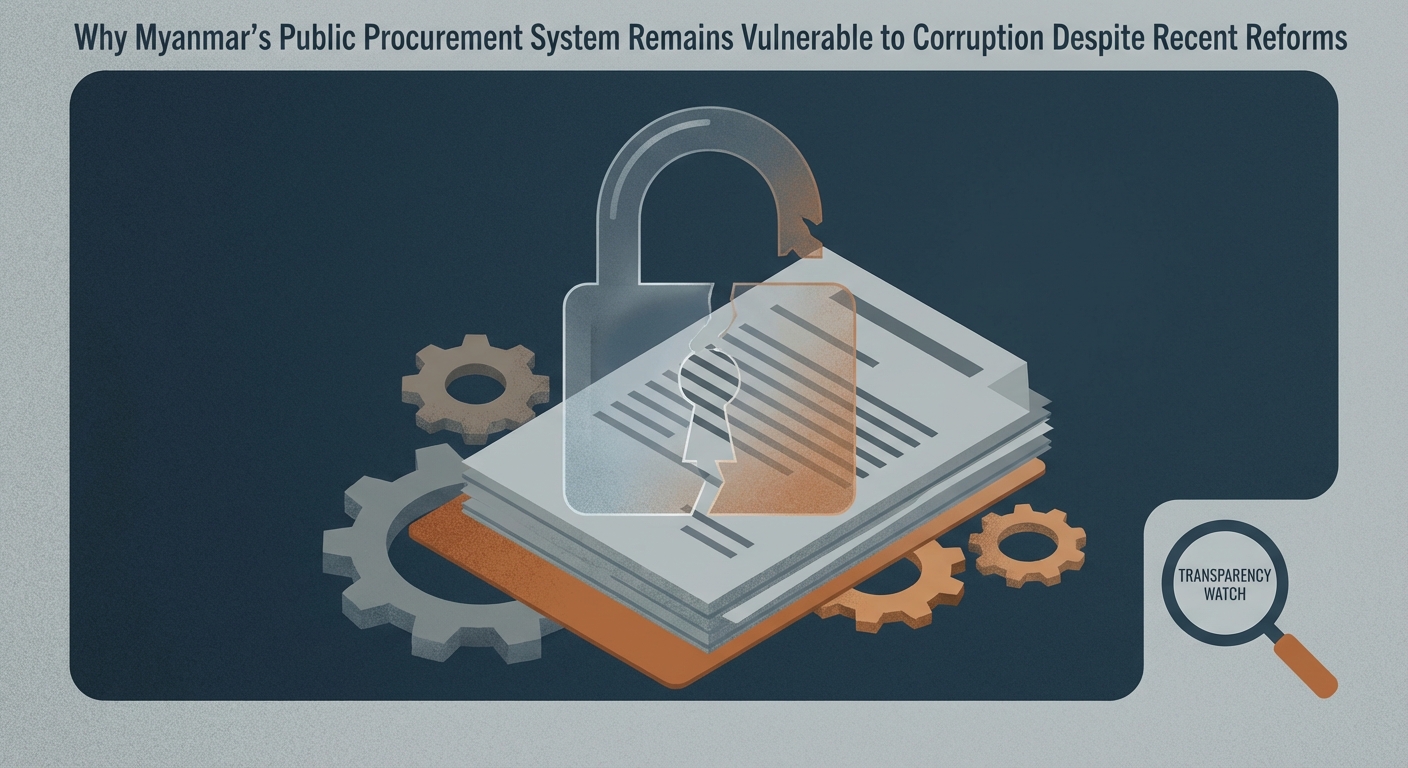
    Myanmar’s government spends billions of kyat each year on roads, schools, hospitals, and infrastructure projects. Yet a troubling pattern persists: contracts awarded to politically connected firms, inflated costs that drain public coffers, and projects that never deliver promised results. Despite legislative reforms introduced over the past decade, corruption in Myanmar public procurement remains deeply entrenched, undermining development goals and eroding public trust.

    Key Takeaway

    Myanmar’s public procurement system suffers from systematic corruption despite recent legal reforms. Weak enforcement mechanisms, lack of genuine competition, opaque bidding processes, and limited civil society oversight create persistent vulnerabilities. Political interference, inadequate training, and poor digital infrastructure compound these structural problems, allowing bid rigging, kickbacks, and contract manipulation to continue across government agencies at national and regional levels.

    Understanding the scope of procurement corruption

    Public procurement accounts for approximately 30 to 40 percent of government spending in many developing countries. For Myanmar, this represents a substantial portion of the national budget flowing through contracts for construction, supplies, services, and equipment.

    The corruption takes many forms. Bid rigging ensures favored companies win contracts regardless of qualifications. Inflated cost estimates pad budgets, creating room for kickbacks. Contract specifications get written to exclude all but predetermined winners. Quality standards go unenforced, allowing substandard materials and shoddy work.

    These practices hurt ordinary citizens directly. A school building collapses because contractors used inferior concrete. A rural road washes away after one monsoon season because proper drainage was never installed. Medical supplies arrive expired or in insufficient quantities. Each failure represents stolen public resources that could have improved lives.

    The financial impact extends beyond immediate waste. Corruption increases project costs by an estimated 20 to 25 percent on average. This means fewer schools built, fewer roads paved, fewer communities served with limited budgets.

    Historical roots and institutional weaknesses

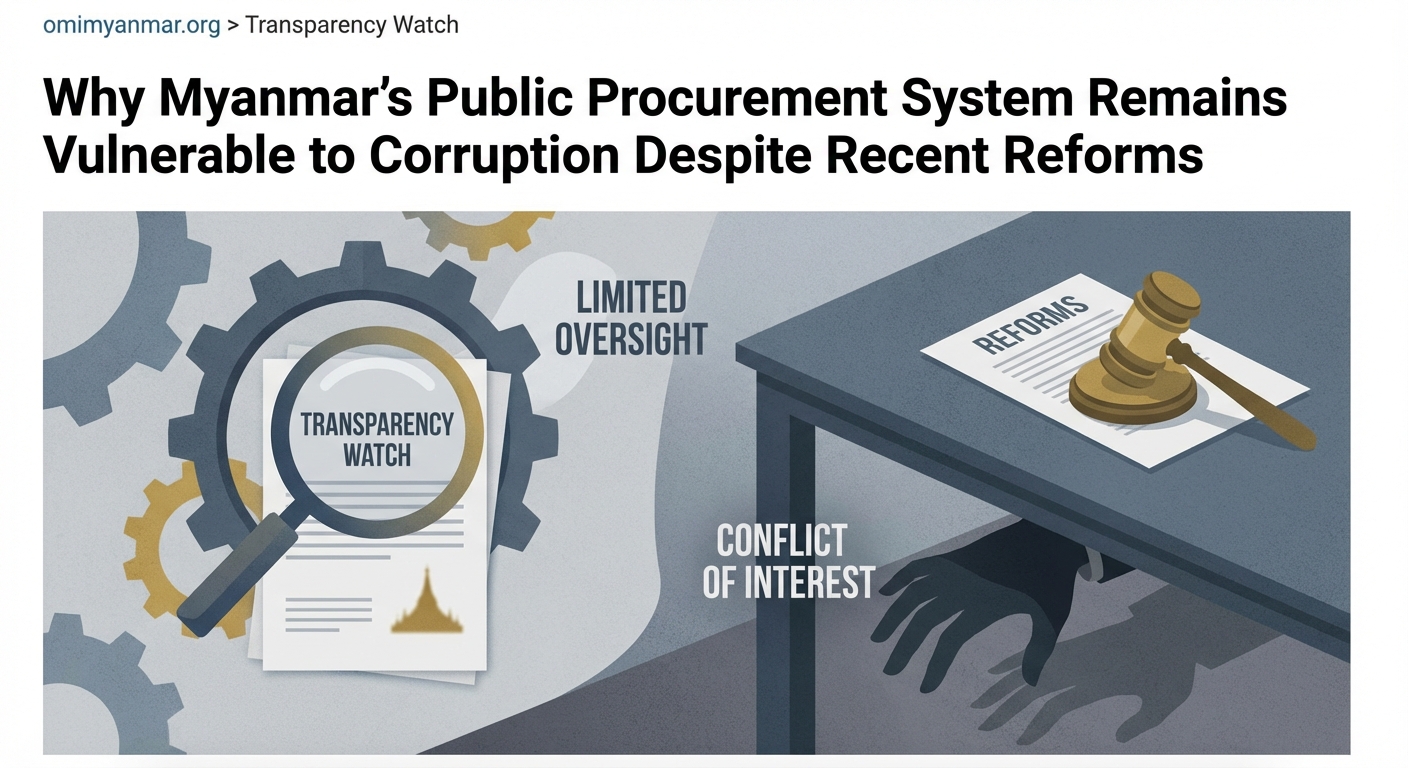
    Why Myanmar's Public Procurement System Remains Vulnerable to Corruption Despite Recent Reforms - Illustration 1

    Myanmar’s procurement vulnerabilities stem from decades of military rule that normalized patronage networks and opacity. The transition toward civilian governance beginning in 2011 brought new laws and institutions, but changing entrenched practices proved far more difficult than changing statutes.

    The 2014 Public Procurement Law represented a significant step forward on paper. It established basic principles of transparency, competition, and value for money. Implementing rules followed in 2017, providing more detailed procedures.

    Yet the law contained critical gaps from the start:

    • No independent oversight body with enforcement powers
    • Weak penalties that fail to deter violations
    • Broad exceptions allowing direct contracting without competition
    • Limited public access to procurement information
    • Insufficient protection for whistleblowers

    The institutional framework remained fragmented. Multiple agencies handle procurement with inconsistent standards. The Ministry of Planning and Finance sets overall policy, but line ministries and regional governments execute contracts with varying levels of capacity and integrity.

    Training gaps persist across government. Many procurement officers lack understanding of competitive bidding principles, conflict of interest rules, or proper evaluation methods. Some have never received formal instruction in procurement procedures at all.

    Common corruption schemes in government contracting

    Understanding specific corruption methods helps explain why reforms have struggled to create change. These schemes appear repeatedly across different sectors and regions.

    Bid rigging and collusion

    Companies coordinate to eliminate genuine competition. They agree in advance who will win which contracts, submitting complementary bids that appear competitive but are actually orchestrated. Sometimes the same individuals control multiple companies that submit separate bids.

    Procurement officials facilitate this by sharing confidential information about competing bids, allowing favored bidders to adjust their proposals. They may also manipulate evaluation criteria after bids open to favor predetermined winners.

    Inflated specifications and cost padding

    Technical specifications get written to match the capabilities of a specific company, excluding legitimate competitors. Requirements may demand proprietary systems, unusual certifications, or unnecessarily complex features.

    Cost estimates inflate significantly above market rates. The excess creates room for kickbacks to officials while still appearing to meet budget requirements. Quantity calculations may exaggerate actual needs.

    Contract splitting and threshold manipulation

    Large projects get artificially divided into smaller contracts that fall below competitive bidding thresholds. This allows direct awards to favored contractors without public tenders. A single road project becomes multiple “independent” segments. A hospital construction splits into separate contracts for foundation, structure, and finishing.

    Quality compromise and substitution

    Contractors win bids with competitive prices, then substitute inferior materials during implementation. Steel reinforcement bars get replaced with lower grade metal. Cement gets diluted. Specified equipment brands get swapped for cheaper alternatives.

    Inspection systems fail to catch these substitutions because inspectors receive payments to overlook violations. Testing requirements get waived or falsified. As-built documentation misrepresents actual construction.

    The enforcement challenge

    Why Myanmar's Public Procurement System Remains Vulnerable to Corruption Despite Recent Reforms - Illustration 2

    Laws mean little without credible enforcement. Myanmar’s procurement system suffers from multiple enforcement failures that allow corruption to continue with minimal consequences.

    Audit capacity remains severely limited. The Office of the Auditor General lacks sufficient staff and resources to examine more than a small fraction of procurement transactions. Audits often occur years after projects complete, reducing their deterrent effect.

    When audits do identify violations, consequences rarely follow. Findings get buried in reports that receive little public attention. Recommendations for administrative action go unimplemented. Criminal referrals stall in a judicial system that lacks independence and capacity for complex financial cases.

    Administrative sanctions carry minimal weight. Companies found violating procurement rules may face temporary suspension from bidding, but enforcement is inconsistent and penalties easily circumvented by creating new corporate entities.

    The complaint and appeal mechanisms provide little practical recourse. Aggrieved bidders face high barriers to challenging awards. Procedures are opaque, time limits are short, and remedies are limited. Many companies avoid filing complaints for fear of retaliation in future procurements.

    Transparency gaps and information asymmetry

    Corruption thrives in darkness. Myanmar’s procurement system maintains significant opacity despite legal requirements for transparency.

    Procurement planning information rarely reaches the public. Annual procurement plans that should guide budgeting and preparation often remain internal documents. Companies struggle to identify upcoming opportunities and prepare competitive bids.

    Tender announcements receive limited circulation. While major contracts may appear in newspapers or government websites, many procurements get advertised only through obscure channels or for minimal periods. This restricts competition to those with insider connections.

    Bid evaluation processes operate behind closed doors. Evaluation criteria may be vague or subjective. Scoring methods lack transparency. Bidders receive little information about why they lost, making it difficult to identify bias or irregularities.

    Contract information remains largely secret. The public cannot easily access details about who won contracts, for what amounts, or under what terms. This prevents civil society monitoring and accountability.

    Performance information is virtually nonexistent. Citizens cannot determine whether contractors delivered what they promised, whether projects met quality standards, or whether value was achieved.

    Table: Procurement vulnerabilities and corruption risks

    Procurement Stage Common Vulnerability Corruption Risk Detection Difficulty
    Planning Needs assessment manipulation Unnecessary projects favoring certain contractors High
    Specification Tailored technical requirements Eliminating legitimate competition Medium
    Bidding Limited advertisement Restricting participation to insiders Medium
    Evaluation Subjective criteria Biased scoring favoring predetermined winner High
    Award Insufficient justification Arbitrary decisions without accountability Medium
    Contract signing Confidential terms Hidden provisions benefiting contractor High
    Implementation Weak supervision Substitution of inferior materials or work Low
    Payment Inadequate verification Payment for incomplete or substandard work Low
    Completion Perfunctory acceptance Accepting deficient deliverables Medium

    Political interference and patronage networks

    Procurement corruption in Myanmar cannot be separated from broader political economy dynamics. Government contracting serves as a key mechanism for distributing patronage and maintaining political support.

    Military-linked companies receive preferential treatment across many sectors. Their political connections provide advantages in accessing information, influencing specifications, and securing contract awards. Challenging these arrangements carries risks that discourage competition.

    Regional governments face particular pressures. Chief ministers and regional ministers maintain networks of business supporters who expect favorable treatment in procurement. These relationships predate recent governance reforms and persist despite legal changes.

    Political transitions create uncertainty but rarely break patronage patterns. New administrations may shift which networks benefit, but the underlying system of using procurement for political purposes continues.

    “Reforming procurement requires more than new laws. It demands political will to disrupt entrenched interests, strengthen institutions with real enforcement power, and create space for civil society to monitor and challenge corrupt practices. Without these elements, legal frameworks remain paper tigers.”

    Civil society constraints and monitoring gaps

    Independent monitoring could help expose corruption and pressure for accountability. Yet civil society organizations in Myanmar face severe constraints that limit their effectiveness.

    Access to information remains highly restricted. Despite a 2016 law establishing information access rights, implementation has been poor. Government agencies routinely deny requests, claim exemptions, or simply ignore inquiries. Procurement information receives particularly tight control.

    Organizations attempting to monitor procurement risk harassment or worse. Authorities view scrutiny as threatening rather than constructive. Activists documenting corruption may face legal action under broad laws criminalizing criticism of government.

    Technical capacity for procurement monitoring is limited. Few organizations possess the expertise to analyze complex bidding documents, evaluate technical specifications, or assess contract performance. Training opportunities are scarce.

    Funding constraints limit sustained monitoring efforts. International donors have supported some initiatives, but resources remain inadequate for systematic oversight across the country’s procurement activities.

    The 2021 military coup dramatically worsened the environment for civil society. Many organizations suspended operations, leaders fled into exile, and the space for independent monitoring effectively disappeared in areas under military control.

    Regional and sector variations

    Corruption vulnerabilities vary across regions and sectors, though common patterns appear throughout the system.

    Major infrastructure projects attract the most attention and often the largest corruption. Road construction, bridge building, and urban development involve substantial budgets and complex technical requirements that create opportunities for manipulation.

    The health sector faces particular challenges. Medical equipment procurement involves specialized products where price comparisons are difficult. Pharmaceutical purchases create opportunities for kickbacks from suppliers. Construction of health facilities combines infrastructure corruption risks with medical supply vulnerabilities.

    Education sector procurement includes both infrastructure and supplies. School construction suffers from the same quality compromise issues affecting other buildings. Textbook and materials procurement involves recurring annual contracts that become targets for systematic corruption.

    Regional governments generally have weaker procurement capacity than national ministries. Staff training is more limited, oversight is lighter, and local political pressures are more intense. This creates heightened vulnerability in state and regional procurements.

    Natural resource extraction presents unique challenges. Timber, jade, and gemstone concessions involve enormous value and deep connections to military and political elites. Licensing and contracting processes are notoriously opaque.

    International development and donor-funded projects

    Foreign-funded projects operate under different rules than domestic procurement, creating a parallel system with its own dynamics.

    Multilateral development banks and bilateral donors typically impose their own procurement procedures for projects they finance. These often include stronger transparency requirements, more rigorous evaluation processes, and better oversight mechanisms.

    Yet donor-funded procurement is not immune to corruption. Local implementing agencies may manipulate processes despite donor rules. Evaluation committees include government officials who bring the same incentives and pressures present in domestic procurement. Contractors learn to navigate donor requirements while maintaining corrupt relationships.

    Capacity building efforts have achieved limited success. Donors have invested in training programs, technical assistance, and institutional strengthening for years. Some improvements have occurred, but sustainable change remains elusive when broader political economy factors undermine reform incentives.

    Coordination among donors is inconsistent. Different agencies apply different procurement standards, creating confusion and administrative burden. Harmonization efforts have made progress but implementation gaps persist.

    The shift toward budget support and national systems increases efficiency but may increase corruption risk if domestic safeguards remain weak. Donors face difficult tradeoffs between country ownership and fiduciary responsibility.

    Digital systems and technology gaps

    Electronic procurement systems could increase transparency and reduce corruption opportunities. Myanmar has taken initial steps toward digitalization, but progress remains limited.

    The Myanmar Electronic Government Procurement system launched in 2019 for some national-level procurements. It provides online tender announcements, bid submission, and basic information sharing. Coverage remains incomplete, with many agencies and regional governments not participating.

    The system lacks key features that would maximize anti-corruption impact:

    • Bid evaluation still occurs offline with limited documentation
    • Contract information is not comprehensively published
    • Performance tracking is minimal
    • Public access to data is restricted
    • Integration with financial management systems is weak

    Technical infrastructure limitations constrain expansion. Internet connectivity remains unreliable in many areas. Power outages disrupt systems. Many potential users lack computer skills or access to necessary equipment.

    The political situation has frozen further development. System improvements planned before 2021 have stalled. The military administration has shown little interest in advancing transparency-enhancing technologies.

    Steps toward meaningful reform

    Addressing corruption in Myanmar public procurement requires comprehensive changes across legal, institutional, and political dimensions. Technical fixes alone cannot succeed without broader governance improvements.

    1. Establish an independent procurement oversight body with genuine authority to investigate violations, impose sanctions, and refer cases for prosecution. This body must have political insulation, adequate resources, and leadership committed to enforcement.

    2. Strengthen transparency requirements by mandating publication of all procurement plans, tender documents, bid evaluations, contract awards, and performance reports in accessible formats. Create a centralized online portal where this information is easily searchable.

    3. Build civil society monitoring capacity through protection of information access rights, support for watchdog organizations, and creation of safe channels for reporting corruption without retaliation.

    4. Improve professional capacity across government through systematic training, clear career paths for procurement specialists, and performance incentives aligned with integrity rather than political loyalty.

    5. Enhance complaint mechanisms by establishing independent bid protest procedures with authority to suspend awards, order re-bidding, and impose remedies when violations are found.

    6. Implement beneficial ownership disclosure requirements so the true owners of companies winning government contracts are publicly known, preventing shell companies from hiding conflicts of interest.

    These reforms face obvious political obstacles. Entrenched interests benefit from current arrangements and will resist changes that threaten their advantages. Success requires sustained pressure from multiple directions: international partners, domestic civil society, reform-minded officials, and public demand for accountability.

    Learning from comparative experience

    Other countries have confronted similar procurement corruption challenges with varying degrees of success. Their experiences offer relevant lessons.

    Georgia implemented radical reforms following its 2003 Rose Revolution, moving most procurement online, establishing severe penalties for corruption, and demonstrating political will to prosecute violators regardless of connections. Corruption indicators improved significantly, though challenges remain.

    The Philippines developed a robust civil society monitoring ecosystem where organizations systematically track infrastructure projects, document problems, and advocate for accountability. While corruption persists, this monitoring creates real consequences and deters some violations.

    Indonesia has gradually strengthened its procurement system through incremental reforms over two decades, including creation of an independent procurement agency, mandatory e-procurement, and improved audit capacity. Progress has been uneven but measurable.

    Rwanda achieved notable improvements through strong political commitment, systematic capacity building, and integration of procurement reform with broader governance initiatives. The small country size facilitated implementation, but the comprehensive approach offers insights.

    These examples share common elements: political leadership committed to change, investment in institutional capacity, meaningful transparency, and consequences for violations. They also demonstrate that reform is a long-term process requiring sustained effort across multiple administrations.

    Why procurement integrity matters for development

    The stakes extend far beyond abstract governance principles. Procurement corruption directly undermines Myanmar’s development prospects and harms its people.

    Every kyat stolen through corrupt contracts is a kyat not spent on education, healthcare, infrastructure, or poverty reduction. The cumulative impact over years represents massive lost opportunities for improving lives.

    Poor quality construction resulting from corruption creates safety risks. Buildings collapse, bridges fail, roads wash out. People die or suffer injuries from infrastructure that should protect rather than endanger them.

    Economic development suffers when procurement favors political connections over competence and efficiency. This misallocates resources, reduces productivity, and discourages legitimate business investment.

    Public trust erodes when citizens see government contracts enriching elites while public services deteriorate. This cynicism undermines civic engagement and makes broader governance reforms more difficult.

    International partnerships become constrained when corruption concerns limit donor willingness to provide budget support or work through national systems. This creates dependency on parallel structures that undermine local capacity.

    Building accountability from the ground up

    Meaningful change will ultimately require pressure from Myanmar’s citizens demanding better governance and accountability from their leaders.

    Communities can monitor local projects, documenting whether schools and clinics get built as promised, whether roads meet quality standards, and whether contractors deliver value. This grassroots oversight creates accountability even when formal systems fail.

    Professional associations can establish ethical standards and peer accountability mechanisms. Engineers, architects, and other technical professionals involved in procurement can refuse to participate in corrupt schemes and report violations.

    Media coverage, where possible, can expose procurement scandals and keep pressure on officials. Investigative journalism highlighting specific cases of waste and corruption creates public awareness and demands for action.

    Business associations representing legitimate contractors can advocate for fair competition and transparent processes that reward quality and efficiency rather than political connections.

    These efforts face real risks under current conditions. Yet they represent the foundation for long-term change that survives political transitions and sustains reform momentum.

    Making procurement work for the people

    Myanmar’s public procurement system will not transform overnight. The challenges are deep, the interests are entrenched, and the political obstacles are formidable. Yet the goal remains essential: government contracting that serves public purposes rather than private enrichment.

    Progress requires action on multiple fronts simultaneously. Legal frameworks need strengthening, but laws alone change nothing without enforcement. Institutions need capacity, but capacity means little without political will. Transparency helps, but only if coupled with consequences for violations and protection for those who expose corruption.

    The path forward demands persistence from everyone with a stake in better governance: citizens tired of seeing public resources stolen, businesses seeking fair competition, officials committed to integrity, and international partners supporting reform. Small victories matter. Each corrupt contract prevented, each violation punished, and each improvement sustained creates momentum for broader change. The work continues, even through setbacks, because the alternative is accepting that public resources will forever serve private interests rather than common good.

  • Hello world!

    Welcome to WordPress. This is your first post. Edit or delete it, then start writing!