
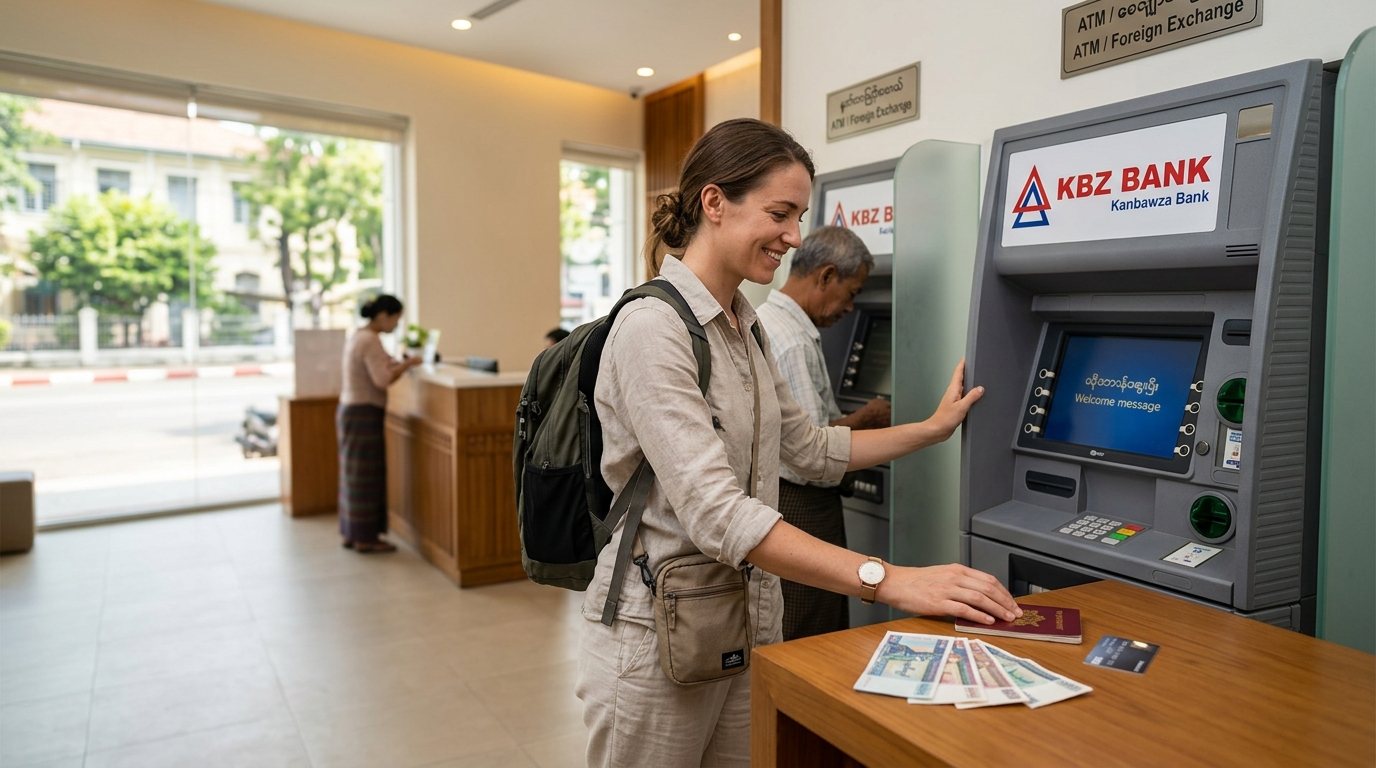
Planning a trip to Myanmar means getting ready for a unique money experience. This isn’t a country where you can rely solely on credit cards or mobile payments. Cash still dominates daily life, and understanding how to handle Myanmar currency and money will make your journey far smoother.
Myanmar operates primarily on cash, using the kyat for most transactions and US dollars for major expenses like hotels and tours. ATMs are widely available in cities but scarce in rural areas. Bring crisp, unmarked US bills for exchange, use licensed money changers for better rates, and always carry enough kyat for daily purchases. Credit cards work in limited upscale locations only.
Understanding the Myanmar kyat
The official currency of Myanmar is the kyat, abbreviated as MMK or simply K. You’ll see prices written as K5,000 or 5,000 kyat throughout the country.
Banknotes come in denominations of K50, K100, K200, K500, K1,000, K5,000, and K10,000. Coins exist but rarely circulate in practice. Most vendors will hand you small bills or candy as change rather than coins.
The kyat fluctuates against major currencies. Exchange rates have varied significantly over the past decade due to economic and political changes. Check current rates before your trip and monitor them during your stay.
You cannot obtain kyat outside Myanmar. Don’t waste time searching for it at your home bank or airport. You’ll need to exchange money once you arrive.
The role of US dollars in Myanmar
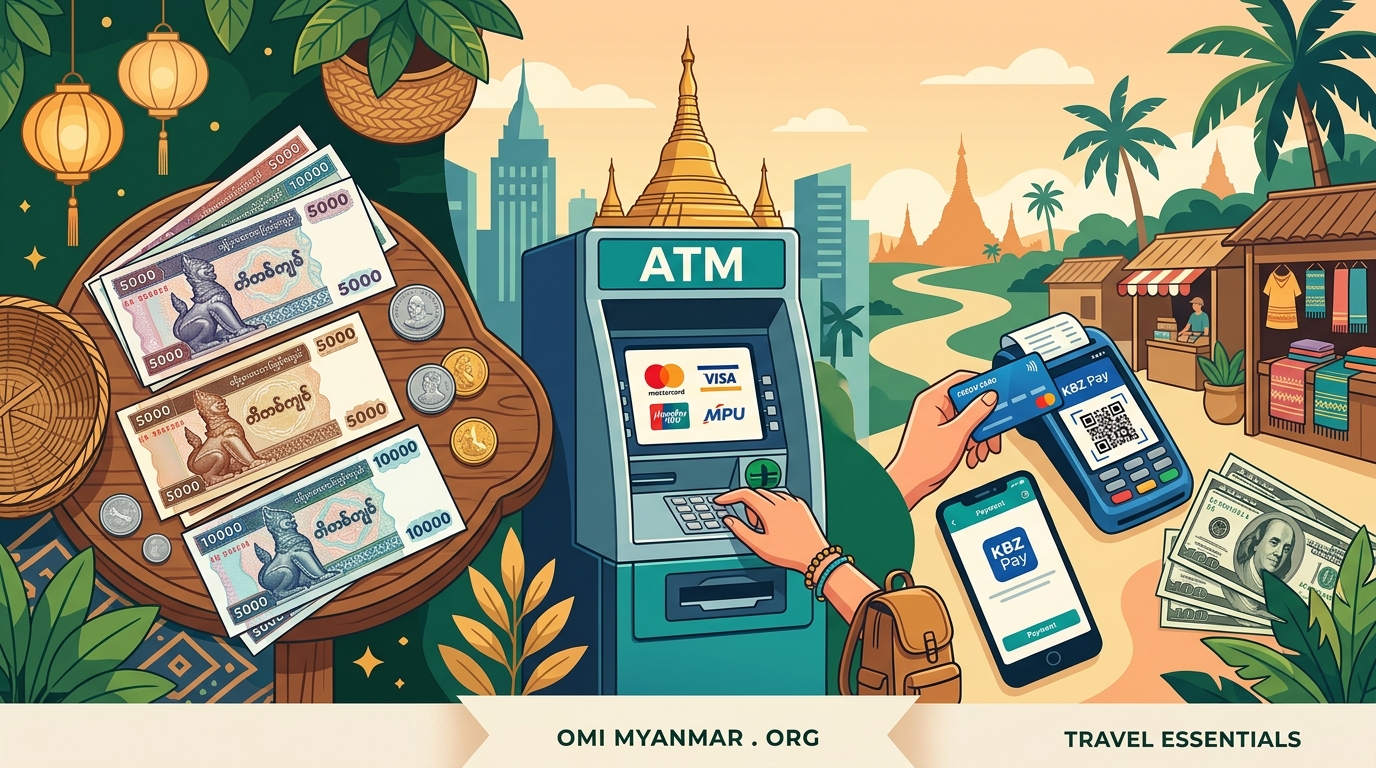
US dollars function as a second currency in Myanmar, particularly for tourist services. Hotels, domestic flights, tour operators, and entrance fees to major attractions often quote prices in USD.
This dual currency system means you’ll need both kyat and dollars during your trip. Keep them organized in separate compartments to avoid confusion.
Not all dollars are created equal in Myanmar. The condition of your bills matters enormously. Currency changers and many businesses will reject bills that are:
- Torn or taped
- Heavily creased or wrinkled
- Marked with ink or stamps
- Printed before 2006
- From the CB series (considered counterfeit prone)
Bring only crisp, clean bills in larger denominations. $100 bills typically get better exchange rates than smaller denominations. $50 and $20 bills work well for mid-range transactions.
Where and how to exchange money
You have several options for exchanging foreign currency to kyat.
Licensed money changers offer the best rates and are found throughout cities. Look for shops with official exchange licenses displayed. Rates are usually posted on boards outside. These changers count money carefully in front of you and provide receipts.
Banks provide legitimate exchange services but often have longer wait times and slightly lower rates than private changers. They’re a good backup option if you prefer institutional security.
Hotels will exchange money for guests but typically offer the worst rates. Use this option only for small amounts in emergencies.
Airports have exchange counters that are convenient but offer below-average rates. Exchange just enough to cover immediate expenses like transportation to your hotel.
Always count your money carefully before leaving the exchange counter. Mistakes happen, and it’s easier to resolve discrepancies immediately than to return later.
Step by step currency exchange process
- Research current exchange rates online before visiting a changer
- Choose a licensed money changer with posted rates
- Present your passport and foreign currency
- Confirm the rate and total kyat you’ll receive
- Watch as they count both currencies in front of you
- Recount your kyat before leaving the counter
- Keep your receipt for your records
ATM availability and usage
ATMs have become widespread in Myanmar’s cities and tourist areas. You’ll find them at banks, shopping centers, and major hotels. Rural areas and remote destinations have limited or no ATM access.
Most ATMs accept international Visa and Mastercard debit cards. Some accept Maestro, Cirrus, and UnionPay. Check with your bank before traveling to confirm your card will work.
Withdrawal limits typically range from K300,000 to K500,000 per transaction. Some machines allow multiple transactions, but daily limits apply. Fees vary by bank but expect K5,000 to K6,500 per withdrawal plus your home bank’s international fees.
Popular ATM networks include:
- CB Bank
- KBZ Bank
- AYA Bank
- Yoma Bank
- AGD Bank
These banks have the most reliable machines and widest networks. CB Bank and KBZ Bank ATMs are particularly common in tourist areas.
Plan your ATM visits strategically. Withdraw larger amounts in cities before heading to rural areas. Machines sometimes run out of cash, especially on weekends and holidays. Have a backup plan if your first choice ATM is empty or offline.
Credit and debit card acceptance
Credit card acceptance remains limited in Myanmar. Don’t count on using cards for most purchases.
Where cards might work:
- International hotel chains and upscale boutique hotels
- High-end restaurants in Yangon and Mandalay
- Some tour operators and travel agencies
- Larger jewelry and handicraft shops
- International airline offices
Where cards definitely won’t work:
- Street food vendors and local restaurants
- Markets and small shops
- Taxis and local transportation
- Guesthouses and budget hotels
- Entrance fees to most attractions
- Domestic transportation tickets
Even establishments that claim to accept cards may have non-functioning terminals or prefer cash. Always ask about card acceptance before ordering or booking, and have cash ready as backup.
Card transactions in Myanmar often incur fees of 2% to 4% added to your bill. Factor this into your budget planning.
Digital payments and mobile wallets
Mobile payment platforms have grown in Myanmar but remain primarily used by locals for domestic transactions. International travelers will find limited utility in these systems.
Popular local platforms include Wave Money, KBZ Pay, and CB Pay. Setting up accounts typically requires a Myanmar phone number and local bank account, making them impractical for short-term visitors.
Some modern cafes and restaurants in Yangon accept mobile payments, but cash remains king even in the capital. Don’t rely on digital payment options during your trip.
Daily costs and budget planning
Understanding typical expenses helps you plan how much money to carry.
| Expense Category | Budget Range | Mid-Range | Upscale |
|---|---|---|---|
| Accommodation | K15,000 to K30,000 | K40,000 to K80,000 | K100,000+ |
| Meals per day | K8,000 to K15,000 | K20,000 to K40,000 | K50,000+ |
| Local transport | K3,000 to K8,000 | K10,000 to K20,000 | K30,000+ |
| Attractions | K5,000 to K15,000 | K15,000 to K30,000 | K40,000+ |
These figures reflect typical daily spending for one person. Budget travelers can manage on K30,000 to K50,000 per day. Mid-range travelers should plan for K70,000 to K150,000 daily. Upscale travel easily exceeds K200,000 per day.
Major expenses like hotels, tours, and domestic flights are often priced in dollars. A typical mid-range hotel might cost $40 to $80 per night. Domestic flights range from $50 to $150 depending on the route.
Practical money safety tips
Carrying cash requires vigilance. Follow these safety practices:
- Split your money between multiple locations on your body and in your luggage
- Use a money belt or hidden pouch for large amounts
- Keep daily spending money separate from your main stash
- Photocopy your credit cards and keep copies separate from the originals
- Note your bank’s international contact numbers before traveling
- Inform your bank of your travel dates to prevent card blocks
Petty theft exists but violent crime targeting tourists is rare. Stay alert in crowded markets and on public transportation. Avoid displaying large amounts of cash in public.
Hotel safes provide reasonable security for excess cash and documents. Use them when available, but photograph valuable items before storing them.
Common money mistakes to avoid
Learning from others’ errors saves frustration:
Bringing damaged or old bills: Currency changers will reject them outright. Inspect all your US dollars before leaving home.
Relying solely on cards: You’ll find yourself unable to pay for most things. Bring sufficient cash for your entire trip.
Exchanging at hotels: You’ll lose 5% to 10% compared to licensed changers. Walk a few blocks to find better rates.
Ignoring small denominations: Breaking a K10,000 note for a K1,000 purchase frustrates vendors. Request smaller bills when exchanging.
Forgetting about ATM fees: Multiple small withdrawals cost more in fees than fewer large ones. Maximize each withdrawal within the limit.
Underestimating cash needs in rural areas: Remote destinations have no ATMs or money changers. Bring enough kyat before leaving cities.
Tipping customs and expectations
Tipping isn’t traditionally expected in Myanmar but has become more common in tourist areas.
Restaurants rarely include service charges. Leaving 5% to 10% for good service is appreciated but not required. Round up the bill or leave small notes for casual dining.
Hotel porters appreciate K1,000 to K2,000 per bag. Housekeeping staff might receive K2,000 to K5,000 for multi-night stays, left in the room on your final day.
Tour guides and drivers expect tips for good service. Budget K5,000 to K10,000 per person per day for guides, and K3,000 to K5,000 for drivers.
Taxi drivers don’t expect tips. Rounding up to the nearest K1,000 is a friendly gesture but not necessary.
Currency restrictions and regulations
Myanmar has specific rules about currency import and export.
You can bring unlimited foreign currency into Myanmar but must declare amounts exceeding $10,000. Failure to declare can result in confiscation.
You cannot export more kyat than K500,000. There’s little reason to try, as kyat has no value outside Myanmar and cannot be exchanged abroad.
Keep exchange receipts if you plan to reconvert kyat to dollars before departure. Licensed changers will buy back kyat, though rates are less favorable than initial exchanges.
Customs officials may ask to see your currency declaration form when departing. Keep it with your passport throughout your trip.
Connecting money management with broader travel planning
Handling Myanmar currency and money effectively connects to other aspects of your journey. Understanding local payment norms helps you budget for navigating Myanmar’s transportation network, where most tickets are purchased with cash. Similarly, when eating your way through Myanmar, you’ll find that street food vendors and local restaurants operate entirely in kyat.
The cash-based economy reflects broader patterns in Myanmar’s developing infrastructure. While connecting to Myanmar through SIM cards and internet access has become easier, digital payment systems lag behind neighboring countries.
Preparing your money strategy before departure
Success with Myanmar currency starts at home. Visit your bank two weeks before departure to order crisp, new US bills. Request a mix of $100, $50, and $20 denominations.
Notify your bank and credit card companies of your travel dates and destinations. This prevents security blocks on your accounts when transactions appear from Myanmar.
Download currency conversion apps on your phone. XE Currency and Currency Converter Plus work offline after initial setup, useful when internet access is limited.
Create a simple daily budget spreadsheet noting expected costs for accommodation, food, transport, and activities. Add 20% for unexpected expenses and souvenirs.
Pack a small calculator for exchange rate verification. While smartphones work, having a dedicated calculator avoids awkward moments when your phone battery dies.
Making money work for your Myanmar adventure
Getting comfortable with Myanmar currency and money transforms your travel experience from stressful to seamless. The country’s cash-based system might feel outdated compared to tap-and-go payments back home, but it connects you more directly to local life. You’ll negotiate with market vendors, count colorful banknotes, and master the art of always having correct change.
Start preparing your currency strategy now. Order those pristine dollar bills, research current exchange rates, and plan your ATM stops around your itinerary. With proper preparation, money management becomes second nature, freeing you to focus on the incredible experiences waiting in Myanmar.