
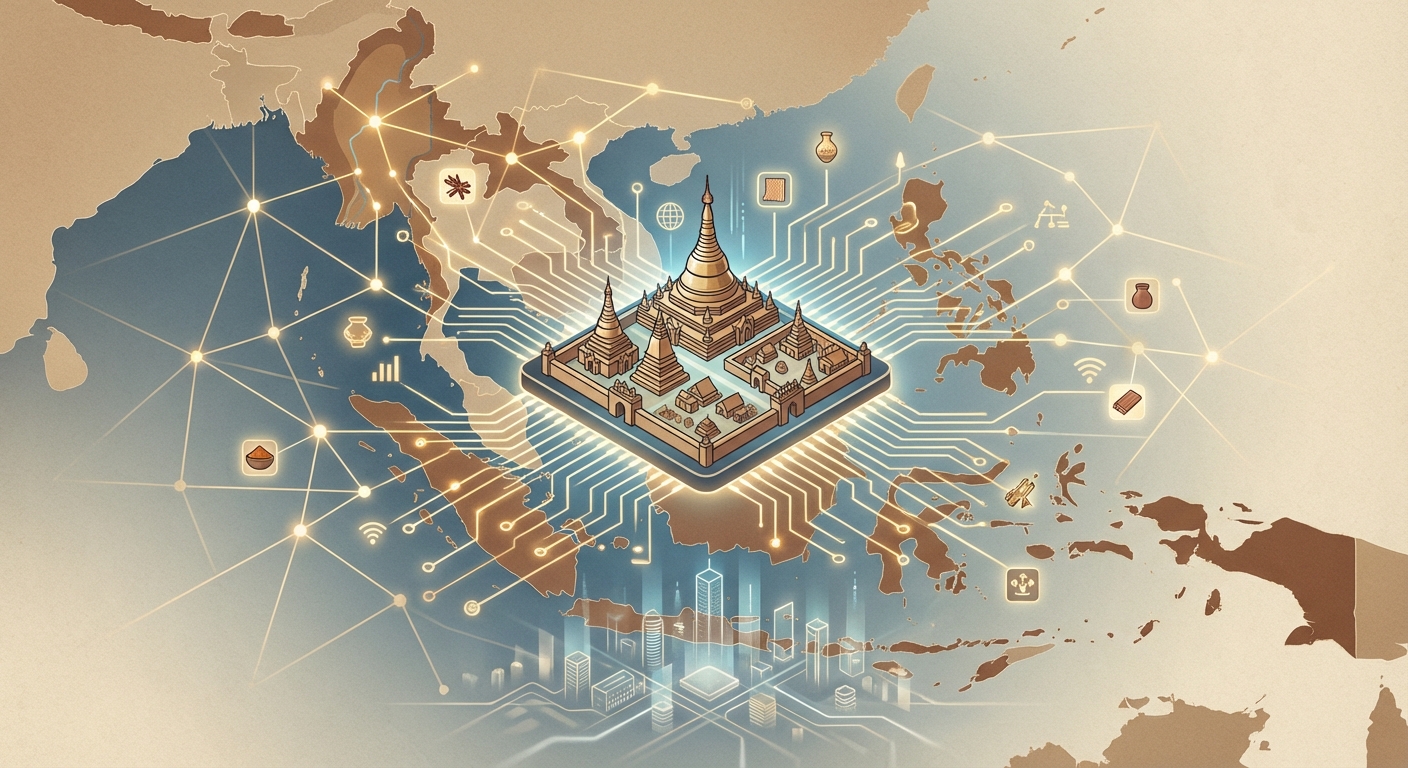
Between the 1st and 9th centuries CE, a network of walled cities stretched across central Myanmar’s Irrawaddy River valley. These weren’t just settlements. They were commercial hubs that controlled some of the most valuable trade routes in Asia. The Pyu city-states turned geography into wealth, connecting Chinese silk merchants with Indian traders in ways that transformed Southeast Asian history.
The Pyu city-states trade routes linked China and India through Myanmar’s river valleys from the 1st to 9th centuries CE. These urban centers controlled overland and riverine commerce, exchanging silk, spices, precious metals, and Buddhist texts. Their strategic position created Southeast Asia’s first major trading civilization, influencing regional culture, technology, and religious practices for centuries after their decline.
Geography Made the Pyu Trade Possible
The Pyu didn’t choose their locations randomly. They built cities where rivers met trade corridors. The Irrawaddy River became their commercial highway, flowing south from the Tibetan plateau through fertile plains to the Andaman Sea.
Sri Ksetra, their largest capital, sat at the northern edge of the Irrawaddy delta. This positioning gave merchants access to both river and ocean routes. Traders could move goods upstream to northern cities or downstream to coastal ports without switching transportation methods.
Beikthano and Halin occupied strategic points along northern tributaries. These cities intercepted overland caravans coming from Yunnan and Sichuan provinces in China. The terrain forced traders to follow specific mountain passes, and the Pyu controlled every major junction.
The monsoon climate created natural trade seasons. Merchants traveled during dry months from November to April. Pyu cities became seasonal marketplaces where goods accumulated before continuing their journeys. This rhythm shaped urban life and economic planning.
Three Major Routes Connected Continents
The Pyu managed three distinct trade corridors that made their cities indispensable to Asian commerce.
The Northern Overland Route
This path started in Xi’an, China’s ancient capital during the Han and Tang dynasties. Caravans crossed Yunnan province, navigating mountain passes before descending into Myanmar’s Chindwin River valley. Roman embassies used this route in 97 and 121 CE when traveling to China, as documented in Chinese historical records.
The journey took months. Traders needed safe stopping points with food, water, and protection. Pyu cities provided these services in exchange for taxes and trading opportunities. Local merchants bought Chinese silk, porcelain, and metalwork, then resold these goods to Indian traders heading west.
The Irrawaddy River Corridor
The Pyu offered an alternative to dangerous mountain crossings. Traders could reach the upper Irrawaddy and float goods downstream to Sri Ksetra. This river route cut travel time significantly and reduced the risk of bandit attacks.
River transport allowed bulk shipments. Heavy items like iron ingots, stone sculptures, and large ceramic vessels moved more efficiently by boat than pack animal. The Pyu developed specialized river craft and port facilities to handle this traffic.
At Sri Ksetra, goods transferred to ocean-going vessels. Ships sailed across the Bay of Bengal to Indian ports in Tamil Nadu and Andhra Pradesh. The maritime connection extended Pyu influence far beyond their river valley homeland.
The Southern Coastal Route
Smaller Pyu settlements dotted the coast near modern Yangon. These ports handled direct maritime trade with the Malay Peninsula, Sumatra, and Java. Traders bypassed the Irrawaddy entirely, moving goods along the Tenasserim coast.
This southern route specialized in forest products. Aromatic woods, resins, and animal products from Myanmar’s jungles reached Southeast Asian markets. The coastal Pyu acted as intermediaries between highland collectors and maritime merchants.
What Traveled These Ancient Highways
Trade goods tell us what different civilizations valued. The archaeological record from Pyu sites reveals surprising diversity.
From China came:
– Silk fabrics and thread
– Bronze mirrors and bells
– Lacquerware containers
– Tea and medicinal herbs
– Copper coins and metalwork
– Jade ornaments
From India arrived:
– Cotton textiles
– Glass beads in multiple colors
– Carnelian and agate stones
– Buddhist texts and religious art
– Iron tools and weapons
– Spices including black pepper
The Pyu exported:
– Rice and agricultural surplus
– Salt from inland deposits
– Timber including teak
– Precious metals from local mines
– Cowrie shells used as currency
– Trained elephants
The Pyu also produced their own trade goods. Archaeological excavations uncovered evidence of specialized workshops for bronze casting, pottery production, and bead making. These items carried distinct Pyu artistic styles that archaeologists recognize across Southeast Asia.
How Pyu Cities Organized Commerce
Running international trade required infrastructure and institutions. The Pyu developed sophisticated systems that kept goods and people moving.
-
Establish customs stations at city gates. Officials inspected incoming caravans, assessed taxes, and recorded transactions. These checkpoints prevented smuggling and generated government revenue.
-
Create standardized weights and measures. Merchants needed consistent systems to conduct fair exchanges. The Pyu adopted Indian measurement standards, making their markets accessible to foreign traders familiar with those systems.
-
Mint silver coins for local circulation. These may be Southeast Asia’s oldest coins. Standardized currency simplified transactions and reduced the need for barter. Coins also served as portable wealth for traveling merchants.
-
Build warehouses and market halls. Covered structures protected goods from monsoon rains. Designated market areas concentrated buyers and sellers, making trade more efficient. Some warehouses offered secure storage for merchants staying multiple days.
-
Maintain rest houses for travelers. Buddhist monasteries often provided accommodation. This hospitality attracted merchants and reinforced religious networks. Comfortable lodging encouraged traders to return regularly.
The Pyu legal system protected merchants. Inscriptions mention trade regulations and dispute resolution mechanisms. Foreign traders could seek justice if local partners cheated them. This legal framework built trust across cultural boundaries.
Buddhism Traveled With the Merchants
Religious ideas moved along trade routes just as effectively as physical goods. Buddhism reached the Pyu cities from India during the early centuries CE. Merchants and monks traveled together, sharing ships and caravans.
Buddhist monasteries became nodes in the trade network. Monks offered literacy, record keeping, and neutral ground for negotiations. Monasteries accumulated wealth through donations, then invested in commercial ventures. Some functioned as early banks, holding deposits and facilitating long-distance payments.
The Pyu adopted Theravada Buddhism, the same tradition practiced in Sri Lanka and southern India. This shared religion created cultural connections that smoothed commercial relationships. Merchants from Buddhist regions trusted Pyu trading partners who followed similar ethical codes.
Religious art moved both directions. Indian sculptors traveled to Pyu cities, creating stone Buddha images in Gupta and post-Gupta styles. Pyu artists learned these techniques and developed local variations. These artistic exchanges influenced later Burmese Buddhist art traditions that continue today, much like Myanmar’s endangered crafts preserve ancient techniques.
Pali language texts reached Myanmar through these trade connections. Pyu inscriptions mix Pali, Sanskrit, and the local Pyu language. This multilingual literacy enabled communication across the trading world. Educated Pyu could read religious texts from India and commercial documents from Chinese trading partners.
“The Pyu cities represent Southeast Asia’s first urban civilization built primarily on commerce rather than conquest. Their wealth came from facilitating exchange, not extracting tribute.” — Archaeological synthesis from multiple Pyu site excavations
Technology Transfer Changed Daily Life
Trade routes carried more than luxury goods. Practical technologies spread between civilizations, improving agriculture, craft production, and daily life.
Iron tools arrived from India with superior metallurgy. Pyu blacksmiths learned these techniques and established local iron industries. Better plows and axes increased agricultural productivity. Surplus food supported larger urban populations and specialized craftspeople.
Irrigation technology transformed Pyu agriculture. Indian and Sri Lankan engineers understood monsoon water management. They designed reservoir systems and canal networks that stored seasonal rainfall. These irrigation works supported multiple rice crops annually, creating the agricultural surplus that funded urban life.
The Pyu adopted Indian architectural techniques for brick construction. Earlier Southeast Asian buildings used wood and bamboo, which deteriorated quickly. Brick structures lasted centuries. Massive city walls, religious monuments, and public buildings demonstrated Pyu wealth and engineering capability to visiting merchants.
Chinese metallurgy influenced Pyu bronze casting. Sophisticated alloy recipes and casting molds produced bells, gongs, and decorative items. Some Pyu bronze work shows technical features found in contemporary Chinese pieces, suggesting direct knowledge transfer.
Writing systems traveled these routes. The Pyu script derives from southern Indian Brahmi alphabets used in the early centuries CE. Literacy enabled record keeping, legal documents, and religious texts. Written contracts made complex commercial arrangements possible across language barriers.
Comparing Trade Advantages and Vulnerabilities
| Strategy | Benefits | Risks |
|---|---|---|
| River transport monopoly | Control bulk goods movement; collect consistent taxes | Vulnerable to upstream rivals; dependent on seasonal water levels |
| Multiple trade routes | Diverse revenue streams; protection if one route closes | Requires defending several corridors; spreads resources thin |
| Buddhist monastery network | Cultural connections; trust building; literacy centers | Religious conflicts could disrupt trade; monastery wealth attracted raiders |
| Local coin production | Simplified transactions; demonstrated sovereignty | Required precious metal supplies; counterfeiting problems |
| Specialized craft workshops | Value-added exports; employment for urban population | Competition from cheaper foreign goods; skill loss if craftspeople emigrate |
| Seasonal market system | Concentrated commercial activity; efficient use of resources | Long idle periods; difficulty maintaining year-round services |
Why the Trade Routes Eventually Shifted
The Pyu trading system dominated for eight centuries. But nothing lasts forever. Multiple factors ended Pyu commercial dominance.
The Nanzhao kingdom in Yunnan grew powerful during the 8th and 9th centuries. These mountain warriors controlled the northern passes that Chinese caravans used. Nanzhao raids disrupted trade and eventually attacked Pyu cities directly. Historical records mention a devastating raid around 832 CE that destroyed Halin.
Maritime routes became more attractive. Improved ship construction made ocean voyages safer and faster. Merchants could sail directly from China to India, bypassing overland routes entirely. The Pyu river corridor lost its competitive advantage.
Political fragmentation weakened the Pyu. No single authority controlled all the major cities. Competition between Pyu states created instability that discouraged merchants. Traders sought more predictable environments for their valuable cargo.
Environmental changes may have played a role. Some archaeological evidence suggests irrigation systems failed or rivers shifted course. Agricultural decline would have reduced the food surplus needed to support urban trading centers.
The Pagan kingdom emerged in the 9th century, absorbing Pyu territories and populations. Pagan rulers inherited Pyu trade networks but reorganized them around their new capital. The Pyu cities declined as commercial activity concentrated elsewhere. This transformation mirrors how trade corridors and logistics continue evolving in modern Myanmar.
Archaeological Evidence Reveals Daily Trade
Excavations at Pyu sites uncovered thousands of trade-related artifacts. These physical remains show how commerce actually functioned.
Beads appear in enormous quantities. Glass beads from India, stone beads from local workshops, and occasional precious stone beads from distant sources. Beads served as portable wealth, personal adornment, and possibly currency for small transactions. Their abundance indicates active bead trading and local production.
Pottery sherds reveal trade connections. Chinese stoneware appears alongside Indian fine wares and local Pyu ceramics. Chemical analysis of clay sources traces pottery origins. This evidence maps trade networks with precision impossible from historical texts alone.
Coins and coin molds prove local minting operations. Silver coins show weight standardization and consistent designs. Some coins display symbols suggesting official government production. Others appear more irregular, possibly private merchant issues.
Metal slag and furnace remains mark industrial areas. Bronze casting, iron smelting, and silver refining left distinctive archaeological signatures. These workshops clustered near city gates and river ports, positioning craftspeople close to raw material arrivals and finished product shipments.
Organic residues in storage jars reveal agricultural trade. Chemical analysis identifies oils, resins, and food products. These perishable goods rarely survive archaeologically, but traces remain in container walls. The evidence confirms that bulk agricultural products moved through Pyu cities alongside luxury items.
Lessons for Understanding Ancient Trade Networks
The Pyu experience teaches us how early civilizations built commercial systems without modern technology.
Geography matters, but not deterministically. The Pyu occupied favorable terrain, but they actively developed that advantage through infrastructure investment. Rivers don’t automatically become trade routes. Someone must build ports, maintain navigation channels, and establish security.
Trust mechanisms enable long-distance trade. Merchants won’t travel months to reach markets where they might be cheated. The Pyu built trust through legal systems, religious networks, and consistent treatment of foreign traders. Reputation became their most valuable asset.
Diversification provides resilience. The Pyu managed multiple trade routes and dealt in various goods categories. When one route faced problems, others continued functioning. This flexibility sustained their economy through temporary disruptions.
Intermediary positions create wealth. The Pyu didn’t produce silk or many spices. Their value came from connecting producers and consumers. This middleman role generated profits without requiring natural resource endowments.
Cultural exchange accompanies commerce. Trade routes carry ideas, technologies, and religious practices alongside physical goods. The Pyu absorbed influences from India and China, then synthesized these into distinctive local forms. This cultural creativity outlasted their commercial dominance.
Modern Myanmar continues navigating similar challenges around trade, connectivity, and cultural exchange, as seen in discussions about Myanmar’s middle class growing despite economic uncertainty.
Where to See Pyu Trade Legacy Today
Three Pyu cities received UNESCO World Heritage designation in 2014. These sites preserve evidence of ancient trade networks.
Sri Ksetra (near Pyay): The most extensively excavated Pyu city. Visitors see massive brick city walls, palace foundations, and Buddhist monuments. The site museum displays trade goods, coins, and artifacts recovered from excavations. The scale of infrastructure demonstrates wealth generated by commerce.
Beikthano (Taungdwingyi District): The oldest confirmed Pyu settlement. Excavations revealed early iron working and agricultural systems. The site shows how Pyu cities developed before reaching commercial peak. Less tourist infrastructure makes this site better for serious researchers.
Halin (near Shwebo): Northern trading hub that controlled routes to China. Extensive brick fortifications remain visible. The site suffered from the 832 CE Nanzhao raid, providing archaeological evidence of trade route conflicts. Local museum interprets the city’s role in regional trade networks.
The National Museum in Yangon houses the finest Pyu artifacts. Collections include coins, religious art, trade goods, and inscriptions. Exhibits explain Pyu civilization’s development and eventual decline. English labels help international visitors understand this crucial period.
Archaeological research continues. New excavations regularly discover additional evidence about Pyu trade practices. Scholars debate interpretations and refine understanding. Anyone interested in ancient commerce should follow current Pyu research publications.
How Ancient Trade Routes Echo in Modern Myanmar
The Pyu demonstrated that Myanmar’s geography creates natural advantages for regional trade. That geographic reality hasn’t changed. The Irrawaddy still flows from China toward the Indian Ocean. Mountain passes still channel overland traffic through specific corridors.
Modern Myanmar faces similar opportunities and challenges. The country sits between Asia’s two largest economies, India and China. Both neighbors want access to Myanmar’s ports, resources, and markets. This positioning creates potential wealth, just as it did for the Pyu.
Infrastructure remains crucial. Ancient brick roads and river ports served the same function as modern highways and container terminals. Investment in connectivity determines whether geographic potential becomes economic reality. The Pyu understood this. They built the infrastructure their era required.
Cultural exchange continues alongside commerce. Buddhism still connects Myanmar to broader Asian networks. Trade brings foreign influences that Myanmar absorbs and adapts. This process of cultural synthesis that began in Pyu times continues shaping Myanmar identity.
The Pyu city-states proved that small polities can prosper through smart positioning and service provision. They didn’t conquer empires or control vast territories. They facilitated exchange and made themselves indispensable to larger neighbors. That strategy remains relevant for understanding Myanmar’s place in regional dynamics.
The Rivers Still Remember
Stand on the banks of the Irrawaddy near Pyay and you’re looking at the same waters that carried Chinese silk and Indian spices 1,500 years ago. The current flows at the same pace. The monsoons arrive on the same schedule. The river remembers what human memory has forgotten.
The Pyu city-states trade routes weren’t just commercial pathways. They were the circulatory system of early Southeast Asian civilization. Goods, ideas, technologies, and beliefs flowed through these networks, nourishing cultures across half a continent. The Pyu positioned themselves at the heart of this system and built something remarkable.
Their cities crumbled. Their language disappeared. But their achievement endures in the cultural DNA of modern Myanmar. Every time merchants negotiate deals in Yangon markets, every time goods move up the Irrawaddy, every time Myanmar connects its neighbors, the Pyu legacy lives on. They showed how geography, commerce, and culture combine to create prosperity. That lesson remains as relevant today as it was a millennium ago.