
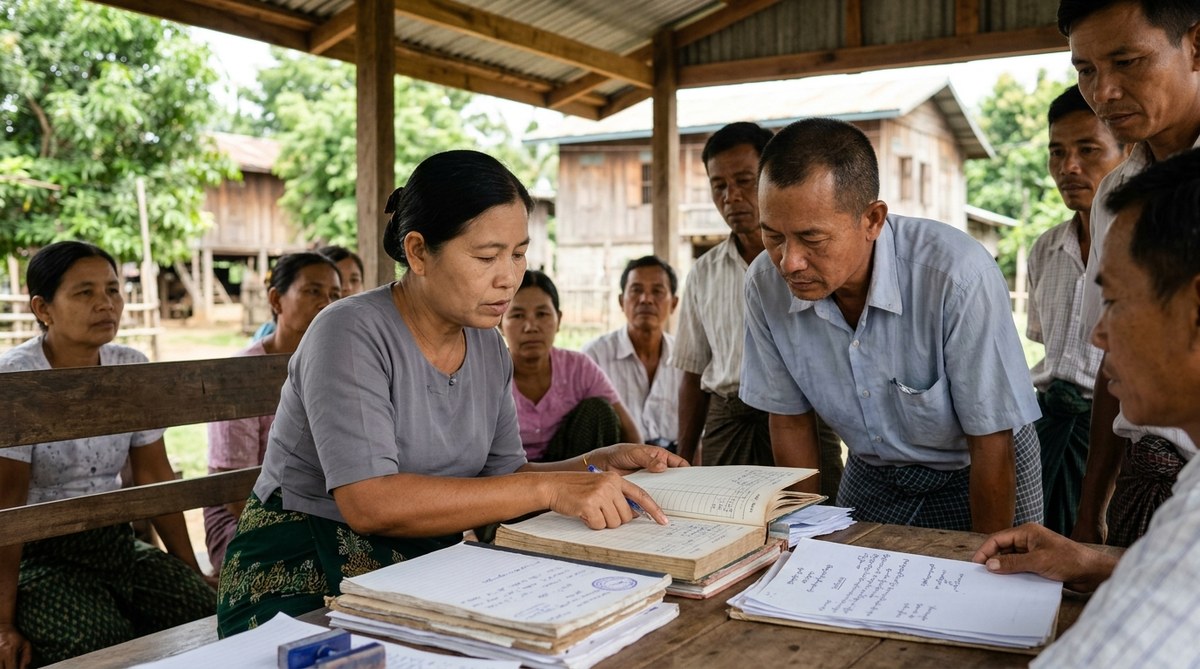
Imagine a small village in the dry zone of Myanmar. The local school needs new roofs before the monsoon. The health clinic has run out of basic medicines. The community pool funds for a new irrigation canal, but the canal never gets built. For years, this story has repeated across the country. Money allocated for public goods seems to vanish. The culprit is not always a natural disaster. Often, it is a quiet, systematic leakage of public funds. These leaks happen at the village level, where oversight is weakest and the impact on daily life is greatest. The good news is that a new wave of citizen-led audits is finally shining a light on these hidden flows.
Village-level audits are transforming how communities in Myanmar track public spending. By comparing official budgets with actual receipts, local volunteers are documenting fund leakages that range from ghost workers to inflated construction contracts. These audits empower villagers to demand accountability from local administrators and create a public record that journalists and researchers can use to push for systemic reform.
How Village Audits Uncover the Invisible Leaks
Public fund leakages in Myanmar are not always dramatic heists. More often, they are small, repeated diversions. A village administrator inflates the cost of a bag of cement. A township officer pays a salary to a “worker” who does not exist. A contractor builds a road that is half the specified width. These acts are hard to catch from a desk in Yangon. They require someone on the ground, checking receipts and measuring outputs.
Village-level audits work because they are local. Trained volunteers, often teachers, retired civil servants, or members of civil society organizations, sit down with the official budget documents for their village tract. They then visit the actual project sites. They talk to the people who were supposed to benefit. They collect copies of payment vouchers and compare them to the work done.
The process is straightforward but powerful. Here is the typical workflow that audit teams follow:
- Gather the baseline documents. The team requests the official annual budget and project list from the village administrator. This includes the amount allocated for each project, the name of the contractor, and the expected completion date.
- Conduct a physical verification. The team visits each project site. They measure the length of a road, count the number of desks in a classroom, or check the wattage of a streetlight. They take photographs and record GPS coordinates.
- Cross-check with receipts. The team collects copies of all payment vouchers, delivery orders, and payroll sheets. They look for discrepancies between what was paid for and what was actually delivered.
- Hold a public hearing. The findings are presented at a community meeting. The village administrator is invited to respond. The discussion is documented and shared with the township-level authorities and the local media.
This method has revealed some startling patterns. In one township in Sagaing Region, an audit found that a school construction project had been paid for in full, but the building had only three walls. The fourth wall had been “budgeted” but never built. The money had been pocketed by a subcontractor. In another case, a village health center was supposed to receive a monthly supply of medicine. The audit team discovered that the delivery receipts were signed, but the medicine never arrived. The signature belonged to a staff member who had been transferred six months earlier.
Common Techniques for Hiding Fund Leakages
The people diverting public funds use a set of predictable techniques. Knowing these patterns helps audit teams know what to look for. The table below outlines the most common methods and the specific audit steps that expose them.
| Common Leakage Technique | How the Audit Exposes It |
|---|---|
| Ghost workers (salaries paid to non-existent employees) | Cross-check payroll lists with actual staff attendance. Interview neighbors to confirm if the person lives in the village. |
| Inflated material costs (overcharging for cement, timber, or steel) | Collect market price quotes from three different suppliers in the nearest town. Compare with the price paid. |
| Short-weighting (delivering less material than paid for) | Physically count bags of cement or measure piles of sand at the project site. Compare against the delivery order. |
| Phantom projects (budgeting for work that was never done) | Visit every project site on the list. Take a dated photograph. If there is no sign of work, flag it. |
| Double billing (submitting the same invoice to two different budget lines) | Cross-reference all invoices against the project list. Look for duplicate invoice numbers or dates. |
These techniques are not complex. They rely on the assumption that no one will check. Village audits break that assumption.
What the Data Tells Us About Scale
The numbers coming out of these audits are sobering. In 2025, a coalition of local transparency groups published a consolidated report based on audits from over 200 village tracts across six regions. They found that, on average, between 15% and 25% of the allocated funds for local infrastructure projects could not be accounted for. In some cases, the figure reached 40%.
The most common leakages were in road construction and school repairs. These are high-value projects with multiple layers of subcontractors, which makes tracking difficult. But audits also found significant losses in smaller line items, such as festival subsidies and stipends for monastic schools. No budget line is too small to be raided.
One of the most powerful findings was the link between fund leakages and the quality of local governance. Villages with active civil society groups and regular public meetings had significantly lower leakage rates. This suggests that the mere presence of an engaged community acts as a deterrent. As one auditor from Mandalay Region put it:
“The administrators know that someone is watching. They may not stop stealing entirely, but they become more careful. They start to think twice before inflating a receipt. That is the first step toward accountability.”
Building a Movement for Transparency
Village audits are not a one-time project. They are part of a broader movement to strengthen local governance in Myanmar. The data generated by these audits feeds into larger advocacy campaigns. Researchers use it to identify systemic weaknesses in the public financial management system. Journalists use it to write stories that name specific officials and highlight specific failures. International watchdogs use it to assess the effectiveness of governance reforms.
For example, the findings from village audits have directly informed the work of groups tracking how international watchdogs are monitoring Myanmar’s governance reforms in 2026. The evidence of leakage at the village level provides a concrete benchmark for whether reforms at the national level are actually changing behavior on the ground.
The audits also complement broader efforts to open up government data. When citizens have access to budget information, they can do more than just complain. They can verify. This is the core idea behind how open data platforms are revolutionizing transparency in Myanmar’s local governments. Village audits are the human side of that data equation. They turn numbers on a spreadsheet into real-world accountability.
Practical Steps for Researchers and Activists
If you are a researcher, journalist, or activist looking to support or replicate this work, here are some actionable starting points.
- Build trust before you audit. Village administrators are often suspicious of outsiders. Spend time meeting with community leaders, explaining the purpose of the audit, and guaranteeing that the findings will be used to improve services, not to punish individuals.
- Train local volunteers. The best auditors are people who already live in the community. They know who the contractors are. They know which roads are supposed to be paved. Invest in training them on basic financial literacy, document collection, and public speaking.
- Use simple technology. A smartphone with a camera and a basic spreadsheet app is enough. Complicated software can create a barrier. Focus on getting clean, verifiable data that can be shared as a PDF or printed report.
- Partner with local media. A dry audit report has limited impact. A news story about a missing school roof reaches a much wider audience. Build relationships with local journalists who can translate the technical findings into human interest stories.
- Create a public database. Compile the findings from multiple audits into a searchable format. This allows other researchers to spot patterns across regions and over time. It also makes it harder for officials to dismiss isolated findings as anomalies.
A Path Forward for Civic Engagement
Village-level audits are not a cure-all. They require time, training, and a degree of political space that is not always available. But they represent one of the most practical tools available for addressing Myanmar village fund leakages. They shift the focus from abstract national-level corruption to specific, verifiable losses that affect real people.
The work is hard, but the rewards are tangible. A village that reclaims 20% of its lost education budget can repair a school. A village that exposes a ghost worker can redirect that salary to a real nurse. Each audit is a small act of citizenship that rebuilds the social contract between the state and the people.
For those who want to see this approach grow, the next step is to support the local organizations that are already doing this work. Read their reports. Share their findings. And if you have the skills, offer to help them build better databases or train more volunteers. The fight against fund leakages in Myanmar is a long one, but it is being won one village audit at a time.