
Myanmar once stood as a rare example of democratic progress in Southeast Asia. Between 2011 and 2021, the country moved from military rule toward civilian governance, introducing legal frameworks that promised transparency and public access to government information. Then the February 2021 military coup reversed nearly everything.
Myanmar freedom of information laws emerged during democratic reforms but have been systematically dismantled since the 2021 coup. The 2016 Right to Information Law promised transparency but was never fully implemented. Today, the military junta enforces censorship, criminalizes information access, and prosecutes journalists and researchers under amended laws that prioritize state security over public accountability and transparency.
The Promise of Transparency Before 2021
Myanmar’s journey toward information freedom began during the quasi-civilian government period starting in 2011. President Thein Sein’s administration initiated reforms that included loosening media restrictions and allowing independent newspapers to publish for the first time in decades.
The most significant milestone arrived in 2016 with the Right to Information Law. This legislation, passed under the National League for Democracy government led by Aung San Suu Kyi, established a legal framework for citizens to request government documents and data.
The law outlined specific procedures. Citizens could submit written requests to government departments. Officials had 14 days to respond, with possible extensions to 30 days for complex requests. Agencies could charge reasonable fees for document reproduction.
But implementation remained patchy. Many government departments lacked the infrastructure, training, or political will to comply. Civil servants accustomed to decades of secrecy struggled to embrace transparency. Bureaucratic resistance meant that even straightforward requests often went unanswered.
“The law existed on paper, but the culture of transparency never took root in Myanmar’s government institutions. Officials saw information as power to be guarded, not a public resource to be shared.”
Still, the period between 2016 and 2021 represented genuine progress. Journalists could report more freely. Civil society organizations accessed some government data. Researchers could request documents for academic purposes. The trajectory pointed toward greater openness, even if the pace frustrated advocates.
What the 2016 Law Actually Covered
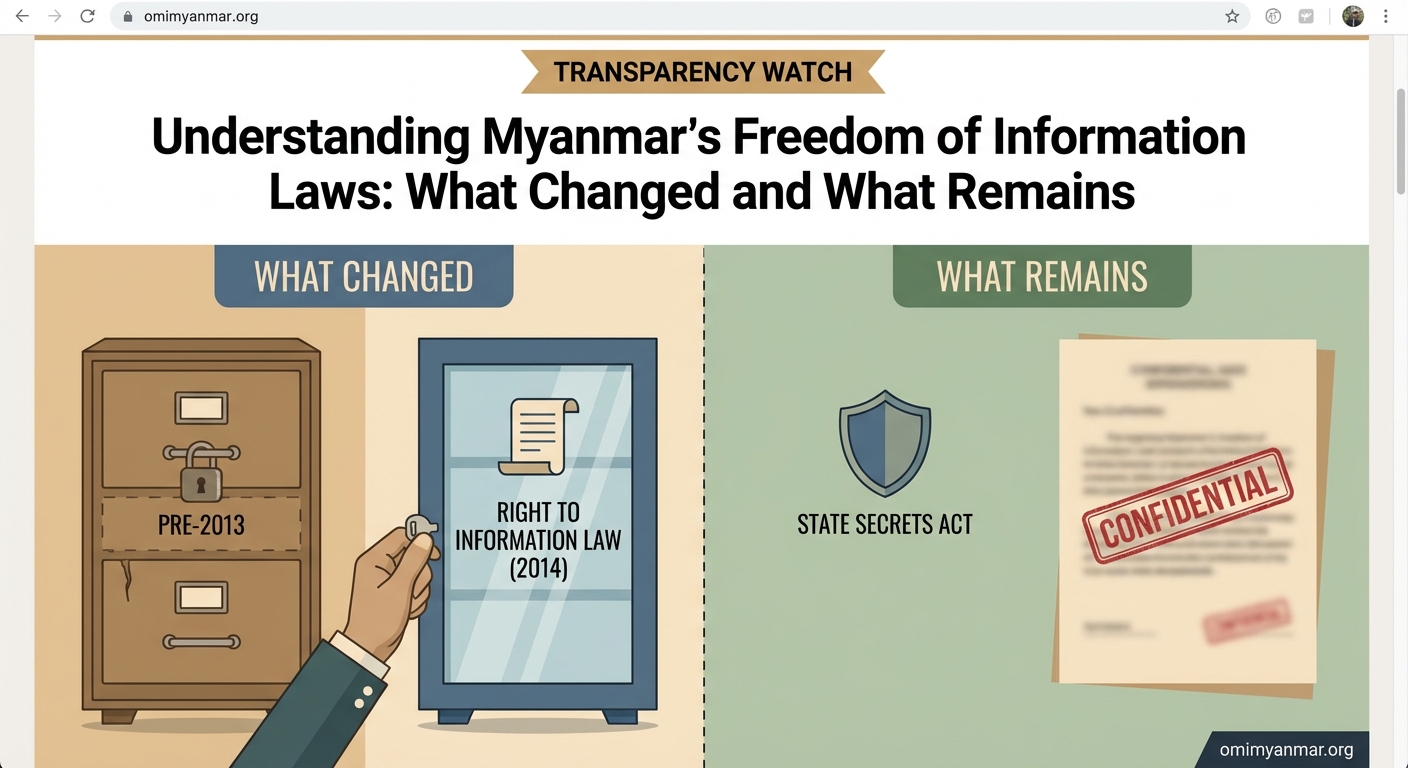
Understanding Myanmar freedom of information laws requires examining what the 2016 legislation promised. The law applied to all government departments, state-owned enterprises, and organizations receiving public funding.
Citizens could request information about:
- Government policies and decision-making processes
- Public spending and budget allocations
- Environmental impact assessments
- Land use and natural resource management
- Public health data and statistics
- Educational policies and outcomes
The law included exemptions for national security, international relations, cabinet deliberations, and personal privacy. These exemptions, while standard in many countries, created loopholes that officials sometimes exploited to deny legitimate requests.
The legislation established an Information Commission to handle appeals when agencies denied requests. This independent body could review decisions and order disclosure. In practice, the commission received limited funding and struggled to enforce its rulings.
| Provision | Intent | Reality Before 2021 |
|---|---|---|
| 14-day response time | Ensure timely access | Often ignored or extended indefinitely |
| Reasonable fees | Prevent cost barriers | Some agencies charged prohibitive amounts |
| Information Commission appeals | Provide oversight | Limited enforcement power and resources |
| Proactive disclosure | Publish data without requests | Minimal compliance across departments |
The law also required proactive disclosure, meaning agencies should publish certain information automatically without waiting for requests. Few departments complied consistently. Government websites remained sparse, outdated, or inaccessible.
The February 2021 Turning Point
The military coup on February 1, 2021 shattered Myanmar’s fragile democratic progress. The Tatmadaw (Myanmar’s armed forces) detained civilian leaders, declared a state of emergency, and established the State Administration Council to govern the country.
Information access collapsed almost immediately. The junta shut down independent media outlets. Journalists faced arrest. Internet access was restricted, with social media platforms blocked and mobile data services cut in many areas.
The military regime began systematically amending laws to criminalize dissent and control information. The Electronic Transactions Law, originally passed in 2004, was amended to punish online criticism of the military government. Penalties increased to three years imprisonment.
The Telecommunications Law received similar treatment. New provisions allowed authorities to order internet shutdowns and compel telecommunications companies to hand over user data without court oversight. Companies that refused faced license revocation.
The Counter-Terrorism Law was weaponized against journalists, activists, and ordinary citizens. Simply sharing information deemed unfavorable to the junta could result in terrorism charges carrying lengthy prison sentences.
By mid-2021, Myanmar ranked among the world’s worst countries for press freedom and information access. The trajectory established between 2011 and 2021 had completely reversed.
How Information Control Works Under Military Rule
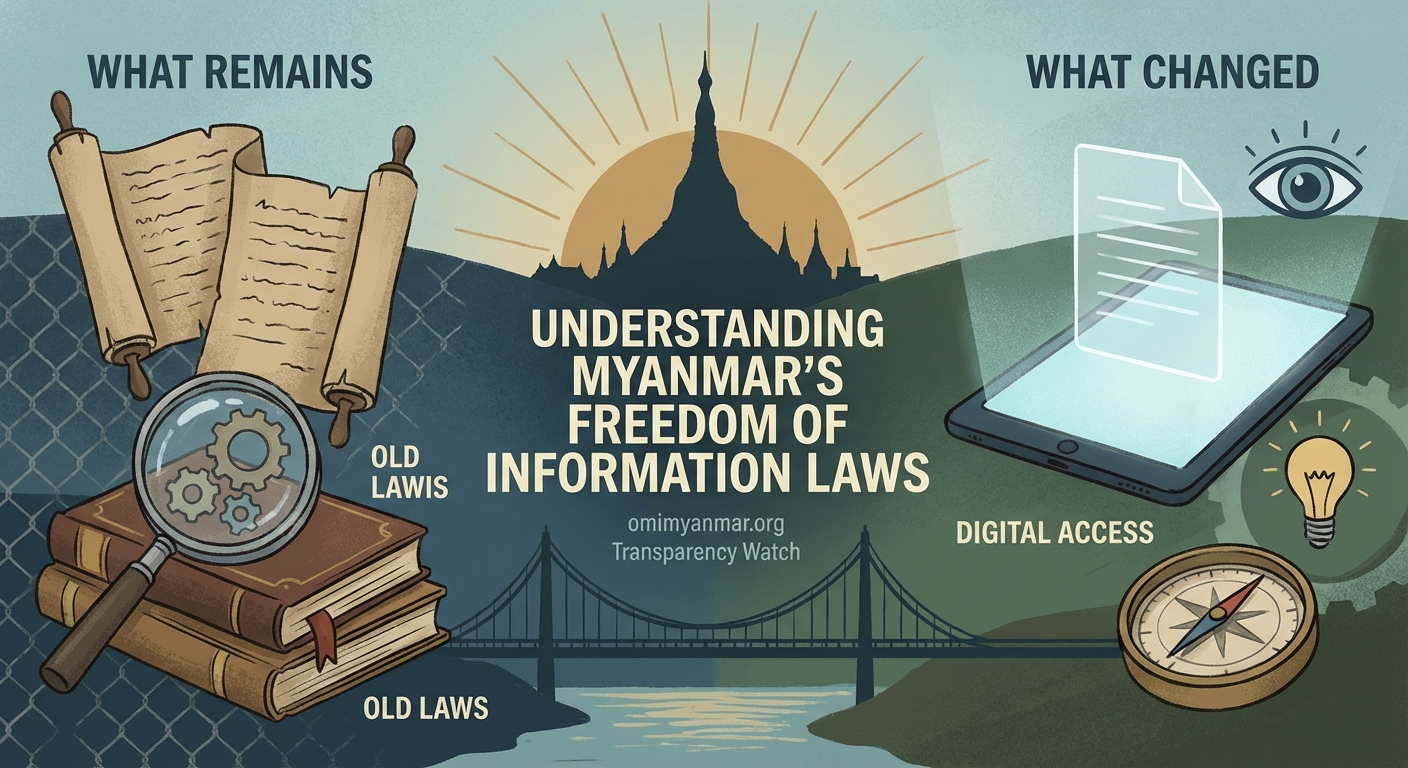
The junta employs multiple tactics to restrict information access and punish those seeking transparency. Understanding these mechanisms helps researchers and journalists navigate the current environment.
-
Internet censorship and shutdowns: The military blocks websites, restricts social media access, and implements complete internet blackouts in conflict areas. Virtual private networks (VPNs) are technically illegal, though many citizens use them anyway.
-
Mandatory SIM registration: New rules require citizens to register mobile phone numbers with biometric data. This enables surveillance and helps authorities track who accesses certain information online.
-
Surveillance technology: The junta has acquired digital monitoring tools to intercept communications, track device locations, and identify dissidents. Telecom infrastructure now includes government-mandated surveillance equipment.
-
Legal prosecution: Journalists, researchers, and activists face charges under amended laws. Possession of certain documents can result in prosecution. Even routine information requests may trigger investigation.
-
Physical intimidation: Security forces conduct raids, seize devices, and detain individuals suspected of sharing information critical of the regime. The threat of arrest creates self-censorship.
The impact extends beyond political information. Researchers struggle to access basic data on public health, education, and economic conditions. How international watchdogs are monitoring Myanmar’s governance reforms in 2024 has become increasingly difficult as the junta restricts external oversight.
What Remains of the 2016 Framework
The Right to Information Law technically remains on the books. The junta has not formally repealed it. But the law exists in name only.
Government departments do not respond to information requests. The Information Commission has ceased functioning. Officials who might have processed requests under the previous government now face pressure to deny access or ignore inquiries entirely.
Some ethnic areas outside direct military control maintain limited information access. Ethnic armed organizations governing these territories sometimes provide data to researchers and humanitarian organizations. But even these areas face challenges as conflict intensifies.
The National Unity Government, a parallel civilian administration formed by elected lawmakers after the coup, has attempted to maintain transparency principles. Operating in exile and underground, the NUG publishes some policy documents and financial reports. However, its ability to access government data remains severely limited.
Civil society organizations continue documenting human rights violations and tracking the coup’s impact. These groups operate under extreme risk, often working anonymously or from outside Myanmar. Their reports provide crucial information but cannot substitute for systematic government transparency.
Practical Implications for Researchers and Journalists
Anyone seeking information about Myanmar today faces significant obstacles. The environment requires careful assessment of risks and realistic expectations.
Legal researchers analyzing Myanmar freedom of information laws should understand that the formal legal framework diverges completely from practice. Academic analysis must account for this gap between law and reality.
Journalists covering Myanmar typically cannot operate inside the country safely. Many report from neighboring countries, relying on sources who remain inside Myanmar and face serious personal risk. Even routine reporting can endanger sources.
Human rights investigators documenting abuses must protect their sources meticulously. Digital security becomes paramount. Encrypted communications, secure data storage, and careful verification procedures are essential.
Policy analysts assessing Myanmar’s situation rarely access official government data. Analysis relies on alternative sources including satellite imagery, witness testimony, refugee interviews, and reports from underground networks.
Business researchers evaluating Myanmar’s economic conditions face similar challenges. Official statistics are unreliable or unavailable. Navigating Myanmar’s tax system as a foreign business owner requires understanding that formal regulations may not reflect actual practice under military rule.
Comparing Myanmar’s Path to Regional Neighbors
Myanmar’s trajectory stands out in Southeast Asia. While other countries in the region maintain varying degrees of press freedom and information access, Myanmar’s collapse has been particularly dramatic.
Thailand experiences periodic military interventions and has strict lèse-majesté laws restricting certain speech. But Thai citizens generally can access government information through established channels. Media operates with constraints but not wholesale shutdown.
Cambodia under Hun Sen’s long rule restricts political opposition and independent media. Yet government data on development projects, health statistics, and economic indicators remains available through official channels and international organizations.
Vietnam’s single-party state controls media and restricts political information. But the government maintains transparency in certain technical areas, particularly economic data needed for international trade and investment.
Myanmar under the junta has moved toward a model resembling North Korea or Eritrea in its information control. The military regime treats nearly all information as potentially threatening and restricts access accordingly.
Alternative Information Sources and Workarounds
Despite severe restrictions, information about Myanmar continues to emerge through alternative channels. Understanding these sources helps researchers piece together accurate pictures of current conditions.
Exile media organizations operate from Thailand and other neighboring countries. Outlets like Democratic Voice of Burma, Mizzima, and The Irrawaddy continue reporting using networks of sources inside Myanmar. Their work carries risk for everyone involved.
Social media, despite blocking attempts, remains a crucial information channel. Myanmar citizens use VPNs to access Facebook, Twitter, and Telegram. These platforms spread news, coordinate resistance activities, and document military actions.
Satellite imagery provides objective evidence of military movements, village burnings, and infrastructure damage. Organizations like Human Rights Watch and Amnesty International use satellite analysis to verify reports from the ground.
International organizations including the United Nations maintain some presence and gather data through humanitarian operations. Their reports offer insights into displacement, food security, and health conditions, though access remains limited in conflict zones.
Refugee testimonies from those who fled to Thailand, India, and Bangladesh provide firsthand accounts of conditions inside Myanmar. These narratives help researchers understand the coup’s impact on ordinary people.
Academic researchers sometimes access information through personal networks developed before the coup. These relationships require careful management to avoid endangering contacts inside Myanmar.
The Human Cost of Information Blackout
Beyond the technical aspects of Myanmar freedom of information laws, the restriction on information access carries profound human consequences. When people cannot access reliable information, they cannot make informed decisions about their safety, health, or future.
Families in conflict areas lack timely warnings about military operations. Connecting to Myanmar through sim cards, internet access, and staying online while traveling has become not just inconvenient but dangerous as authorities monitor communications.
Students cannot access educational resources. Teachers struggle to provide quality instruction without internet access or current materials. An entire generation faces educational setbacks that will affect Myanmar’s development for decades.
Healthcare suffers when medical professionals cannot access current research, treatment protocols, or epidemiological data. The COVID-19 pandemic hit Myanmar particularly hard as the junta restricted health information and disrupted vaccination campaigns.
Economic decision-making becomes guesswork without reliable data. Farmers cannot access weather forecasts or market prices. Why Myanmar’s middle class is growing despite economic uncertainty becomes difficult to assess when official statistics are unavailable or manipulated.
International Response and Accountability Efforts
The international community has responded to Myanmar’s information crisis with varying degrees of effectiveness. Understanding these efforts provides context for the current situation.
The United Nations Special Rapporteur on Myanmar regularly reports on human rights conditions, including press freedom and information access. These reports document violations and maintain international attention, though they cannot compel the junta to change policies.
Regional organizations like ASEAN (Association of Southeast Asian Nations) have struggled to address Myanmar’s crisis effectively. ASEAN’s consensus-based approach and non-interference principle limit its ability to pressure the military regime.
Western governments have imposed sanctions targeting military leaders and military-owned businesses. These measures aim to pressure the junta but have not restored information access or press freedom.
Technology companies face difficult decisions about operating in Myanmar. Some have withdrawn services. Others maintain limited operations, arguing that complete withdrawal would further isolate Myanmar’s population from information sources.
International journalism organizations provide training and support for Myanmar journalists working in exile or underground. These programs help maintain reporting capacity despite severe restrictions.
What History Suggests About Myanmar’s Future
Myanmar has experienced cycles of opening and closing throughout its modern history. Understanding these patterns provides perspective on current conditions and potential futures.
After independence in 1948, Myanmar enjoyed a brief period of democratic governance and press freedom. The 1962 military coup under Ne Win initiated decades of isolation and information control that lasted until 2011.
The 2011-2021 opening demonstrated that change is possible, even after prolonged authoritarian rule. But it also showed how fragile democratic gains can be without deep institutional roots and broad-based support.
When Ava Kingdom fell silent during the 16th century crisis that fractured Burma offers historical perspective on how Myanmar has repeatedly experienced periods of fragmentation followed by eventual reunification under new arrangements.
The current resistance movement, combining civil disobedience with armed opposition, represents something new in Myanmar’s history. The outcome remains uncertain, but the determination to restore democratic governance and information freedom persists despite severe repression.
The silent struggle of Myanmar professionals who left successful careers behind illustrates the personal costs of the coup and the commitment many have made to opposing military rule.
Why Understanding These Laws Still Matters
Even though Myanmar freedom of information laws exist only on paper today, understanding the legal framework remains important for several reasons.
The 2016 Right to Information Law represents a standard that Myanmar achieved and could potentially restore. When political conditions eventually change, this framework could be revived and strengthened.
Legal professionals and policy analysts need to understand what existed before the coup to design better systems for the future. Learning from the 2016 law’s weaknesses can inform future reforms.
International organizations and foreign governments reference these laws when engaging with Myanmar. Understanding the legal landscape helps diplomats and development professionals craft appropriate policies and programs.
Researchers documenting the coup’s impact need to establish baselines. Comparing current conditions to the 2016-2021 period demonstrates the extent of democratic backsliding and information restriction.
The legal framework also matters for accountability efforts. When Myanmar eventually transitions to a more open system, the systematic violation of information rights will form part of the historical record and potentially legal proceedings.
Navigating the Current Reality
For those who must work with or research Myanmar despite current restrictions, several practical approaches can help.
Build relationships carefully and prioritize source security above all else. Anyone inside Myanmar who provides information faces real danger. Researchers and journalists bear responsibility for protecting their contacts.
Verify information through multiple independent sources. In an environment of restricted access and active disinformation, cross-checking becomes essential. Satellite imagery, refugee testimony, and exile media reports should corroborate each other.
Understand that official government information from the junta is often unreliable or deliberately misleading. Why Myanmar’s public procurement system remains vulnerable to corruption despite recent reforms cannot be properly assessed using junta-provided data alone.
Document methodology transparently. When writing about Myanmar, explain clearly what information sources were used, what limitations exist, and what confidence level different conclusions warrant.
Stay informed about the security situation. Conditions change rapidly. What might be relatively safe one month could become dangerous the next as military operations shift or crackdowns intensify.
Consider the ethical implications of research and reporting. Does the work genuinely serve Myanmar’s people, or does it primarily serve external interests? How can research contribute to eventual positive change rather than simply documenting suffering?
The Road Ahead for Information Freedom
Myanmar’s future remains deeply uncertain. The military shows no signs of voluntarily returning to democratic governance. The resistance movement continues despite severe repression. The country faces potential long-term conflict and fragmentation.
Several scenarios could eventually restore information access. A negotiated political settlement might include provisions for press freedom and government transparency. Military defeat could lead to a new civilian government committed to democratic principles. International pressure might eventually compel reforms.
Each scenario would require rebuilding institutions from scratch. The 2016 Right to Information Law could serve as a starting point, but future frameworks would need stronger enforcement mechanisms, better resourced oversight bodies, and deeper cultural change within government bureaucracies.
Technology will likely play a crucial role. Digital tools that helped citizens access information during the 2016-2021 period could be revived and expanded. But technology alone cannot substitute for political will and institutional capacity.
The generation of Myanmar citizens who experienced the brief democratic opening between 2011 and 2021 will remember what information freedom felt like. That memory could drive future demands for transparency and accountability that prove harder to suppress than in previous eras.
Making Sense of a Broken System
Myanmar freedom of information laws tell a story of promise, progress, and devastating reversal. The 2016 legislation represented genuine hope that Myanmar could join other nations in embracing government transparency and public accountability.
That hope has been crushed, at least temporarily. The military junta has systematically dismantled the legal and institutional framework for information access. Journalists, researchers, and ordinary citizens face prosecution simply for seeking or sharing information.
Yet understanding this legal framework remains crucial. The laws that once promised transparency now serve as a measuring stick for how far Myanmar has fallen. They also provide a potential roadmap for eventual restoration of information freedom when political conditions allow.
For now, anyone working on Myanmar issues must navigate an environment of severe restriction, active disinformation, and real physical danger for sources. The work continues because the world cannot afford to look away from Myanmar’s crisis, and because the Myanmar people deserve to have their stories told and their suffering documented.
The path back to information freedom will be long and difficult. But Myanmar’s history shows that even after prolonged periods of repression, change eventually comes. The legal framework established in 2016, however imperfect, demonstrates that Myanmar can build systems supporting transparency and accountability. When the opportunity arises again, that knowledge will matter.
Leave a Reply