

Myanmar’s media landscape has endured one of the most turbulent journeys in Southeast Asia. From strict military censorship to brief democratic openings and back to repression, the story of press freedom in this nation reflects broader struggles for democracy and human rights. Understanding this timeline helps contextualize current challenges and honors the journalists who risked everything to report truth.
Myanmar’s press freedom timeline spans decades of military rule, brief democratic reforms from 2011 to 2021, and renewed crackdowns following the February 2021 coup. Journalists faced censorship, imprisonment, and violence throughout. The 2010s brought unprecedented media expansion, licensing reforms, and independent outlets, but the coup reversed these gains. Today, over 170 media workers have been arrested, and many outlets operate in exile while the Myanmar press freedom timeline continues to document ongoing resistance.
The Military Era Foundations
Burma’s independence in 1948 began with modest press freedoms, but the 1962 military coup under General Ne Win shattered those early hopes. The Burmese Socialist Programme Party established the Printers and Publishers Registration Law, requiring all publications to obtain government approval.
Censorship became absolute. The Press Scrutiny Board reviewed every word before publication. Journalists faced imprisonment for criticizing the military regime. Many fled to border areas or neighboring countries.
State media dominated the landscape. The Working People’s Daily and Myanmar Alin newspapers served as propaganda tools. Radio and television remained entirely under military control. Independent voices existed only underground or in exile.
The 1988 pro-democracy uprising brought brief hope. Students and citizens demanded reform. The military responded with violence, killing thousands. The State Law and Order Restoration Council (SLORC) seized power and intensified media restrictions.
The 1990s Under SLORC Rule
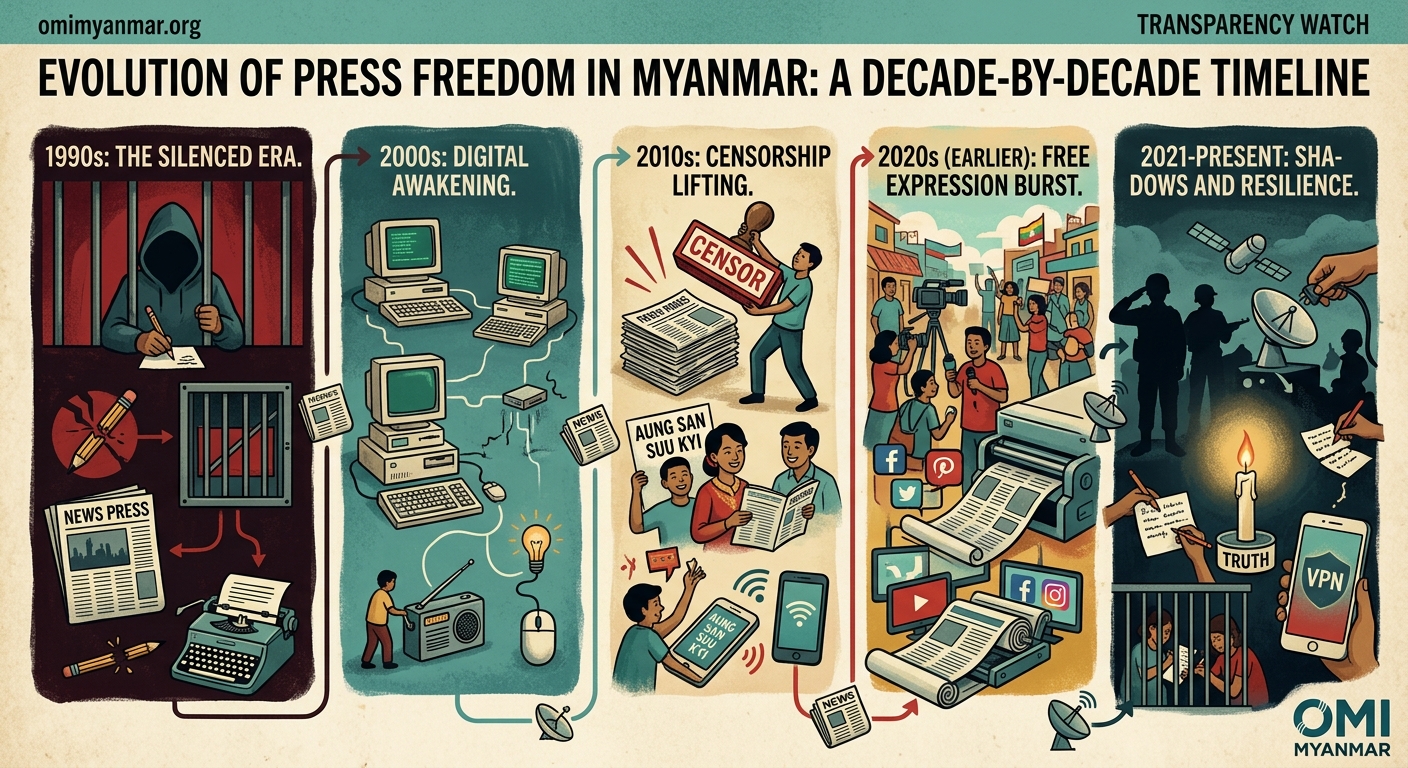
This decade marked one of the darkest periods in the Myanmar press freedom timeline. The military junta banned political gatherings and public speech. Journalists who reported on human rights abuses disappeared.
Aung San Suu Kyi’s National League for Democracy won elections in 1990, but the military refused to honor results. Media coverage of the election and its aftermath led to widespread arrests. Foreign journalists faced deportation if caught reporting without permission.
The Printers and Publishers Registration Law of 1962 remained the primary censorship tool. Publications needed approval for every issue. Censors wielded red pens liberally, often leaving pages nearly blank.
Exile media emerged as crucial alternatives. The Irrawaddy, founded in 1990 by Burmese journalists in Thailand, provided independent coverage. Democratic Voice of Burma started radio broadcasts from Norway in 1992. These outlets became lifelines for information.
Technology began changing the game slowly. Fax machines allowed some information flow. Satellite dishes, though illegal, appeared in urban areas. The junta struggled to control information completely, but penalties remained severe.
The 2000s and Pre-Reform Tensions
The military changed names from SLORC to State Peace and Development Council (SPDC) in 1997, but repression continued. Internet access arrived in Myanmar around 2000, heavily restricted and monitored.
Journalists adapted to survive. Self-censorship became necessary for anyone working inside the country. Writers developed coded language to discuss sensitive topics. Readers learned to read between the lines.
The 2007 Saffron Revolution tested media control. Monks led peaceful protests against fuel price increases and political repression. Citizen journalists captured footage on mobile phones and smuggled it to exile media. The regime responded with brutal crackdowns.
Japanese journalist Kenji Nagai died while filming the protests. His death drew international attention to the dangers facing media workers in Myanmar. The junta expelled foreign correspondents and tightened internet controls.
Yet cracks appeared in the system. Exile media grew more sophisticated. The Irrawaddy expanded its reporting team. Democratic Voice of Burma trained citizen journalists inside Myanmar. Information flowed despite barriers.
The Reform Decade Begins
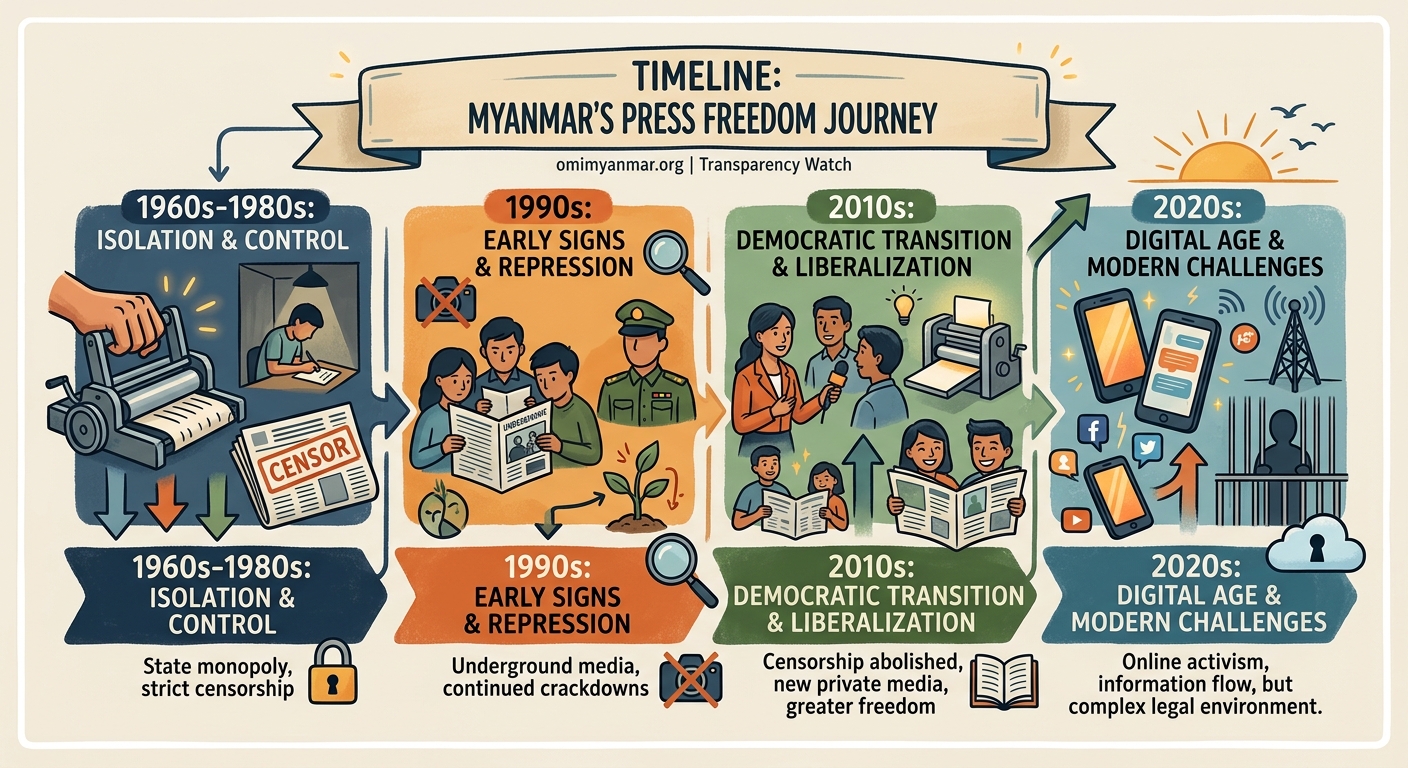
President Thein Sein’s quasi-civilian government took power in 2011, initiating surprising reforms. The government dissolved the Press Scrutiny Board in 2012, ending pre-publication censorship for the first time in five decades.
This shift transformed Myanmar’s media landscape overnight. Journalists could publish without submitting content for approval. Weekly journals tested boundaries with political commentary. Circulation numbers soared as readers hungry for information bought publications eagerly.
The News Media Law passed in 2014, replacing the 1962 registration law. It allowed private daily newspapers for the first time since 1964. Dozens of outlets launched, creating vibrant competition. Journalists returned from exile to work legally inside Myanmar.
International organizations rushed to support media development. Training programs taught investigative techniques. Grants funded new outlets. Understanding Myanmar’s freedom of information laws became essential for this emerging press corps.
Challenges remained. Defamation laws still threatened journalists. The Official Secrets Act hung over reporting on military matters. Ethnic conflicts in border regions stayed largely off-limits. But compared to previous decades, the change felt revolutionary.
Mapping the 2010s Media Expansion
The Myanmar press freedom timeline shows remarkable growth between 2011 and 2020. Here’s how the landscape transformed:
| Period | Key Development | Impact on Press Freedom | Remaining Restrictions |
|---|---|---|---|
| 2011-2012 | Press Scrutiny Board dissolved | End of pre-publication censorship | Self-censorship persisted |
| 2013-2014 | News Media Law enacted | Private daily newspapers allowed | Registration requirements remained strict |
| 2015-2016 | NLD election victory | Optimism for further reforms | Military retained constitutional power |
| 2017-2018 | Reuters journalists imprisoned | Chilling effect on Rohingya coverage | Telecommunications Act used against critics |
| 2019-2020 | Digital media growth | Diverse online platforms emerged | Internet shutdowns in conflict zones |
The Reuters case in 2017 particularly damaged Myanmar’s reform reputation. Wa Lone and Kyaw Soe Oo investigated a massacre in Rakhine State. Authorities arrested them under the Official Secrets Act. Their imprisonment until 2019 sent clear signals about forbidden topics.
Despite setbacks, media diversity flourished. Television stations multiplied. Radio stations covered local issues. Digital outlets attracted young audiences. Facebook became the primary news source for millions, creating both opportunities and misinformation challenges.
Ethnic media also expanded. Publications in Shan, Karen, Kachin, and other languages gave voice to minority communities. These outlets covered conflicts and displacement that Yangon-based media often ignored.
“The decade from 2010 to 2020 represented the freest period for Myanmar’s press in over 50 years. Journalists could investigate corruption, interview opposition figures, and criticize government policies. That freedom proved fragile, built on political will rather than strong institutional protections.” – Anonymous Myanmar journalist currently in exile
The Rohingya Crisis and Media Restrictions
The 2017 military crackdown in Rakhine State tested press freedom severely. Over 700,000 Rohingya fled to Bangladesh. International observers documented atrocities. Myanmar’s government restricted journalist access to affected areas.
Local media faced impossible choices. Reporting the military’s actions risked prosecution. Ignoring the crisis meant abandoning journalistic principles. Many outlets chose cautious middle paths that satisfied neither truth nor authorities.
The Reuters case exemplified these dangers. The two journalists obtained documents showing a massacre. Police arrested them in an apparent setup. Their trial and conviction demonstrated that certain topics remained absolutely forbidden.
Internet shutdowns became a new censorship tool. Authorities cut mobile internet in conflict areas, claiming security concerns. These blackouts prevented journalists from reporting and citizens from sharing information. The shutdowns lasted months in some townships.
How international watchdogs are monitoring Myanmar’s governance reforms in 2024 became increasingly important as domestic oversight weakened during this period.
February 2021 and the Coup’s Impact
The military seized power on February 1, 2021, arresting Aung San Suu Kyi and other elected leaders. Media outlets faced immediate threats. Soldiers raided newsrooms. Authorities revoked broadcasting licenses. Journalists went into hiding.
The junta reinstated censorship rapidly. They blocked independent news websites. Facebook, the primary information source for most Myanmar citizens, faced restrictions. Virtual private networks became essential tools for accessing information.
Arrests began immediately. Security forces detained reporters covering protests. Charges included incitement, violating the Official Secrets Act, and terrorism. Bail became nearly impossible. Many journalists faced years in detention without trial.
The Myanmar press freedom timeline shows over 170 media workers arrested since the coup. At least 60 remained in detention as of late 2023. Sentences ranged from three years to life imprisonment. Conditions in military detention centers were harsh and often included torture.
Many journalists fled to border areas or neighboring countries. Exile media operations resumed, echoing the 1990s and 2000s. Outlets operated from Thailand, India, and further abroad. They relied on networks inside Myanmar for information.
How Journalists Adapted After the Coup
Media workers developed survival strategies in this hostile environment. Understanding these methods reveals both resilience and ongoing risks.
- Many journalists adopted pseudonyms to protect their identities while continuing to report.
- Secure communication tools became essential, with encrypted messaging apps replacing phone calls and emails.
- Exile newsrooms established remote reporting networks, coordinating with sources inside Myanmar through trusted intermediaries.
- Citizen journalists filled gaps, using smartphones to document military violence and civil disobedience movements.
- Underground printing operations produced news bulletins in areas without internet access.
These adaptations came with costs. Journalists separated from families. Income disappeared as advertising dried up. Trauma from covering violence and experiencing persecution took psychological tolls.
Digital security became a life-or-death skill. Authorities monitored communications and tracked journalists through digital footprints. Training in operational security helped some avoid arrest, but many lacked access to such resources.
Current Challenges Facing Myanmar Media
The Myanmar press freedom timeline continues to document severe restrictions. Here are the primary obstacles journalists face today:
- Military raids on newsrooms and homes of journalists force many into hiding or exile
- Revoked licenses prevent legal media operations inside Myanmar
- Internet shutdowns and website blocks limit information distribution
- Arrest warrants under terrorism laws make return to Myanmar impossible for many journalists
- Financial pressures as advertising revenue collapses and international funding faces restrictions
- Trauma and mental health challenges from covering violence and experiencing persecution
- Difficulty verifying information from inside Myanmar due to communication barriers
The junta designated several media outlets as “terrorist organizations” in 2021. This unprecedented move criminalized even reading or sharing content from these outlets. The list included Myanmar’s most respected independent media.
What NGO workers need to know about navigating Myanmar’s regulatory environment applies equally to journalists trying to operate legally while maintaining editorial independence.
State media reverted to pure propaganda. Myanmar Radio and Television broadcasts military narratives exclusively. The Global New Light of Myanmar newspaper reads like publications from the 1990s, filled with junta announcements and no critical reporting.
Exile Media Operations Today
Myanmar’s exile media landscape has grown sophisticated since 2021. Outlets combine traditional journalism with innovative digital strategies. They maintain audiences inside Myanmar despite censorship.
The Irrawaddy continues operations from Thailand, now with decades of experience. Myanmar Now reports from multiple countries. Democratic Voice of Burma maintains radio broadcasts and digital platforms. Frontier Myanmar, Mizzima, and others adapted to exile conditions.
These organizations face funding challenges. International donors provide crucial support, but sustainability remains uncertain. Advertising revenue disappeared when they lost legal status inside Myanmar. Subscription models work for some outlets but exclude many Myanmar readers.
Coordination among exile media improved. Outlets share resources and information. Joint investigations tackle complex stories. This cooperation strengthens overall coverage despite individual organizations’ limitations.
Burmese-language services from international broadcasters also expanded. BBC Burmese, Voice of America Burmese, and Radio Free Asia provide additional sources. Their institutional backing offers stability that independent outlets lack.
Comparing Myanmar’s Timeline to Regional Patterns
Myanmar’s press freedom struggles reflect broader Southeast Asian trends but with unique intensity. Understanding these comparisons provides context.
Thailand experienced multiple coups affecting press freedom, but media recovered between military governments. Cambodia’s press freedom declined gradually under long-term authoritarian rule. The Philippines saw dramatic swings depending on leadership.
Myanmar’s pattern differs. The country experienced sustained military control from 1962 to 2011, making the reform decade an anomaly rather than a norm. The 2021 coup represented a return to historical patterns rather than a new development.
This context matters for understanding current resistance. Myanmar’s journalists and citizens remember both the pre-reform darkness and the reform decade’s possibilities. That lived experience fuels determination to resist the current repression.
Can digital tools bridge Myanmar’s accountability gap explores how technology might support transparency despite authoritarian controls, relevant to media freedom challenges.
Resources for Tracking Press Freedom
Researchers and advocates can access several valuable resources for monitoring the Myanmar press freedom timeline:
The Committee to Protect Journalists maintains updated databases of imprisoned journalists worldwide, including detailed Myanmar coverage. Reporters Without Borders publishes annual press freedom indexes and special reports on Myanmar. The International Federation of Journalists documents arrests and threats.
Inside Myanmar, Athan (Freedom of Expression Activist Organization) tracks legal cases and provides analysis. The Myanmar Pressroom Development Institute, though now operating in exile, continues advocacy work. These local organizations offer crucial context that international groups sometimes miss.
Academic institutions also contribute. The Center for International Media Assistance published comprehensive studies on Myanmar’s media development. University research programs analyze the reform period and current crisis.
Social media, despite its limitations, provides real-time updates. Journalists and organizations share information about arrests, trials, and releases. Following verified accounts helps track developments as they unfold.
The Human Cost Beyond Statistics
Numbers tell part of the Myanmar press freedom timeline story, but individual experiences reveal the full impact. Journalists imprisoned face torture and denial of medical care. Families lose income and face harassment. Children grow up with parents in detention or exile.
Several journalists died in custody under suspicious circumstances. Authorities claimed natural causes, but families reported signs of abuse. These deaths intimidate others from continuing their work.
Mental health impacts extend across the profession. Journalists covering violence experience secondary trauma. Those in hiding or exile deal with isolation and uncertainty. Support systems remain inadequate for these widespread needs.
Yet many continue reporting despite dangers. They document resistance movements, human rights abuses, and daily life under military rule. Their commitment to truth-telling persists even when personal costs become severe.
Looking Forward While Honoring the Past
The Myanmar press freedom timeline remains unfinished. Current repression recalls the darkest periods of military rule, but resistance also continues. Exile media operations persist. Citizen journalists document realities inside Myanmar. International attention, though insufficient, provides some protection.
History suggests that Myanmar’s media will eventually experience another opening. The reform decade proved that change is possible. When that next opportunity arrives, lessons from both the successes and failures of 2011 to 2021 will matter.
Institutional protections need strengthening beyond individual leaders’ goodwill. Legal frameworks must protect journalists even when political winds shift. International pressure and support systems should remain consistent rather than following news cycles.
The journalists who maintained truth-telling through decades of repression, brief reform, and renewed crackdown deserve recognition. Their work preserved historical memory and documented injustice. Future Myanmar will need accurate records of this period, and these journalists are creating them at great personal cost.
Why This Timeline Matters for Understanding Myanmar Today
Myanmar’s press freedom journey illuminates broader democratic struggles. Media independence serves as both a barometer of political freedom and a tool for accountability. Tracking this timeline helps predict broader political developments and understand resistance strategies.
For journalists worldwide, Myanmar’s experience offers sobering lessons about fragile gains and the importance of institutional protections. For researchers and students, this timeline provides essential context for understanding contemporary Myanmar. For advocates, it highlights ongoing needs and effective support strategies.
The Myanmar press freedom timeline will continue evolving. Journalists inside and outside the country will keep reporting despite obstacles. Their work ensures that when Myanmar’s next political transition arrives, accurate historical records will inform better outcomes. Until then, supporting exile media, advocating for imprisoned journalists, and maintaining international attention remains crucial for those who believe press freedom matters for democracy and human rights.