
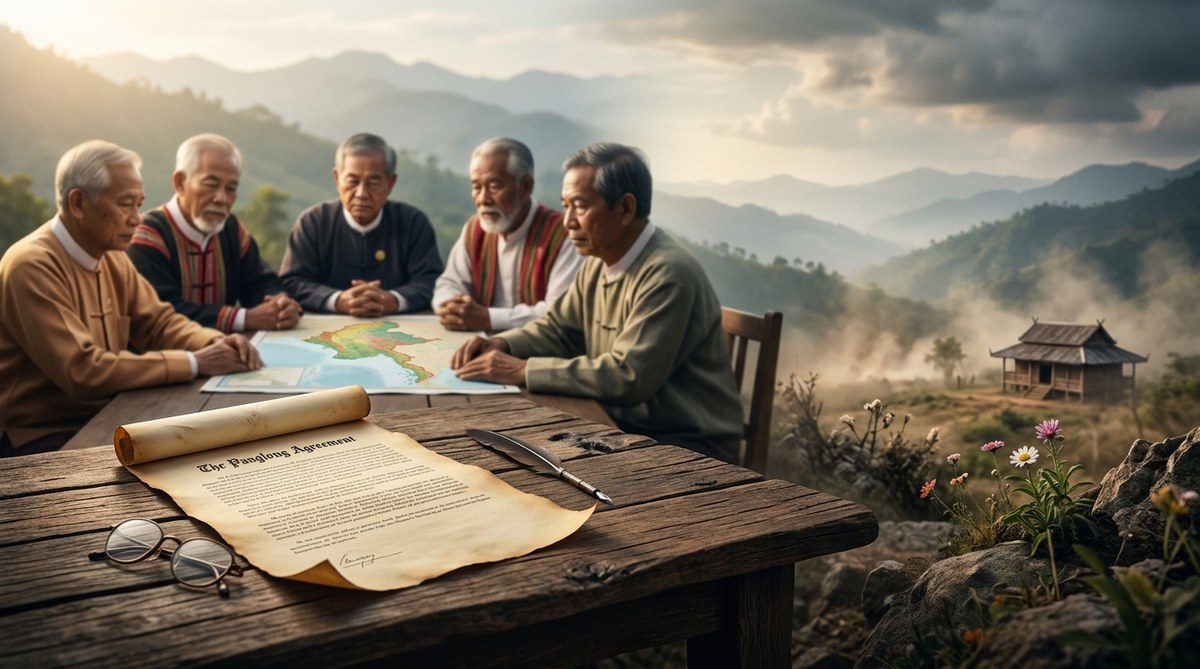
On February 12, 1947, a group of ethnic leaders gathered in a small town in Shan State to sign what many hoped would be Myanmar’s founding document of unity. The Panglong Agreement promised equality, autonomy, and shared governance for the country’s diverse ethnic populations. Instead, it became a symbol of broken promises and the foundation of one of the world’s longest-running civil conflicts.
The Panglong Agreement Myanmar signed in 1947 promised ethnic minorities equal rights and autonomy within a unified Burma. However, successive governments failed to implement these commitments, leading to decades of armed conflict. Understanding this agreement helps explain why ethnic tensions persist and why peace negotiations continue referencing Panglong as both inspiration and cautionary tale for Myanmar’s future.
What the Panglong Agreement actually promised
The agreement signed at Panglong contained just nine clauses, but each carried enormous weight for Burma’s future. General Aung San, representing the interim Burmese government, met with representatives from the Shan, Kachin, and Chin peoples to negotiate the terms of independence from Britain.
The document guaranteed full autonomy for the Shan and Karenni states in internal administration. It promised that all ethnic groups would receive the same rights and privileges as the Burman majority. Perhaps most significantly, it included a provision allowing states to secede from the union after ten years if they chose.
Financial arrangements were spelled out clearly. The agreement stated that ethnic areas would receive a fair share of national revenues based on their population and needs. Representatives from ethnic regions would participate fully in the constituent assembly drafting Burma’s constitution.
The Frontier Areas Committee of Enquiry, which preceded Panglong, had documented deep concerns among ethnic populations about joining Burma. Many ethnic leaders feared Burman domination. They worried their languages, cultures, and traditional governance systems would disappear under centralized rule.
Panglong was supposed to address these fears. The agreement represented a social contract between Burma’s ethnic groups, promising a federal structure that balanced unity with diversity.
Who signed and who didn’t
Three ethnic groups formally signed the Panglong Agreement. The Shan, Kachin, and Chin leaders put their names to the document alongside Aung San. Their signatures represented millions of people across Burma’s northern and eastern hills.
But several major ethnic groups were absent from Panglong. The Karen, who had fought alongside the British during World War II, did not attend. The Mon, Rakhine, and Karenni peoples were also not represented. Some groups were not invited. Others chose not to participate.
The reasons for these absences varied. Some ethnic leaders distrusted Aung San and the independence movement. Others had their own negotiations underway with the British. Geographic distance and poor communication meant some groups simply didn’t make it to Panglong in time.
This incomplete participation would haunt Burma for decades. Groups that didn’t sign the agreement felt no obligation to honor its terms. They developed their own visions for independence or autonomy. The Karen, for instance, soon launched an armed struggle that continues in some form today.
Even among signatories, not everyone was convinced. Some Shan leaders later claimed they were pressured to sign. They said promises made at Panglong were intentionally vague, leaving room for the Burman majority to interpret them favorably.
How promises turned into broken commitments
Burma gained independence on January 4, 1948. Within months, the promises of Panglong began unraveling. The 1947 constitution, drafted after Panglong, did include federal elements. But it fell far short of what ethnic leaders expected.
The constitution gave states less autonomy than the Panglong Agreement suggested. Financial arrangements favored the central government. The provision allowing secession after ten years was included, but the military would never allow it to be tested.
General Aung San’s assassination in July 1947, just months after Panglong, removed the one Burman leader many ethnic groups trusted. His successor, U Nu, lacked Aung San’s authority and vision. Ethnic insurgencies began almost immediately after independence.
By 1962, General Ne Win seized power in a military coup. His government explicitly rejected federalism and ethnic autonomy. Ne Win’s “Burmese Way to Socialism” emphasized national unity over ethnic diversity. He banned ethnic languages from schools and government offices.
The military government renamed the country Myanmar in 1989, erasing even the name “Burma” that connected back to Panglong. Ethnic armed organizations proliferated across border regions. What began as political disagreements became entrenched military conflicts.
Successive military governments made occasional gestures toward ethnic reconciliation. Ceasefires were signed and broken. Peace conferences were held and failed. But the fundamental structure promised at Panglong was never implemented.
The three main reasons Panglong failed
1. Lack of clear implementation mechanisms
The Panglong Agreement contained no enforcement provisions. It didn’t specify how autonomy would work in practice. There were no timelines, no accountability measures, no dispute resolution processes. The agreement was more a statement of principles than a binding legal document.
2. Assassination of Aung San
Aung San’s death removed the leader most committed to ethnic federalism. He had personal relationships with ethnic leaders built during the independence struggle. His successors lacked his credibility and vision. Without Aung San, there was no one powerful enough to force the Burman elite to honor Panglong’s promises.
3. Centralized military power
Burma’s military, the Tatmadaw, developed as a centralized force focused on national unity above all else. Military leaders viewed ethnic autonomy as a threat to territorial integrity. They saw federalism as a path to national disintegration. This institutional bias against Panglong’s vision has persisted for over 70 years.
Modern attempts to revive the Panglong spirit
In 2016, Aung San Suu Kyi’s government launched the “21st Century Panglong Conference.” The name deliberately invoked the 1947 agreement, positioning the new talks as a continuation of her father’s work. The conference aimed to bring all ethnic armed organizations, political parties, and civil society groups together to negotiate a lasting peace.
The 21st Century Panglong held multiple sessions between 2016 and 2020. Hundreds of delegates attended. They discussed federalism, ethnic rights, natural resource management, and power sharing. Some progress was made on paper, with agreements signed on various principles.
But the new Panglong faced many of the same problems as the original. Implementation remained vague. The military, which controlled 25% of parliament and key ministries, resisted meaningful reforms. Armed conflicts continued even as peace talks proceeded. Youth activism and civil society organizations pushed for more inclusive processes, but political will remained limited.
The February 2021 military coup ended the 21st Century Panglong process. The Tatmadaw overthrew the elected government, arrested Aung San Suu Kyi, and suspended the peace talks. Ethnic armed organizations resumed or intensified fighting. The National Unity Government, formed by ousted lawmakers, promised a federal democratic charter, but Myanmar descended into civil war.
“Panglong has become both a promise and a warning. It shows us what’s possible when ethnic groups come together in good faith. But it also reminds us that written agreements mean nothing without genuine commitment to implementation and power sharing.” – Ethnic affairs researcher, 2019
What researchers and students need to understand
Anyone studying the Panglong Agreement Myanmar signed in 1947 should recognize several critical points that textbooks often miss.
First, Panglong was a product of very specific historical circumstances. Burma was transitioning from colonial rule. World War II had just ended. Ethnic groups had fought on different sides of that conflict. The British were eager to leave. These pressures created both opportunity and constraints that shaped the agreement.
Second, the agreement’s brevity was both strength and weakness. Nine clauses could be negotiated relatively easily. But that simplicity left enormous questions unanswered. What exactly did “full autonomy in internal administration” mean? How would revenue sharing work? Who would resolve disputes?
Third, oral promises mattered as much as written text. Many ethnic leaders signed based on verbal assurances from Aung San. These promises were never documented. When Aung San died, those commitments died with him. Future governments denied these oral agreements ever existed.
Fourth, Panglong must be understood in the context of British colonial policy. The British administered ethnic areas separately from “Burma proper.” This created distinct political identities and governance structures. Panglong tried to bridge this colonial divide, but decades of separation couldn’t be overcome with one agreement.
For policy analysts, Panglong offers lessons about peace agreement design. Vague principles don’t create lasting peace. Implementation mechanisms matter more than lofty language. Power imbalances between parties will undermine even the best-intentioned agreements unless addressed directly.
How Panglong shapes current conflicts
Every ethnic armed organization in Myanmar references Panglong in some way. Some claim they’re fighting to fulfill its original promises. Others cite Panglong’s failure as proof that ethnic groups can never trust the Burman-dominated state.
The Karen National Union, which didn’t sign the original agreement, has fought the central government since 1949. Their political platform calls for a federal system similar to what Panglong promised. The Kachin Independence Organization, representing a group that did sign Panglong, resumed fighting in 2011 after the government violated ceasefire terms.
Understanding how international watchdogs are monitoring Myanmar’s governance reforms provides additional context for these ongoing struggles. The Shan State Army, the United Wa State Army, and dozens of smaller armed groups all maintain that they’re defending rights guaranteed at Panglong but never delivered.
Peace negotiations consistently return to Panglong as a reference point. Ethnic leaders demand a “genuine federal union” based on Panglong principles. The military insists on national unity and territorial integrity. This fundamental disagreement has prevented lasting peace for 75 years.
The 2021 coup intensified these conflicts. Many ethnic armed organizations sided with the pro-democracy movement against the military. They saw an opportunity to finally achieve the federal system Panglong promised. But the military’s response has been brutal, with entire villages burned and hundreds of thousands displaced.
Comparing Panglong’s promises with what was delivered
| What Panglong Promised | What Actually Happened | Current Status |
|---|---|---|
| Full autonomy in internal administration | Centralized military control over ethnic regions | States have nominal autonomy but no real power |
| Equal rights for all ethnic groups | Burman language and culture privileged | Ethnic languages banned in many official contexts |
| Fair revenue sharing | Resources extracted from ethnic areas with minimal return | Natural resources fuel conflict, not development |
| Right to secede after 10 years | Military would never allow secession discussion | Secession now considered treason |
| Ethnic participation in governance | Token representation without real power | Ethnic parties marginalized or banned |
| Federal democratic structure | Unitary military dictatorship | Federal system remains unrealized |
This table makes clear how completely the original Panglong vision was abandoned. Not a single major promise was fully implemented. Some weren’t even attempted. The gap between promise and reality explains why armed conflict persists.
The role of external powers then and now
Britain played a crucial role in creating the conditions for Panglong. British colonial policy had separated ethnic regions from Burma proper. British officials encouraged ethnic groups to negotiate with Aung San. Then Britain left, washing its hands of the problems its colonial policies created.
China has become increasingly important in Myanmar’s ethnic conflicts. Many armed groups operate along the Chinese border. Some receive tacit Chinese support. China’s Belt and Road Initiative runs through ethnic conflict zones. Beijing wants stability but also leverage over Myanmar’s government.
Thailand hosts refugee camps for ethnic minorities fleeing conflict. Thai businesses profit from trade with ethnic armed organizations. Thailand’s military has complex relationships with various ethnic groups. Sometimes Thailand mediates conflicts. Other times it fuels them.
The United States and European Union impose sanctions on Myanmar’s military. They provide humanitarian aid to ethnic regions. Western governments rhetorically support federalism and ethnic rights. But their practical influence is limited. Sanctions haven’t changed military behavior.
India shares a long border with Myanmar’s ethnic regions. Indian states host ethnic refugees and armed groups. India’s military cooperates with Myanmar’s Tatmadaw against insurgents. But India also maintains relationships with ethnic organizations as a hedge against Chinese influence.
ASEAN, the regional bloc, follows a non-interference policy. This means ASEAN rarely pressures Myanmar on ethnic issues. The organization provides a forum for dialogue but little concrete support for peace processes.
Why language matters in understanding Panglong
The Panglong Agreement was written in English and Burmese. Ethnic leaders signed a document many couldn’t read in their own languages. This linguistic imbalance reflected broader power dynamics.
The term “Frontier Areas” in the agreement came from British colonial administration. It implied these regions were peripheral, not central to Burma. Ethnic leaders objected to this framing but lacked the power to change it.
“Full autonomy in internal administration” sounds clear in English. But what does “internal” mean? Does it include natural resources? Education? Police? The military? These questions were never answered, allowing different interpretations.
The Burmese word for “union” (pyidaungsu) carries different connotations than the English term. In Burmese political discourse, it emphasizes unity over federation. This linguistic difference reflects fundamentally different visions for Myanmar’s political structure.
When the military government renamed Burma to Myanmar in 1989, they claimed “Myanmar” was more inclusive of ethnic minorities. But ethnic groups weren’t consulted. Many reject the name Myanmar as another imposition by the Burman majority.
Current peace negotiations struggle with language issues. Ethnic armed organizations insist on using their own languages in talks. The government prefers Burmese. Even basic terms like “federalism” and “autonomy” mean different things to different parties. These linguistic barriers reflect deeper political divides.
Steps to research Panglong effectively
-
Start with primary sources. Read the original agreement text. Examine the Frontier Areas Committee of Enquiry report. Review the 1947 constitution. These documents reveal what was actually promised versus later interpretations.
-
Study ethnic perspectives. Most academic writing on Panglong comes from Burman or Western scholars. Seek out ethnic minority voices. Karen, Shan, Kachin, and Chin scholars offer different interpretations of Panglong’s meaning and failure.
-
Understand the colonial context. Read about British Burma’s administrative structure. Study how World War II affected ethnic relations. Examine how independence movements developed differently among ethnic groups.
-
Follow current conflicts. The Panglong Agreement isn’t just history. It shapes contemporary politics and violence. Track peace negotiations, ceasefire agreements, and armed conflicts to see how Panglong’s legacy continues.
-
Compare with other cases. Look at federal systems in India, Switzerland, and Canada. Study peace agreements in other countries with ethnic conflicts. This comparative perspective helps identify what makes Myanmar’s situation unique.
-
Examine economic dimensions. Natural resources in ethnic regions drive much of the conflict. Research jade mining in Kachin State, timber extraction in Karen areas, and drug production in Shan State. Economic interests often override political principles.
-
Consider the military’s perspective. Understanding why the Tatmadaw opposes federalism is crucial. Study military ideology, institutional interests, and how officers are trained to view ethnic issues.
Common misconceptions about the agreement
Many people believe Panglong created a federal system in Burma. It didn’t. The agreement expressed principles for a future federal structure, but that structure was never built.
Some think all ethnic groups signed Panglong. As discussed earlier, major groups like the Karen, Mon, and Rakhine were absent. This incomplete participation undermined the agreement’s legitimacy from the start.
There’s a misconception that Panglong failed because ethnic groups were unreasonable. Historical evidence shows the opposite. Ethnic leaders repeatedly tried to negotiate implementation. The Burman-dominated government and military refused meaningful power sharing.
People often assume the 21st Century Panglong was making progress before the 2021 coup. In reality, the process had stalled. The military blocked substantive reforms. Armed conflicts continued. The coup ended a process that was already failing.
Some believe federalism would lead to Myanmar’s breakup. But many federal countries maintain unity while respecting diversity. Switzerland, Canada, and India prove federalism can work. The military’s fears about federalism are ideological, not based on evidence.
There’s a myth that Aung San Suu Kyi could have solved ethnic conflicts if given more time. While she faced military constraints, her government also failed to prioritize ethnic issues. Her silence during the Rohingya crisis damaged her credibility with ethnic minorities. The problems run deeper than any single leader.
Panglong’s influence on Myanmar’s political culture
The Panglong Agreement established a pattern in Myanmar politics. Make promises to ethnic groups. Fail to implement them. Blame ethnic groups for being unreasonable. Use military force to maintain control. Repeat.
This cycle has created deep distrust between ethnic minorities and the central government. Even well-intentioned reform efforts face skepticism. Ethnic leaders assume promises will be broken because they always have been.
Panglong also created a powerful symbol for ethnic resistance movements. Every armed organization claims to fight for Panglong’s principles. The agreement gives ethnic insurgencies historical legitimacy. They’re not rebels, they argue. They’re defending rights the government promised and then stole.
The concept of “unity in diversity” that Panglong represented has been completely inverted. Instead of unity through respecting diversity, Myanmar’s military promotes unity through enforced homogeneity. Burman language, culture, and Buddhism are privileged. Ethnic differences are treated as threats.
Panglong shaped how Myanmar approaches negotiations. There’s always a peace conference being planned or conducted. Talks become performative rather than substantive. All sides know real change is unlikely, but the process continues. This reflects how grassroots transparency initiatives struggle against entrenched power structures.
The agreement’s failure taught ethnic groups to maintain armed forces. Negotiation alone won’t protect their interests. Only military capability gives them leverage. This militarization of ethnic politics stems directly from Panglong’s broken promises.
What the future holds for Panglong’s legacy
The Panglong Agreement will continue shaping Myanmar’s politics for decades. Every peace process will reference it. Every ethnic armed organization will cite it. The gap between Panglong’s promises and Myanmar’s reality won’t close easily.
The 2021 coup paradoxically created new possibilities. The military’s brutality pushed many Burman civilians to understand ethnic grievances for the first time. The National Unity Government promises a federal democratic charter that would finally fulfill Panglong’s vision. But whether they can deliver remains uncertain.
Some ethnic armed organizations now control significant territory. They’ve built parallel governance structures, education systems, and economies. These de facto autonomous regions might become the basis for a future federal system. Or they might become frozen conflicts like those in the former Soviet Union.
International pressure on Myanmar’s military is stronger than ever. Sanctions, arms embargoes, and diplomatic isolation might eventually force negotiations. But external pressure alone won’t resolve conflicts rooted in 75 years of broken promises.
Younger generations of ethnic minorities are less patient than their elders. They’ve grown up in conflict zones with no memory of peace. Some seek independence rather than federalism. Others embrace armed struggle as the only path. The window for a Panglong-style compromise may be closing.
Myanmar’s neighbors want stability but disagree on how to achieve it. China, Thailand, and India pursue their own interests, sometimes supporting different ethnic groups. This external meddling complicates peace efforts.
Why this history matters for everyone studying Myanmar
The Panglong Agreement Myanmar signed in 1947 isn’t just an interesting historical footnote. It’s the key to understanding Myanmar’s present and future. The promises made and broken at Panglong explain why Myanmar has been at war with itself for 75 years.
Students researching Myanmar must grasp that ethnic conflict isn’t about ancient tribal hatreds. It’s about broken political commitments. Researchers analyzing peace processes should study Panglong to understand why vague agreements fail. Journalists covering Myanmar need this context to explain why conflicts persist despite numerous peace talks.
Policy analysts should recognize that any lasting solution must address Panglong’s unfinished business. Myanmar needs a genuine federal system with real power sharing, resource distribution, and ethnic autonomy. Anything less will perpetuate the cycle of conflict.
The Panglong Agreement shows how colonial legacies shape post-independence conflicts. How promises matter more than documents. How implementation determines whether peace agreements succeed or fail. These lessons apply far beyond Myanmar.
For those working on transparency initiatives or governance reforms, Panglong demonstrates that political structures matter enormously. You can’t build a stable, democratic state on a foundation of broken promises and ethnic oppression.
When promises become history instead of reality
The Panglong Agreement represents one of modern history’s great missed opportunities. A diverse nation could have built unity through respecting difference. Instead, forced assimilation and military rule created endless conflict.
Understanding Panglong helps make sense of Myanmar’s complex present. The agreement’s failure explains why peace remains elusive. Why ethnic armed organizations fight on. Why the military resists reform. Why Myanmar can’t move forward without addressing its past.
The story of Panglong reminds us that peace agreements need more than good intentions. They require clear implementation plans, enforcement mechanisms, and genuine political will. They demand that powerful parties actually share power, not just promise to do so.
For students, researchers, and policy analysts, the Panglong Agreement offers crucial lessons about ethnic conflict, peace processes, and state building. It’s a case study in how not to manage ethnic diversity. But it’s also a reminder that different ethnic groups can come together when they trust each other and see genuine commitment to shared principles.
The promises made at Panglong in 1947 still wait to be fulfilled. Until they are, Myanmar will continue struggling with conflicts that could have been avoided if those promises had been kept.