

Hiring in Myanmar presents unique opportunities and challenges for international businesses. The country offers a young, cost-effective workforce, but navigating employment regulations requires careful attention to local laws and cultural expectations.
Hiring employees in Myanmar involves registering your business entity, understanding the Employment and Skill Development Law, calculating mandatory social security contributions, drafting compliant employment contracts, and navigating cultural nuances around communication and workplace hierarchy. Most international companies choose between establishing a local entity or partnering with an Employer of Record to manage compliance, payroll, and benefits administration while building their Myanmar team.
Understanding Myanmar’s employment landscape
Myanmar’s labor market has transformed significantly over the past decade. The workforce is predominantly young, with over 60% under age 35, and literacy rates exceed 75% in urban areas.
The country’s Employment and Skill Development Law governs most employment relationships. This framework replaced older British colonial labor laws and introduced modern protections for workers.
Understanding anti-corruption measures in Myanmar’s business sector helps international employers navigate regulatory expectations beyond basic employment law.
Yangon and Mandalay concentrate most skilled workers, particularly in technology, finance, and professional services. Manufacturing hubs have developed in industrial zones outside major cities.
English proficiency varies widely. Senior professionals and younger graduates often speak conversational English, while factory workers and administrative staff may require Burmese language support.
Legal structures for employing staff
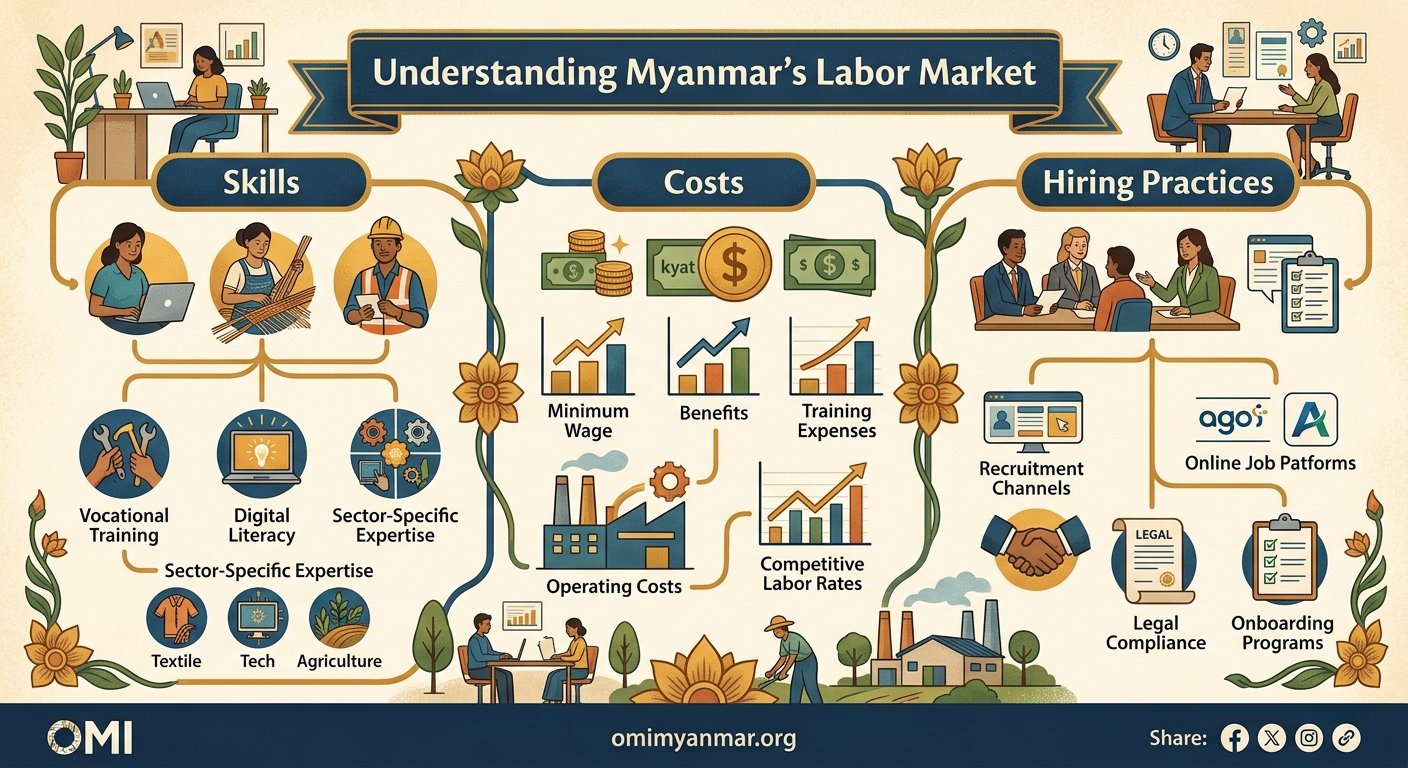
Foreign companies face a fundamental choice before hiring anyone in Myanmar. You can establish a local legal entity or use an Employer of Record service.
Setting up a local entity requires registering with the Directorate of Investment and Company Administration. This process typically takes three to six months and involves:
- Submitting incorporation documents
- Obtaining necessary business licenses
- Registering for tax purposes
- Opening a local bank account
- Securing office space
Local entities provide maximum control but demand significant upfront investment and ongoing compliance management.
Employer of Record services allow you to hire immediately without establishing a legal entity. The EOR becomes the legal employer while you maintain day-to-day management of your team members.
This model suits companies testing the Myanmar market or hiring small teams. Costs typically range from $299 to $599 per employee monthly, depending on service levels.
Foreign investment regulations in Myanmar have evolved considerably, affecting entity setup requirements and foreign ownership restrictions in certain sectors.
Step-by-step hiring process
Here’s how to hire employees in Myanmar once your legal structure is ready:
-
Define the role and compensation package. Research local salary benchmarks for your industry and position level. Factor in mandatory benefits and employer contributions when budgeting total compensation.
-
Post job openings through appropriate channels. Popular platforms include JobNet Myanmar, MyWorld Careers, and LinkedIn for professional roles. Manufacturing and retail positions fill better through local job centers and community networks.
-
Screen applications and conduct interviews. Expect high application volumes for entry-level positions. Phone screenings help narrow candidates before in-person meetings. Plan for longer interview processes than Western markets, as candidates often need multiple conversations before accepting offers.
-
Verify credentials and conduct background checks. Educational certificates require verification, as fraudulent documents exist. Previous employment verification works best through direct employer contact rather than written references.
-
Extend written offers and negotiate terms. Provide offer letters in both English and Burmese when possible. Allow time for candidates to review terms with family, as employment decisions often involve household consultation.
-
Prepare employment contracts. Contracts must include specific terms required by Myanmar law, including job description, salary, working hours, leave entitlements, and termination conditions.
-
Complete registration and onboarding. Register new employees with the Social Security Board within seven days of their start date. Collect required documentation including National Registration Card copies and educational certificates.
“The biggest mistake foreign employers make is rushing the hiring process. Myanmar candidates value relationship building and clear communication about expectations. Taking time upfront prevents misunderstandings later.” – HR Manager, international manufacturing company
Employment contract essentials
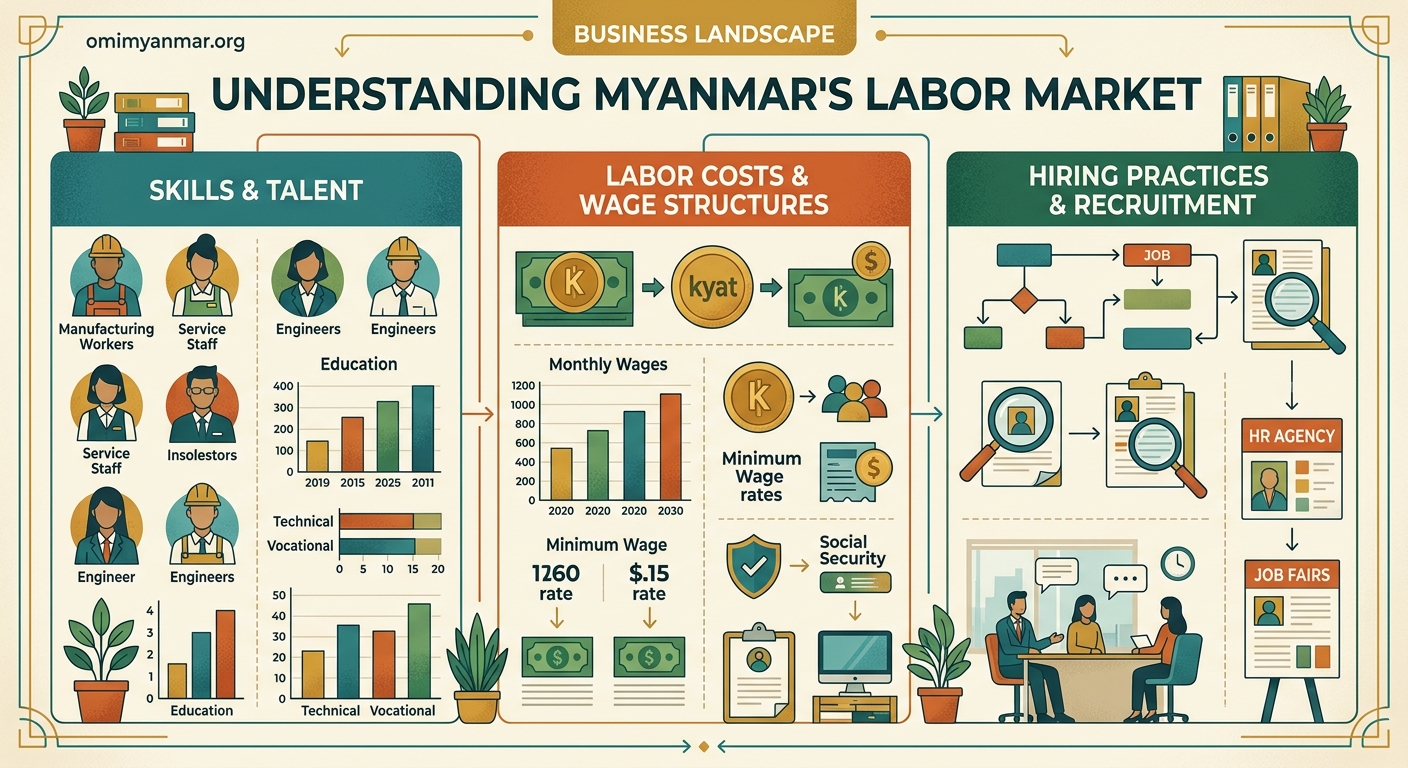
Myanmar law requires written employment contracts for all employees. Verbal agreements hold no legal weight in disputes.
Your contracts must specify these mandatory elements:
- Employee name and National Registration Card number
- Job title and detailed responsibilities
- Start date and contract duration (if fixed-term)
- Work location
- Salary amount and payment schedule
- Working hours and overtime provisions
- Leave entitlements
- Termination notice periods
- Dispute resolution procedures
Contracts can be indefinite or fixed-term. Fixed-term contracts require genuine business justification and cannot exceed two years for the same role with the same employee.
Probation periods typically last three to six months. During probation, either party can terminate with shorter notice periods, usually seven days.
All employees receive written job descriptions separate from contracts. These documents outline specific duties and reporting relationships.
Compensation and benefits requirements
Minimum wage varies by sector and region. As of 2024, the general minimum wage sits at 4,800 kyat per day, though specific industries have different rates.
Salaries for professional roles vary significantly:
| Position Level | Monthly Salary Range (USD) |
|---|---|
| Entry-level graduate | $300 – $500 |
| Mid-level professional | $600 – $1,200 |
| Senior manager | $1,500 – $3,000 |
| Executive leadership | $3,500 – $8,000+ |
These figures represent gross salaries in Yangon. Other cities typically pay 10-20% less for equivalent roles.
Mandatory employer contributions include:
- Social Security Fund: 3% of gross salary
- Employee contribution (deducted from salary): 2% of gross salary
The Social Security Fund covers medical care, maternity benefits, disability, and survivor benefits.
Statutory leave entitlements include:
- Annual leave: 10 working days after one year of service
- Casual leave: 6 days per year
- Medical leave: 30 days per year with medical certification
- Maternity leave: 14 weeks (6 weeks before delivery, 8 weeks after)
- Public holidays: Approximately 20 days annually
Many employers offer additional benefits to attract talent, including private health insurance, transportation allowances, and performance bonuses.
The 13th-month bonus has become standard practice in many industries, though not legally required. Employees expect this payment around the Thingyan (New Year) holiday in April.
Working hours and overtime rules
Standard working hours cannot exceed 8 hours daily or 48 hours weekly. Many offices operate 44-hour weeks, typically Monday through Friday with Saturday half-days.
Overtime requires employee consent and additional compensation. Overtime rates are:
- Regular overtime: 200% of hourly wage
- Rest day overtime: 200% of hourly wage
- Public holiday overtime: 300% of hourly wage
Calculate hourly wages by dividing monthly salary by 208 hours (52 weeks × 4 hours).
Employees can work maximum 12 hours daily including overtime. Weekly overtime cannot exceed 16 hours except in special circumstances with regulatory approval.
Rest periods of at least 30 minutes apply for shifts exceeding 5 hours. This break time doesn’t count toward working hours.
Termination procedures and severance
Terminating employment in Myanmar requires following specific procedures to avoid wrongful dismissal claims.
Notice periods depend on employment duration:
- Less than 1 year: 30 days
- 1-5 years: 35 days
- 5-10 years: 40 days
- Over 10 years: 45 days
Either party can provide payment in lieu of notice.
Severance pay applies when employers terminate without cause. Calculations use this formula:
- 15 days wages for each completed year of service
Employees terminated for misconduct receive no severance. Valid misconduct grounds include theft, violence, repeated policy violations, or extended unauthorized absence.
Redundancy requires demonstrating genuine business need and following consultation procedures. Employers must notify affected employees at least 30 days before termination and provide severance as outlined above.
Documentation matters enormously in termination cases. Maintain records of:
- Performance reviews
- Disciplinary warnings
- Attendance records
- Policy violation notices
Labor disputes often reach the Township Arbitration Body. Strong documentation significantly improves employer positions in these proceedings.
Navigating cultural workplace expectations
Myanmar workplace culture differs substantially from Western business environments. Success requires understanding these cultural dimensions.
Hierarchy and respect shape all workplace interactions. Employees expect clear authority structures and rarely challenge supervisor decisions publicly. This doesn’t mean lack of engagement, but feedback flows through appropriate channels.
Address senior colleagues and supervisors with respectful titles. Using first names with superiors feels inappropriate to many Myanmar employees.
Indirect communication prevails in Myanmar business culture. Direct criticism or confrontation causes loss of face. Frame feedback constructively and privately. Employees may say “yes” to maintain harmony even when they mean “I understand” rather than “I agree.”
Family obligations take priority over work commitments. Employees may need unexpected leave for family events, religious ceremonies, or elder care. Flexible policies around these situations build loyalty.
Religious observance matters deeply. Buddhist holidays and practices influence workplace rhythms. Many employees visit pagodas before work on important dates. Some observe weekly Buddhist sabbath days.
The Thingyan water festival in April essentially shuts down business for a week. Plan around this holiday rather than expecting normal operations.
Dress codes tend toward conservative. Even in casual offices, shorts and sleeveless tops are uncommon. Women typically wear traditional longyi skirts in more formal settings.
Tax obligations for employers
Employers must register for and remit several taxes:
Commercial Tax applies to certain business activities at rates from 0% to 8% depending on goods or services provided.
Income Tax withholding requires deducting tax from employee salaries monthly. Progressive rates range from 0% to 25% based on annual income brackets.
Current income tax brackets (subject to change):
- Up to 4,800,000 kyat: 0%
- 4,800,001 to 10,000,000 kyat: 5%
- 10,000,001 to 20,000,000 kyat: 10%
- 20,000,001 to 30,000,000 kyat: 15%
- 30,000,001 to 50,000,000 kyat: 20%
- Over 50,000,000 kyat: 25%
Employers file monthly tax returns and annual reconciliations. Navigating Myanmar’s tax system as a foreign business owner provides detailed guidance on corporate tax obligations.
Social Security contributions require monthly remittance to the Social Security Board by the 15th of the following month.
Late payments incur penalties of 2% monthly on outstanding amounts.
Common hiring mistakes to avoid
International employers frequently stumble in these areas:
| Mistake | Why It Happens | How to Avoid |
|---|---|---|
| Rushing background checks | Pressure to fill positions fast | Build 2-3 week verification time into hiring timelines |
| Unclear job expectations | Assuming shared understanding | Document detailed responsibilities in Burmese and English |
| Ignoring probation reviews | Lack of structured onboarding | Schedule formal reviews at 30, 60, and 90 days |
| Misclassifying workers | Cost-saving attempts | Consult legal counsel on contractor vs employee status |
| Informal policy communication | Verbal rather than written policies | Maintain employee handbook in local language |
| Inadequate documentation | Trusting relationships over records | Create paper trails for all employment actions |
Worker misclassification creates significant liability. Myanmar authorities scrutinize contractor relationships. True independent contractors control their work methods, serve multiple clients, and provide their own equipment.
Employees work under employer direction, follow set schedules, and use company resources. Misclassifying employees as contractors to avoid benefits and contributions leads to penalties and back payments.
Recruitment channels that work
Different roles require different sourcing strategies in Myanmar.
Professional and technical positions fill best through:
- LinkedIn (growing but still limited penetration)
- JobNet Myanmar and MyWorld Careers
- University career centers for graduate recruitment
- Professional networks and referrals
- Recruitment agencies specializing in your sector
Manufacturing and operational roles respond to:
- Factory job boards and community postings
- Township labor offices
- Employee referral programs
- Local newspaper classifieds in regional areas
Senior leadership typically requires executive search firms with Myanmar networks. These positions rarely fill through public postings.
Employee referrals generate high-quality candidates across all levels. Implement referral bonus programs to encourage your existing team to recommend qualified contacts.
Consider partnering with Myanmar’s emerging tech startup ecosystem if you’re hiring technical talent. Co-working spaces and startup communities provide access to skilled developers and digital professionals.
Managing payroll and benefits administration
Payroll in Myanmar involves several moving parts beyond salary payments.
Payment timing typically occurs monthly, with most companies paying between the 1st and 10th of the following month. Some manufacturers pay twice monthly.
Payment methods include:
- Bank transfers (increasingly common in urban areas)
- Cash payments (still prevalent in manufacturing and retail)
- Mobile money (emerging option)
Bank account ownership remains limited outside cities. Verify payment preferences during hiring.
Payslips must detail gross salary, deductions (income tax, social security), and net pay. Provide these monthly in written form.
Benefits administration requires tracking:
- Leave balances and usage
- Medical leave certifications
- Overtime hours and payments
- Bonus calculations and payments
Many companies use Excel spreadsheets for small teams, but dedicated payroll software becomes essential beyond 20-30 employees.
Consider outsourcing payroll to local service providers who understand regulatory requirements and maintain updated tax tables. This typically costs $50-150 monthly depending on employee count.
Building your team for the long term
Retention matters as much as recruitment in Myanmar’s competitive talent market. Skilled employees receive multiple offers, particularly in Yangon.
Career development drives retention more than salary alone. Employees value:
- Clear advancement paths
- Skills training opportunities
- Exposure to international practices
- Recognition and increased responsibility
Training investment pays dividends. Myanmar employees often lack exposure to modern business systems and processes. Structured onboarding and ongoing development create loyalty and capability.
Communication practices require adaptation. Regular team meetings, transparent decision-making processes, and open-door policies feel unfamiliar to employees from traditional Myanmar companies. Introduce these gradually with clear explanations of purpose.
Work-life balance increasingly matters to younger employees. Flexible hours, remote work options, and family-friendly policies attract talent from Myanmar’s growing middle class.
Getting started with confidence
Hiring employees in Myanmar requires understanding both legal frameworks and cultural context. The regulatory environment continues evolving, making local expertise valuable whether you establish your own entity or partner with an EOR provider.
Start small and learn as you grow. Many successful international companies began with two or three key hires before expanding teams. This approach allows you to understand local dynamics while building your employer brand.
Document everything, communicate clearly, and invest in your team’s development. These practices create foundations for sustainable growth in one of Southeast Asia’s most promising markets.
Your Myanmar team can become a significant competitive advantage. The combination of cost-effectiveness, growing skills, and strong work ethic makes the country an increasingly attractive location for regional operations and back-office functions.
Take time to understand the market, build proper legal structures, and create workplace cultures that blend international standards with local values. This balanced approach positions your Myanmar operations for long-term success.