
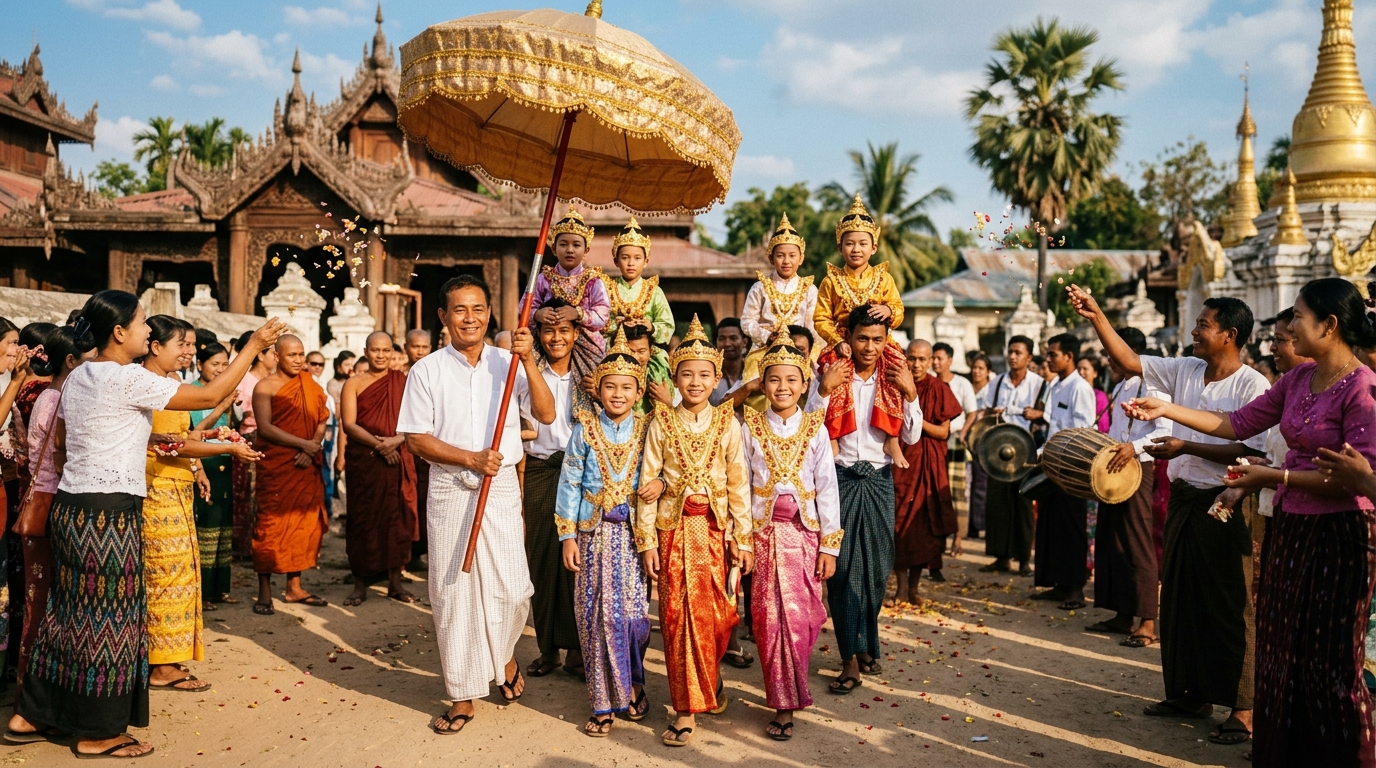
In rural Myanmar, a young boy dressed in silk robes and a jeweled crown rides through his village on horseback, surrounded by musicians and dancers. He looks like a prince, but this isn’t a celebration of royalty. Within hours, his head will be shaved, his finery replaced with simple saffron robes, and he’ll enter a monastery to live as a Buddhist novice. This is Shinbyu, one of the most important rites of passage in Burmese culture.
The Burmese Shinbyu ceremony marks a boy’s temporary ordination as a Buddhist novice, typically between ages 7 and 14. This multi-day event combines elaborate processions, ritual head shaving, and monastery entry. Families invest significant resources to honor Buddha’s renunciation story while earning religious merit. Girls may participate in ear-piercing ceremonies called Natwin during the same celebration.
Why Shinbyu Matters in Myanmar Society
Nearly every Buddhist family in Myanmar plans for this ceremony from the moment a son is born. The ritual recreates Prince Siddhartha’s renunciation of worldly pleasures before becoming Buddha. Parents believe hosting a proper Shinbyu earns them tremendous merit, improving their karma and future rebirths.
The ceremony serves multiple purposes beyond religious obligation. It teaches boys discipline, Buddhist scripture, and meditation practices. Even a brief stay in the monastery, sometimes just a few days, fulfills this cultural expectation. Some boys remain for weeks or months, while others return repeatedly throughout their youth.
Communities rally around Shinbyu celebrations. Neighbors contribute food, labor, and money. Extended family members travel from distant cities. The event strengthens social bonds and demonstrates a family’s standing within their community. Wealthier families may host elaborate multi-day festivals, while modest households arrange simpler versions that still honor the tradition.
The Prince for a Day Transformation
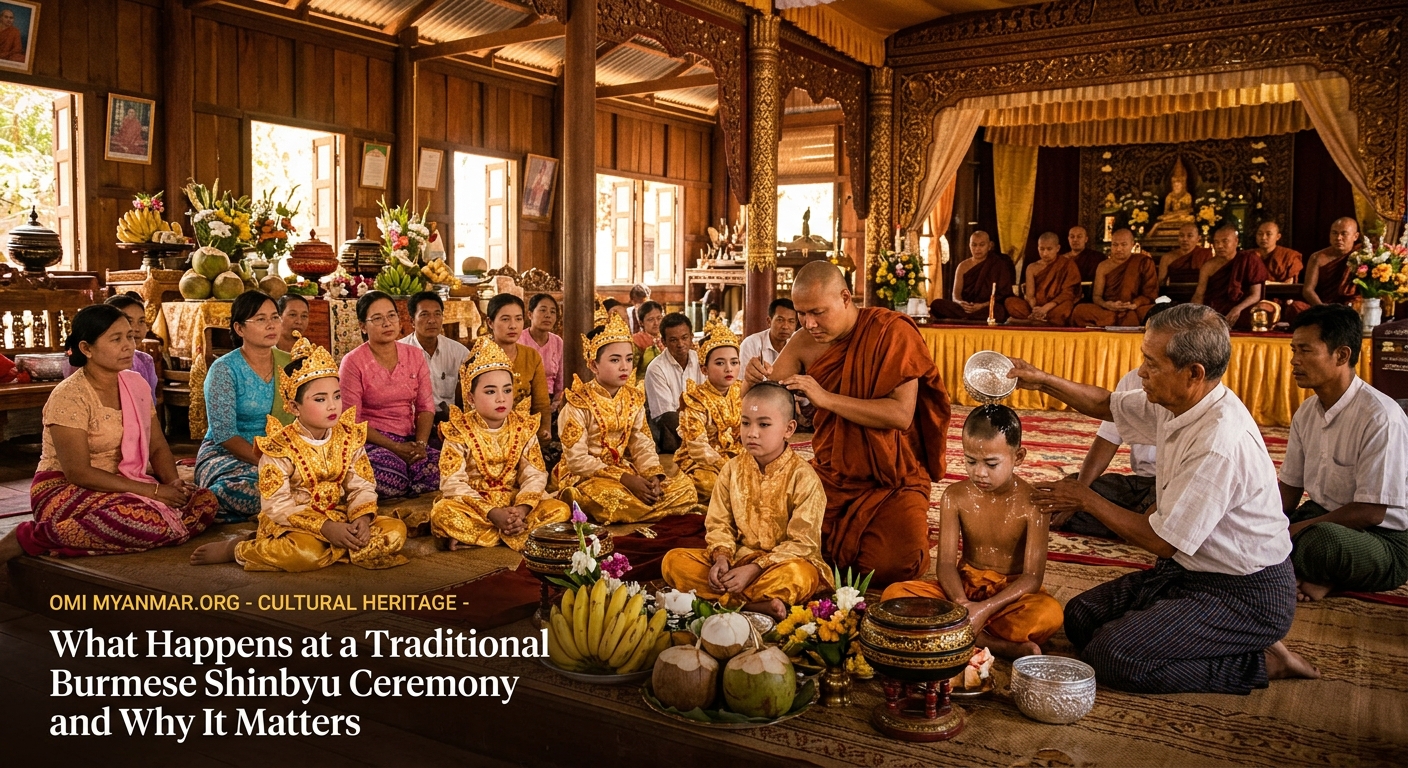
Before entering monastic life, boys dress as princes to mirror Buddha’s royal origins. This contrast makes the subsequent renunciation more meaningful. Families rent or purchase ornate costumes featuring:
- Velvet robes embroidered with gold thread
- Jeweled crowns or traditional headdresses
- White horses or decorated carts for processions
- Face makeup including traditional thanaka paste
- Silk umbrellas held by attendants
Girls participating in concurrent Natwin ceremonies wear similarly elaborate dresses and jewelry. Their transformation is less dramatic but equally significant. The ear-piercing ritual connects them to Buddhist femininity and marks their passage into young womanhood.
Photography has become central to modern Shinbyu celebrations. Families hire professional photographers to document every stage. These images appear in homes for generations, preserving the memory of this singular event.
Step by Step Through the Ceremony
The full Shinbyu process unfolds over several days, though timing varies by region and family resources. Here’s the typical sequence:
-
Preparation and invitation: Families select an auspicious date, often consulting astrologers. They invite monks, prepare food for hundreds of guests, and arrange accommodations for traveling relatives.
-
The procession (Shinlaung): Boys parade through their community on horses, elephants, or decorated vehicles. Musicians play traditional instruments. Dancers perform. Villagers line streets to observe and offer blessings.
-
Head shaving ritual: At the monastery or family home, respected elders or monks shave the boy’s head. This symbolizes releasing attachment to appearance and worldly vanity. Families collect the hair as a keepsake.
-
Robe ceremony: The boy exchanges princely garments for simple saffron robes. He receives an alms bowl and learns proper monk etiquette. This moment often brings tears from mothers watching their sons transform.
-
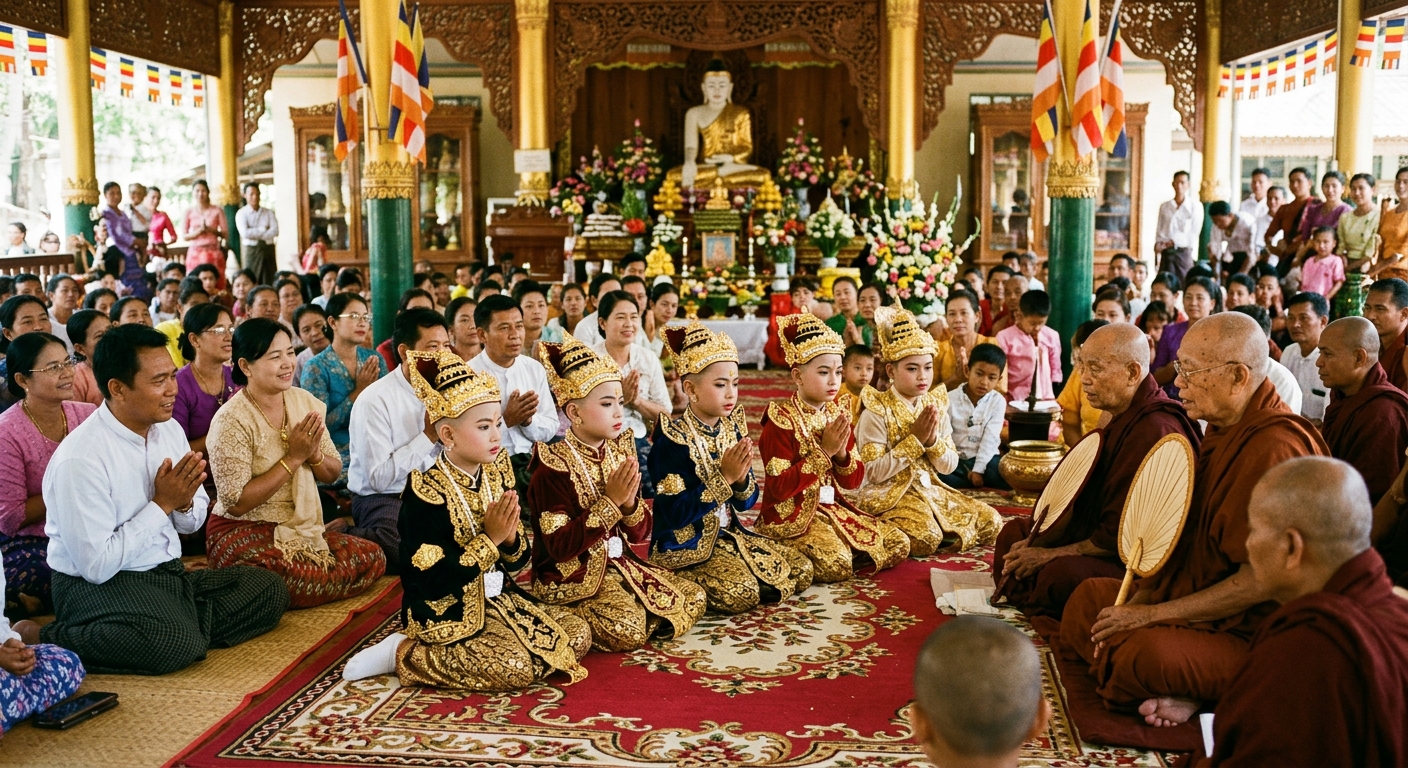
Taking precepts: The novice recites the Ten Precepts before senior monks, committing to rules including no killing, stealing, lying, intoxication, or eating after noon.
-
Monastery entry: The new novice begins his stay, waking before dawn for meditation, studying Pali scriptures, and participating in alms rounds where monks collect food donations from laypeople.
“When my son entered the monastery, I felt both pride and sadness. Pride that he would walk Buddha’s path, sadness seeing him leave childhood behind. But this ceremony connects us to every generation of our family who performed the same ritual.” – Daw Khin, mother of three, Mandalay
Regional Variations Across Myanmar
Shinbyu practices differ between Myanmar’s diverse ethnic groups and regions. Shan communities incorporate unique musical traditions. Mon people add specific prayers in their language. Coastal areas near the Andaman Sea might include boat processions.
Urban celebrations in Yangon or Mandalay tend toward grander scale with hotel receptions and hired entertainment. Rural villages maintain simpler, more traditional formats. Some families combine multiple boys’ ceremonies to share costs and increase community participation.
Timing also varies. Many families schedule Shinbyu during school holidays, particularly the hot season from March to May. Others choose dates aligned with Buddhist festivals or family events. The ceremony rarely occurs during the rainy season monsoon months when travel becomes difficult.
The Economics Behind the Celebration
Hosting Shinbyu requires substantial financial investment. Middle-class families might spend several thousand dollars, equivalent to months of income. Wealthy families spend far more, viewing the ceremony as both religious duty and social statement.
Major expenses include:
| Category | Typical Costs | Purpose |
|---|---|---|
| Costumes and accessories | $200-$2,000 | Prince outfit, jewelry, makeup |
| Food and refreshments | $500-$5,000 | Feeding monks and hundreds of guests |
| Entertainment | $100-$1,000 | Musicians, dancers, sound systems |
| Monastery donations | $100-$10,000 | Cash offerings, building repairs, supplies |
| Transportation | $50-$500 | Horses, carts, vehicle decorations |
| Photography and video | $100-$800 | Professional documentation |
Families save for years or take loans to afford proper ceremonies. Community members contribute through a system called “pwe,” where guests give cash donations to offset costs. Recipients record donations carefully, as they’re expected to reciprocate when donors host their own ceremonies.
This economic dimension has sparked some criticism. Monks and social reformers occasionally advocate for simpler celebrations focused on spiritual rather than material display. Yet most families resist reducing the ceremony’s scale, viewing it as a once-in-a-lifetime opportunity to demonstrate devotion and generosity.
What Happens Inside the Monastery
Life changes dramatically for newly ordained novices. They wake around 4 AM for meditation and chanting. After sunrise, they walk barefoot through neighborhoods collecting alms, accepting whatever food donors offer. They eat before noon, then fast until the next morning.
Daily activities include:
- Scripture study in Pali, Buddhism’s liturgical language
- Meditation practice under senior monks’ guidance
- Monastery maintenance and cleaning
- Evening chanting sessions
- Lessons on Buddhist philosophy and ethics
Modern novices face unique challenges. Many struggle without smartphones or entertainment. Rural boys adjust to communal sleeping arrangements. City children unused to discipline find the strict schedule difficult. Yet most complete their commitment, understanding the ceremony’s cultural importance.
Parents visit regularly, bringing supplies and encouragement. Some monasteries allow novices to leave on weekends. Others maintain stricter separation. Duration varies tremendously. A few days satisfies the basic requirement, though longer stays bring more merit and learning.
The Female Counterpart and Gender Dynamics
Girls’ Natwin ceremonies receive less attention than boys’ Shinbyu, reflecting Buddhism’s historical gender hierarchy. Ear piercing doesn’t carry the same spiritual weight as monastic ordination. Girls don’t renounce the world or take precepts. They simply mark a transition toward adulthood.
Yet families often celebrate both simultaneously, dressing daughters as princesses alongside their princely brothers. The combined event, called Shinbyu Natwin, maximizes merit-making opportunities and shares costs. Girls receive jewelry, new clothes, and recognition, even if the religious significance differs.
Some progressive families have begun emphasizing girls’ participation more equally. Temporary nun ordinations, though less common, do occur. Female novices shave their heads and wear pink robes, studying at nunneries. This practice remains relatively rare but shows evolving attitudes toward gender in Myanmar’s Buddhist traditions.
Witnessing Shinbyu as a Visitor
Travelers to Myanmar often encounter Shinbyu processions unexpectedly. The colorful parades, loud music, and festive atmosphere stand out dramatically in rural landscapes or city streets. Most families welcome respectful observers, viewing foreign interest as honoring their ceremony.
Photography etiquette matters. Ask permission before photographing children or monks. Avoid disrupting processions or ceremonies. Dress modestly, covering shoulders and knees. Remove shoes before entering monastery grounds. If invited to observe the head shaving or ordination, sit quietly and follow local cues.
Some tour operators arrange visits to scheduled ceremonies, particularly in tourist areas near Bagan’s sacred sites. These arranged viewings can feel less authentic but provide guaranteed access with proper cultural context. Independent travelers might encounter spontaneous celebrations while exploring villages.
Bringing a small cash donation in an envelope shows respect if you attend. Even modest amounts are appreciated. The gesture acknowledges the family’s hospitality and contributes to their significant expenses.
How Shinbyu Reflects Myanmar’s Cultural Resilience
Despite decades of political turmoil, economic hardship, and rapid modernization, Shinbyu remains nearly universal among Buddhist families. The ceremony survived British colonialism, military dictatorship, and recent conflicts. It adapts to changing circumstances while preserving core elements.
Modern additions include social media livestreaming for distant relatives, professional videography with drone footage, and hotel venue rentals. Yet the essential sequence, the head shaving, the robes, the precepts, and the monastery stay continue largely unchanged from centuries past.
This resilience speaks to Buddhism’s deep integration into Myanmar identity. The ceremony isn’t merely religious practice but cultural definition. Skipping Shinbyu would mean breaking connection with ancestors, community, and national heritage. Few families consider that option, regardless of personal belief levels.
Traditional crafts support the ceremony through costume making, jewelry crafting, and musical instrument building. These artisans depend on Shinbyu demand, creating economic incentive to maintain elaborate celebrations. The ceremony thus preserves multiple cultural elements simultaneously.
Common Misconceptions About the Ritual
Foreign observers sometimes misunderstand Shinbyu’s nature and purpose. Here are frequent misconceptions:
“Boys become permanent monks”: Most novices return to normal life after days or weeks. Full monastic commitment is separate and less common.
“Only wealthy families participate”: Even poor families arrange modest ceremonies. The scale varies, but participation crosses economic classes.
“It’s purely religious”: Social, economic, and cultural factors intertwine with spiritual motivations. Merit-making coexists with community status demonstration.
“Girls are excluded”: While boys receive more emphasis, girls participate through Natwin and increasingly through temporary nun ordination.
“The ceremony is ancient and unchanging”: Core elements persist, but contemporary additions like photography, sound systems, and venue choices show ongoing evolution.
Understanding these nuances helps visitors appreciate the ceremony’s complexity beyond surface-level observations.
Comparing Shinbyu to Other Buddhist Traditions
Similar novice ordination ceremonies exist throughout Theravada Buddhist countries. Thailand’s “Buat Nak” and Laos’s “Boun Pha Vet” share structural similarities with Shinbyu. All recreate Buddha’s renunciation. All involve temporary monastic stays. All generate family merit.
Yet Myanmar’s version includes distinctive elements. The elaborate prince costumes appear more ornate than Thai equivalents. The procession scale often exceeds neighboring countries’ celebrations. The combination with girls’ ear-piercing ceremonies is particularly Burmese.
These differences reflect Myanmar’s specific cultural development, influenced by royal court traditions, ethnic diversity, and historical isolation. The ceremony incorporates pre-Buddhist elements, animist beliefs, and local customs alongside Theravada doctrine.
Mahayana Buddhist cultures in East Asia lack direct equivalents. Their coming-of-age rituals take different forms. This makes Shinbyu especially significant for understanding Theravada practice and Myanmar’s unique interpretation of Buddhist tradition.
The Ceremony’s Future in Changing Myanmar
Younger generations face pressures that might reshape Shinbyu. Urban migration separates families from village monasteries. Economic pressures make expensive celebrations harder to justify. Western education systems leave less time for monastery stays. Digital entertainment competes with religious instruction.
Yet the ceremony shows remarkable persistence. Even families living abroad often return to Myanmar for their sons’ ordinations. Second-generation immigrants in Thailand, Singapore, or Malaysia maintain the tradition. The ritual’s identity function appears strong enough to survive modernization pressures.
Some adaptations seem likely. Shorter monastery stays may become standard. Virtual participation for distant relatives could expand. Costs might moderate as younger parents question extravagant spending. Environmental concerns could reduce waste from single-use decorations.
The core experience, a boy temporarily renouncing worldly life to honor Buddha and earn family merit, will likely endure. This central meaning transcends specific cultural expressions and connects contemporary Myanmar to centuries of Buddhist practice.
Planning Around Shinbyu Season
Travelers interested in witnessing ceremonies should time visits for peak season. March through May, during school holidays and hot weather, sees the most celebrations. Rural areas hold more frequent ceremonies than cities during this period.
Local contacts help identify upcoming events. Guesthouse owners, guides, and monastery connections can provide information. Some regions post ceremony schedules at community centers. Asking respectfully about attendance usually receives positive responses.
Attending multiple ceremonies reveals regional and economic variations. A wealthy urban celebration differs dramatically from a rural village event. Both offer authentic experiences but showcase different aspects of Myanmar society and Buddhist practice.
Combining Shinbyu observation with broader cultural exploration creates richer understanding. Traditional dance performances often accompany ceremonies. Local food specialties appear at celebration feasts. The event provides windows into multiple aspects of Myanmar life simultaneously.
When Tradition Meets Contemporary Myanmar
The Burmese Shinbyu ceremony continues shaping childhood and family life across Myanmar. Despite political uncertainty, economic challenges, and social changes, families invest enormous resources to honor this tradition. The ritual connects present generations to Buddhist teachings, cultural heritage, and community identity.
For visitors, witnessing Shinbyu offers profound insights into Myanmar’s values, beliefs, and social structures. The contrast between princely splendor and monastic simplicity, the community cooperation, the blend of joy and solemnity, all reveal a culture where Buddhism remains vibrantly alive in daily practice rather than abstract belief.
Whether you encounter a grand procession in Mandalay or a simple village ceremony in the countryside, you’re observing one of Southeast Asia’s most meaningful coming-of-age rituals. The young boys in their borrowed finery, soon to trade crowns for shaved heads and silk for saffron, embody Myanmar’s ongoing conversation between tradition and change, worldly life and spiritual aspiration.