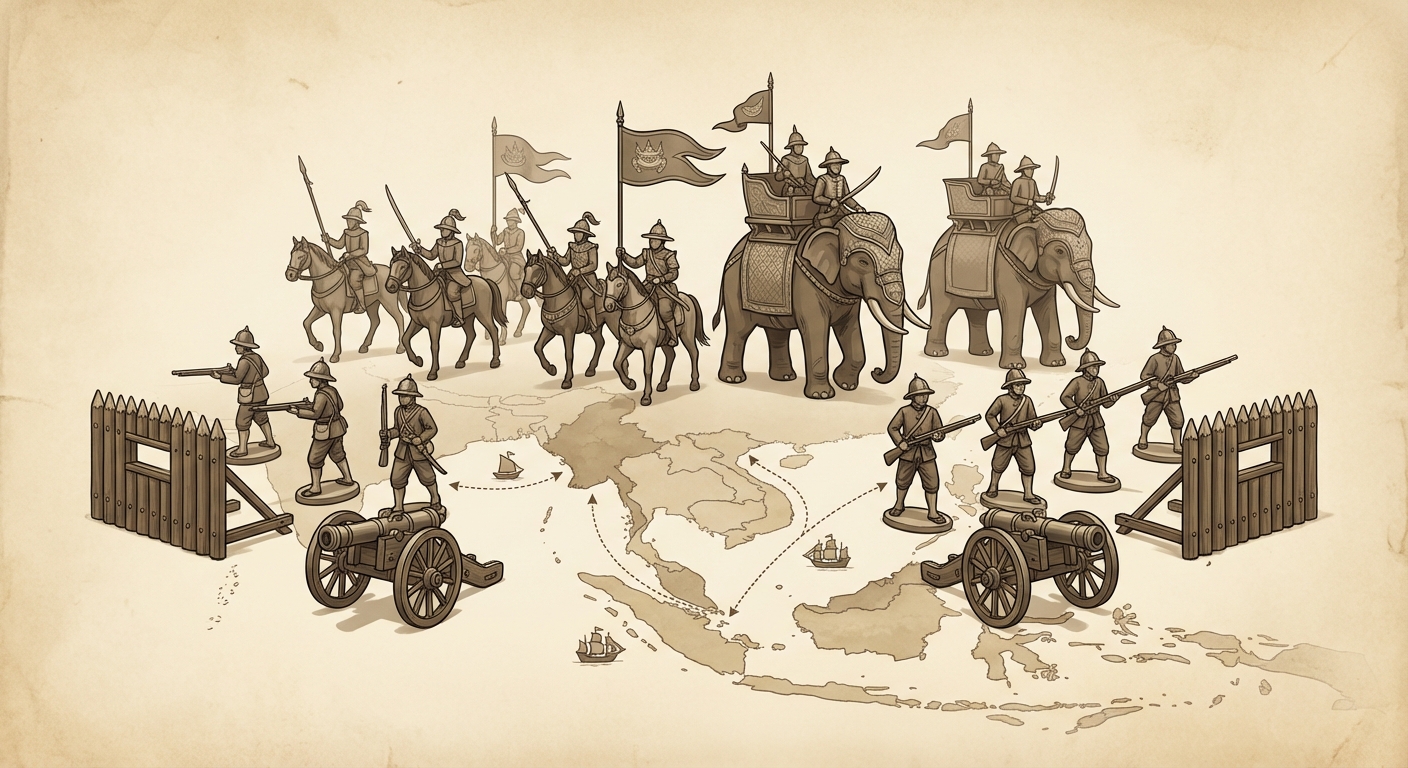
When Alaungpaya founded the Konbaung Dynasty in 1752, he inherited a fractured Burma surrounded by hostile neighbors. Within two decades, his military innovations transformed a collection of rural militias into the most formidable fighting force in mainland Southeast Asia. The dynasty’s tactical brilliance, technological adoption, and organizational reforms didn’t just reunify Burma. They permanently altered how wars were fought across the entire region.
The Konbaung Dynasty military innovations combined European firearm technology with traditional Southeast Asian cavalry tactics, creating a hybrid warfare system that dominated the region from 1752 to 1885. Their advances in artillery deployment, fortification engineering, naval warfare, and military logistics set new standards that neighboring kingdoms struggled to match. These innovations reshaped regional power dynamics and influenced military thinking across Thailand, Laos, and southern China for generations.
The Artillery Revolution That Changed Everything
The Konbaung military didn’t invent gunpowder weapons, but they perfected their use in Southeast Asian terrain.
Previous Burmese armies treated cannons as siege weapons only. Heavy, immobile, useful for battering city walls but little else. King Alaungpaya changed that calculation entirely.
He recruited Portuguese and French mercenaries who understood field artillery. These advisors helped Burmese foundries produce lighter, more mobile cannon designs. The result was a three-tier artillery system that could move with infantry columns.
Light swivel guns mounted on elephant backs provided mobile fire support. Medium field pieces traveled on specially designed carts that could navigate monsoon-muddied roads. Heavy siege cannons remained for fortress warfare but incorporated better metallurgy and more accurate boring techniques.
The impact was immediate. During the 1759 siege of Ayutthaya, Konbaung forces deployed over 2,000 cannons in coordinated bombardments. Thai defenders had never faced such concentrated firepower. The city fell after 14 months of relentless artillery barrages.
Contemporary accounts describe Burmese gunners achieving accuracy that European observers found remarkable. They could hit specific sections of fortification walls repeatedly, creating breach points for infantry assault. This precision came from standardized manufacturing processes and systematic gunnery training.
Fortress Design That Frustrated Invaders
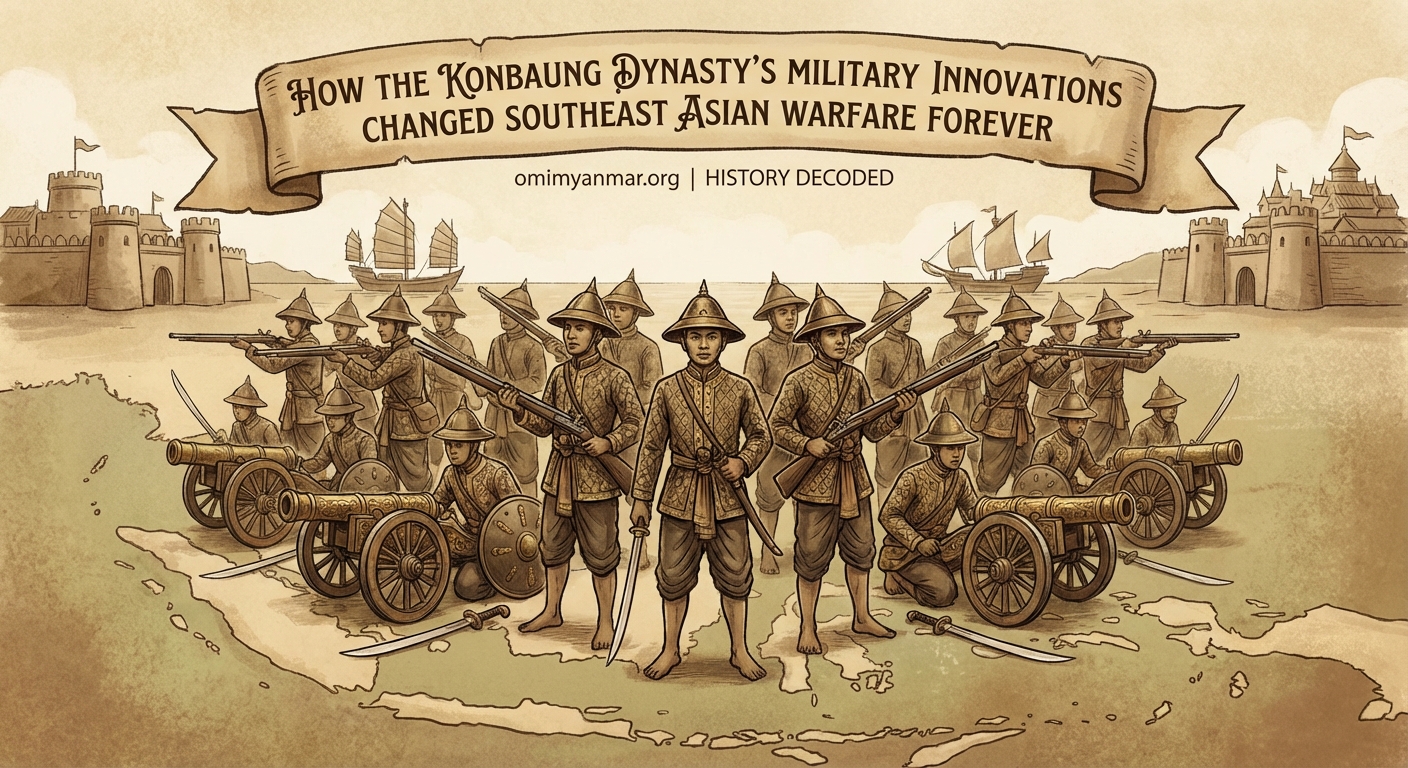
Konbaung Dynasty military innovations extended beyond offensive weapons to revolutionary defensive architecture.
Traditional Southeast Asian fortifications relied on wooden palisades and earthen ramparts. Effective against infantry and cavalry, but vulnerable to cannon fire. Konbaung engineers studied European star fort designs and adapted them to local conditions.
The new fortresses featured:
- Angled bastions that eliminated blind spots for defensive fire
- Thick earthen walls backed by brick cores to absorb cannon impacts
- Multiple defensive layers with killing zones between walls
- Moats designed to flood during monsoon season, creating impassable barriers
- Underground supply tunnels allowing defenders to withstand extended sieges
King Bodawpaya’s fortifications at Amarapura represented the pinnacle of this engineering. The outer walls stretched over 16 kilometers, incorporating 12 major gates and 48 defensive towers. Each bastion could support multiple cannon positions with overlapping fields of fire.
When Qing Chinese forces invaded in 1769, they encountered these new fortifications for the first time. Their traditional siege tactics failed completely. After months of unsuccessful assaults, the Chinese commanders negotiated a face-saving withdrawal rather than continue losing troops to Konbaung defensive innovations.
The Standardization Revolution
Perhaps the most overlooked Konbaung Dynasty military innovation was organizational reform.
Before Alaungpaya, Burmese armies operated as loose federations of regional levies. Each lord brought his own troops with their own weapons, training, and tactics. Coordination was chaotic. Supply was haphazard.
The Konbaung system introduced radical standardization:
- Uniform weapon specifications meant parts could be swapped between muskets and cannons
- Standardized training regimens created predictable unit performance across the army
- Centralized supply depots positioned along major campaign routes ensured consistent provisioning
- Hierarchical command structures replaced feudal obligations with merit-based promotion
- Regular drill schedules maintained readiness even during peacetime
This organizational framework allowed Konbaung armies to mobilize faster and campaign longer than their opponents. While Thai or Mon forces needed weeks to assemble scattered levies, Konbaung regiments could march within days of receiving orders.
The supply system deserves special attention. Konbaung quartermasters established grain storage facilities every 30 kilometers along invasion routes into Siam and Manipur. Each depot maintained enough rice, dried fish, and fodder to sustain 10,000 troops for one week. This infrastructure enabled campaigns that previous Burmese kings could only imagine.
Naval Warfare Gets a Complete Overhaul
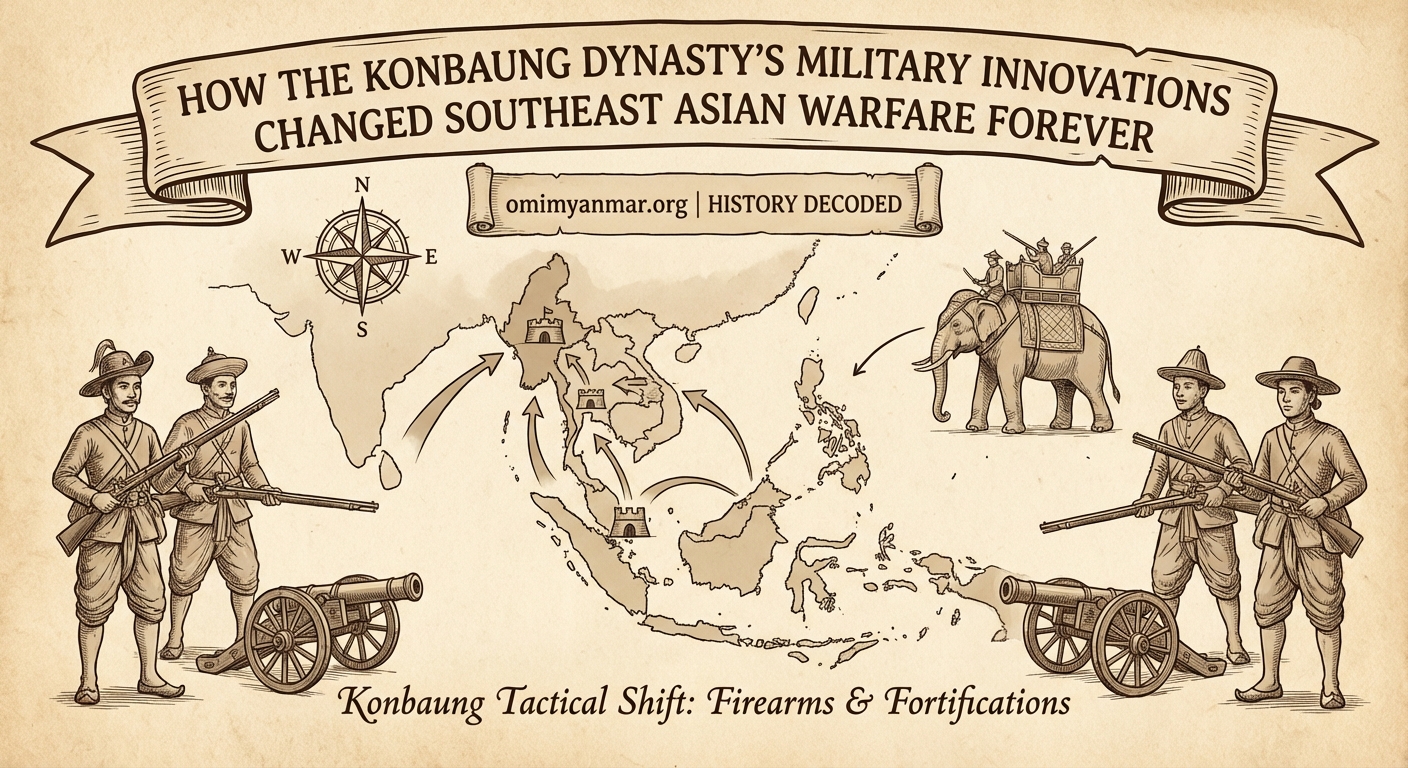
The Irrawaddy River wasn’t just a transportation route. It was a strategic highway that Konbaung planners transformed into a military advantage.
Early Konbaung naval forces consisted of traditional war canoes and merchant vessels pressed into military service. Effective for river patrols but inadequate for major operations. King Hsinbyushin commissioned a complete naval redesign in the 1760s.
Burmese shipwrights created specialized war galleys that combined European hull designs with local construction techniques. These vessels featured:
- Reinforced hulls capable of mounting heavy cannon
- Covered gun decks protecting crews from small arms fire
- Shallow drafts allowing operation in seasonal waterways
- Modular construction enabling rapid repairs at forward bases
The new fleet transformed riverine warfare. During the 1767 invasion of Ayutthaya, Konbaung naval forces blockaded the city from the Chao Phraya River while artillery batteries bombarded from land. Thai defenders couldn’t break the river blockade, cutting off their supply lines and escape routes.
Konbaung naval innovations also included specialized transport vessels for moving artillery pieces and cavalry horses. Previous campaigns struggled with river crossings that could take days. The new transport fleet reduced major crossings to hours, maintaining campaign momentum.
Cavalry Integration That Maximized Mobility
Southeast Asian warfare traditionally separated cavalry and infantry operations. Konbaung commanders developed combined arms tactics that integrated mounted and foot soldiers into cohesive units.
The key innovation was the three-element formation:
| Element | Composition | Primary Role |
|---|---|---|
| Vanguard | Light cavalry with carbines | Reconnaissance and skirmishing |
| Main Body | Infantry with muskets and pikes | Sustained combat and holding ground |
| Reserve | Heavy cavalry with lances | Exploitation and pursuit |
This formation allowed Konbaung armies to adapt to changing battlefield conditions. Light cavalry screened advances and harassed enemy formations. Infantry absorbed counterattacks and maintained defensive positions. Heavy cavalry delivered decisive charges when opportunities emerged.
The system required extensive training to coordinate properly. Konbaung drill masters developed specific signals using drums, gongs, and flags. Units could shift from column to line formation, from defensive squares to offensive wedges, with remarkable speed.
Contemporary observers noted that Konbaung cavalry could reload muskets while mounted, a skill that European dragoons were still perfecting. This capability came from specialized saddle designs and systematic training that started with young recruits.
Intelligence Networks That Predicted Enemy Moves
Konbaung Dynasty military innovations weren’t limited to weapons and tactics. The dynasty developed sophisticated intelligence gathering systems that gave commanders strategic advantages.
Each major city maintained a network of informants who reported on:
- Enemy troop movements and concentrations
- Supply stockpiles and logistics preparations
- Political divisions among opposing leadership
- Economic conditions affecting enemy mobilization capacity
- Weather patterns and seasonal flooding predictions
This information flowed through dedicated courier networks to central command posts. Konbaung generals often knew enemy plans before opposing commanders finalized them. The intelligence advantage allowed preemptive strikes and strategic positioning that appeared almost prescient.
During the 1785 campaign against Arakan, Konbaung forces intercepted enemy supply convoys with uncanny accuracy. They knew exact routes, timing, and cargo contents. Arakanese resistance collapsed within weeks, partly because defenders couldn’t maintain supply lines against such precise interdiction.
The intelligence system also incorporated psychological warfare. Konbaung agents spread disinformation about troop strengths, planned attack directions, and royal intentions. Enemy commanders wasted resources defending against phantom threats while actual attacks materialized elsewhere.
“The Burmese knew our movements before we made them. Their spies were everywhere, their information always accurate. Fighting them was like playing cards against someone who could see your hand.” – Account from a Thai military officer, circa 1770
Training Programs That Built Professional Armies
The shift from feudal levies to professional soldiers required systematic training programs that became another Konbaung Dynasty military innovation.
Young recruits entered three-year training cycles that transformed farmers into disciplined soldiers. The curriculum covered:
- Musket drill and maintenance procedures
- Pike formations and close-quarters combat
- Artillery loading and firing sequences
- Fortification construction techniques
- Map reading and terrain navigation
- Swimming and river crossing methods
Training camps near major cities maintained permanent facilities with practice ranges, obstacle courses, and mock fortifications. Instructors were veterans who had proven themselves in actual combat. The merit-based instructor selection ensured quality teaching rather than relying on aristocratic appointments.
Physical conditioning received particular emphasis. Recruits marched 30 kilometers daily carrying full equipment. They practiced combat drills in monsoon rains and dry season heat. The goal was creating soldiers who could campaign year-round regardless of weather conditions.
The training investment paid enormous dividends. Konbaung regiments could execute complex maneuvers under fire that would have dissolved less disciplined forces. When British forces first encountered Konbaung armies during the First Anglo-Burmese War, they were surprised by the tactical sophistication and unit cohesion.
Logistics Systems That Sustained Long Campaigns
Moving armies is easy. Feeding them is hard. Konbaung Dynasty military innovations in logistics enabled campaigns that previous rulers couldn’t sustain.
The system operated on three principles:
- Forward positioning placed supplies ahead of advancing armies
- Local requisition supplemented stored provisions with controlled foraging
- Rotating supply columns maintained continuous flow from rear bases to front lines
Each principle addressed specific challenges. Forward positioning meant armies didn’t outrun their supply lines. Local requisition reduced transport burdens while denying resources to enemies. Rotating columns prevented bottlenecks at critical points.
The infrastructure supporting this system was extensive. Major roads received regular maintenance to ensure cart traffic during monsoons. River ports maintained warehouses stocked with preserved foods. Regional governors faced severe penalties for failing to support military logistics.
Konbaung quartermasters also innovated in food preservation. They developed techniques for drying fish and meat that extended storage life to six months. Rice was parboiled before storage, reducing spoilage and cooking time in the field. These seemingly minor improvements allowed armies to operate hundreds of kilometers from home bases.
Medical Services That Reduced Campaign Losses
Disease killed more soldiers than combat in 18th-century Southeast Asia. Konbaung military planners addressed this reality with medical innovations that improved survival rates.
Each regiment included trained medical personnel who understood basic wound treatment and disease prevention. Field hospitals followed advancing armies, providing treatment facilities within one day’s march of combat zones. Evacuation procedures moved seriously wounded soldiers to rear-area hospitals equipped for surgery and extended care.
The medical system incorporated both traditional Burmese medicine and techniques learned from European advisors. Herbal remedies treated dysentery and malaria. Surgical instruments allowed extraction of musket balls and amputation of damaged limbs. Hygiene protocols reduced infection rates in field hospitals.
Konbaung medical officers also pioneered systematic record-keeping. They tracked which treatments worked, which diseases affected specific regions, and which seasons posed greatest health risks. This data informed campaign planning and troop positioning.
The results were measurable. Konbaung armies sustained lower non-combat casualty rates than their opponents. Soldiers who received prompt medical attention had better survival odds than those in armies lacking organized medical services. This advantage accumulated over long campaigns, leaving Konbaung forces at higher strength when opponents were depleted.
Common Mistakes When Studying Konbaung Military History
Modern researchers sometimes misinterpret Konbaung Dynasty military innovations by applying inappropriate analytical frameworks.
| Mistake | Why It Happens | Correction Needed |
|---|---|---|
| Viewing innovations as simple European copying | Eurocentrism in military history | Recognize hybrid adaptations to local conditions |
| Ignoring logistical achievements | Focus on dramatic battles | Study supply systems and infrastructure |
| Underestimating training programs | Lack of detailed records | Analyze unit performance and tactical execution |
| Dismissing intelligence networks | Limited documentation | Examine campaign outcomes and strategic decisions |
| Overlooking naval developments | Emphasis on land warfare | Consider riverine operations and amphibious tactics |
The Konbaung military system wasn’t a simple import of European methods. It was a sophisticated synthesis that took Western firearms technology and integrated it with Southeast Asian tactical traditions, local terrain realities, and regional political structures.
Understanding this synthesis requires looking beyond battlefield narratives to examine organizational structures, economic foundations, and cultural contexts. The innovations worked because they fit Burmese society and geography, not because they copied foreign models wholesale.
Regional Impact That Outlasted the Dynasty
Konbaung Dynasty military innovations influenced warfare across mainland Southeast Asia long after the dynasty itself fell to British conquest in 1885.
Thai military reformers studied Konbaung fortification designs when modernizing Bangkok’s defenses in the early 19th century. The angled bastions and layered walls became standard features in Siamese military architecture. Similar influences appeared in Lao and Cambodian fortress construction.
Vietnamese military planners adopted Konbaung-style combined arms tactics during their conflicts with French colonial forces. The integration of cavalry, infantry, and artillery in coordinated formations proved effective against European opponents who expected less sophisticated resistance.
Even the British learned from their Konbaung adversaries. After struggling through three Anglo-Burmese Wars, British colonial administrators recognized the effectiveness of certain Konbaung methods. They incorporated elements of the intelligence network and local supply systems into their own colonial military structures.
The training programs influenced military education across the region. The concept of systematic soldier development, merit-based promotion, and professional military careers became standard in modernizing Southeast Asian armies. These ideas traced directly back to Konbaung innovations from a century earlier.
The legacy extended beyond purely military matters. Konbaung administrative systems for managing large-scale logistics influenced civilian governance structures. The record-keeping practices, hierarchical organization, and performance evaluation methods found applications in tax collection, public works projects, and agricultural management.
Why These Innovations Still Matter for Understanding Myanmar
Studying Konbaung Dynasty military innovations provides insights that extend beyond military history into Myanmar’s broader cultural development.
The emphasis on standardization and systematic organization reflected deeper cultural values about order and hierarchy. These values continue influencing Myanmar society today, visible in everything from traditional craft preservation to modern institutional structures.
The hybrid approach that combined foreign technology with local traditions established patterns that repeat throughout Myanmar’s history. Modern Myanmar continues adapting external influences while maintaining cultural distinctiveness, whether in business practices, educational systems, or social organizations.
Understanding how the Konbaung Dynasty built effective institutions through merit-based systems and accountability structures offers relevant lessons for contemporary governance challenges. The historical precedent shows Myanmar has traditions of effective administration and transparent operations, even if recent decades have seen setbacks.
The military innovations also demonstrate Myanmar’s historical role as a regional power rather than a peripheral actor. This perspective matters for understanding Myanmar’s place in Southeast Asian geopolitics and its relationships with neighboring countries. The historical context helps explain modern diplomatic relationships and regional cooperation frameworks.
For visitors interested in Myanmar’s historical sites, understanding Konbaung military innovations adds depth to experiences at locations like Mandalay Palace, Amarapura fortifications, and various battlefield sites. The physical remnants of walls, moats, and defensive structures tell stories about engineering sophistication and strategic thinking that shaped the region.
The innovations also connect to broader patterns in Myanmar’s cultural heritage. The same organizational principles that created effective armies also supported the construction of magnificent religious sites and preservation of artistic traditions. Military efficiency and cultural achievement weren’t separate spheres but interconnected aspects of Konbaung society.
What the Battlefield Innovations Teach About Adaptation
The Konbaung Dynasty succeeded not through rigid adherence to tradition or wholesale adoption of foreign methods, but through intelligent adaptation.
They recognized that European firearms technology offered advantages over traditional weapons. But they also understood that European tactics designed for flat European battlefields wouldn’t work in monsoon-soaked river valleys and mountainous jungle terrain. So they adapted the technology while developing original tactics suited to local conditions.
This adaptive approach appears throughout Konbaung military history. When elephant-mounted artillery proved too unstable for accurate fire, they switched to cart-mounted systems. When traditional wooden fortifications failed against cannon bombardment, they redesigned defensive architecture. When feudal levies proved unreliable, they built professional standing armies.
Each innovation addressed specific problems through creative problem-solving rather than blind imitation. The Konbaung military establishment maintained openness to new ideas while critically evaluating what would actually work in their operational environment.
This adaptive mindset offers lessons beyond military history. It demonstrates how societies can successfully modernize while maintaining cultural identity. The key is selective adoption based on clear-eyed assessment of what serves actual needs rather than what appears impressive or fashionable.
Modern Myanmar continues facing similar adaptation challenges in economic development, technological integration, and institutional reform. The Konbaung precedent shows that successful adaptation requires understanding both external innovations and local realities, then creating hybrid solutions that work in specific contexts.
The military innovations succeeded because Konbaung leaders asked the right questions. Not “what do Europeans do?” but “what problems do we face and what tools might help solve them?” This problem-focused approach rather than solution-focused imitation made the difference between superficial copying and genuine innovation.
How Military History Connects to Myanmar’s Present
The Konbaung Dynasty military innovations remain relevant for understanding contemporary Myanmar beyond simple historical interest.
The organizational principles that created effective 18th-century armies share characteristics with successful modern institutions. Clear hierarchies, merit-based advancement, systematic training, and accountability mechanisms work whether you’re managing soldiers or building businesses. The historical examples provide templates for institutional development.
The emphasis on logistics and infrastructure investment offers lessons for economic development. Konbaung military success depended on roads, storage facilities, and supply networks. Modern economic growth requires similar infrastructure investments in transportation, warehousing, and distribution systems. The parallel isn’t exact but the underlying principle holds.
The intelligence networks that gave Konbaung commanders strategic advantages find modern equivalents in information systems and data analysis. Organizations that gather accurate information, analyze it systematically, and act on insights maintain competitive advantages just as Konbaung armies did centuries ago.
The medical services that reduced campaign casualties parallel modern public health systems. Systematic record-keeping, preventive measures, and organized treatment facilities improve outcomes whether you’re managing military campaigns or civilian health crises. The Konbaung precedent shows Myanmar has historical experience with effective health system organization.
Understanding these historical innovations helps counter narratives that portray Myanmar as perpetually backward or incapable of sophisticated organization. The Konbaung military achievements demonstrate that Myanmar societies have created world-class institutions and systems when circumstances allowed. The challenge is recreating conditions that enable similar achievements in contemporary contexts.
The military history also provides common ground for cross-cultural dialogue. Military historians worldwide recognize Konbaung innovations as significant contributions to warfare development. This recognition offers entry points for conversations about Myanmar’s broader historical contributions and contemporary potential.
The Lasting Mark on Southeast Asian Military Thinking
Konbaung Dynasty military innovations didn’t disappear when the British conquered Mandalay in 1885. They embedded themselves in regional military culture and continue influencing how Southeast Asian armies think about warfare.
The combined arms approach that integrated cavalry, infantry, and artillery became standard doctrine across the region. Modern Southeast Asian militaries still emphasize coordination between different force components, a principle the Konbaung Dynasty helped establish as fundamental rather than optional.
The focus on fortification and defensive warfare shaped regional strategic thinking. Southeast Asian military planners traditionally emphasize territorial defense and fortified positions over expeditionary operations. This defensive orientation traces partly to Konbaung innovations in fortress design and defensive tactics that proved their effectiveness against multiple opponents.
The logistics emphasis influenced how regional armies approach campaign planning. The principle that supply systems determine operational possibilities rather than just supporting them became embedded in military education. Officers learn to plan logistics first, then design operations around sustainable supply capabilities.
The intelligence gathering systems established patterns that modern militaries expanded with technology but didn’t fundamentally change. The emphasis on human intelligence networks, local informants, and systematic information analysis remains central to Southeast Asian military intelligence operations.
Even the training philosophies show Konbaung influence. The focus on physical conditioning, repetitive drill, and building unit cohesion through shared hardship characterizes military training across the region. These methods work because they create reliable soldiers, a lesson the Konbaung Dynasty proved through battlefield success.
Understanding these continuing influences helps explain why Southeast Asian militaries sometimes approach problems differently than Western forces. The different approach isn’t backwardness or lack of sophistication. It reflects different historical experiences and proven methods that emerged from regional conditions and requirements.
The Konbaung legacy reminds us that military innovation happens everywhere, not just in Europe or North America. Southeast Asian military thinkers made genuine contributions to warfare development that influenced how wars were fought across a vast region. Recognizing these contributions provides more accurate and complete understanding of global military history.
Leave a Reply