
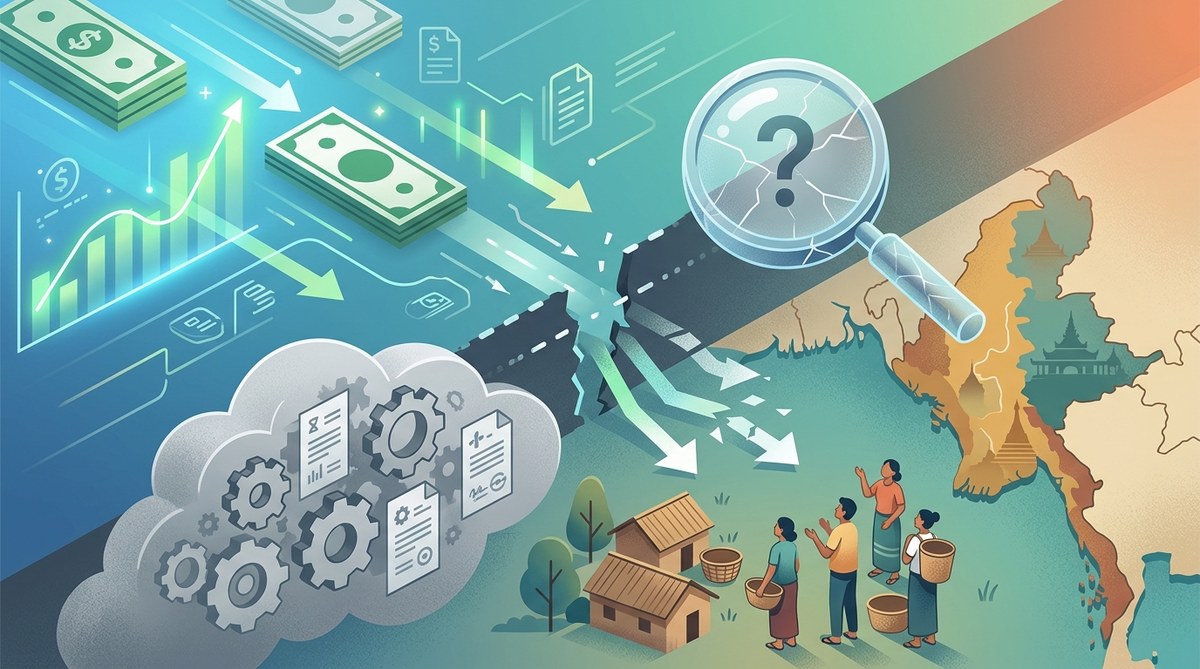
The Union Budget for 2026 was released last month in Naypyidaw. It is a thick document, hundreds of pages long, filled with spreadsheets and projections. For most people in Myanmar, however, those pages might as well be written in a foreign language. Not because of the Burmese text, but because the numbers rarely match what happens on the ground. A school in Ayeyarwady Region was promised new classrooms. The budget said the money was allocated. Yet the classrooms never appeared. The funds simply vanished into a system where no one is held accountable.
This is not an accident. It is a pattern. And it is a pattern that defines the Myanmar budget transparency failure that researchers, NGO analysts, and journalists have been tracking for years.
Myanmar’s lack of budget transparency is not just a governance flaw. It is a direct cause of poverty and inequality. When funds for schools, clinics, and roads disappear into opaque accounts, local communities lose more than money. They lose trust in the state. Understanding this failure is the first step toward demanding real accountability.
Where Does the Money Go? The Black Box of Public Spending
Think of the national budget as a promise. The government promises to spend your tax money on things that benefit everyone: roads, hospitals, teacher salaries, disaster relief. In a transparent system, citizens can check whether that promise is kept. They can look at line items, compare spending to outcomes, and ask questions.
Myanmar does not have that.
The country ranks near the bottom of the Open Budget Index year after year. The 2024 survey placed Myanmar among the least transparent nations in the world for fiscal governance. Citizens and even local parliamentarians struggle to get basic information about how money is allocated and spent.
Here is what that looks like in practice:
- Missing project data: Large infrastructure projects are approved without public feasibility studies or cost-benefit analyses.
- Vague categories: Budget lines are grouped into broad categories like “other expenses” or “administrative costs” that can hide almost anything.
- No real-time tracking: There is no publicly accessible digital platform where citizens can see if funds have been released to a township or school.
- Weak audit follow-up: The Auditor General’s office publishes reports, but recommendations are rarely enforced. Officials face few consequences for misusing funds.
For a policy researcher trying to trace the flow of money from the central treasury to a rural health clinic, the process is frustrating. Documents are often classified. Requests for information are ignored. And when data does surface, it is frequently outdated or incomplete.
How Budget Opacity Harms Local Communities
The consequences of the Myanmar budget transparency failure are not abstract. They show up in measurable ways that affect daily life.
Consider the education sector. The government has committed to spending a certain percentage of GDP on schools. Yet in many townships, teachers report going months without pay. School buildings lack roofs or toilets. Textbooks never arrive. The budget says the money was sent, but it gets siphoned off at regional or district levels before it reaches the classroom.
The same pattern repeats in healthcare. Funds designated for medicine and equipment disappear. Clinics run out of basic supplies. Patients are told to buy their own bandages or pay bribes for a bed.
Local communities are left with few options. They cannot file a formal complaint because there is no clear process. They cannot protest the budget because they do not know what is in it. The opacity of the system is a weapon. It disarms citizens and protects the powerful.
A 2025 study by a coalition of Myanmar civil society groups found that in 14 out of 20 townships surveyed, less than half of the allocated development funds actually reached the intended projects. The rest was lost to a combination of corruption, administrative fees, and “leakage” at various levels of government.
Three Steps to Investigate Budget Flows in Myanmar
For an NGO analyst or journalist on the ground, tracking the money requires patience and creativity. Here is a practical process that has worked for local transparency groups:
-
Start with the Union Budget Law. This is the only document that is technically public. Download it from the Ministry of Planning and Finance website. Compare the budgeted amounts for specific ministries or regions with actual disbursement reports published later in the year. Look for large discrepancies.
-
Cross-reference with township-level data. This is harder to get. Reach out to local civil society organizations or ward administrators. Ask for copies of the “township development plan” or “village tract fund” records. These are often handwritten ledgers. Compare them to what the central budget says should have been sent.
-
Use proxy indicators. If you cannot get the financial data directly, look at outcomes. Is a road being built? Are children vaccinated? Is the electricity grid expanding? If the budget allocated money for these things but nothing changed on the ground, you have found a red flag. Document it with photographs, interviews, and dates.
This approach is not perfect. It relies on fragments of information. But it is often the only way to build a case.
Common Mistakes in Analyzing Myanmar’s Budget Data
Researchers new to this field often make similar errors. The table below outlines the most common pitfalls and how to avoid them.
| Mistake | Why It Happens | How to Avoid It |
|---|---|---|
| Trusting official numbers | Budget documents look authoritative but are often political statements, not financial records. | Always verify with third-party sources like World Bank reports or independent audits. |
| Ignoring the exchange rate | Myanmar’s official exchange rate differs from the market rate. Budget figures can be misleading. | Convert all figures using the parallel market rate for a realistic picture. |
| Focusing only on the central level | Most leakage happens at regional or township levels, not in Naypyidaw. | Request data from local budget offices and compare it to central allocations. |
| Overlooking off-budget funds | Special funds, military expenditures, and state-owned enterprise revenues are often excluded. | Look for mentions of “special projects” or “emergency funds” in parliamentary records. |
“The biggest mistake is assuming the budget is a technical document. It is a political one. Every number is a choice about who gets resources and who gets left out. Understanding that is the only way to read it correctly.” — Senior researcher at a Yangon-based governance think tank
The Role of Civil Society and Digital Tools
Despite the obstacles, there is growing momentum for change. Local groups are using creative methods to pierce the veil of secrecy.
One approach is participatory budgeting. In a few townships, community members have been invited to help decide how small portions of the local budget are spent. These pilot programs, supported by international donors, have shown promising results. When people have a say, projects are more likely to be completed and funds are less likely to disappear.
Digital tools are also making a difference. A handful of civic tech platforms now allow citizens to report problems with public services and track whether funds are being used. These tools are still limited in scope, but they represent a shift toward greater accountability. For more on this, see our analysis of how open data platforms are revolutionizing transparency in Myanmar’s local governments.
The challenge is scale. These initiatives cover only a tiny fraction of the country. The system as a whole remains closed. But each success story provides a model that could be replicated.
Why This Matters for International Observers
If you are an international policy researcher or a journalist covering Southeast Asia, Myanmar’s budget transparency failure should be a central part of your reporting. It is not a niche issue. It is the engine that drives many of the country’s worst problems: corruption, inequality, ethnic conflict, and the erosion of public trust.
When foreign aid is given to the central government without strict transparency conditions, it often ends up funding the same opaque system. The money does not reach the people who need it. This is not a secret. It is well documented by groups like the International Budget Partnership and Transparency International.
For those working on governance reforms, the lesson is clear. Technical fixes alone will not work. You cannot simply install a new software system or pass a law and expect transparency to follow. You need political will, grassroots pressure, and a free press to hold officials accountable. For a deeper look at the broader landscape, read our piece on how international watchdogs are monitoring Myanmar’s governance reforms in 2026.
A Path Forward: What Citizens and Researchers Can Do
The situation is grim, but it is not hopeless. There are concrete actions that different groups can take.
For local citizens:
– Form or join a community budget watch group.
– Request information from your township office. Even if they say no, the request creates a paper trail.
– Share what you learn with local media or civil society networks.
For researchers and analysts:
– Standardize your methodology so findings can be compared across regions.
– Publish your data in open formats so others can build on it.
– Collaborate with Burmese-language media to ensure findings reach local audiences.
For international organizations:
– Tie funding to specific, verifiable transparency benchmarks.
– Support local groups that are doing the hard work of tracking budgets.
– Do not accept “sensitive” as a reason for secrecy. Push for disclosure.
The goal is not just better data. It is better lives. When a village gets the school it was promised, when a clinic has medicine, when a road is actually paved, that is transparency working. That is what accountability looks like.
Building a Culture of Accountability in Myanmar
Myanmar’s budget transparency failure will not be solved overnight. It is the product of decades of military rule, weak institutions, and a culture of impunity. But change is possible. It starts with small acts of courage: a citizen asking a question, a journalist publishing a number, a researcher sharing a spreadsheet.
Each piece of information that becomes public is a small victory. Each leak in the wall of secrecy lets in a little more light. Over time, those small victories add up. They create pressure. They shift norms. They make it harder for officials to hide.
The work is difficult. It can be dangerous. But it is necessary. For the people of Myanmar, transparency is not an abstract concept. It is the difference between a child who learns to read and one who does not. It is the difference between a family that gets healthcare and one that goes without. It is the difference between a community that trusts its government and one that fears it.
If you are reading this and wondering where to start, start where you are. Look at your local budget. Ask a question. Share what you find. The system only stays hidden as long as we let it.