
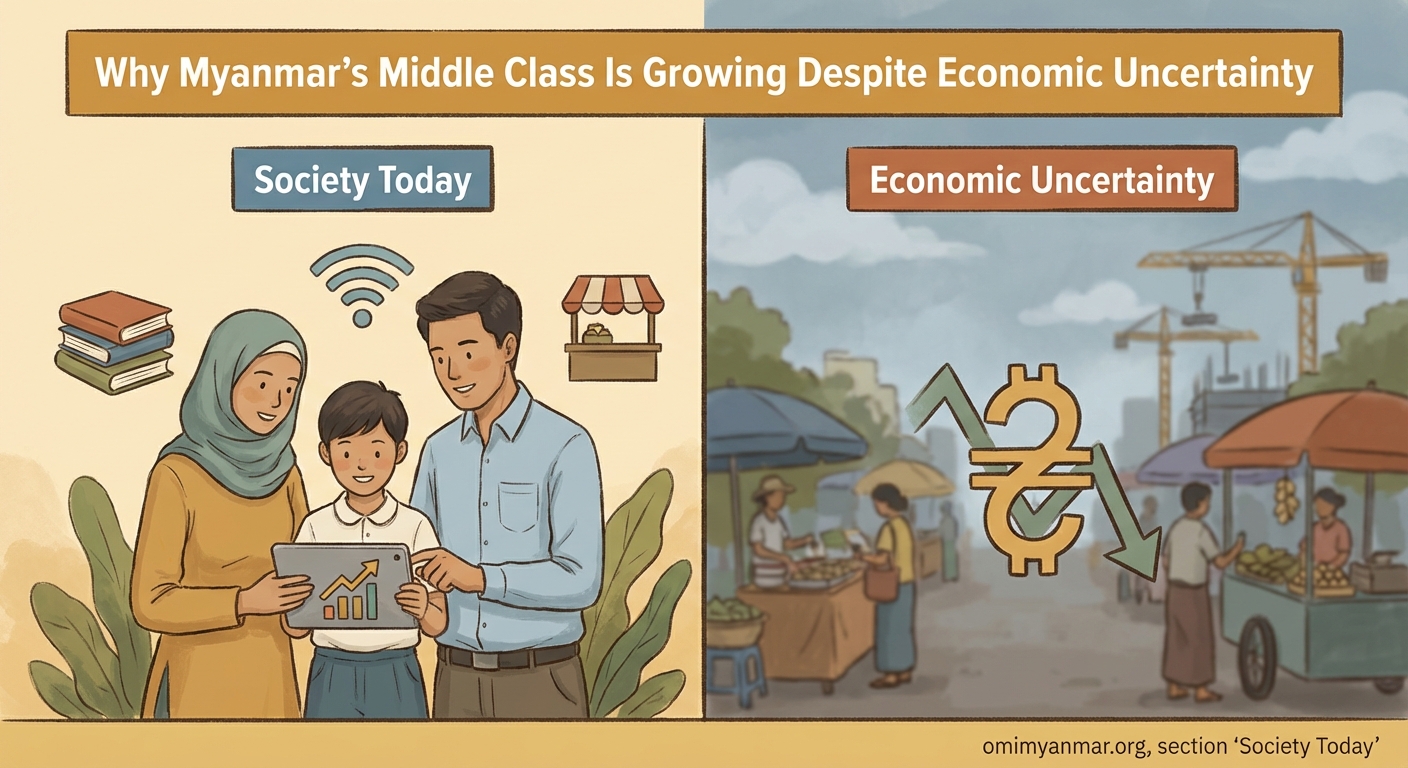
Myanmar’s economy presents one of the most puzzling contradictions in Southeast Asia today. While headlines focus on conflict and sanctions, a significant portion of the population continues climbing into middle class income brackets. This isn’t happening despite the chaos. In many ways, it’s happening because of how people have adapted to it.
Myanmar middle class growth persists through remittances, informal economy expansion, digital commerce, and strategic consumer behavior. Urban populations leverage mobile banking and cross-border trade networks while rural communities benefit from agricultural modernization. Understanding these resilience mechanisms reveals investment opportunities and market dynamics that traditional economic indicators miss entirely. Political instability paradoxically accelerates certain entrepreneurial adaptations that fuel household income growth.
Understanding the numbers behind middle class expansion
Defining middle class status in Myanmar requires looking beyond simple income thresholds. The Asian Development Bank typically uses $10 to $100 daily purchasing power parity as the range. By that measure, roughly 25 to 30 percent of Myanmar’s population now falls into this category, up from approximately 15 percent a decade ago.
These figures seem impossible given recent economic contractions. GDP growth turned negative after 2021. Inflation spiked above 20 percent in several periods. Currency depreciation made imports expensive.
Yet household consumption data tells a different story. Sales of motorcycles, smartphones, and home appliances have remained surprisingly stable in urban centers. Restaurant spending continues. Private school enrollment hasn’t collapsed.
The explanation lies in how income actually flows through Myanmar’s economy. Official statistics capture only a fraction of economic activity. The informal sector accounts for an estimated 60 to 70 percent of employment. Cash transactions dominate. Many households maintain multiple income streams that never appear in government records.
How remittances fuel household prosperity

Myanmar has one of the highest emigration rates in Southeast Asia. Millions work in Thailand, Malaysia, Singapore, and the Middle East. Their remittances form a crucial pillar of middle class stability.
The World Bank estimates formal remittance flows at $2 to 3 billion annually. Informal channels likely double or triple that figure. Money transfer agents operate throughout the country, moving funds through networks that bypass traditional banking entirely.
These remittances don’t just cover basic needs. They fund:
- Down payments on urban apartments
- Capital for small business ventures
- Education expenses for younger siblings
- Medical care at private clinics
- Consumer electronics and household upgrades
A construction worker in Bangkok earning $400 monthly can send home $200. That amount exceeds what many local jobs pay for full-time work. Multiply this across hundreds of thousands of workers and the impact becomes substantial.
The political situation actually increased emigration in some demographics. Young professionals who might have stayed now seek opportunities abroad. Their higher earnings translate into larger remittances. Families back home experience income growth even as local job markets deteriorate.
Digital commerce creates new economic pathways
Mobile penetration in Myanmar exceeds 100 percent when accounting for multiple SIM cards. Smartphone ownership has become nearly universal in cities and increasingly common in rural areas. This connectivity opened entirely new income channels.
Facebook Marketplace dominates e-commerce. Sellers operate without formal business registration, avoiding taxes and regulations. A teacher might sell cosmetics online after school. A retired government worker could run a clothing import business from home. A university student might manage social media for local shops.
“The digital economy in Myanmar operates almost entirely outside official frameworks. This creates resilience because it doesn’t depend on institutional stability. When formal systems fail, informal digital networks adapt and continue functioning.” – Regional economist studying Southeast Asian informal markets
Payment systems evolved to match this reality. Mobile money services process billions in transactions monthly. Peer-to-peer transfers happen instantly. Cross-border payments flow through cryptocurrency, money changers, and informal banking networks.
This digital infrastructure supports middle class consumption in several ways:
- Income diversification becomes accessible to anyone with a smartphone
- Geographic barriers disappear for both buyers and sellers
- Capital requirements stay minimal for starting online businesses
- Operating costs remain low without physical storefronts
- Market reach extends nationally or even internationally
A woman in Mandalay can source products from China, market them on Facebook, collect payments through mobile money, and ship via local delivery services. Her entire operation might generate $500 to $1,000 monthly profit with minimal startup investment. That income places her household firmly in middle class territory.
Agricultural modernization benefits rural households
While cities grab attention, rural income growth contributes significantly to overall middle class expansion. Agricultural productivity improvements have raised farmer incomes in key regions.
Rice yields increased through better seed varieties and fertilizer access. Export crops like pulses, sesame, and rubber generate hard currency. Contract farming arrangements with processors provide stable income and technical support.
Mechanization reached even small landholders. Chinese-made tractors and harvesters became affordable. Equipment rental services spread the benefits to farmers who can’t purchase machinery outright. Labor productivity jumped accordingly.
The following table illustrates how different agricultural improvements translate into household income gains:
| Improvement Type | Investment Required | Annual Income Increase | Payback Period |
|---|---|---|---|
| Hybrid rice seeds | $50-100 per hectare | $200-400 | 3-6 months |
| Drip irrigation system | $300-500 | $400-600 | 12-18 months |
| Small tractor purchase | $3,000-5,000 | $1,000-2,000 | 2-3 years |
| Contract farming participation | Minimal cash outlay | $500-1,500 | Immediate |
| Solar water pump | $400-700 | $300-500 | 18-24 months |
These gains might seem modest in absolute terms. But for a household previously earning $2,000 annually, an extra $500 represents a 25 percent income increase. Combined with remittances from one family member working abroad, total household income can easily double.
Rural electrification also matters enormously. Solar panels and mini-grids brought power to communities that never had reliable electricity. This enabled cold storage for agricultural products, reducing post-harvest losses. It powered irrigation pumps, extending growing seasons. It allowed households to operate small processing businesses, adding value before selling crops.
Consumer behavior reveals adaptive strategies
Middle class households in Myanmar don’t consume the same way their counterparts do in stable economies. They’ve developed sophisticated strategies for protecting purchasing power and managing uncertainty.
Savings preferences shifted heavily toward physical assets. Gold purchases increased. Real estate investment continued despite price volatility. Foreign currency holdings became common, particularly US dollars and Thai baht.
Shopping patterns emphasize bulk buying when prices dip. Households stock up on rice, cooking oil, and other staples during periods of currency strength. They switch between brands based on availability and price fluctuations rather than maintaining brand loyalty.
Cross-border shopping trips to Thailand became routine for those living near the border. Groups organize van trips to Mae Sot or Chiang Mai, returning with electronics, clothing, and household goods at lower prices than domestic markets offer.
These behaviors demonstrate economic sophistication. Households actively manage inflation risk, currency exposure, and supply chain disruptions. They function as informed economic actors rather than passive consumers.
Why traditional metrics miss the full picture
Standard economic indicators fail to capture Myanmar’s reality. GDP calculations rely on formal sector data. Inflation measures use official exchange rates. Employment statistics miss informal work entirely.
The actual lived experience of middle class households operates largely outside these frameworks. A family might show no formal employment yet maintain comfortable consumption through remittances, online selling, and agricultural income. Official statistics would classify them as unemployed and poor. Reality tells a different story.
Currency depreciation looks catastrophic in charts showing the kyat’s declining value. But many households hold assets in dollars or gold. They earn income in foreign currency through exports or remittances. The weak kyat actually benefits them when converting foreign earnings.
Banking sector struggles appear severe when examining deposit outflows and credit contraction. Yet most middle class transactions never touched banks to begin with. Mobile money, cash, and informal lending networks handle the bulk of financial activity.
This disconnect between official data and ground reality creates opportunities for those willing to look deeper. Consumer markets remain viable. Certain sectors show genuine growth. Investment returns can be substantial for those who understand the actual mechanisms driving economic activity.
Sector-specific growth patterns
Different industries contribute to middle class expansion in distinct ways. Understanding these patterns helps clarify where opportunity and risk lie.
Construction continues in major cities despite broader economic challenges. Apartment buildings rise in Yangon and Mandalay. Infrastructure projects proceed, funded by Chinese investment or domestic capital. Construction workers, suppliers, and related service providers benefit from this activity.
Education spending remains a priority for middle class families. Private schools, tutoring centers, and test preparation services thrive. Parents view education as the best investment for children’s futures, particularly given limited domestic opportunities. This spending sustains a substantial service sector ecosystem.
Healthcare follows similar patterns. Private clinics and hospitals serve those who can afford to avoid public facilities. Medical tourism to Thailand increased for serious conditions. Pharmaceutical sales stay strong. Middle class households prioritize health spending even when cutting other expenses.
Transportation and logistics adapted to new realities. Delivery services exploded alongside e-commerce growth. Motorcycle taxi apps function in major cities. Cross-border trucking networks expanded to handle increased trade with neighboring countries.
Food and beverage businesses show resilience. Coffee shops proliferate in urban areas. Bakeries, bubble tea stands, and casual dining restaurants maintain customer bases. Food delivery services became routine for middle class consumers.
Regional variations create different dynamics
Myanmar’s middle class growth isn’t uniform across the country. Regional factors create distinct patterns worth understanding.
Yangon remains the commercial center with the largest middle class population. Access to imports, diverse job opportunities, and established infrastructure support higher living standards. Competition for housing and services also drives costs higher.
Mandalay functions as the northern commercial hub with strong connections to China. Cross-border trade generates substantial income for merchants, logistics operators, and service providers. Chinese investment in infrastructure and manufacturing creates employment.
Border regions like Tachileik, Myawaddy, and Muse benefit enormously from trade flows. Informal commerce thrives. Currency exchange, transportation, warehousing, and retail sectors employ thousands at middle class wages.
Coastal areas with fishing industries maintain stable incomes through seafood exports. Processing facilities, cold storage operations, and trading companies provide employment. These regions often have stronger foreign currency earnings than agricultural areas.
Resource-rich states with jade, gems, or timber generate wealth that filters through local economies. While extraction industries themselves employ relatively few people, the income they generate supports broader service sectors.
Investment implications for business professionals
Understanding Myanmar middle class growth patterns reveals specific opportunities and risks for investors and business strategists.
Consumer goods companies should focus on value-oriented products rather than premium positioning. Price sensitivity remains high. Brand switching happens readily. Distribution through informal channels often outperforms formal retail.
Digital services face fewer barriers than physical infrastructure businesses. Mobile apps, online platforms, and digital payment systems can scale without navigating complex regulatory environments or physical logistics challenges.
Cross-border business models leverage Myanmar’s integration with regional economies. Sourcing from China, selling to Thailand, or providing services to diaspora communities all represent viable strategies.
Financial services innovation happens outside traditional banking. Mobile money, peer-to-peer lending, and alternative payment systems serve middle class needs better than conventional banks in current conditions.
Education and healthcare businesses demonstrate consistent demand. Middle class families prioritize these categories regardless of broader economic conditions. Service quality matters more than price in these sectors.
Looking ahead at sustainability questions
The key question for investors and analysts isn’t whether Myanmar middle class growth exists. The evidence clearly shows it does. The real question is whether these patterns can sustain themselves or represent temporary adaptations to abnormal conditions.
Several factors support continued growth. Regional economic integration will likely deepen regardless of domestic political situations. Labor migration patterns seem stable. Digital infrastructure continues improving. Agricultural productivity gains have room to run.
Risk factors include potential escalation of internal conflict, additional international sanctions targeting broader economic sectors, or regional economic downturns affecting remittance flows. Banking sector instability could eventually impact even informal financial networks.
The middle class itself shows remarkable adaptability. Households that survived the past several years of disruption have developed robust coping mechanisms. They’ve diversified income sources, built informal safety nets, and learned to navigate uncertainty.
Making sense of the paradox
Myanmar middle class growth amid economic chaos isn’t actually paradoxical once you understand the mechanisms involved. It reflects how economies actually function versus how economic models assume they should function.
Formal institutions matter less than theory suggests. Informal networks prove remarkably effective at allocating resources, facilitating transactions, and enabling commerce. Human ingenuity finds paths around obstacles.
For business professionals and investors, this reality demands different analytical approaches. Traditional due diligence methods miss crucial dynamics. On-the-ground understanding of how transactions actually happen, where income really comes from, and what consumers genuinely need becomes essential.
The middle class consumers driving this growth aren’t waiting for political stability or institutional reform. They’re building businesses, educating children, improving homes, and planning futures right now. Understanding their strategies, motivations, and capabilities reveals opportunities that aggregate statistics obscure entirely.
Leave a Reply