
The banking executive who now drives for Grab in Bangkok. The surgeon retraining as a nurse in Singapore. The university lecturer stocking shelves in Malaysia.
These are not hypothetical scenarios. They represent a mass exodus of Myanmar’s educated workforce, a brain drain accelerating since 2021 that has reshaped the country’s professional landscape and scattered talent across Southeast Asia and beyond.
Myanmar professionals leaving careers behind face a complex mix of political instability, economic collapse, and safety concerns that push them abroad. Most accept significant professional downgrades initially, working jobs far below their qualifications while navigating visa restrictions, credential recognition challenges, and cultural adjustment. Despite these obstacles, many choose exile over returning, fundamentally altering Myanmar’s talent landscape and creating diaspora communities that maintain ties to home while building new lives abroad.
The Scale of Professional Departure
Numbers tell part of the story. An estimated 1.2 million people left Myanmar between February 2021 and mid-2023, according to UN migration data. But raw numbers miss the crucial detail: who is leaving.
Teachers, doctors, engineers, journalists, and business professionals make up a disproportionate share of recent emigrants. These are not economic migrants seeking better wages. Many held stable, respected positions before departure.
A 2023 survey of Myanmar diaspora communities in Thailand found that 68% of respondents held university degrees. Among those, 41% worked in professional roles before leaving. Compare this to Myanmar’s overall tertiary education rate of roughly 14%, and the selectivity becomes clear.
The departure patterns reveal distinct waves:
- Immediate post-coup flight (February to June 2021): Activists, civil servants who joined the Civil Disobedience Movement, and journalists
- Economic deterioration phase (late 2021 to 2022): Business owners, finance professionals, and tech workers
- Sustained exodus (2023 onward): Healthcare workers, educators, and mid-career professionals seeing no path forward
This is not temporary displacement. Most professionals who leave do not return.
Why Established Professionals Choose Exile
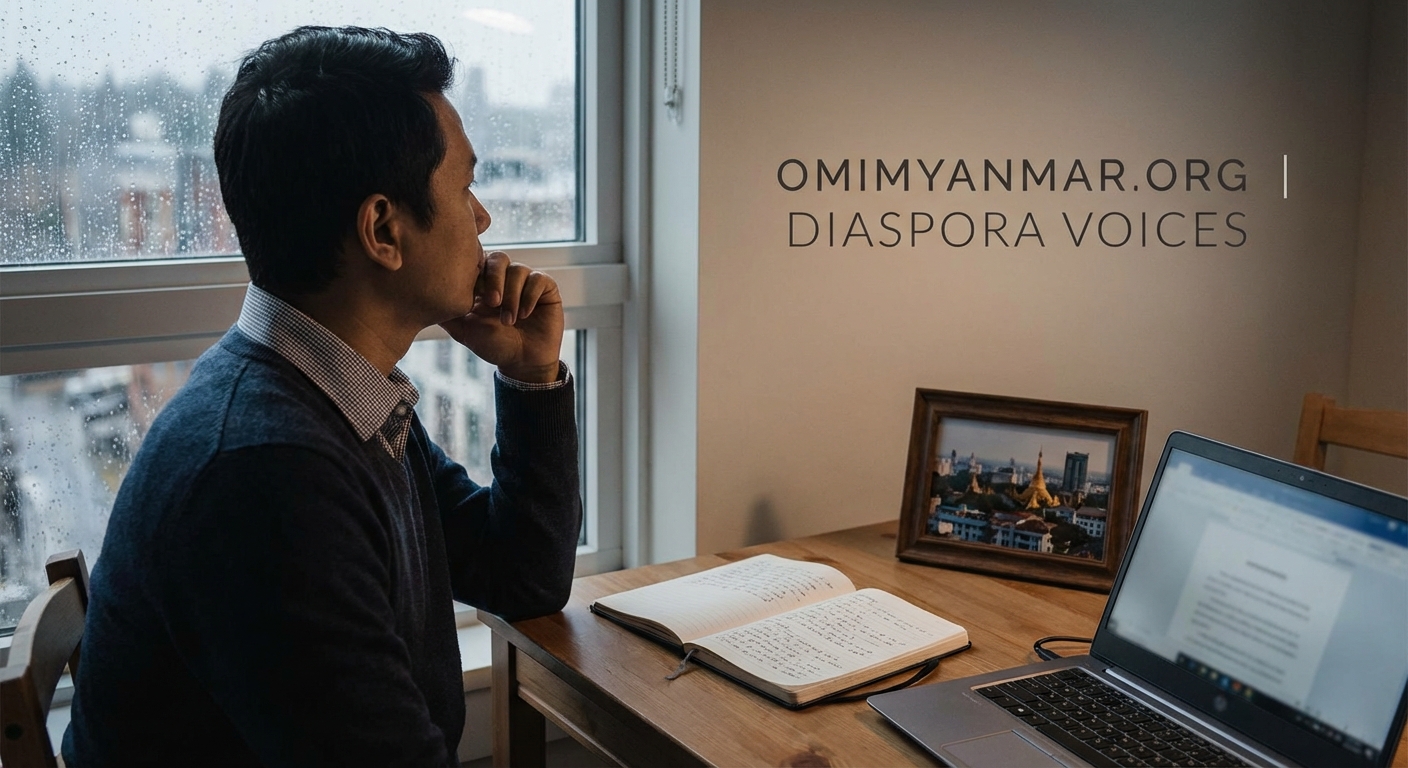
Career abandonment rarely happens on impulse. The decision to leave involves weighing immediate risks against long-term prospects, family safety against professional identity.
Political factors dominate the calculus. Professionals in visible roles face particular scrutiny. University lecturers must teach revised curricula. Doctors in public hospitals work under military oversight. Journalists face arrest for reporting facts.
But politics alone does not explain the exodus. Economic collapse plays an equally critical role.
The kyat has lost more than 60% of its value since 2021. Salaries that once supported middle-class lifestyles now barely cover basics. A doctor earning 1.5 million kyat monthly (roughly $700 at 2021 rates) now makes the equivalent of $300, while rice, fuel, and medicine prices have doubled or tripled.
Professional development has frozen. International conferences are inaccessible. Research funding has evaporated. Career advancement paths that once seemed clear now lead nowhere.
Safety concerns extend beyond political activism. Yangon, once considered relatively secure, has seen armed conflict reach urban areas. Explosions, arrests, and military raids create constant background anxiety.
For professionals with children, education quality has deteriorated sharply. Schools operate intermittently. University programs face accreditation questions. Parents see their children’s futures narrowing.
“I did not leave because I wanted to. I left because staying meant watching my daughter’s education collapse and my savings evaporate. Every month I stayed, I had less ability to leave later.” — Former HR manager, now in Kuala Lumpur
Destination Countries and Professional Realities
Geographic proximity shapes initial destinations. Thailand hosts the largest number of Myanmar professionals, followed by Malaysia and Singapore. Each offers different trade-offs.
Thailand: Accessibility With Limitations
Thailand’s porous border and large Myanmar population make it the default first stop for many. Bangkok, Mae Sot, and Chiang Mai host substantial professional communities.
But work authorization presents immediate challenges. Tourist visas allow 30 to 60 days. Border runs buy time but create legal uncertainty. Formal work permits require employer sponsorship, which most cannot secure.
Many professionals work informally. English teachers give private lessons. Engineers take construction jobs. Accountants do bookkeeping for Myanmar-owned businesses under the table.
A former bank manager described his first year in Bangkok: “I had 15 years of banking experience. In Thailand, I delivered food for eight months because that was the only job I could do legally on my visa situation.”
Malaysia: Middle Ground
Malaysia offers slightly better work authorization pathways through its MM2H program and employment passes, though requirements have tightened. Kuala Lumpur and Penang host growing Myanmar professional communities.
Credential recognition remains challenging. Medical degrees require requalification. Engineering certifications need local validation. Most professionals accept positions below their qualification level initially.
Language barriers are less severe than in Thailand. English is widely used in business settings. But Malay language skills become necessary for many professional roles.
Singapore: High Bar, High Reward
Singapore represents the aspirational destination. Salaries match or exceed pre-departure earnings. Professional credentials hold value. Legal work authorization is clearer.
But entry barriers are substantial. Employment passes require employer sponsorship and minimum salary thresholds. Competition for positions is intense. Most Myanmar professionals cannot meet visa requirements without significant career compromises.
Those who do enter often start in junior roles despite senior experience. A former chief financial officer described taking a financial analyst position: “I went from managing a team of 12 to being the most junior person in the office. But I had legal status and a path forward.”
The Professional Downgrade Reality

Career regression is nearly universal among Myanmar professionals who leave. Understanding this pattern helps set realistic expectations.
| Original Role | Common First Job Abroad | Typical Timeline to Recovery |
|---|---|---|
| Doctor | Clinic assistant, caregiver | 3-5 years (with requalification) |
| University lecturer | Private tutor, language teacher | 2-4 years |
| Bank manager | Bookkeeper, financial assistant | 2-3 years |
| Engineer | Technical assistant, draftsperson | 2-4 years |
| Journalist | Freelancer, content writer | 1-3 years |
| HR manager | Recruiter, admin assistant | 1-2 years |
Recovery timelines assume successful credential recognition, language proficiency development, and some luck. Many never fully recover their previous professional level.
The psychological impact is substantial. Professional identity forms a core part of self-concept. Losing that status creates grief similar to other major losses.
A former surgeon now working as a medical assistant in Singapore described the adjustment: “Every day I watch doctors do procedures I could do with my eyes closed. But my degree means nothing here until I pass their exams. I am 48 years old, studying like a medical student again.”
Credential Recognition Obstacles
Professional qualifications earned in Myanmar face skepticism abroad. This is not unique to Myanmar, but the country’s current situation exacerbates existing challenges.
Medical credentials face the highest barriers. Most countries require local medical licensing exams, which test not just medical knowledge but also local regulations, drug names, and practice standards.
The process typically involves:
- Credential verification (challenging when Myanmar institutions cannot provide documentation)
- Language proficiency testing (IELTS or equivalent)
- Medical knowledge examination (often multi-part, expensive)
- Supervised practice period (requires sponsorship)
- Final licensing examination
The timeline stretches 2 to 5 years. Costs can reach $10,000 to $20,000. Many doctors cannot afford this while supporting themselves.
Engineering and technical credentials face similar but less severe obstacles. Professional engineering licenses require local examinations. But technical skills often transfer more readily, allowing engineers to work in adjacent roles while pursuing formal recognition.
Business and finance credentials vary by country. Some nations recognize international certifications like CPA or CFA. Others require local equivalents. Most professionals can enter business roles more easily than regulated professions.
Teaching credentials depend on education level. University lecturers struggle most, as academic positions require recognized PhD credentials and publication records. Primary and secondary teachers can often find private tutoring work, though formal school positions require local teaching licenses.
Financial Survival Strategies
The first six months abroad determine whether professionals can sustain their new lives. Financial planning makes the difference between successful transition and forced return.
Savings requirements vary by destination, but minimum cushions are substantial:
- Thailand: $3,000 to $5,000 for three months of basic expenses
- Malaysia: $4,000 to $6,000 for three months
- Singapore: $8,000 to $12,000 for three months
These figures assume shared housing, minimal lifestyle, and no dependents. Families need substantially more.
Income generation often requires creativity. Professional skills have value even without formal credentials:
- Language skills: English, Chinese, or other languages allow tutoring work
- Technical skills: Web design, graphic design, and programming can be freelanced
- Business skills: Bookkeeping, administrative work, and consulting for Myanmar businesses
- Licensed skills: Even without local credentials, professionals can advise compatriots
Many professionals piece together multiple income streams. A former architect described her first year in Kuala Lumpur: “I tutored English three evenings a week, did CAD drafting for a Myanmar firm remotely, and worked weekends at a Myanmar restaurant. It was not what I imagined, but it paid rent.”
Remittance obligations add pressure. Many professionals support family members remaining in Myanmar. This dual financial burden creates constant stress.
Network Effects and Community Support
Myanmar professional communities abroad have developed sophisticated mutual aid systems. These networks provide practical support that often determines success or failure.
Information sharing happens through Viber and Telegram groups organized by profession and location. A “Myanmar Doctors in Thailand” group has over 3,000 members sharing exam tips, job leads, and housing information.
Job referrals flow through personal networks. Formal job applications rarely succeed for professionals with credential recognition issues. But community connections lead to informal opportunities.
Housing arrangements often start with community contacts. Professionals newly arrived in Bangkok or Kuala Lumpur typically stay with friends or friends of friends while finding permanent housing.
Emotional support matters as much as practical assistance. Professional identity loss creates isolation. Community connections provide space to maintain professional identity even while working below qualification level.
Professional associations have formed in major destination cities. The Myanmar Medical Association (Thailand) helps doctors navigate licensing requirements. The Myanmar Engineers Network (Malaysia) provides technical skill development and job networking.
These organizations also maintain connections to Myanmar, preparing for eventual reconstruction. Many professionals see their current exile as temporary, though timelines keep extending.
The Impact on Myanmar’s Professional Landscape
The outflow reshapes Myanmar’s remaining professional environment. Gaps appear in critical sectors.
Healthcare has been hit hardest. An estimated 2,000 to 3,000 doctors have left since 2021, according to medical professional associations. Remaining doctors face overwhelming patient loads and deteriorating working conditions.
Education faces similar pressures. Universities operate with depleted faculty. Secondary schools struggle to fill teaching positions. Private international schools have lost substantial staff.
The business sector has seen entire management teams depart. Multinational companies operating in Myanmar report difficulty finding qualified local managers. Many have shifted regional operations to Thailand or Singapore.
This creates a paradox: opportunities exist for professionals who remain, but conditions make staying untenable. A senior engineer still in Yangon described the situation: “I could have my pick of jobs. Every company is desperate for qualified people. But what good is a job title when I cannot feed my family or keep them safe?”
The long-term implications extend beyond immediate shortages. Professional knowledge transfer has stopped. Junior professionals have no mentors. Institutional knowledge is being lost.
Legal Status and Documentation Challenges
Visa uncertainty creates constant anxiety for Myanmar professionals abroad. Legal status determines everything: work authorization, housing access, bank accounts, and basic security.
Tourist visas provide initial entry but no long-term solution. Border runs to renew tourist visas work temporarily but create legal gray areas. Immigration officials increasingly scrutinize repeat entries.
Work permits require employer sponsorship, which most professionals cannot secure immediately. The chicken-and-egg problem is obvious: you need a job to get a work permit, but you need a work permit to work legally.
Some professionals enter on education visas, enrolling in language schools or degree programs primarily to maintain legal status. This adds tuition costs to already strained budgets.
Others pursue asylum claims, though success rates vary widely. Thailand does not recognize refugee status formally. Malaysia has large refugee populations but limited formal protections. Singapore rarely grants asylum.
Documentation challenges compound visa issues. Myanmar passports expire, and renewing them requires engaging with embassy officials representing the military government. Many professionals refuse on principle.
Without valid passports, legal status becomes precarious. Some professionals become effectively stateless, unable to leave their host country or regularize their status.
Family Separation and Reunification Efforts
Professional departure often means family separation. Visa costs, housing expenses, and income uncertainty make bringing family members immediately impossible.
The typical pattern involves one family member leaving first, establishing income and housing, then bringing others gradually. This process can take years.
Children’s education drives many reunification timelines. Parents prioritize bringing children before critical educational transitions. A doctor in Singapore described her calculation: “My daughter was in Grade 9 when I left. I had two years to bring her before Grade 11, or she would lose too much educational continuity.”
Elderly parents present different challenges. They often cannot or will not leave Myanmar. Adult children abroad face constant worry about parents’ safety and wellbeing, with limited ability to help.
Spousal separation strains marriages. Video calls replace daily interaction. Financial stress and uncertainty create tension. Some marriages do not survive the separation.
Professional couples face coordination challenges. Both partners need income and legal status. Staggered departures mean extended separation. Simultaneous departure means no income safety net.
Psychological Adjustment and Identity Reconstruction
Professional identity loss creates psychological challenges that often surprise those experiencing it. Career achievement forms a core part of self-concept for most professionals. Losing that status requires identity reconstruction.
The stages resemble grief: denial, anger, bargaining, depression, acceptance. Not everyone progresses linearly through these stages.
Initial denial is common. Professionals tell themselves the situation is temporary, they will return soon, their credentials will be recognized quickly. Reality typically proves otherwise.
Anger follows. Anger at the military government for creating the situation. Anger at host countries for not recognizing credentials. Anger at themselves for leaving or for not leaving sooner.
Bargaining appears in various forms. Maybe a different city would be better. Maybe a different profession would work. Maybe returning to Myanmar is possible.
Depression is widespread. A 2023 mental health survey of Myanmar professionals in Thailand found that 47% reported symptoms consistent with clinical depression. Access to mental health services is limited, and stigma prevents many from seeking help.
Acceptance, when it comes, involves reconstructing professional identity. This might mean embracing a new career path, finding meaning in community service, or maintaining professional identity through volunteer work.
A former university professor in Malaysia described her adjustment: “I spent a year mourning my career. Then I realized I could still be an educator, just differently. I started teaching Myanmar students online, helping them prepare for international exams. It is not the same, but it matters.”
The Question of Return
Most Myanmar professionals who leave plan to return eventually. But “eventually” keeps receding into an uncertain future.
Return calculations involve multiple factors:
- Political stability: Most professionals will not return under military rule
- Economic recovery: Even with political change, economic rebuilding will take years
- Professional reintegration: Can they reclaim their career level?
- Children’s education: Many have enrolled children in international curricula
- Aging parents: As parents age, pull to return strengthens
The longer professionals stay abroad, the harder return becomes. Children adapt to new countries. Professional networks shift abroad. Skills and knowledge become less relevant to Myanmar’s context.
Some professionals maintain active ties, working remotely for Myanmar organizations or providing pro bono professional services. These connections keep return options open.
Others have mentally closed the door on return, at least for the foreseeable future. They focus on building new lives rather than maintaining connections to a country they may never see again under acceptable conditions.
A former journalist now in Bangkok described his perspective: “I thought I would be back in six months. Then a year. Then two years. Now I do not make predictions. I will return when it is safe and possible to do the work I trained for. Until then, I build a life here.”
Building Professional Lives in Limbo
Despite uncertainty and downward mobility, many Myanmar professionals abroad are rebuilding professional lives. The process requires patience, flexibility, and community support.
Success strategies include:
- Skill diversification: Learning new technical skills that complement existing expertise
- Credential pursuit: Slowly working toward local professional recognition
- Entrepreneurship: Starting small businesses serving Myanmar communities
- Remote work: Leveraging internet connectivity to work for international clients
- Community leadership: Taking leadership roles in diaspora organizations
These paths rarely restore previous professional status quickly. But they provide income, purpose, and forward momentum.
Professional development continues through online courses, certifications, and self-study. Many professionals use their displacement period to gain skills that will be valuable upon return or in building international careers.
The diaspora professional community is creating new institutions. Myanmar professional associations abroad provide networking, skill development, and mutual support. Some have begun offering mentorship programs pairing established diaspora professionals with recent arrivals.
What Comes Next for Myanmar’s Professional Class
The professional exodus represents a fundamental reshaping of Myanmar’s human capital. Even with political resolution, recovery will take a generation.
Brain drain creates brain gain for host countries. Thailand, Malaysia, and Singapore benefit from an influx of educated, motivated professionals willing to work hard for less than local workers with similar qualifications.
For Myanmar, the loss is catastrophic. Professional capacity takes decades to build. The doctors, engineers, and teachers leaving now represent investments in education and training that will not be easily replaced.
Some diaspora professionals will return with new skills, international experience, and expanded networks. This could accelerate reconstruction. But many will not return, especially those who have brought families abroad and established new lives.
The Myanmar professional diaspora is becoming permanent. Second-generation Myanmar professionals will grow up in Bangkok, Kuala Lumpur, and Singapore, maintaining cultural connections but building careers abroad.
This pattern is not unique to Myanmar. Lebanon, Syria, Venezuela, and other countries facing prolonged instability have seen similar professional diasporas form. Recovery timelines measured in decades, not years.
Staying Connected While Building New Lives
The tension between maintaining Myanmar identity and adapting to new contexts defines daily life for professionals abroad. Most navigate this by maintaining strong community connections while pragmatically adapting to local requirements.
Language learning is essential. English proficiency helps initially, but local language skills determine long-term success. Professionals in Thailand study Thai. Those in Malaysia learn Malay. Language ability unlocks better jobs, deeper integration, and reduced daily friction.
Cultural adaptation happens gradually. Food, social norms, and daily rhythms differ from Myanmar. Some professionals embrace new cultural contexts enthusiastically. Others maintain Myanmar cultural practices as anchors of identity.
Children adapt faster than parents, creating intergenerational tensions. Kids pick up local languages, make local friends, and adopt local cultural references. Parents worry about children losing Myanmar language and cultural knowledge.
Many families compromise by maintaining Myanmar language at home, celebrating Myanmar holidays, and participating in community cultural events while encouraging children’s integration into local schools and social environments.
Professional identity increasingly becomes transnational. A doctor might hold a Myanmar medical degree, be working toward Malaysian licensing, and provide telemedicine consultations to Myanmar patients. An engineer might work for a Thai company while consulting remotely for Myanmar reconstruction planning.
These hybrid professional identities reflect the reality of modern displacement. Professional lives no longer fit neatly into national boundaries.
Professional Resilience in Uncertain Times
Myanmar professionals leaving careers behind demonstrate remarkable resilience. They abandon established positions, accept dramatic status reductions, navigate foreign legal systems, and rebuild professional lives under constant uncertainty.
This resilience draws on several sources. Professional training provides problem-solving skills applicable beyond original contexts. Community networks provide practical and emotional support. Family obligations create motivation to persist despite obstacles.
But resilience has limits. Financial resources eventually deplete. Visa uncertainty creates constant stress. Family separation takes psychological tolls. Not everyone succeeds in rebuilding professional lives abroad.
The professionals who thrive tend to share certain characteristics: flexibility in redefining success, willingness to start over, strong community connections, and realistic timelines for recovery.
Those who struggle often maintain rigid expectations about career trajectory, isolate themselves from community support, or expect rapid credential recognition and professional recovery.
Understanding these patterns helps newly displaced professionals set realistic expectations and identify strategies most likely to succeed in their specific circumstances.
The Myanmar professional exodus is not ending soon. Political instability continues. Economic conditions worsen. Safety concerns persist. More professionals will leave in coming months and years.
Each departure represents individual tragedy and collective loss. A doctor who spent a decade training to serve Myanmar patients now changes bedpans in Singapore. An engineer who designed infrastructure projects stocks shelves in Kuala Lumpur. A teacher who shaped young minds tutors privately in Bangkok.
These are not just statistics or trends. They are individual lives disrupted, careers abandoned, and potential unrealized. Behind each number is a person who made an impossible choice between staying in an untenable situation or leaving everything they built behind.
The professionals who leave carry Myanmar with them. They maintain language, culture, and identity. They support family members who remain. They plan for eventual return, even as that return recedes into an uncertain future. They represent Myanmar’s future potential, scattered across Southeast Asia and beyond, waiting for conditions that allow them to come home and rebuild.
Leave a Reply